1948 Jefferson Nickel Coin Value: How Much Is It Worth?
The 1948 Jefferson nickel is a coin most people have seen rattling around in jars and drawers. Worn examples carry modest value above face.
Uncirculated pieces, however, tell a different story: USA Coin Book guide estimates range from about $1.24 at MS60 up to $25 at MS65, depending on mint. Full Steps designations, overmintmark varieties, and authenticated errors each occupy their own pricing lanes.
Fast Way to Identify Your 1948 Jefferson Nickel
Want a quick read on your 1948 nickel? Upload clear photos of the front and back, and our identifier can give you a preliminary take on the mint, general condition, and version.
It is not a substitute for professional authentication or exact grading, but it is a solid starting point before you dig deeper.
1948 Jefferson Nickel Value
Upload both sides of your 1948 Jefferson Nickel.
Front Obverse
Upload photo
Back Reverse
Upload photo
Which 1948 Jefferson Nickel Versions Are Worth Money?
- Uncirculated 1948 Philadelphia nickels in MS65 condition can reach around $25 according to USA Coin Book guide estimates.
- Denver mint examples at MS65 guide at roughly $19 and tend to show stronger strikes on average than some Philadelphia pieces.
- San Francisco issues at MS65 also guide near $19, but coins with fully separated Monticello steps can command additional premiums beyond standard values.
- Authenticated mint errors — off-center strikes, doubled dies, broadstrikes — are valued individually based on severity, condition, and third-party certification.
Step 1: Identify Your 1948 Jefferson Nickel Mint Mark and Version
Start with the obverse. The date "1948" sits on the lower right, next to Jefferson's bust.
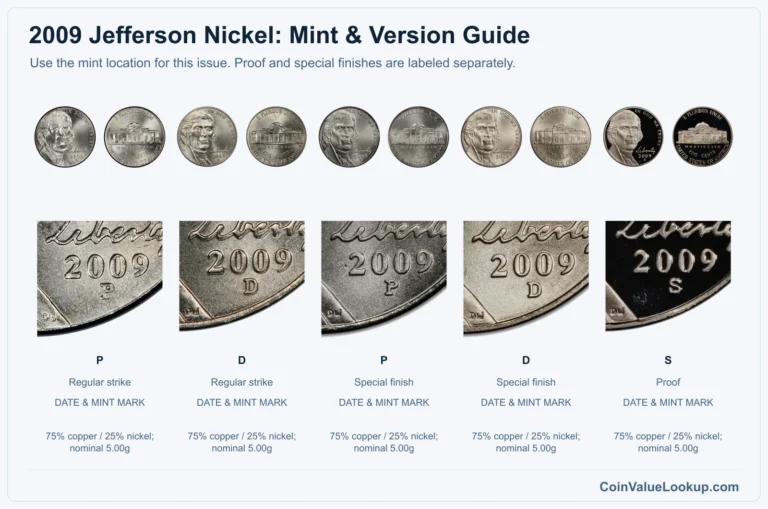
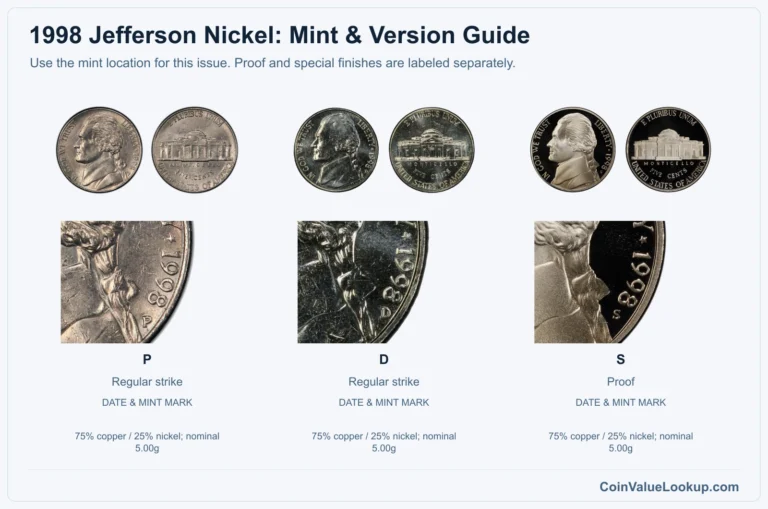
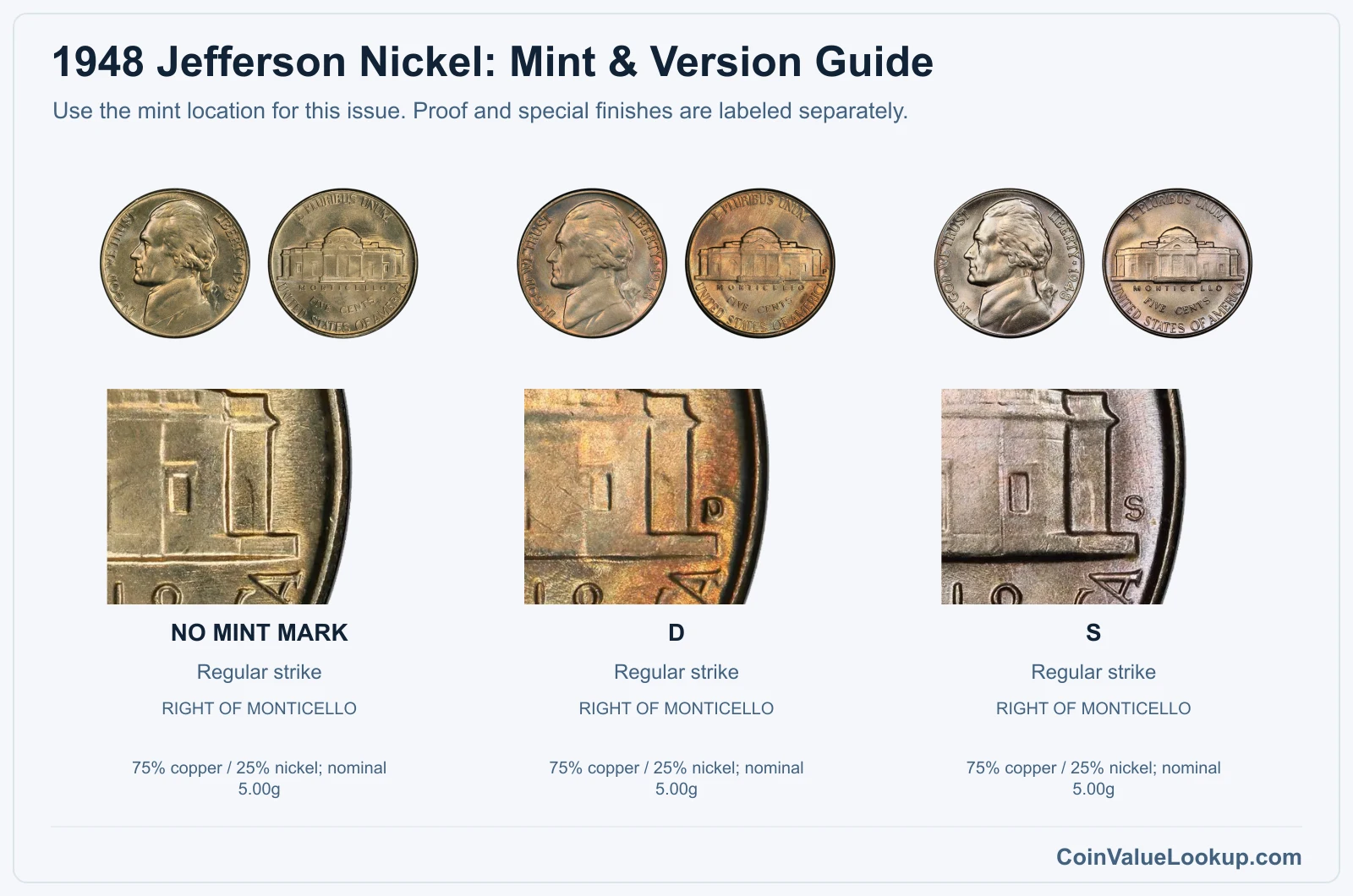
Philadelphia strikes carry no mintmark at all. For Denver and San Francisco issues, flip the coin over and look to the right of Monticello's dome — a small "D" or "S" will be there.
All three mints struck these from the standard 75% copper, 25% nickel alloy. Each coin weighs about 5.00 grams, measures 21.2 mm across, and has a plain edge.
There is no silver content in normal 1948 nickels, so silver-colored toning does not mean you have an off-metal piece.
Be careful not to confuse a polished business strike with a proof. The U.S. Mint did not produce proof Jefferson nickels in 1948.
Proof production resumed in 1950 at Philadelphia. If someone offers you a "1948 proof," that is a red flag.
Step 2: Check Your 1948 Jefferson Nickel Grade
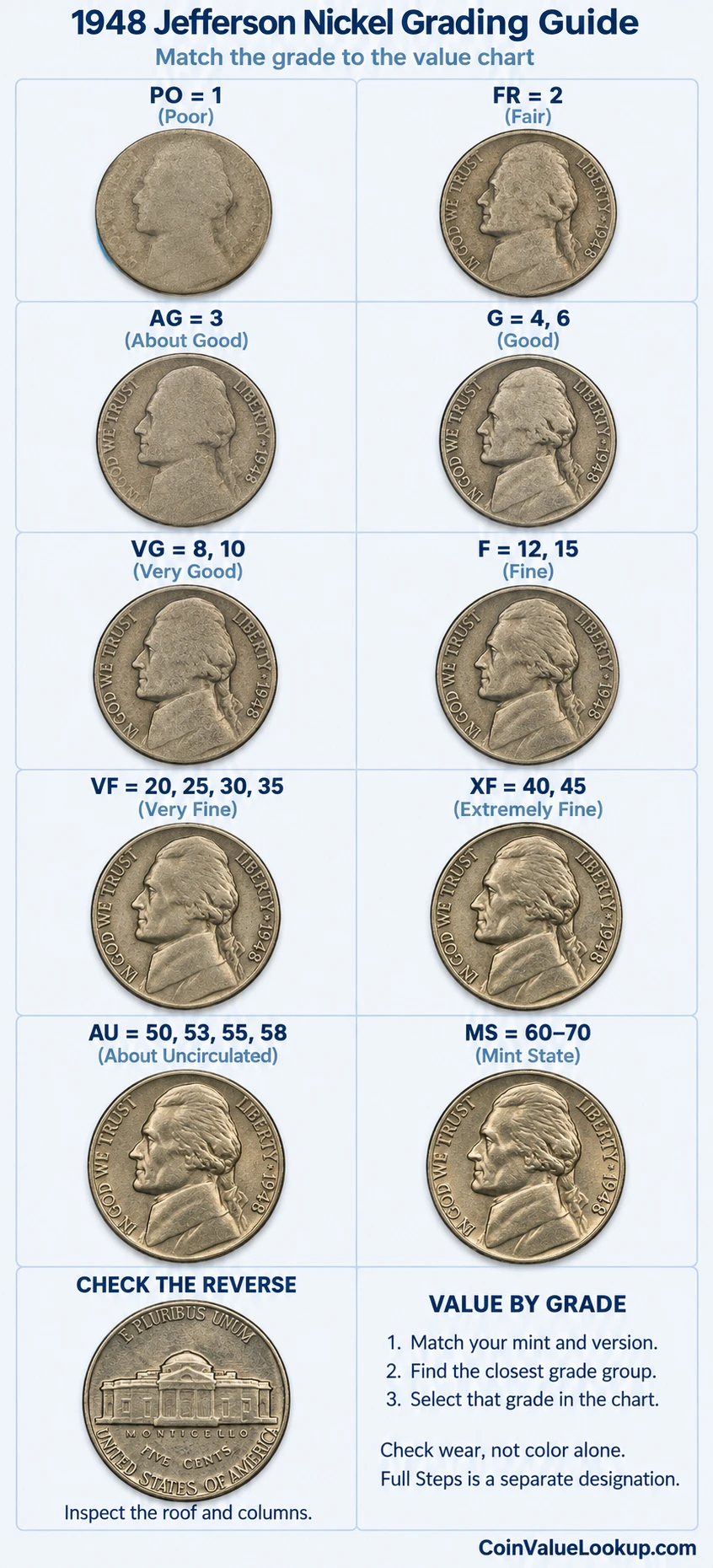
Check Jefferson's cheekbone first. On a well-worn coin, the cheek is flat and blends into the surrounding field.
A lightly circulated piece retains some roundness there but shows friction. Move to the hair detail above the ear — fine strands disappear early in a coin's life.
Flip to the reverse and examine the Monticello roofline and the four columns. As wear increases, the columns merge and the triangular roof loses definition.
Luster matters as much as detail: a coin can have sharp features but show dull, cleaned surfaces that hurt its grade.
The steps at the base of Monticello are a strike-quality indicator, not a wear gauge. PCGS awards the Full Steps designation when at least five steps are clearly separated on a coin grading MS60 or higher.
A weak strike can leave interrupted steps even on an otherwise unworn coin, so do not assume missing steps mean circulation damage. Use the comparison image to match your coin's wear pattern against known grade benchmarks.
Step 3: Check 1948 Jefferson Nickel Value by Mint and Version
1948 Jefferson Nickel — No mintmark (Philadelphia)
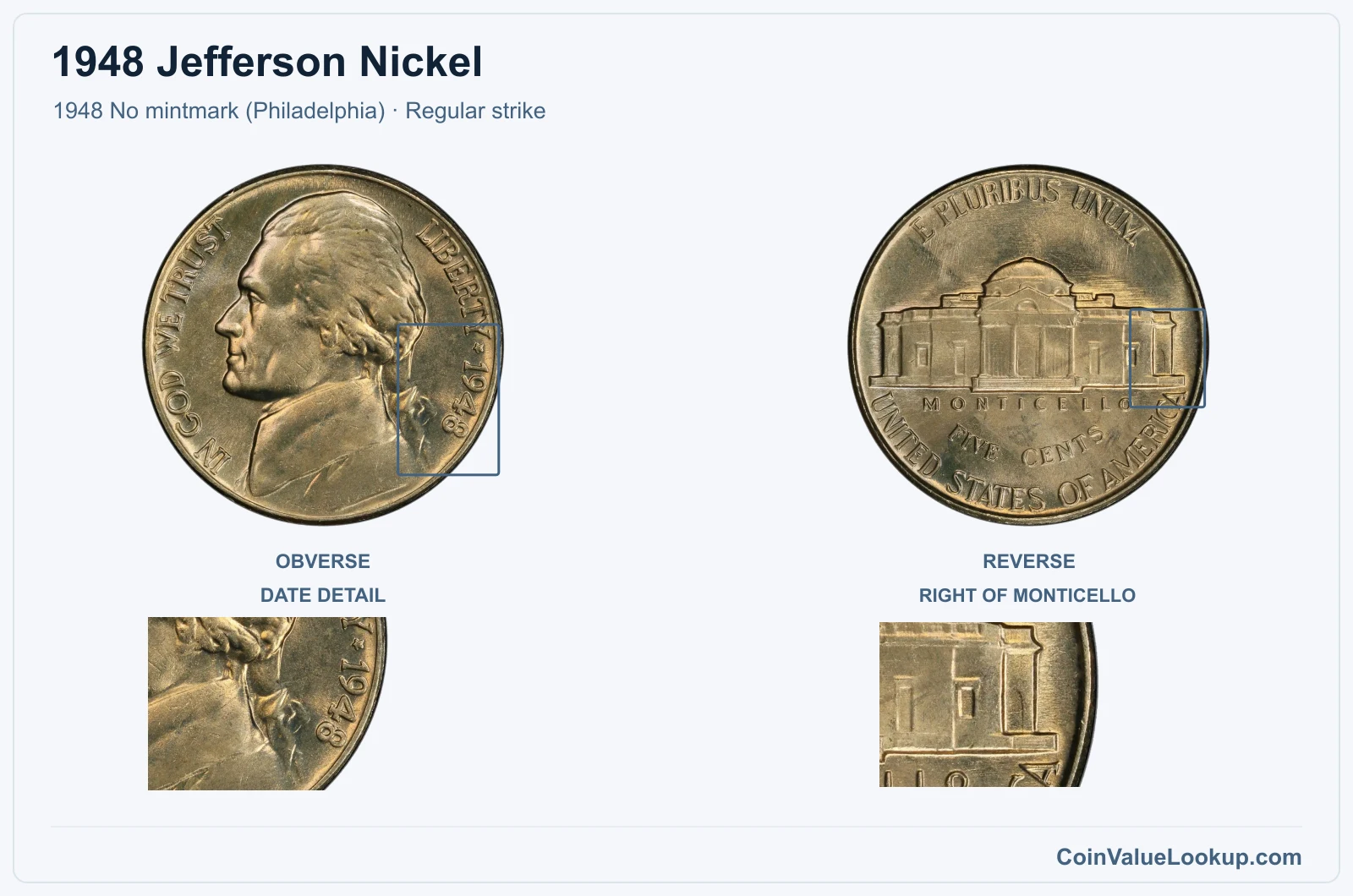
The 1948 Philadelphia nickel has no mintmark. Look at the reverse, to the right of Monticello — the space should be empty.
These were struck in the standard 75% copper and 25% nickel composition at 5.00 grams.
USA Coin Book guides this version at about $1.24 in MS60 and around $25 in MS65. Worn examples are common enough that guide prices focus on uncirculated grades.
Full Steps coins carry a separate premium beyond these figures and should not be mixed into ordinary Mint State values.
Coin Value Lookup is a useful place to look up guides for other Jefferson nickel dates and mints if you are working through a collection or a roll find.
| Range | Grade | Price | Auction Records | Appraisal |
|---|---|---|---|---|
| PO | PO 1 | — | Coin Identifier | |
| FR | FR 2 | — | Coin Identifier | |
| AG | AG 3 | — | Coin Identifier | |
| G | G 4 | — | Coin Identifier | |
| G 6 | — | Coin Identifier | ||
| VG | VG 8 | — | Coin Identifier | |
| VG 10 | — | Coin Identifier | ||
| F | F 12 | — | Coin Identifier | |
| F 15 | — | Coin Identifier | ||
| VF | VF 20 | — | Coin Identifier | |
| VF 25 | — | Coin Identifier | ||
| VF 30 | — | Coin Identifier | ||
| VF 35 | — | Coin Identifier | ||
| XF | XF 40 | — | Coin Identifier | |
| XF 45 | — | Coin Identifier | ||
| AU | AU 50 | — | Coin Identifier | |
| AU 53 | — | Coin Identifier | ||
| AU 55 | — | Coin Identifier | ||
| AU 58 | — | Coin Identifier | ||
| MS | MS 60 | — | Coin Identifier | |
| MS 61 | — | Coin Identifier | ||
| MS 62 | — | Coin Identifier | ||
| MS 63 | — | Coin Identifier | ||
| MS 64 | Coin Identifier | |||
| MS 65 | Coin Identifier | |||
| MS 66 | Coin Identifier | |||
| MS 67 | Coin Identifier | |||
| MS 68 | — | — | — | |
| MS 69 | — | — | — | |
| MS 70 | — | — | — |
1948 Jefferson Nickel — D
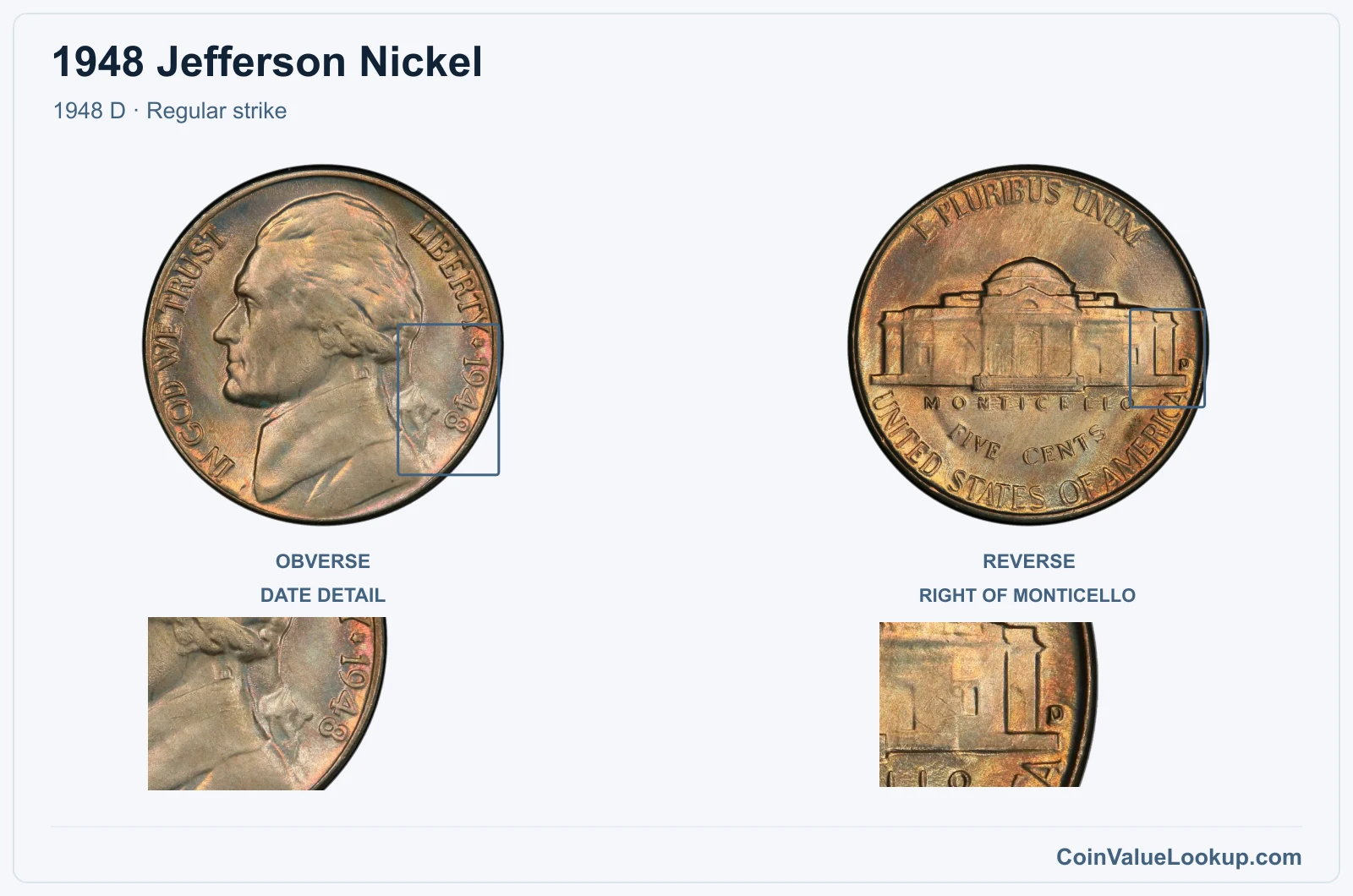
The 1948-D was struck in Denver. You will find a small "D" mintmark on the reverse, sitting to the right of Monticello.
Same alloy, same weight, same plain edge as the Philadelphia issue.
Guide estimates from USA Coin Book place this one at about $3.62 in MS60 and roughly $19 in MS65. The MS60 figure is actually higher than the Philadelphia version at the same grade, which sometimes surprises people.
As with all three mints this year, Full Steps examples are graded and valued on a separate scale.
| Range | Grade | Price | Auction Records | Appraisal |
|---|---|---|---|---|
| PO | PO 1 | — | Coin Identifier | |
| FR | FR 2 | — | Coin Identifier | |
| AG | AG 3 | — | Coin Identifier | |
| G | G 4 | — | Coin Identifier | |
| G 6 | — | Coin Identifier | ||
| VG | VG 8 | — | Coin Identifier | |
| VG 10 | — | Coin Identifier | ||
| F | F 12 | — | Coin Identifier | |
| F 15 | — | Coin Identifier | ||
| VF | VF 20 | — | Coin Identifier | |
| VF 25 | — | Coin Identifier | ||
| VF 30 | — | Coin Identifier | ||
| VF 35 | — | Coin Identifier | ||
| XF | XF 40 | — | Coin Identifier | |
| XF 45 | — | Coin Identifier | ||
| AU | AU 50 | — | Coin Identifier | |
| AU 53 | — | Coin Identifier | ||
| AU 55 | — | Coin Identifier | ||
| AU 58 | — | Coin Identifier | ||
| MS | MS 60 | — | Coin Identifier | |
| MS 61 | — | Coin Identifier | ||
| MS 62 | — | Coin Identifier | ||
| MS 63 | — | Coin Identifier | ||
| MS 64 | Coin Identifier | |||
| MS 65 | Coin Identifier | |||
| MS 66 | Coin Identifier | |||
| MS 67 | Coin Identifier | |||
| MS 68 | — | — | — | |
| MS 69 | — | — | — | |
| MS 70 | — | — | — |
1948 Jefferson Nickel — S
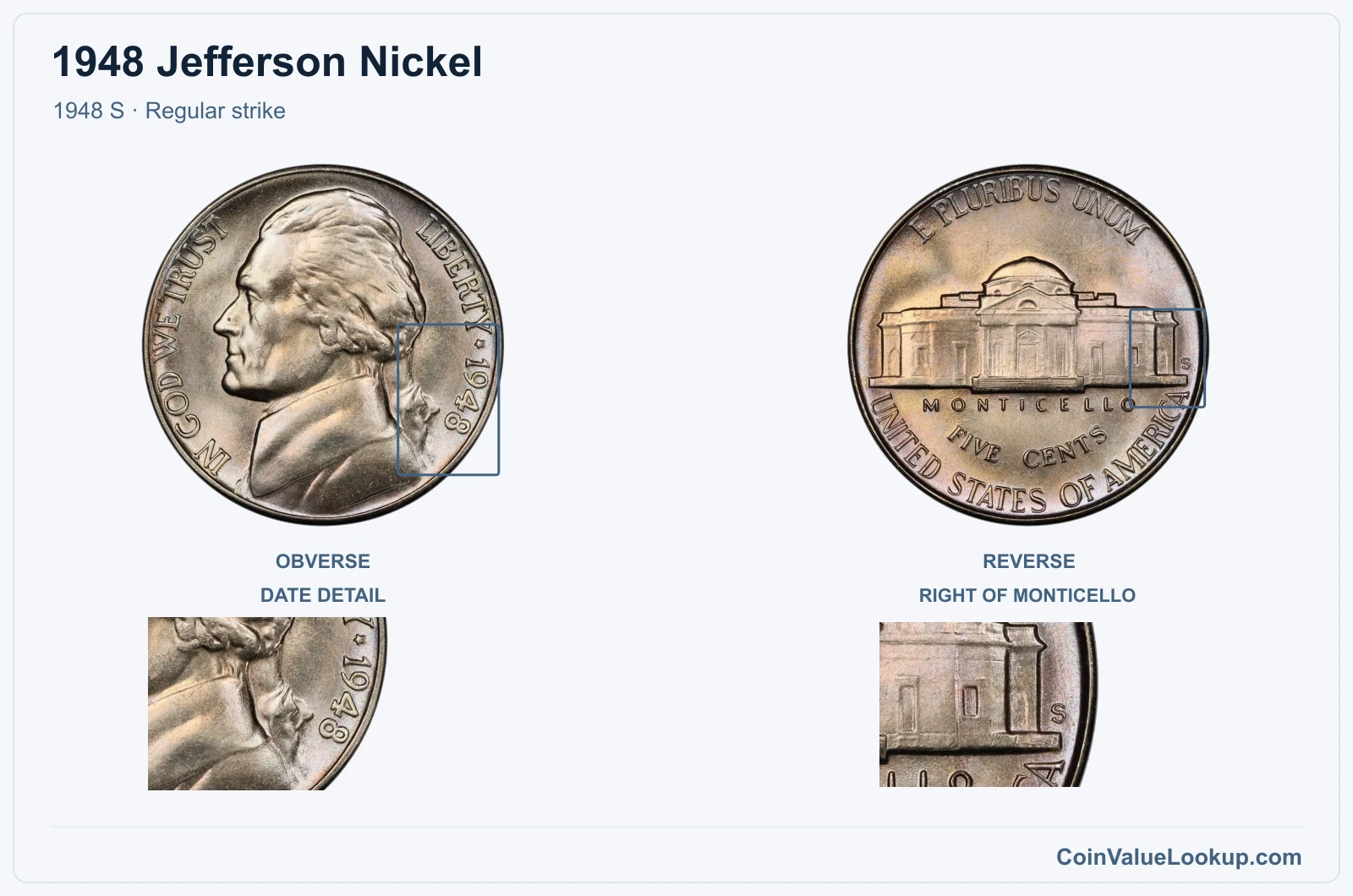
San Francisco's contribution carries an "S" mintmark on the reverse, right of Monticello. It shares the 75% copper, 25% nickel alloy and 5.00-gram weight of its siblings.
USA Coin Book guides the 1948-S at about $1.88 in MS60 and around $19 in MS65. These are retail guide estimates, not guaranteed buy prices.
Circulated examples are plentiful and not individually priced in the guide source used here. If your coin shows clear luster and sharp detail on the cheekbone and Monticello columns, it is worth a closer look for uncirculated grade potential and possible Full Steps quality.
| Range | Grade | Price | Auction Records | Appraisal |
|---|---|---|---|---|
| PO | PO 1 | — | Coin Identifier | |
| FR | FR 2 | — | Coin Identifier | |
| AG | AG 3 | — | Coin Identifier | |
| G | G 4 | — | Coin Identifier | |
| G 6 | — | Coin Identifier | ||
| VG | VG 8 | — | Coin Identifier | |
| VG 10 | — | Coin Identifier | ||
| F | F 12 | — | Coin Identifier | |
| F 15 | — | Coin Identifier | ||
| VF | VF 20 | — | Coin Identifier | |
| VF 25 | — | Coin Identifier | ||
| VF 30 | — | Coin Identifier | ||
| VF 35 | — | Coin Identifier | ||
| XF | XF 40 | — | Coin Identifier | |
| XF 45 | — | Coin Identifier | ||
| AU | AU 50 | — | Coin Identifier | |
| AU 53 | — | Coin Identifier | ||
| AU 55 | — | Coin Identifier | ||
| AU 58 | — | Coin Identifier | ||
| MS | MS 60 | — | Coin Identifier | |
| MS 61 | — | Coin Identifier | ||
| MS 62 | — | Coin Identifier | ||
| MS 63 | — | Coin Identifier | ||
| MS 64 | Coin Identifier | |||
| MS 65 | Coin Identifier | |||
| MS 66 | Coin Identifier | |||
| MS 67 | Coin Identifier | |||
| MS 68 | — | — | — | |
| MS 69 | — | — | — | |
| MS 70 | — | — | — |
1948 Jefferson Nickel Error List
1. 1948 Jefferson Nickel — Off-center strike
An off-center strike happens when the planchet is not seated properly between the dies. The result is an unstruck crescent on one side and a missing or incomplete rim on the opposite edge.
The design shifts in the direction of the misalignment.
A confirmed example exists from the San Francisco mint: an NGC MS64 Full Steps piece struck roughly 15% off-center. That is enough displacement to be visually obvious but still shows the full date and mintmark, which matters for collectibility.
Do not confuse this with single-die misalignment, which shifts the design slightly but keeps the full rim. Also rule out ordinary weak strikes and coins that have been physically cut or ground down.
Each off-center nickel is assessed individually based on the degree of displacement, whether the date is visible, and the coin's overall condition. Third-party certification adds confidence for buyers.
2. 1948 Jefferson Nickel — Broadstruck,multiple strike
A broadstruck, multiple-strike error combines two problems: the collar that normally constrains the blank was absent, allowing the planchet to spread beyond its standard diameter, and the coin received more than one impression from the dies in displaced positions. You will see overlapping or doubled design elements — repeated letters, ghost outlines of Jefferson or Monticello — and an expanded, irregular edge.
A Denver mint example graded NGC Uncirculated Details with a wheel mark sold through Heritage Auctions in March 2025 for $64. The wheel-mark damage was noted and retained in the grade, which kept the price modest for an otherwise dramatic error.
Do not mistake machine doubling or a vise-job impression for a genuine multiple strike. Machine doubling produces flat shelf-like doubling without the displaced second image, and vise jobs are post-mint damage from squeezing two coins together.
3. 1948 Jefferson Nickel — Doubled Die Obverse
Doubled die obverse errors on 1948 nickels have been reported by collectors. This variety results from a misaligned hub impression during die production, creating consistent doubling on obverse design elements such as lettering or profile details.
To check your coin, compare the obverse inscriptions and Jefferson's profile against a normal 1948 nickel under good lighting and at least 5x magnification. Genuine doubling shows separation or notching that is consistent in direction across affected elements.
It will not appear as a flat, shelf-like distortion.
Machine doubling is the most common lookalike. It produces a flat secondary image rather than the rounded, split appearance of a true doubled die.
Reflections from a shiny surface or worn die contours can also mimic doubling to the naked eye. Value depends on condition, the visibility of the doubling, and the specific die involved.
Professional authentication is the safest path for any doubled die claim.
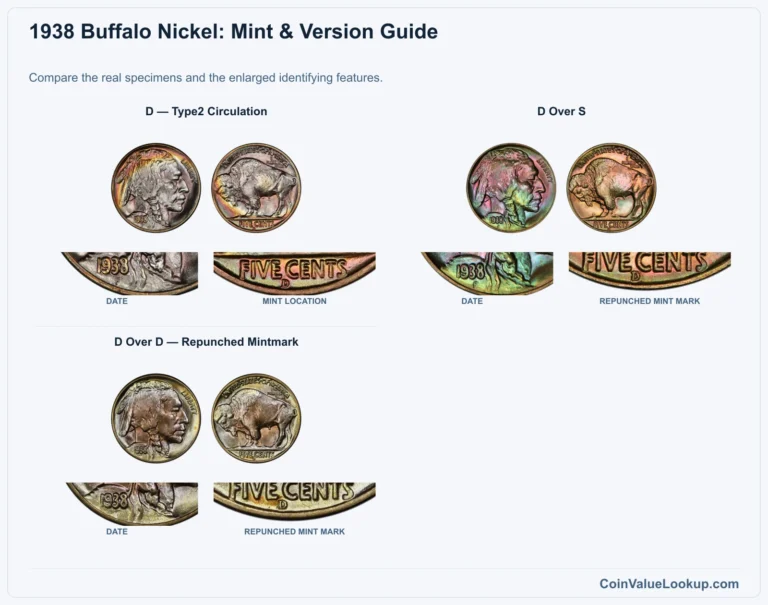
4. 1948 Jefferson Nickel — Repunched Mintmark
Repunched mintmark errors occur when the mintmark punch was applied more than once in slightly different positions, leaving traces of the earlier placement. On 1948 nickels from Denver or San Francisco, inspect the "D" or "S" closely for a secondary outline, notch, or partial extra letter overlapping the primary mark.
Use magnification of at least 5x and compare your mintmark side-by-side with a known normal example at the same angle. The remnant should be consistent and not easily explained by wear or debris.
Common lookalikes include machine doubling around the mintmark, small die chips that fill or extend the letter shape, and surface corrosion that blurs edges. Value varies based on the prominence of the repunching, the coin's grade, and collector demand for the specific variety.
Certification by a major grading service helps establish the error's authenticity.
5. 1948 Jefferson Nickel — Die Crack / Die Chip
Die cracks appear as raised, irregular lines on the coin's surface, formed when the steel die develops fractures from repeated use. Die chips are small raised blobs where a piece of the die face has broken away, leaving a void that fills with metal during striking.
On 1948 nickels, look for thin raised lines connecting design elements or running from the rim inward. A "cud" is a more dramatic version — a larger die break at the rim that produces a raised, featureless lump.
Interior chips are usually smaller and isolated.
Do not confuse these with incuse scratches, which are recessed into the surface rather than raised. Corrosion pitting and foreign material stuck to the coin can also create bumps that mimic die chips.
Value depends on the size, location, and visual impact of the crack or break, along with the coin's overall condition.
6. 1948 Jefferson Nickel — Lamination / Split Planchet
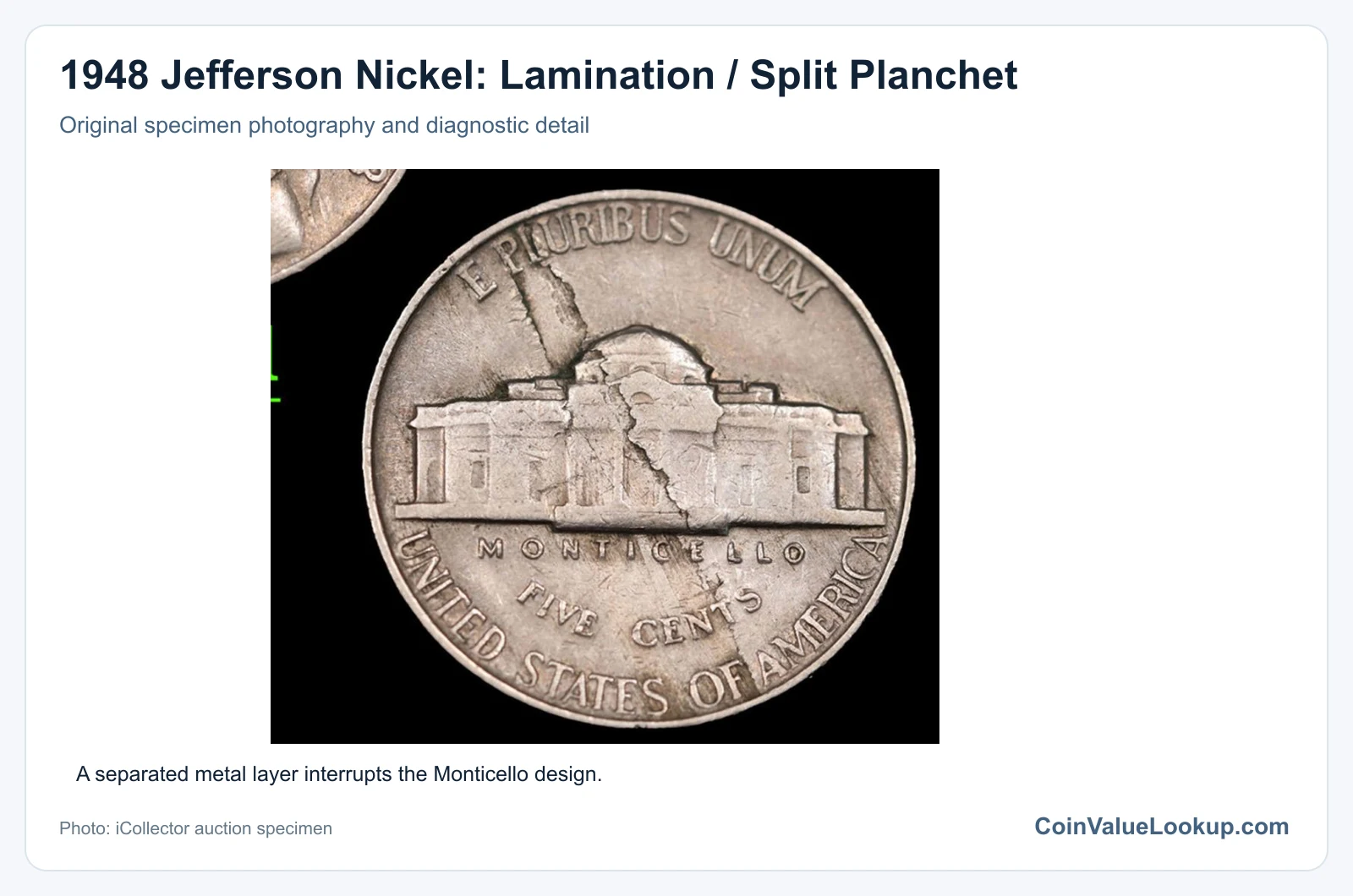
Lamination errors result from impurities or gas trapped within the planchet alloy during manufacture. The defect shows up as peeling metal, a retained flap, or a visible split within the coin's thickness.
Sometimes the separated layer is missing entirely, leaving a recessed area with a distinctive layered edge.
To document one, photograph the affected face and the coin's edge together so the separation is visible in context. Compare the texture of the exposed area — it should look like raw metal, not a smooth gouge.
Scraping from a hard surface, corrosion that lifts surface layers, and deliberately altered coins can all mimic lamination errors. Genuine laminations follow the metal's internal structure rather than showing sharp tool marks or uniform depth.
Each example is evaluated individually based on size, location, and condition of the coin.
7. 1948 Jefferson Nickel — Clashed Dies
A die clash occurs when the obverse and reverse dies strike each other without a planchet between them. The impact transfers a mirror-image impression of one die's design onto the face of the other.
When the damaged dies then strike actual coins, faint ghost images of the opposite design appear in the fields.
On a 1948 nickel, look for traces of Monticello's outline in the open field around Jefferson's portrait, or parts of Jefferson's profile appearing near the Monticello side. The transferred elements should align with where the opposite die's features would naturally fall.
Random scratches, raised lines from die polish, and brockage errors can look similar at first glance. A brockage involves an actual coin stuck to the die, producing a much stronger and more complete transferred image.
Clash traces are typically subtle and require careful lighting to confirm.
8. 1948 Jefferson Nickel — Doubled Die Reverse
Doubled die reverse errors on 1948 nickels have been reported in collector resources. Like the obverse version, this variety originates during die manufacture when a hub impression is slightly misaligned, doubling elements of the reverse design.
Examine the Monticello columns, the "MONTICELLO" legend, and "E PLURIBUS UNUM" under magnification. Compare each letter and architectural line against a normal example photographed at the same angle and magnification.
True hub doubling shows rounded, separated secondary images that are consistent in direction.
Machine doubling is again the primary lookalike — it produces flat, shelf-like displacement rather than the distinct split profile of a genuine doubled die. Reflections and random surface damage can also fool the eye.
Value hinges on the specific die, doubling strength, and overall coin condition. Third-party certification is recommended before buying or selling any doubled die claim.