1964 Kennedy Half Dollar Coin Value: How Much Is It Worth?
The 1964 Kennedy half dollar is a 90% silver coin, which gives even well-worn examples a solid floor around $31 according to the USA Coin Book guide. Uncirculated pieces range from about $32 at MS60 up to $74 for a Denver mint coin in MS65.
Proofs, the Accented Hair variety, error strikes, and the rare SMS issue each carry their own premium above that silver baseline.
Fast Way to Identify Your 1964 Kennedy Half Dollar
Snap a clear photo of both sides of your 1964 half dollar and upload them here. This gives you a preliminary identification of mint, variety, and approximate condition.
It is not a substitute for professional certification, but it is a solid first step before you decide whether deeper attribution is worthwhile.
1964 Kennedy Half Dollar Value
Upload both sides of your 1964 Kennedy Half Dollar.
Front Obverse
Upload photo
Back Reverse
Upload photo
Which 1964 Kennedy Half Dollar Versions Are Worth Money?
- Accented Hair proofs show heavier hair detail above the ear and a weak lower-left serif on the I in LIBERTY, with a PR65 guide value around $140 versus $48 for a regular proof.
- Denver mint coins in MS65 list at roughly $74, higher than the Philadelphia MS65 at $60, making condition on D-mint pieces worth watching.
- A 1964-D doubled-die obverse with clear doubling in IN GOD WE TRUST has sold for $130 at MS65, so check your D-mint lettering under magnification.
- Die-cap and brockage errors are dramatic and have individually sold for over $4,000 at auction in certified MS65.
- The 1964 SMS specimen is a rare specialist attribution that commands its own premium, but requires professional certification to confirm.
Step 1: Identify Your 1964 Kennedy Half Dollar Mint Mark and Version
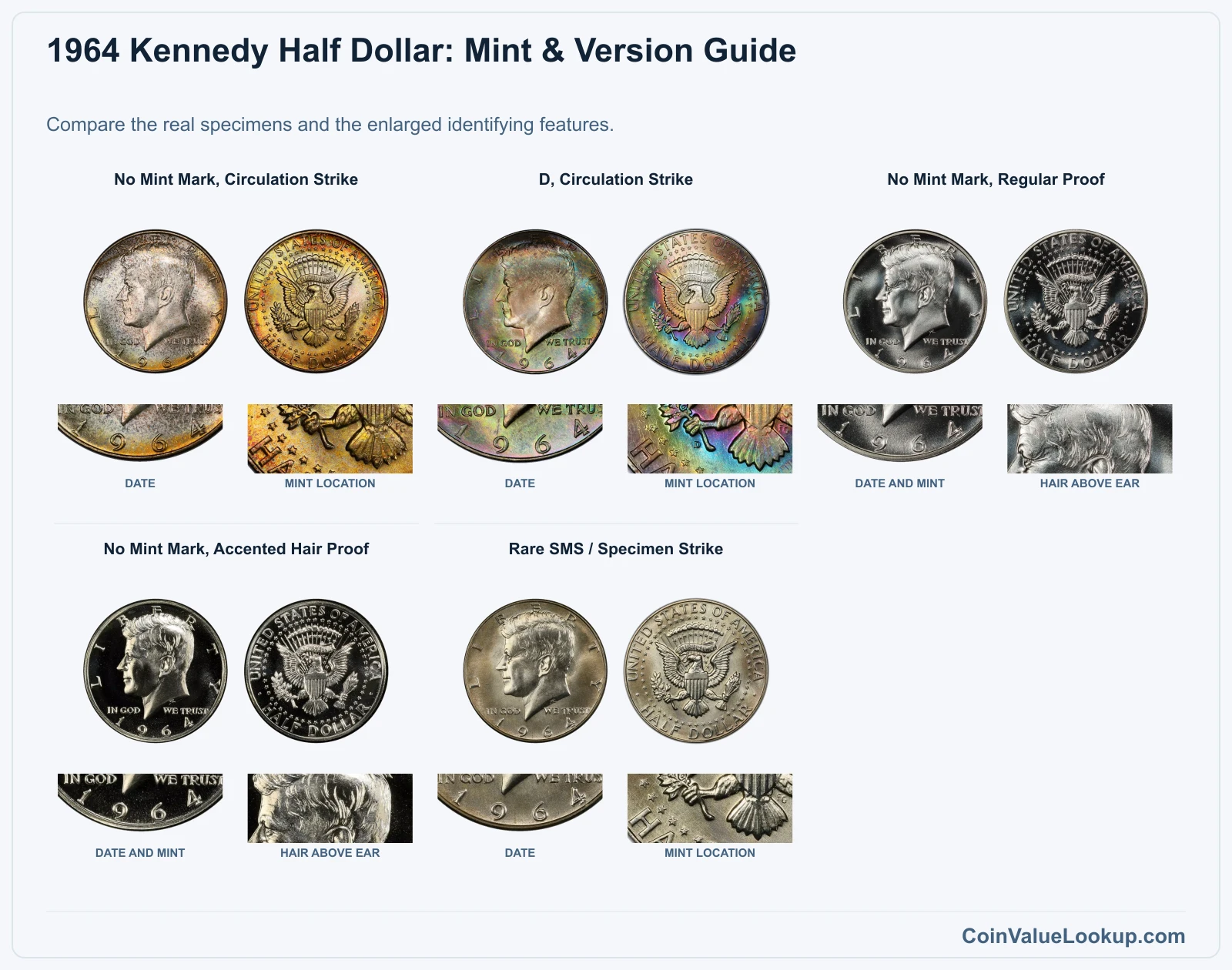
Start by flipping the coin to the reverse. A small "D" mintmark sits below the eagle's tail feathers, indicating Denver.
If there is no mintmark, you have either a Philadelphia business strike or a proof. Later Kennedy halves moved the mintmark to the obverse, so do not look there on a 1964.
Every regular-issue 1964 Kennedy half is struck in 90% silver and 10% copper, weighing about 12.50 grams. The 40% silver composition belongs to later years only.
If someone tells you a 1964 is clad, they are mistaken.
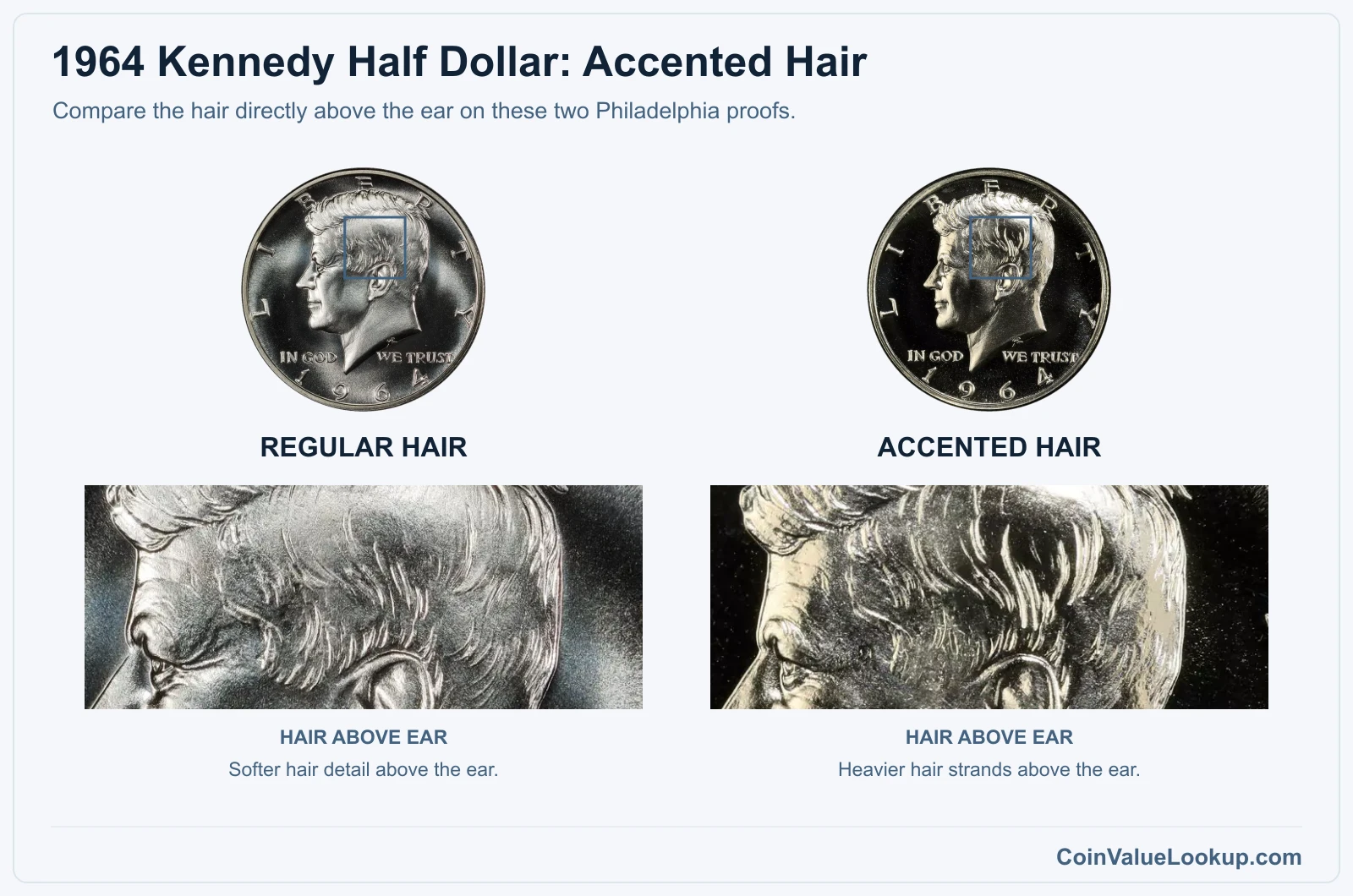
Proofs need closer inspection. Compare the hair detail directly above Kennedy's ear.
On the Accented Hair variety, those strands are noticeably heavier and more defined. Then check the letter "I" in LIBERTY: on the Accented Hair die, the lower-left serif is weak or missing.
Both diagnostics together separate Accented Hair from the regular proof.
The 1964 SMS (Special Mint Set) specimen is a genuinely rare coin with a distinct finish and documented provenance. It is not simply a proof without a mintmark and not something you can identify by elimination alone.
Third-party certification with an explicit SMS designation is the standard for that attribution.
Step 2: Check Your 1964 Kennedy Half Dollar Grade
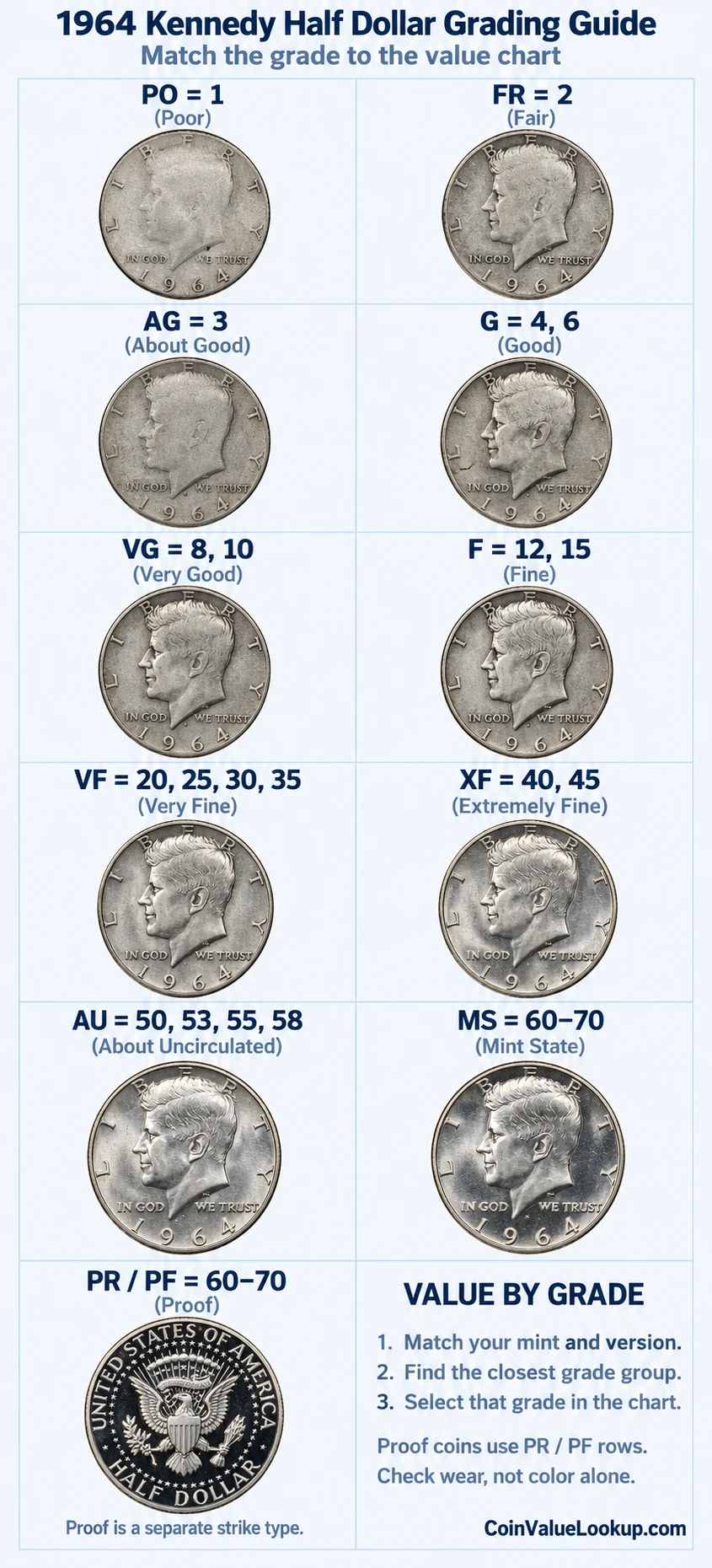
Hold the coin under angled light and examine the high points: Kennedy's cheekbone, the hair above the ear, and the eagle's breast feathers on the reverse. Wear shows first as a flattening of those areas, and luster breaks before metal actually disappears.
Do not confuse brightness with grade. A harshly cleaned coin can look shiny yet grade far below a naturally toned example with full original surfaces.
Compare your coin to the reference image nearby, matching the same areas at the same angle.
For proofs, grading follows a separate PR scale. Hairlines from improper handling are the main enemy.
Cameo or deep-cameo contrast, where frosted devices stand against mirror fields, is a desirable feature noted separately from the numeric grade.
Coin Value Lookup is a useful starting point when you want to compare your half dollar against other Kennedy dates and denominations. You can look up guides for the full series without digging through auction archives yourself.
Step 3: Check 1964 Kennedy Half Dollar Value by Mint and Version
1964 Kennedy Half Dollar — No Mint Mark, Circulation Strike
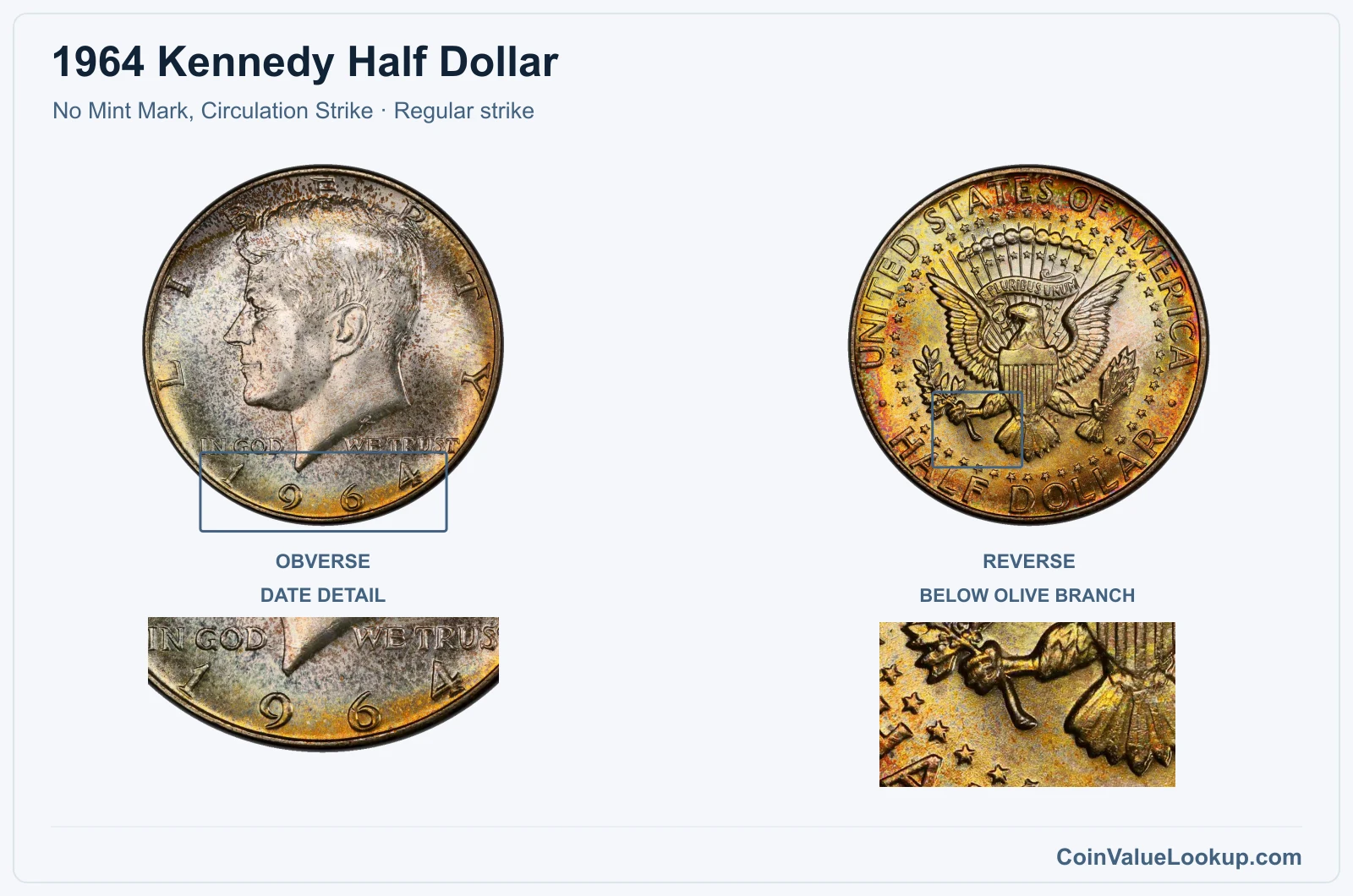
The Philadelphia business strike carries no mintmark. In circulated grades from G4 through AU50, the USA Coin Book guide lists it at about $31, driven largely by its silver content.
At MS60 you are looking at approximately $32, and an MS65 example is guided around $60.
This is the coin most people find in old collections. Silver content sets the floor, and condition determines how far above that floor you go.
Do not confuse this coin with Accented Hair proof values; those belong to an entirely different manufacturing process.
Range Grade
Price Auction Records Appraisal PO PO 1
Coin Identifier FR FR 2
Coin Identifier AG AG 3
—
Coin Identifier G G 4
—
Coin Identifier
G 6
—
Coin Identifier VG VG 8
—
Coin Identifier
VG 10
—
Coin Identifier F F 12
—
Coin Identifier
F 15
—
Coin Identifier VF VF 20
—
Coin Identifier
VF 25
—
Coin Identifier
VF 30
—
Coin Identifier
VF 35
—
Coin Identifier XF XF 40
—
Coin Identifier
XF 45
—
Coin Identifier AU AU 50
Coin Identifier
AU 53
—
Coin Identifier
AU 55
Coin Identifier
AU 58
Coin Identifier MS MS 60
Coin Identifier
MS 61
Coin Identifier
MS 62
Coin Identifier
MS 63
Coin Identifier
MS 64
Coin Identifier
MS 65
Coin Identifier
MS 66
Coin Identifier
MS 67
Coin Identifier
MS 68
—
—
—
MS 69
—
—
—
MS 70
—
—
—
1964 Kennedy Half Dollar — D, Circulation Strike
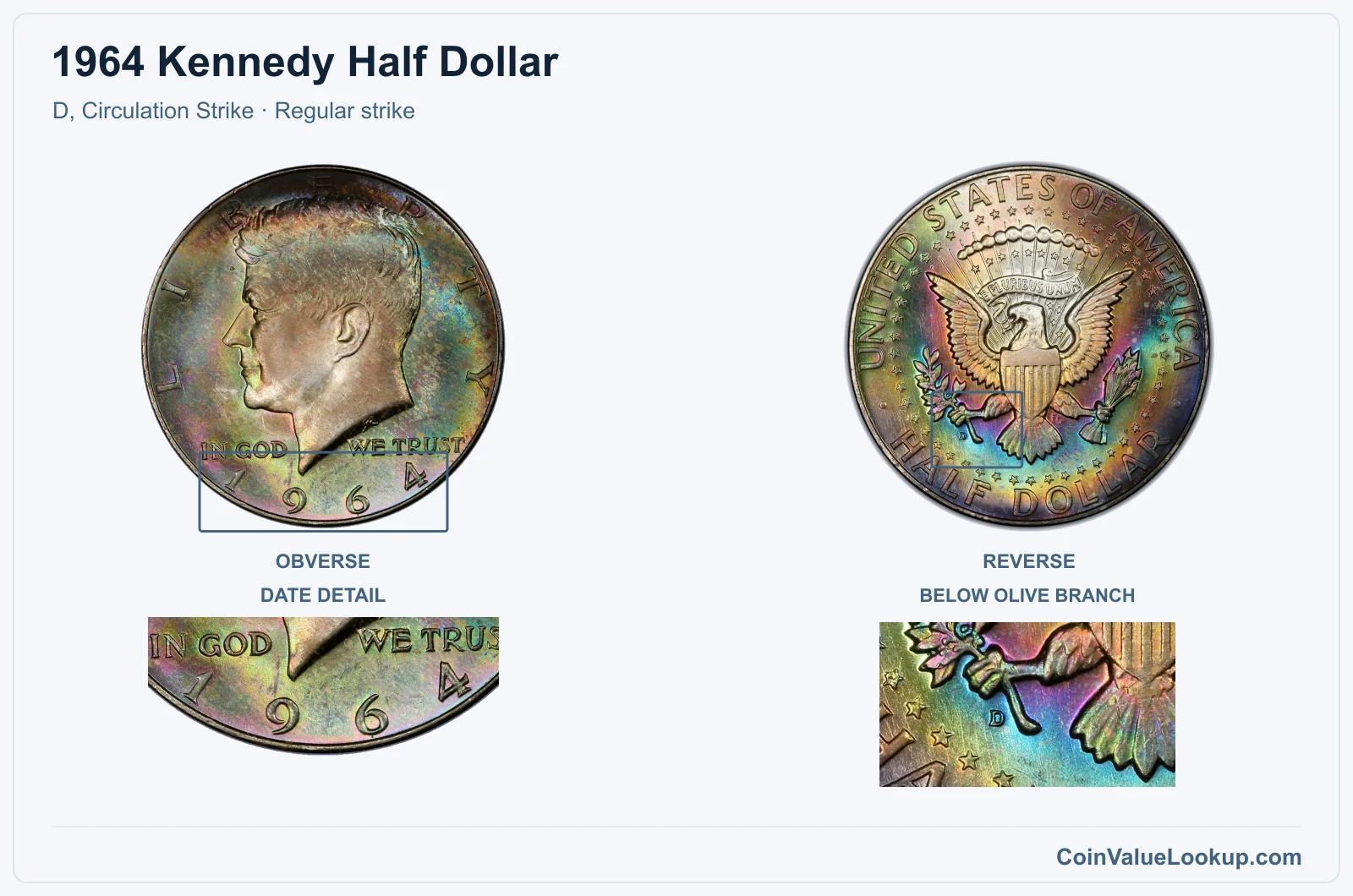
Look for the D mintmark beneath the eagle on the reverse. The Denver mint produced these in large numbers, and circulated examples track the same $31 guide figure as Philadelphia through AU50.
At MS60, expect about $32.
Where it gets interesting is MS65, where the Denver coin guides at roughly $74, a step above the Philadelphia MS65 at $60. That gap means bag-fresh D-mint halves in top condition deserve a closer look.
Do not confuse a doubled-looking edge with a true doubled die; that is a separate, authenticated variety.
Range Grade
Price Auction Records Appraisal PO PO 1
—
Coin Identifier FR FR 2
—
Coin Identifier AG AG 3
—
Coin Identifier G G 4
—
Coin Identifier
G 6
—
Coin Identifier VG VG 8
—
Coin Identifier
VG 10
—
Coin Identifier F F 12
—
Coin Identifier
F 15
—
Coin Identifier VF VF 20
—
Coin Identifier
VF 25
—
Coin Identifier
VF 30
—
Coin Identifier
VF 35
—
Coin Identifier XF XF 40
—
Coin Identifier
XF 45
—
Coin Identifier AU AU 50
—
Coin Identifier
AU 53
—
Coin Identifier
AU 55
Coin Identifier
AU 58
Coin Identifier MS MS 60
Coin Identifier
MS 61
—
Coin Identifier
MS 62
Coin Identifier
MS 63
Coin Identifier
MS 64
Coin Identifier
MS 65
Coin Identifier
MS 66
Coin Identifier
MS 67
Coin Identifier
MS 68
Coin Identifier
MS 69
—
—
—
MS 70
—
—
—
1964 Kennedy Half Dollar — No Mint Mark, Regular Proof
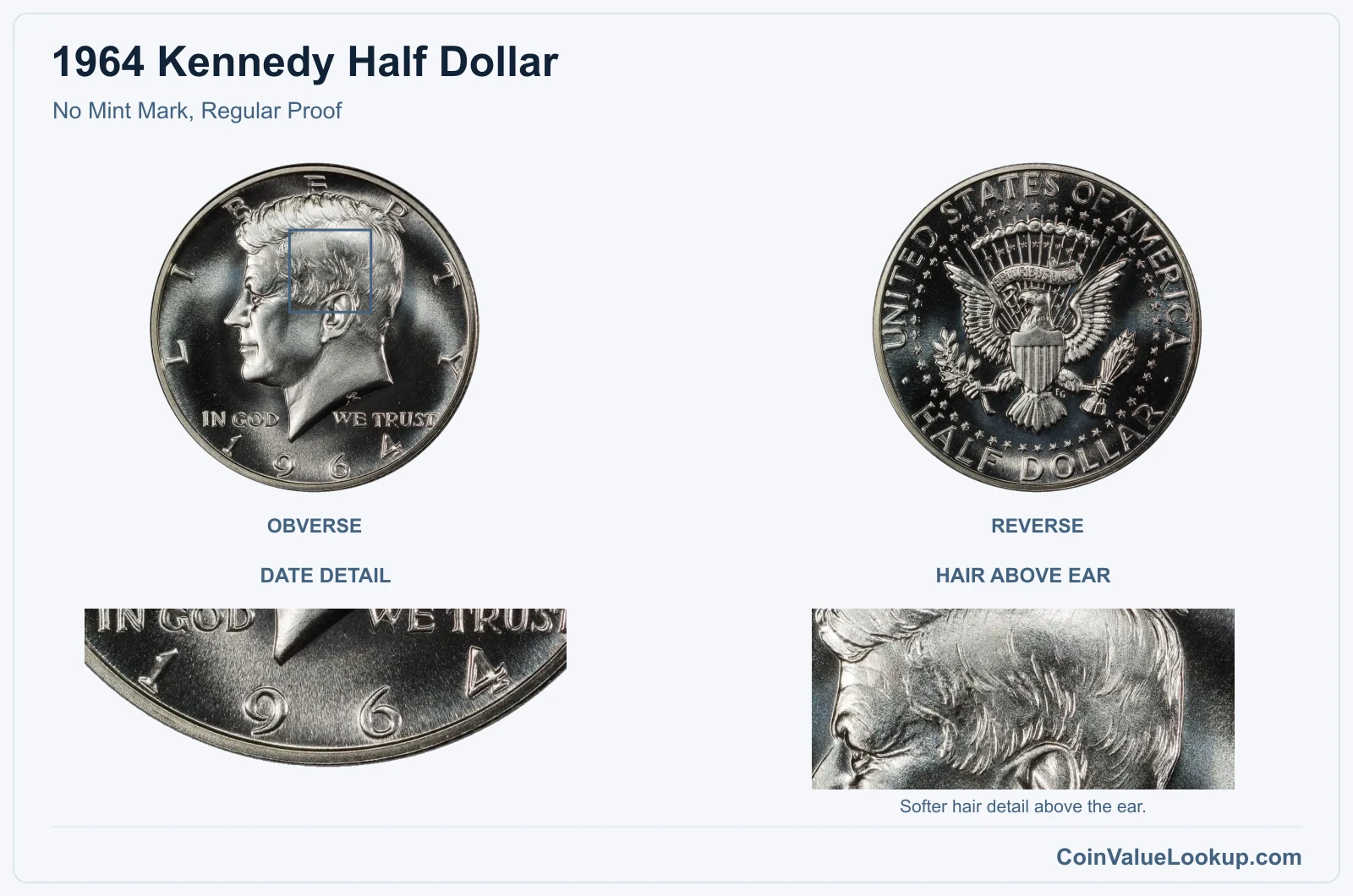
The regular 1964 proof has no mintmark and was struck at Philadelphia with polished dies on specially prepared planchets. These show mirror-like fields and sharp detail straight from the mint.
The USA Coin Book guide places a PR65 at about $48.
Before you price a proof, compare it carefully against the Accented Hair diagnostics. The regular proof has lighter, more edited hair strands above the ear and a complete lower-left serif on the I in LIBERTY.
Getting this distinction right matters, because the Accented Hair version guides at nearly three times the regular proof figure.
Range Grade
Price Auction Records Appraisal PR PR 1
—
Coin Identifier
PR 2
—
Coin Identifier
PR 3
—
Coin Identifier
PR 4
—
Coin Identifier
PR 6
—
Coin Identifier
PR 8
—
Coin Identifier
PR 10
—
Coin Identifier
PR 12
—
Coin Identifier
PR 15
—
Coin Identifier
PR 20
—
Coin Identifier
PR 25
—
Coin Identifier
PR 30
—
Coin Identifier
PR 35
—
Coin Identifier
PR 40
—
Coin Identifier
PR 45
—
Coin Identifier
PR 50
—
Coin Identifier
PR 53
—
Coin Identifier
PR 55
—
Coin Identifier
PR 58
—
Coin Identifier
PR 60
—
Coin Identifier
PR 61
—
Coin Identifier
PR 62
Coin Identifier
PR 63
Coin Identifier
PR 64
Coin Identifier
PR 65
Coin Identifier
PR 66
Coin Identifier
PR 67
Coin Identifier
PR 68
Coin Identifier
PR 69
Coin Identifier
PR 70
Coin Identifier
1964 Kennedy Half Dollar — No Mint Mark, Accented Hair Proof
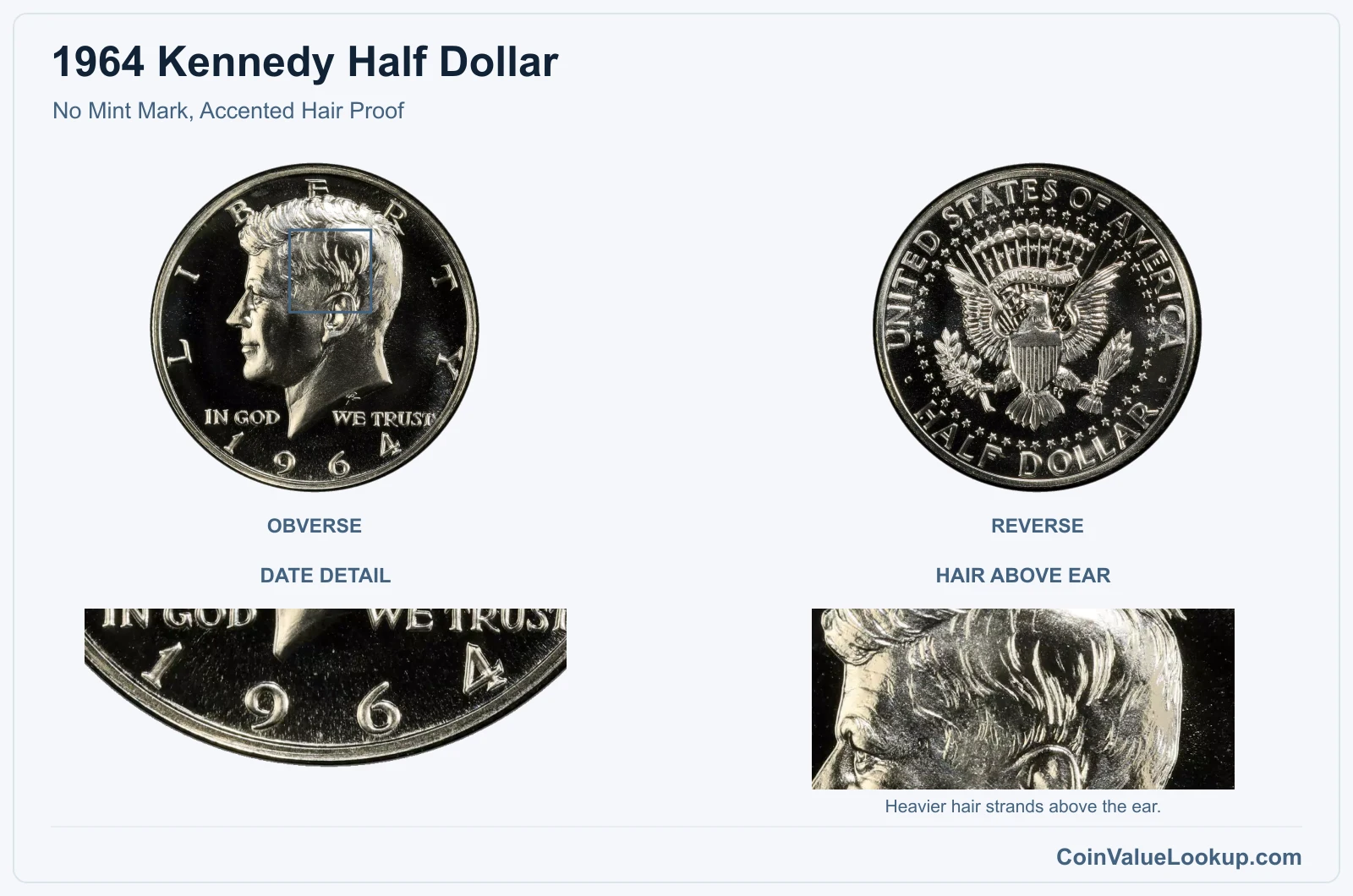
The Accented Hair proof is a die variety, not a striking error. It was produced early in the 1964 proof run before the dies were re-engraved to soften the hair detail above Kennedy's ear.
Two diagnostics confirm it: heavier, more pronounced hair strands directly above the ear, and a weak or absent lower-left serif on the letter I in LIBERTY. You need both markers to be confident.
At PR65, the USA Coin Book guide places the Accented Hair proof at roughly $140, compared to about $48 for the regular proof. That spread makes correct identification worthwhile.
Cameo and deep-cameo designations can add further premium, but those are separate from the Accented Hair attribution itself. If you think you have one, professional certification from a major grading service removes doubt and preserves resale confidence.
Range Grade
Price Auction Records Appraisal PR PR 1
—
Coin Identifier
PR 2
—
Coin Identifier
PR 3
—
Coin Identifier
PR 4
—
Coin Identifier
PR 6
—
Coin Identifier
PR 8
—
Coin Identifier
PR 10
—
Coin Identifier
PR 12
—
Coin Identifier
PR 15
—
Coin Identifier
PR 20
—
Coin Identifier
PR 25
—
Coin Identifier
PR 30
—
Coin Identifier
PR 35
—
Coin Identifier
PR 40
—
Coin Identifier
PR 45
—
Coin Identifier
PR 50
—
Coin Identifier
PR 53
—
Coin Identifier
PR 55
—
Coin Identifier
PR 58
—
Coin Identifier
PR 60
—
Coin Identifier
PR 61
—
Coin Identifier
PR 62
Coin Identifier
PR 63
Coin Identifier
PR 64
Coin Identifier
PR 65
Coin Identifier
PR 66
Coin Identifier
PR 67
Coin Identifier
PR 68
Coin Identifier
PR 69
Coin Identifier
PR 70
—
—
—
1964 Kennedy Half Dollar — Rare SMS / Specimen Strike
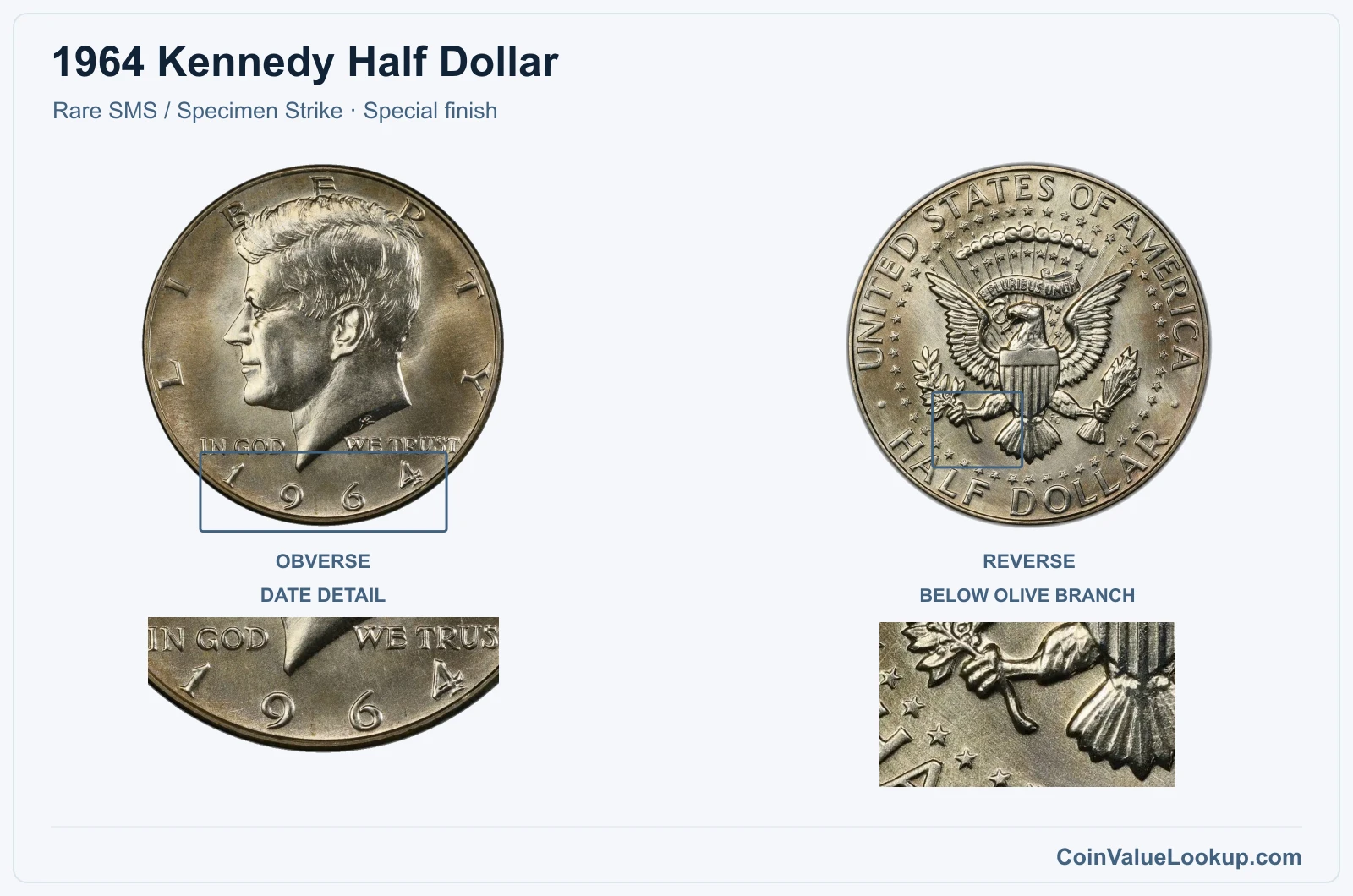
The 1964 SMS, or Special Mint Set, half dollar is a rare specialist coin with a finish distinct from both business strikes and standard proofs. It is not simply a proof without a mintmark.
Die characteristics, surface texture, and documented provenance all factor into the attribution, and major grading services certify it as a separate issue.
No guide price is adopted here because each example is individually valued based on its specific qualities and certification. A single extreme auction result would misrepresent what a normal collector might encounter.
If you believe you have an SMS specimen, third-party certification is essentially mandatory. Without it, the coin is just an unattributed no-mintmark half dollar to the market.
Range Grade
Price Auction Records Appraisal SP SP 1
—
Coin Identifier
SP 2
—
Coin Identifier
SP 3
—
Coin Identifier
SP 4
—
Coin Identifier
SP 6
—
Coin Identifier
SP 8
—
Coin Identifier
SP 10
—
Coin Identifier
SP 12
—
Coin Identifier
SP 15
—
Coin Identifier
SP 20
—
Coin Identifier
SP 25
—
Coin Identifier
SP 30
—
Coin Identifier
SP 35
—
Coin Identifier
SP 40
—
Coin Identifier
SP 45
—
Coin Identifier
SP 50
—
Coin Identifier
SP 53
—
Coin Identifier
SP 55
—
Coin Identifier
SP 58
—
Coin Identifier
SP 60
—
Coin Identifier
SP 61
—
Coin Identifier
SP 62
—
Coin Identifier
SP 63
—
Coin Identifier
SP 64
—
Coin Identifier
SP 65
—
Coin Identifier
SP 66
—
Coin Identifier
SP 67
Coin Identifier
SP 68
Coin Identifier
SP 69
Coin Identifier
SP 70
—
—
—
1964 Kennedy Half Dollar Error List
1. 1964 Kennedy Half Dollar — Doubled Obverse Lettering
On a 1964-D doubled-die obverse, look for a second, slightly offset impression in the letters of IN GOD WE TRUST and in the date numerals. Under moderate magnification, the doubling appears as distinct secondary outlines rather than a flat shelf along one side of each letter.
That flat-shelf appearance is machine doubling, a mechanical artifact from die bounce during striking. It has no significant collector premium.
A true doubled die was created when the die itself received a second misaligned impression during its manufacture, and the effect is consistent across every coin struck from that die.
A PCGS-reported sale from July 2021 recorded a certified MS65 example at $130. That is a single historical transaction, not a current guaranteed range.
Condition, the specific doubled-die attribution, and the clarity of the doubling all affect what a given coin will bring.
2. 1964 Kennedy Half Dollar — Curved Clipped Planchet
A curved clipped planchet shows a smooth, concave missing section along the rim where the blank was incompletely punched from the metal strip. On the referenced 1964 example, the clip appears at roughly the 2 o'clock position.
Inspect the metal flow near the clip boundary and check for a slightly weaker rim on the opposite side, sometimes called the Blakesley effect.
That opposite-side weakness supports the diagnosis but is not always visible on every genuine clip. The key distinction from post-mint damage is the smooth, factory-consistent edge of the missing area.
Filed edges, fresh cuts, or jagged breaks point to damage after the coin left the press.
A 1964 curved-clip half dollar graded NGC MS64 sold at Heritage Auctions in June 2026 for $94. That is one documented sale, not a universal clip premium.
3. 1964 Kennedy Half Dollar — Strike-Through
A strike-through occurs when foreign material, such as grease, thread, or a metal fragment, sits between the die and the planchet during striking. The result is a localized area where the normal design is interrupted or missing.
On the referenced 1964 half dollar, the obstruction affected the obverse, leaving a visible blank or textured patch in Kennedy's portrait area.
Do not confuse a strike-through with a gouge, a worn spot, or a scratch made after minting. Post-mint damage typically cuts into the surface, while a strike-through shows an area that was never fully impressed.
A 1964 half dollar with an obverse strike-through graded NGC MS62 sold at Heritage Auctions in June 2026 for $84. That reported amount reflects one specific example and its particular severity.
4. 1964 Kennedy Half Dollar — Struck on a Smaller-Denomination Planchet
This error happens when a half-dollar die strikes a blank intended for a different denomination. On the referenced 1964 example, the half-dollar design was impressed onto a quarter-sized planchet.
The result is a coin visibly smaller than a normal half dollar, with peripheral design elements cut off because the blank was too small to receive the full image.
Compare the flan diameter directly against a standard half dollar. The size difference is obvious.
Do not confuse this with a trimmed or shaved coin. Post-mint trimming leaves tool marks on the edge, while a wrong-planchet strike has properly formed edges from the striking process.
A 1964 half dollar struck on a quarter planchet, graded ANACS MS60, sold at Heritage Auctions in June 2026 for $1,128.50. These are scarce errors and each example is individually assessed.
5. 1964 Kennedy Half Dollar — Die Cap
A die cap forms when a struck coin sticks to the upper die and is carried along for subsequent strikes. With each new strike, the trapped coin wraps further around the die, gradually taking on a cup or bottle-cap shape.
The obverse, now facing away from the planchet, develops a progressively distorted and spread-out design.
The key visual is that distinctive cupped profile. Pick the coin up and look at it edge-on.
A genuine die cap has a deep, uniform curve from the manufacturing process. A coin bent into a cup shape after minting will show crease lines, uneven curvature, or tool marks.
A 1964 obverse die cap graded NGC MS65 sold at Heritage Auctions in June 2026 for $4,392. Die caps are among the more dramatic mint errors and tend to draw strong collector interest.
Each one is individually valued.
6. 1964 Kennedy Half Dollar — Off-Center Strike
An off-center strike occurs when the planchet is not properly seated in the collar before the dies close. Part of the design is displaced toward one edge, and the opposite side shows a blank, unstruck crescent.
On the referenced 1964 half dollar, the strike was approximately 35% off-center and the coin also exhibits cupping, meaning it did not sit flat during the strike.
Distinguish an off-center strike from a curved clip, which removes metal entirely, or a misaligned die, where the opposite face still looks normal. A bent coin from post-mint handling will not have a crisp unstruck area.
No specific price is adopted for this error. Value depends on the percentage of off-center displacement, whether the date remains visible, the degree of cupping, and the authenticated condition.
Individual professional assessment is the way to go.
7. 1964 Kennedy Half Dollar — Brockage with Broadstrike
A brockage happens when a previously struck coin remains on the die and impresses its image into the next coin struck beneath it. The result is one face with a normal design and the other showing a mirror-image, incuse version of that previously struck coin's design.
On the referenced 1964 half dollar, the reverse carries a full brockage, and the coin also spread beyond the collar as a broadstrike.
That combination of full brockage and broadstrike is visually dramatic. Compare the incuse mirrored lettering on one side against the normally raised lettering on the other.
Damage made by pressing two coins together in a vise will show uneven depth and lack the broadstrike spread.
A 1964 half dollar with a full reverse brockage and broadstrike, graded PCGS MS65, sold at Heritage Auctions in February 2020 for $4,200.
8. 1964 Kennedy Half Dollar — Repunched Mintmark
A repunched mintmark appears when the D mintmark punch was applied more than once in slightly different positions on the working die. Under magnification, you can see remnants of the first placement alongside the final position, sometimes as a partial second D slightly offset from the primary mark.
Compare the mintmark area on your coin to a normal 1964-D at the same magnification. On a normal coin, the D is cleanly singular.
On an RPM, you will spot traces of an earlier, differently positioned punch. Do not mistake a die chip filling part of the D, corrosion roughening the area, or flat machine doubling for a genuine repunched mintmark.
No specific price is adopted for this variety. Value depends on the visibility of the repunching, the specific RPM attribution, and the coin's overall condition.
9. 1964 Kennedy Half Dollar — Doubled Die Reverse
A doubled-die reverse on a 1964 Kennedy half shows doubling in the reverse legends or design elements, created when the working die received a second, slightly misaligned impression during its manufacture. Look at the reverse lettering, particularly UNITED STATES OF AMERICA and HALF DOLLAR, for consistent secondary outlines.
Compare your coin's reverse closely to a known normal example at matching magnification. True die doubling is consistent and repeatable across every coin from that die.
Machine doubling, by contrast, tends to produce flat, shelf-like distortions on one side of the lettering and carries no premium.
Reflections under certain lighting can also mimic doubling, so rotate the coin and check whether the apparent second image moves with the light. No specific price is adopted for this variety.
Value depends on the clarity of the doubling, the specific attribution, and overall condition.
10. 1964 Kennedy Half Dollar — Die Crack / Die Chip
Die cracks and die chips are raised features on a coin's surface caused by damage to the steel die during its working life. A die crack appears as a thin raised line, often running from the rim into the design or connecting design elements.
A die chip shows up as a small raised blob where a piece of the die face broke away.
These are distinct from scratches or incuse lines, which are pressed into the coin's surface. Die cracks and chips are raised because they correspond to voids in the die.
Run your fingernail across the mark: if it catches as a raised line, that is consistent with a die crack. An incuse scratch will feel like a groove.
A rim-connected die break that removes a significant chunk of the design is sometimes called a cud and typically carries more premium. No specific price is adopted for die cracks on the 1964 half dollar.
Value depends on size, location, and the coin's overall condition.