1823 Capped Bust Dime Coin Value: How Much Is It Worth?
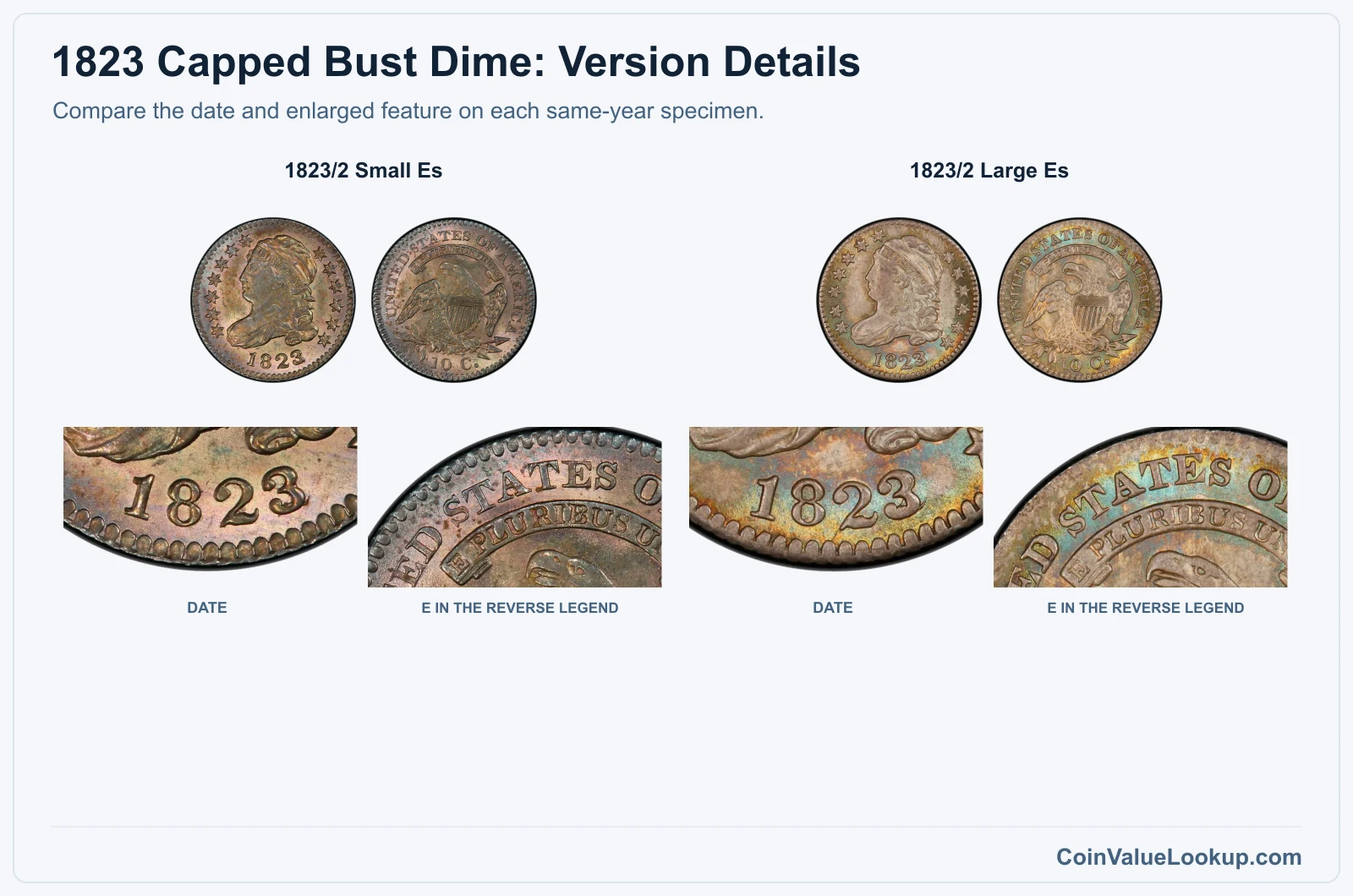
The 1823 Capped Bust Dime is an early American silver dime struck at the Philadelphia Mint, and every surviving example is an overdate — the "3" was punched over an earlier "2" in the date. Guide estimates for this coin range from about $127.00 in well-worn Good-4 condition to around $4,209.00 at the Mint State 63 level, depending on the specific variety and grade.
These are reference anchors, not guaranteed offers; your coin's actual value depends on its exact variety, wear, and the condition of its original surfaces.
Fast Way to Identify Your 1823 Capped Bust Dime
Want a quick starting point? Upload clear photos of both the front and back of your 1823 dime, and our identifier can offer a preliminary take on which variety you might have.
Good lighting and a sharp close-up of the date area help the most. This is not a substitute for professional authentication, but it can point you in the right direction.
1823 Capped Bust Dime Value
Upload both sides of your 1823 Capped Bust Dime.
Front Obverse
Upload photo
Back Reverse
Upload photo
Which 1823 Capped Bust Dime Versions Are Worth Money?
- 1823/2 Small Es — guide estimates run from $127.00 in G4 to $4,209.00 in MS63; check the reverse lettering size carefully.
- 1823/2 Large Es — same guide range as the Small Es variety; distinguished by its larger E letters in the reverse legends.
- Both varieties are overdates with the 3 punched over a 2, so magnify the date on any 1823 dime to confirm the underlying digit.
- Coins with original, uncleaned surfaces and strong overdate visibility tend to attract the most collector interest.
Step 1: Identify Your 1823 Capped Bust Dime Mint Mark and Version
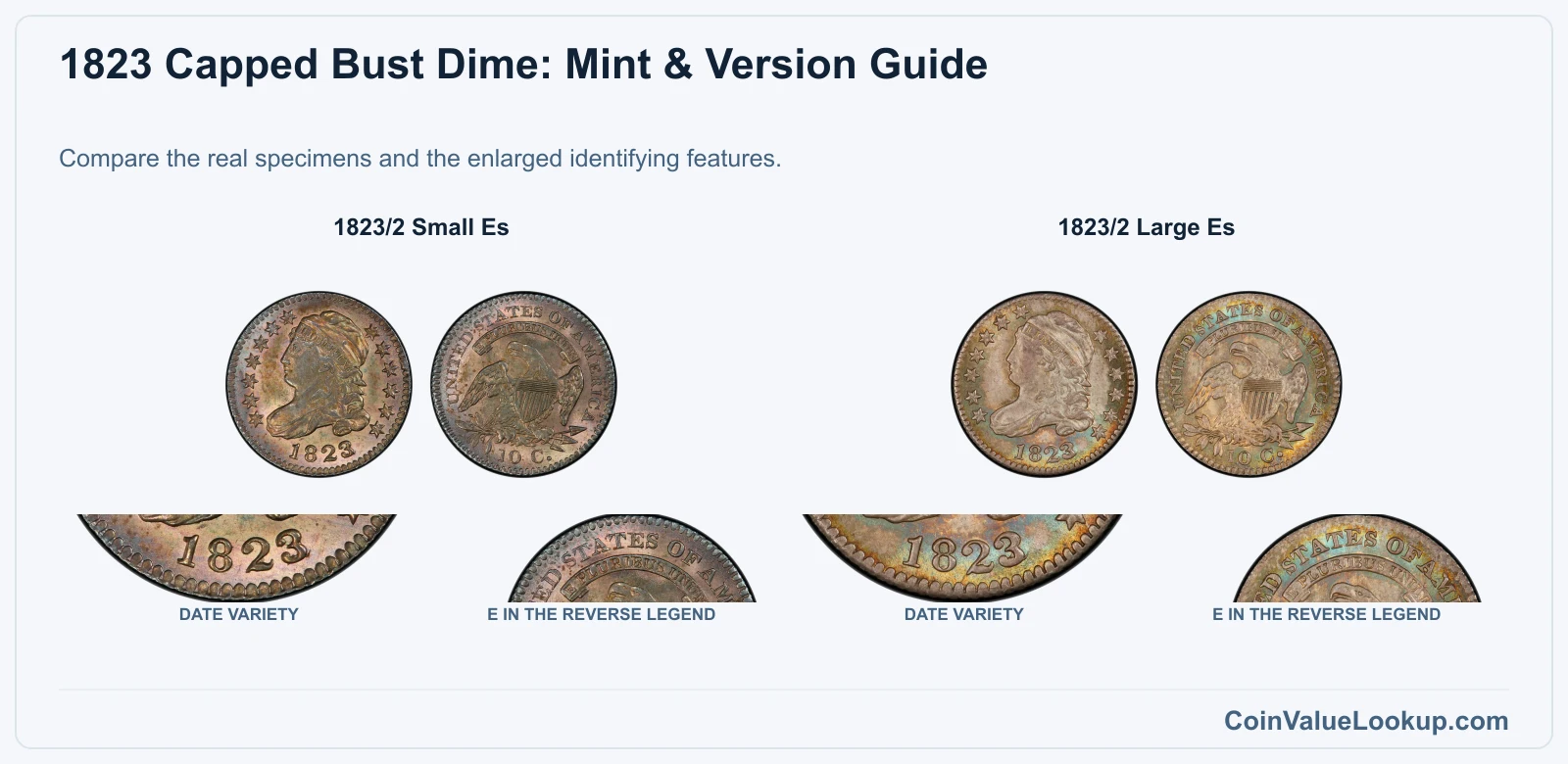
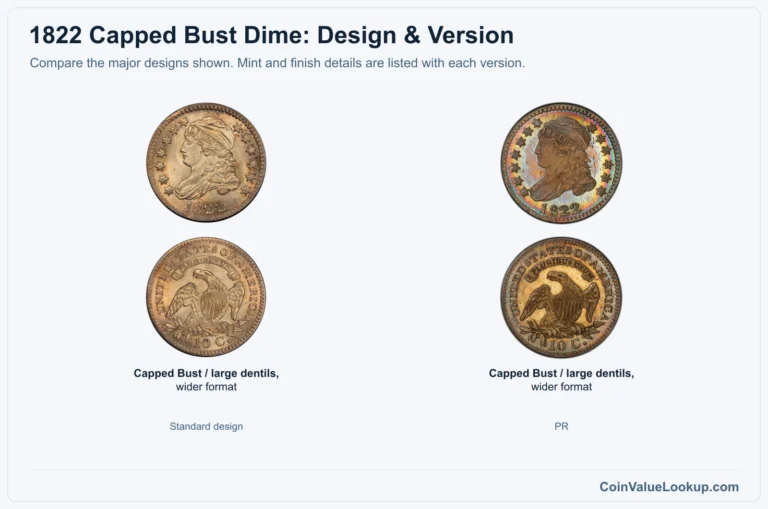
Every 1823 Capped Bust Dime was struck at the Philadelphia Mint, so there is no mintmark to look for. The coin is a silver-copper alloy, roughly 89.24% silver, and uses the wider Capped Bust design with large dentils (the tooth-like border elements) around the rim.
The key thing to know: the "3" in the date sits on top of a "2" from an earlier die. Under magnification you can see traces of the underlying "2" peeking out beneath the final digit.
That makes every genuine 1823 dime an overdate variety.
The two recognized branches are the 1823/2 Small Es and the 1823/2 Large Es. The difference is in the letter "E" used in legends like UNITED and STATES on the reverse.
Compare the size and proportions of those letters carefully — one variety uses noticeably smaller E's than the other. A magnifying glass and a known reference image of each letter style are your best tools here.
Do not confuse this coin with a half dime, which is a smaller denomination entirely.
Step 2: Check Your 1823 Capped Bust Dime Grade
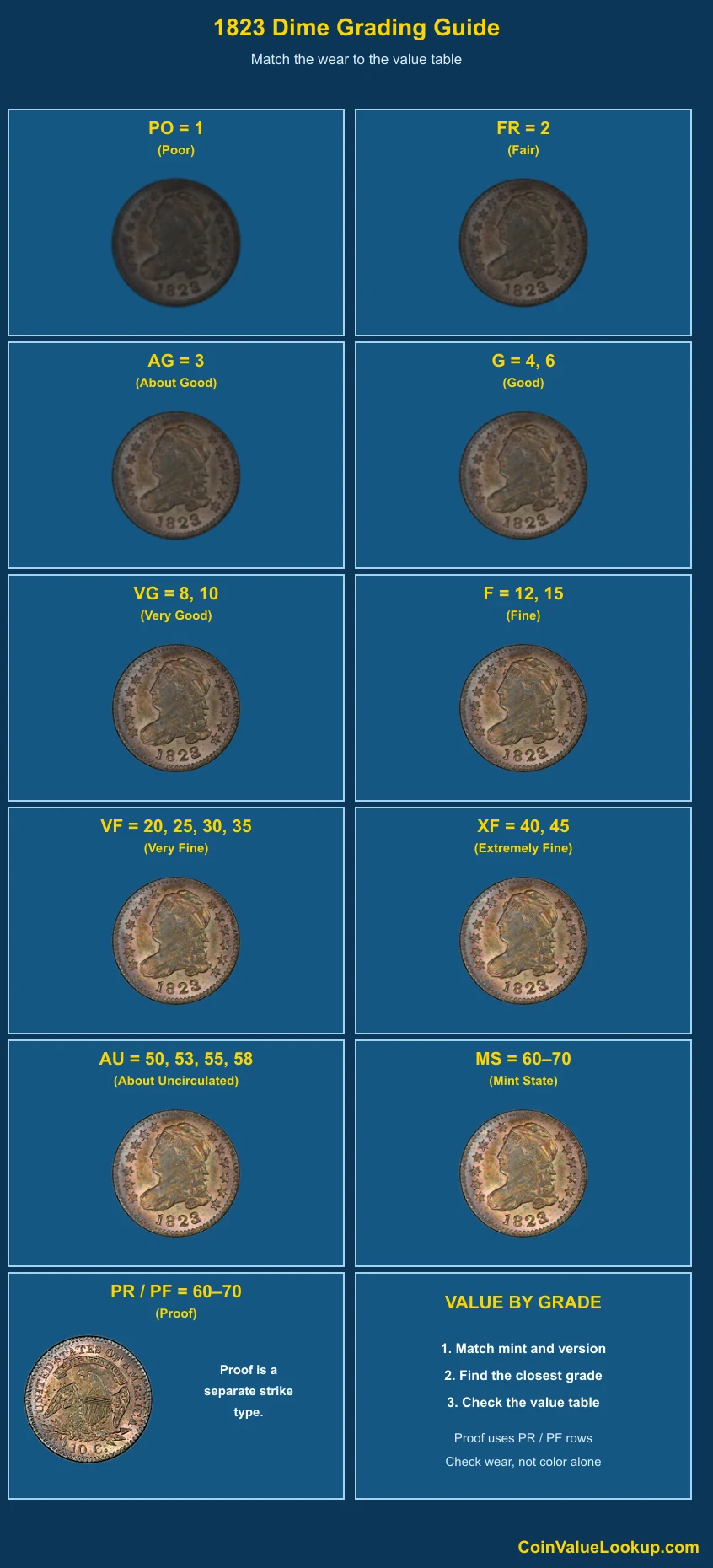
Start by examining the high points on Liberty's portrait: her hair curls above the forehead, the cheek, and the drapery near her shoulder wear first. On the reverse, the eagle's breast feathers and wing tips lose detail before anything else.
These coins were struck on hand-operated presses, so even a brand-new example can show uneven detail or slight weakness in spots. That is not the same as wear.
Look at the overall luster and surface — a coin with original mint luster and only minor contact marks is a very different animal from one that has been cleaned or polished.
Use the comparison image to match your coin's wear pattern against known grade examples of the same type. Check whether the high points still show their original texture or have gone flat and smooth.
Cleaning, scratches, and corrosion all reduce a coin's appeal and comparability to published guide values, sometimes dramatically.
Step 3: Check 1823 Capped Bust Dime Value by Mint and Version
1823 Capped Bust Dime — /2 Small Es
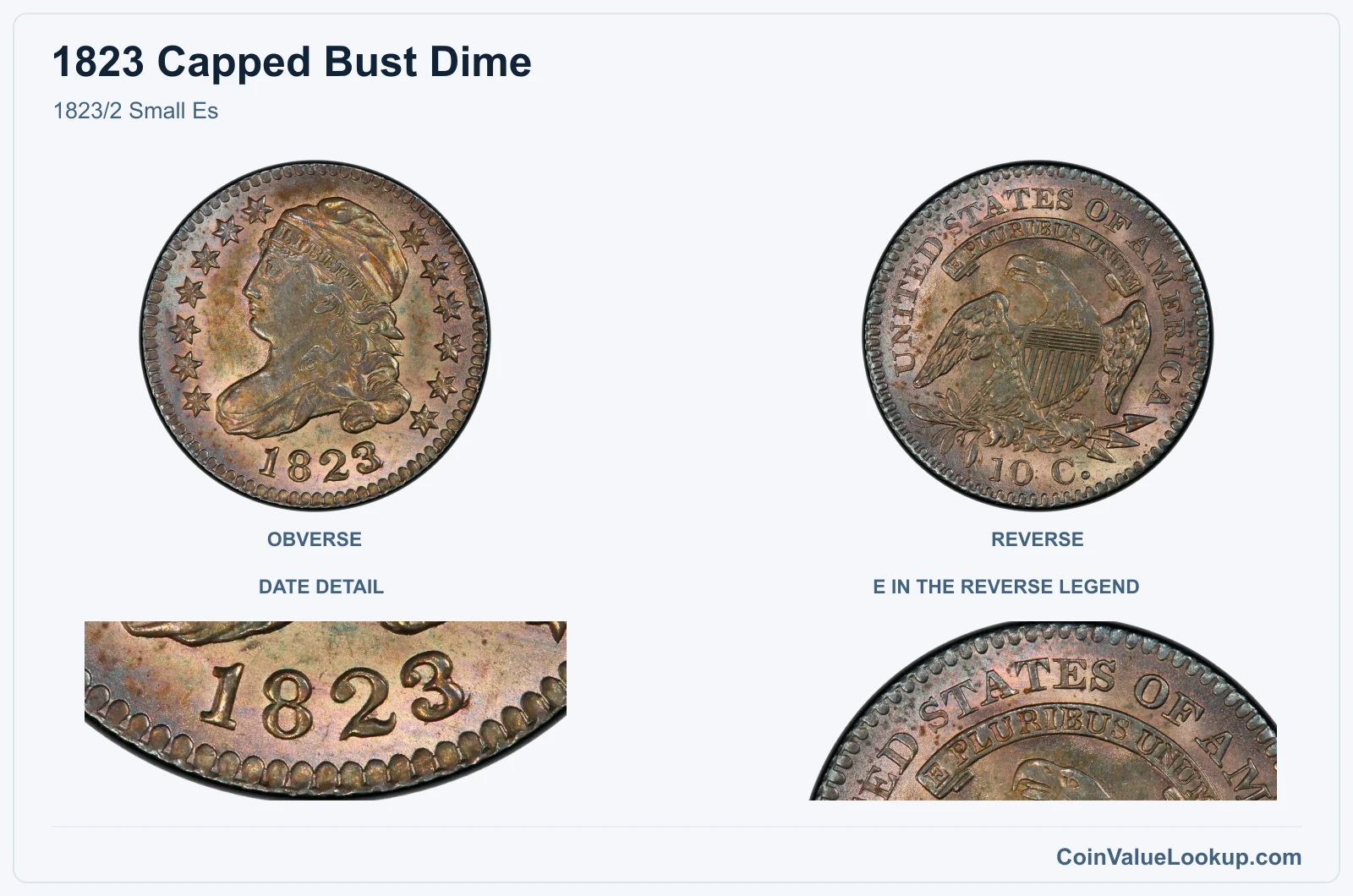
The 1823/2 Small Es variety was struck at Philadelphia from a die where the final "3" in the date was cut over an earlier "2." Under magnification, you can see curved remnants of the "2" lurking beneath the "3" — look especially at the lower loop area. The "Small Es" part refers to the reverse: the letter E in words like UNITED and STATES is proportionally smaller and narrower than on the Large Es variety.
Guide estimates place this coin at approximately $127.00 in Good-4 and around $4,209.00 in MS63. Those are reference anchors from USA Coin Book, not buy-it-now prices.
Actual value depends on the coin's surfaces, strike quality, and whether it has been cleaned or damaged. Original surfaces matter far more than shine on a 200-year-old dime.
Range Grade
Price Auction Records Appraisal PO PO 1
—
Coin Identifier FR FR 2
—
Coin Identifier AG AG 3
Coin Identifier G G 4
Coin Identifier
G 6
Coin Identifier VG VG 8
Coin Identifier
VG 10
Coin Identifier F F 12
Coin Identifier
F 15
Coin Identifier VF VF 20
Coin Identifier
VF 25
Coin Identifier
VF 30
Coin Identifier
VF 35
Coin Identifier XF XF 40
Coin Identifier
XF 45
Coin Identifier AU AU 50
Coin Identifier
AU 53
Coin Identifier
AU 55
—
Coin Identifier
AU 58
Coin Identifier MS MS 60
—
Coin Identifier
MS 61
Coin Identifier
MS 62
Coin Identifier
MS 63
Coin Identifier
MS 64
Coin Identifier
MS 65
Coin Identifier
MS 66
—
—
—
MS 67
—
—
—
MS 68
—
—
—
MS 69
—
—
—
MS 70
—
—
—
1823 Capped Bust Dime — /2 Large Es
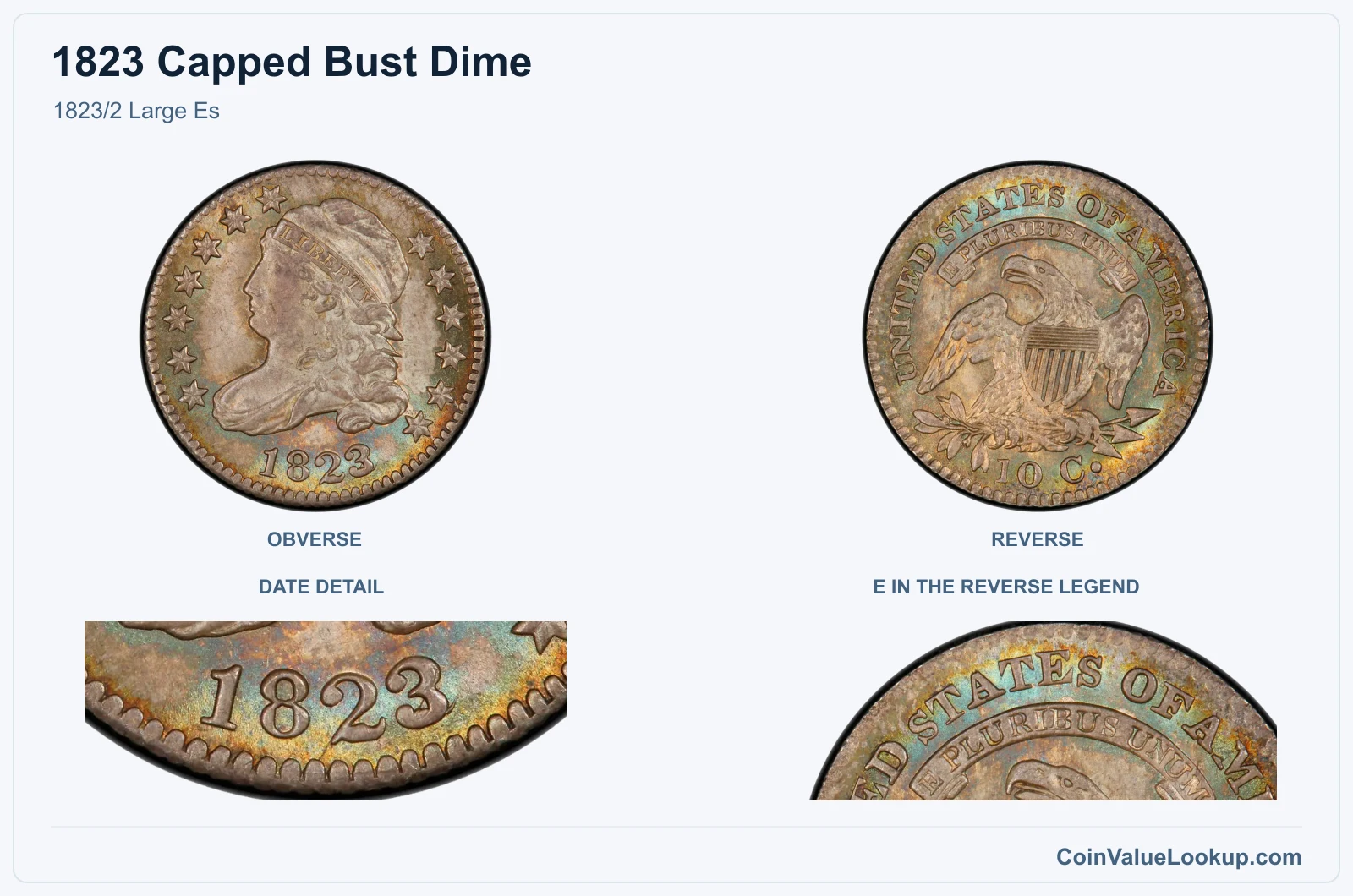
The 1823/2 Large Es variety shares the same overdate date — a "3" punched over a "2" — but the reverse die uses a distinctly larger, broader style of the letter E throughout the legends. Compare the E in STATES or UNITED side by side with a Small Es example and the difference becomes clear; it is not subtle once you know what to look for.
Coin Value Lookup is a good place to start if you want to look up other early dime varieties or check values for different years in this series.
Guide estimates from USA Coin Book list this variety at about $127.00 in G4 and roughly $4,209.00 in MS63. As with its Small Es sibling, condition and originality drive real-world pricing.
A lightly worn example with honest, untouched surfaces will typically outperform a brighter coin that has been cleaned.
Range Grade
Price Auction Records Appraisal PO PO 1
—
Coin Identifier FR FR 2
—
Coin Identifier AG AG 3
—
Coin Identifier G G 4
Coin Identifier
G 6
Coin Identifier VG VG 8
—
Coin Identifier
VG 10
Coin Identifier F F 12
Coin Identifier
F 15
Coin Identifier VF VF 20
Coin Identifier
VF 25
Coin Identifier
VF 30
Coin Identifier
VF 35
Coin Identifier XF XF 40
Coin Identifier
XF 45
—
Coin Identifier AU AU 50
Coin Identifier
AU 53
Coin Identifier
AU 55
Coin Identifier
AU 58
Coin Identifier MS MS 60
Coin Identifier
MS 61
—
Coin Identifier
MS 62
—
Coin Identifier
MS 63
Coin Identifier
MS 64
Coin Identifier
MS 65
Coin Identifier
MS 66
Coin Identifier
MS 67
—
—
—
MS 68
—
—
—
MS 69
—
—
—
MS 70
—
—
—
1823 Capped Bust Dime Error List
1. 1823 Capped Bust Dime — Overdate
The 1823 Capped Bust Dime is itself an overdate: every genuine example shows the final "3" in the date punched over an earlier "2." Under a loupe or magnifying glass, you can spot the curved contours of the original "2" beneath the "3," particularly in the lower portion of the digit where the two numbers differ most in shape.
This is a die variety, not a random mint accident, so it appears on all 1823 dimes — but the strength and visibility of the underlying "2" varies from coin to coin and die state to die state. The specific branch reported by PCGS is the 1823/2 Large Es regular strike.
Do not confuse a genuine overdate with a damaged or corroded date area, or with ordinary machine doubling, which produces a flat, shelf-like shadow rather than clear remnants of a different numeral. No specific price range is adopted for this as a standalone error listing; the coin's value depends on its variety (Small Es or Large Es), overall grade, surface condition, and how clearly the overdate shows.