1948 Roosevelt Dime Coin Value: How Much Is It Worth?
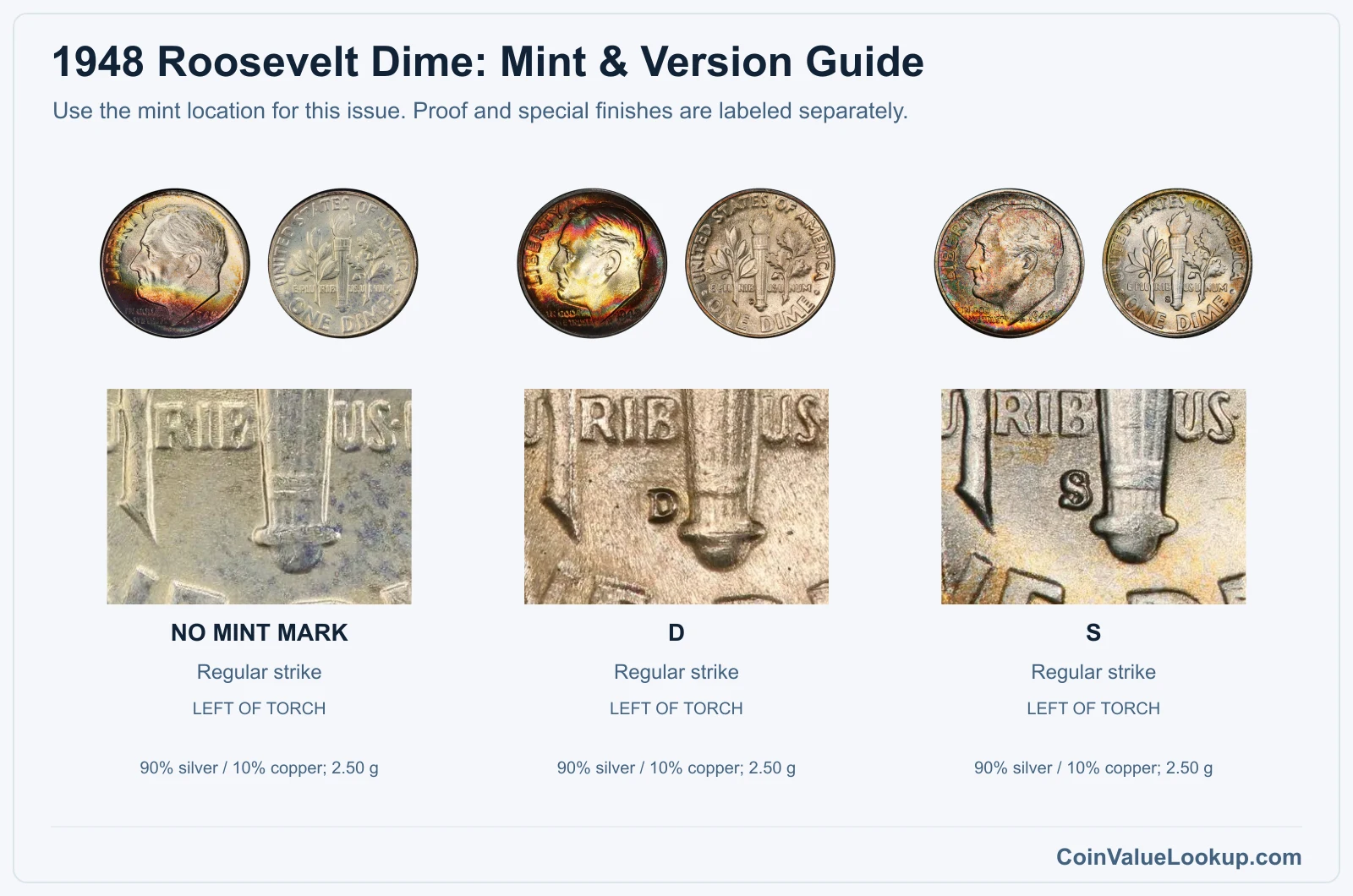
The 1948 Roosevelt Dime is a 90% silver coin struck at all three U.S. mints. Guide estimates for ordinary business strikes range from about $5.81 in Good-4 condition to around $18 in Mint State 65, depending on the specific mint and grade.
These are retail reference points from published guides, not guaranteed buy prices, and the silver content means values shift with precious-metal markets.
Fast Way to Identify Your 1948 Roosevelt Dime
Snap a clear photo of the front and back of your 1948 dime and upload both images. The preliminary identifier can help you figure out which mint produced your coin and flag visible features worth a closer look.
It is not a substitute for professional authentication or precise grading, but it gives you a solid starting point.
1948 Roosevelt Dime Value
Upload both sides of your 1948 Roosevelt Dime.
Front Obverse
Upload photo
Back Reverse
Upload photo
Which 1948 Roosevelt Dime Versions Are Worth Money?
- Uncirculated examples with fully separated torch bands and original, uncleaned surfaces command the strongest premiums for regular strikes.
- A curved clipped planchet on a 1948-S dime is a documented mint error — check the rim for a missing crescent of metal.
- A repunched S mintmark variety exists — magnify the reverse mintmark area and look for doubling of the letter.
- A defective planchet with a crack through the coin metal has been attributed on 1948-S dimes — this is distinct from a raised die crack.
- Die cracks on 1948-S reverses are documented in multiple die states and may carry a modest premium depending on severity.
Step 1: Identify Your 1948 Roosevelt Dime Mint Mark and Version
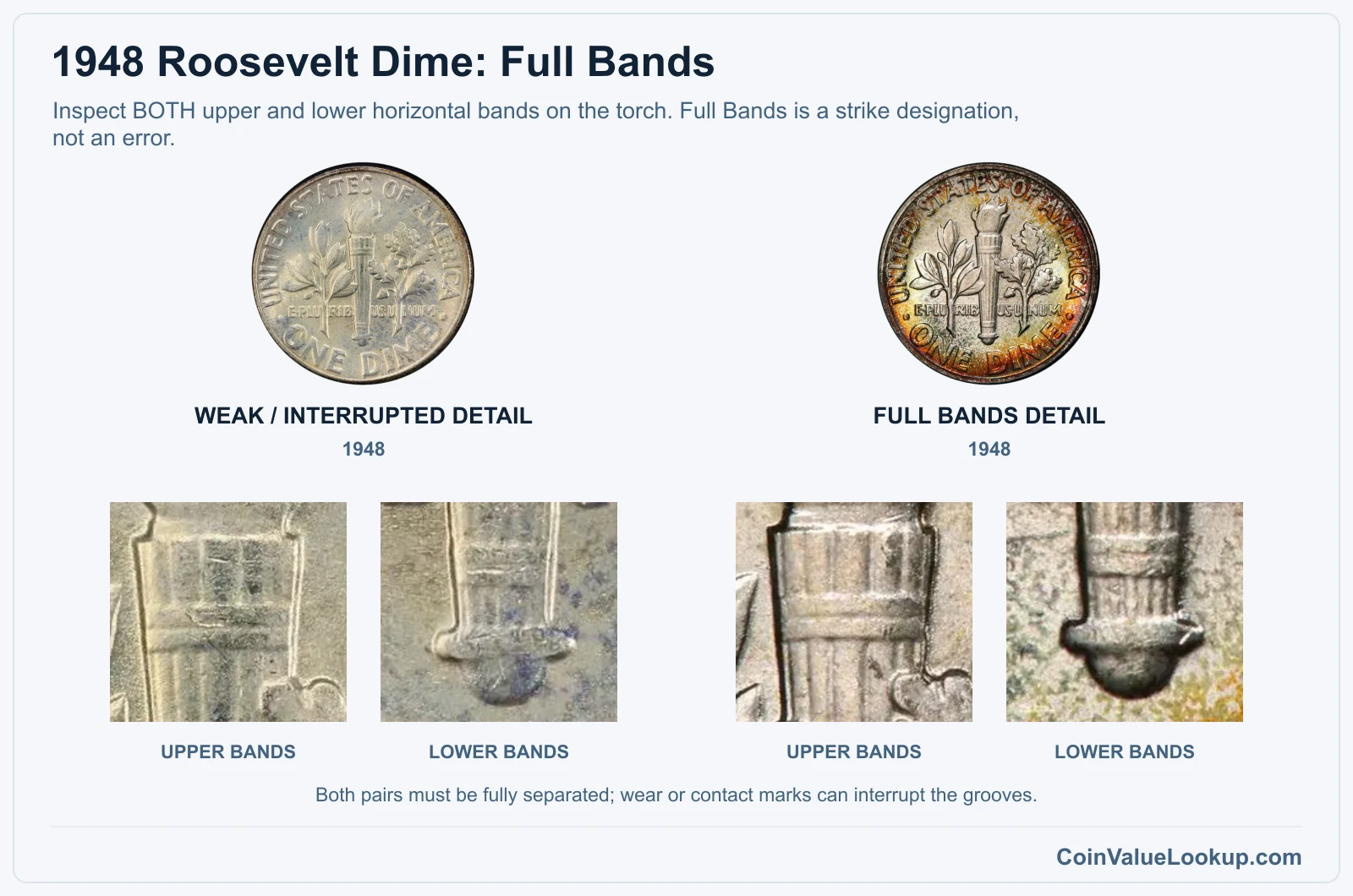
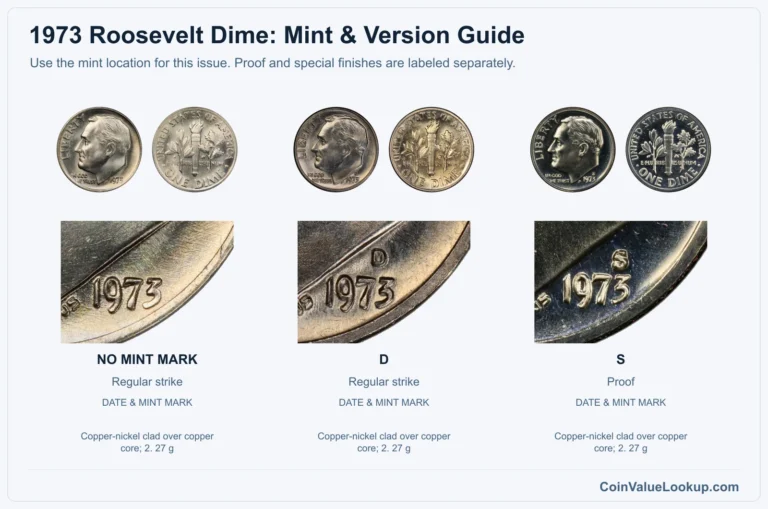
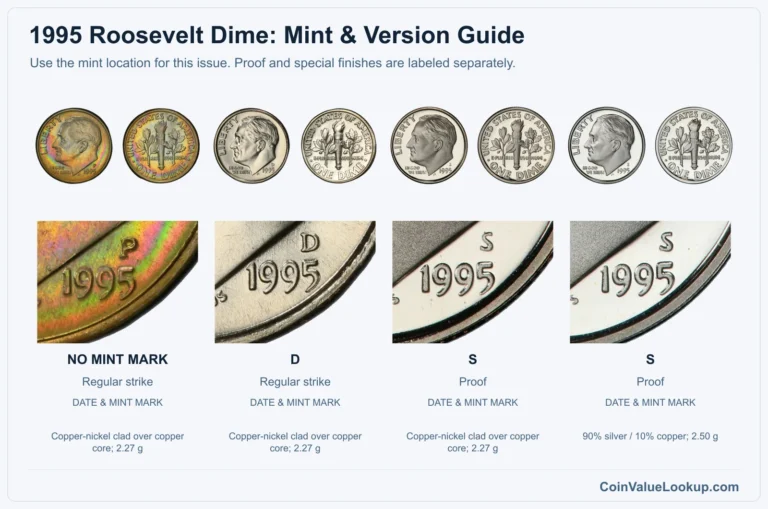
Start by confirming the date reads 1948 and the design shows Roosevelt's portrait on the front with a torch flanked by olive and oak branches on the reverse. Flip the coin over and look near the base of the torch for a small letter.
A "D" means Denver, an "S" means San Francisco, and no letter at all means Philadelphia. The absence of a mintmark on a Philadelphia coin is completely normal and not a missing-mintmark error.
Every regular 1948 dime is 90% silver and 10% copper, weighing about 2.50 grams and measuring roughly 17.9 mm across. There is no clad version for this year.
If your coin feels unusually light or looks like a modern sandwich of metals, it may be a different date altogether.
Step 2: Check Your 1948 Roosevelt Dime Grade
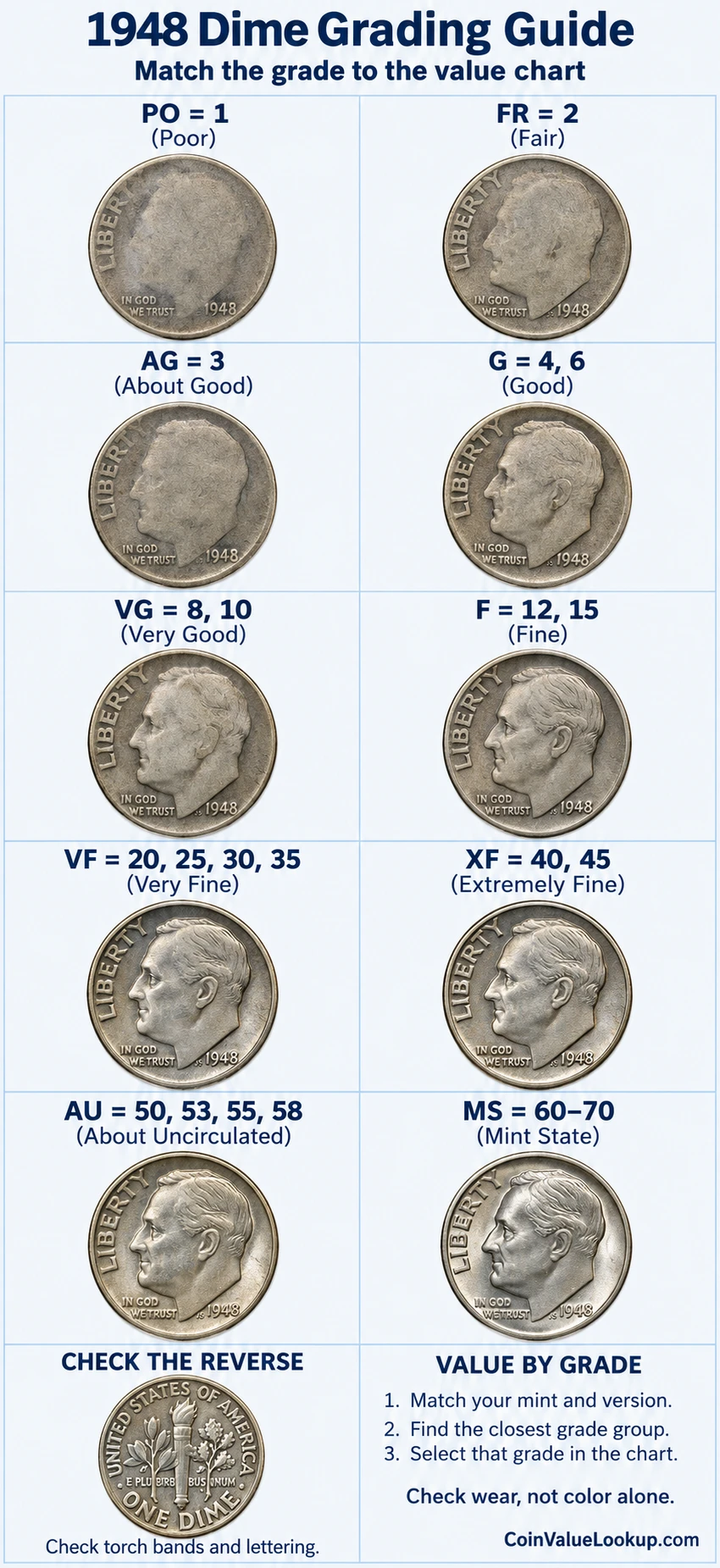
Focus on Roosevelt's cheek, the hair detail above his ear, and the line of his jaw. These high points lose detail first.
On the reverse, check the upper torch flames and the leaf tips for flattening.
A soft or incomplete torch band does not automatically mean the coin circulated. Some 1948 dimes left the press with weak strikes.
Full Bands, which refers to complete separation of both horizontal torch-band pairs, is a strike designation, not an indication of wear. Compare your coin against the reference image at matching grades.
Original luster matters more than raw shininess. A harshly cleaned coin that looks bright can actually grade lower than a naturally toned piece with honest surfaces.
Evaluate surface damage, contact marks, and remaining luster together when estimating condition.
Step 3: Check 1948 Roosevelt Dime Value by Mint and Version
1948 Roosevelt Dime — No Mintmark / Philadelphia
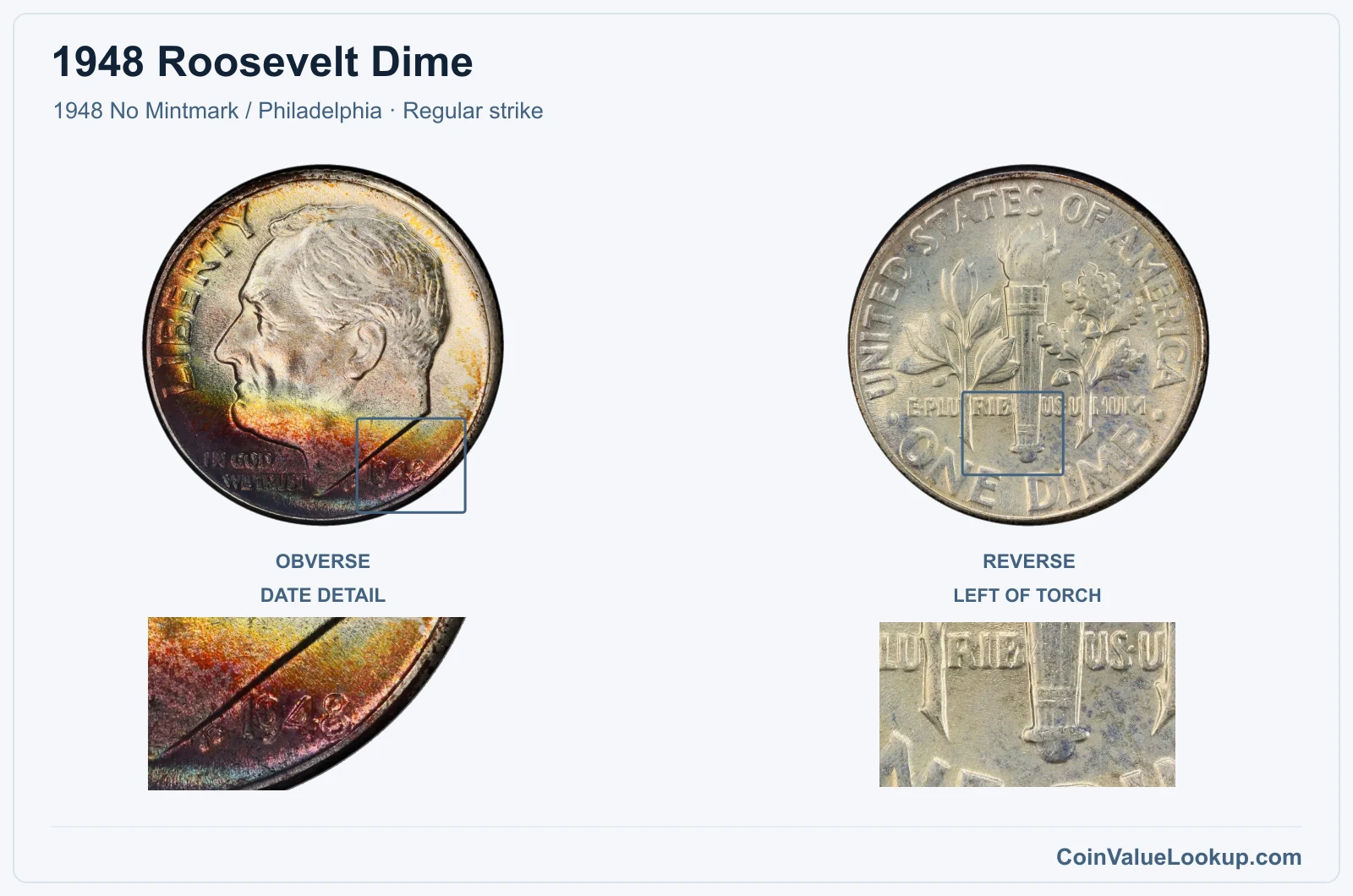
The 1948 Philadelphia dime carries no mintmark. Look at the reverse near the torch base and confirm there is nothing there.
Guide values run from about $5.81 in Good-4 to roughly $18 in MS65. Full Bands pieces in high grades will trade above those baseline figures.
Philadelphia struck a large quantity, so circulated survivors are common. The real action is in gem uncirculated coins with clean, original surfaces and strong torch detail.
Avoid cleaned examples — they look washed-out and trade at a discount.
Range Grade
Price Auction Records Appraisal PO PO 1
—
Coin Identifier FR FR 2
—
Coin Identifier AG AG 3
—
Coin Identifier G G 4
—
Coin Identifier
G 6
—
Coin Identifier VG VG 8
—
Coin Identifier
VG 10
—
Coin Identifier F F 12
—
Coin Identifier
F 15
—
Coin Identifier VF VF 20
—
Coin Identifier
VF 25
—
Coin Identifier
VF 30
—
Coin Identifier
VF 35
—
Coin Identifier XF XF 40
—
Coin Identifier
XF 45
—
Coin Identifier AU AU 50
—
Coin Identifier
AU 53
—
Coin Identifier
AU 55
—
Coin Identifier
AU 58
—
Coin Identifier MS MS 60
—
Coin Identifier
MS 61
—
Coin Identifier
MS 62
—
Coin Identifier
MS 63
—
Coin Identifier
MS 64
—
Coin Identifier
MS 65
Coin Identifier
MS 66
Coin Identifier
MS 67
Coin Identifier
MS 68
—
—
—
MS 69
—
—
—
MS 70
—
—
—
1948 Roosevelt Dime — D / Denver
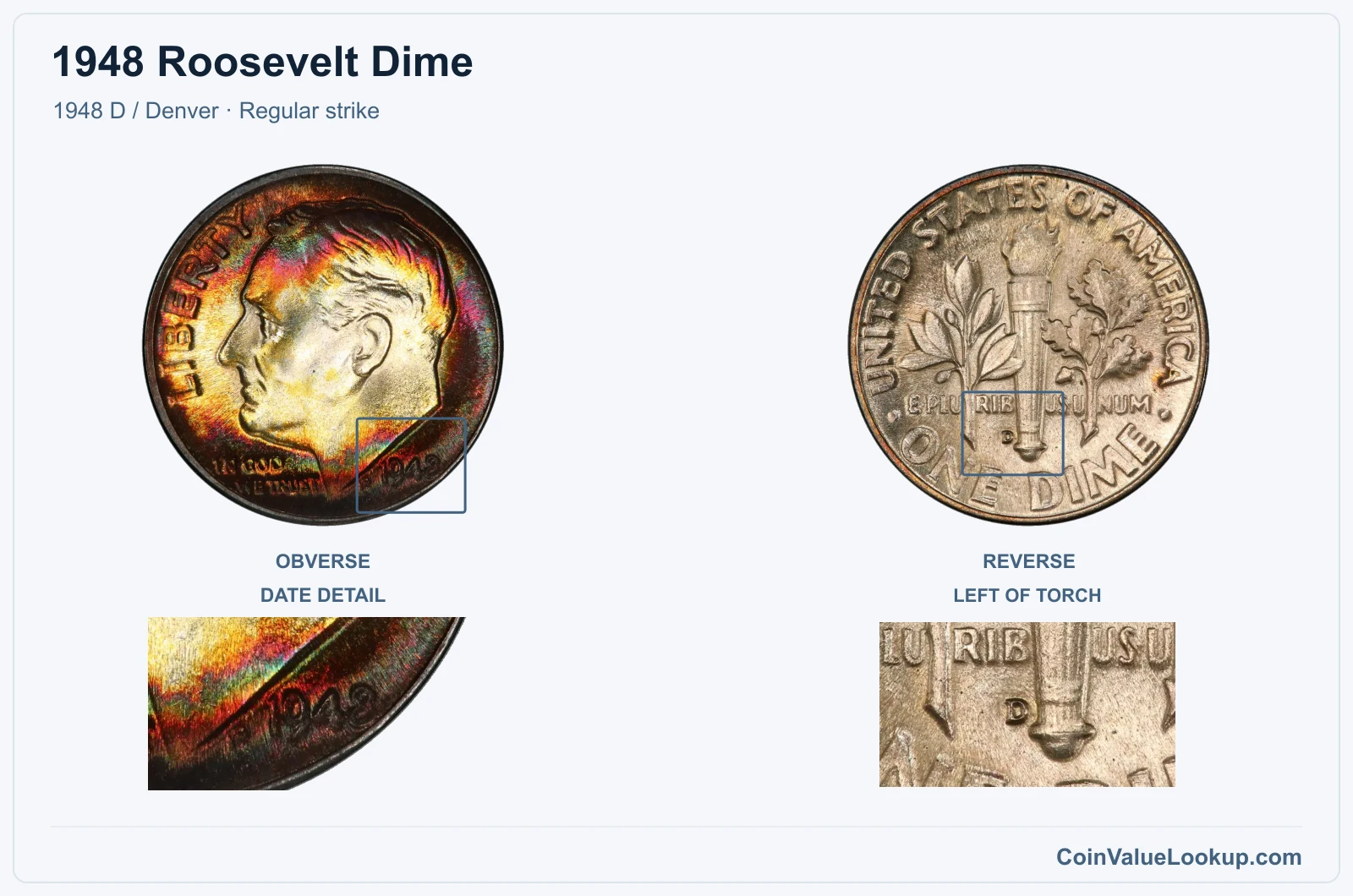
The 1948-D carries a small "D" mintmark on the reverse near the torch base. Guide estimates match the Philadelphia issue at about $5.81 in Good-4 and around $18 in MS65.
Again, Full Bands designation at upper grades pushes values higher.
Coin Value Lookup is a handy place to look up guides for Roosevelt Dimes and other series when you want to compare across years and mints.
Denver dimes of this era are plentiful in lower grades. Your best shot at real value is an original, lustrous coin in MS65 or above with fully split torch bands.
Range Grade
Price Auction Records Appraisal PO PO 1
—
Coin Identifier FR FR 2
—
Coin Identifier AG AG 3
—
Coin Identifier G G 4
—
Coin Identifier
G 6
—
Coin Identifier VG VG 8
—
Coin Identifier
VG 10
—
Coin Identifier F F 12
—
Coin Identifier
F 15
—
Coin Identifier VF VF 20
—
Coin Identifier
VF 25
—
Coin Identifier
VF 30
—
Coin Identifier
VF 35
—
Coin Identifier XF XF 40
—
Coin Identifier
XF 45
—
Coin Identifier AU AU 50
—
Coin Identifier
AU 53
—
Coin Identifier
AU 55
—
Coin Identifier
AU 58
—
Coin Identifier MS MS 60
—
Coin Identifier
MS 61
—
Coin Identifier
MS 62
—
Coin Identifier
MS 63
—
Coin Identifier
MS 64
—
Coin Identifier
MS 65
Coin Identifier
MS 66
Coin Identifier
MS 67
Coin Identifier
MS 68
Coin Identifier
MS 69
—
—
—
MS 70
—
—
—
1948 Roosevelt Dime — S / San Francisco
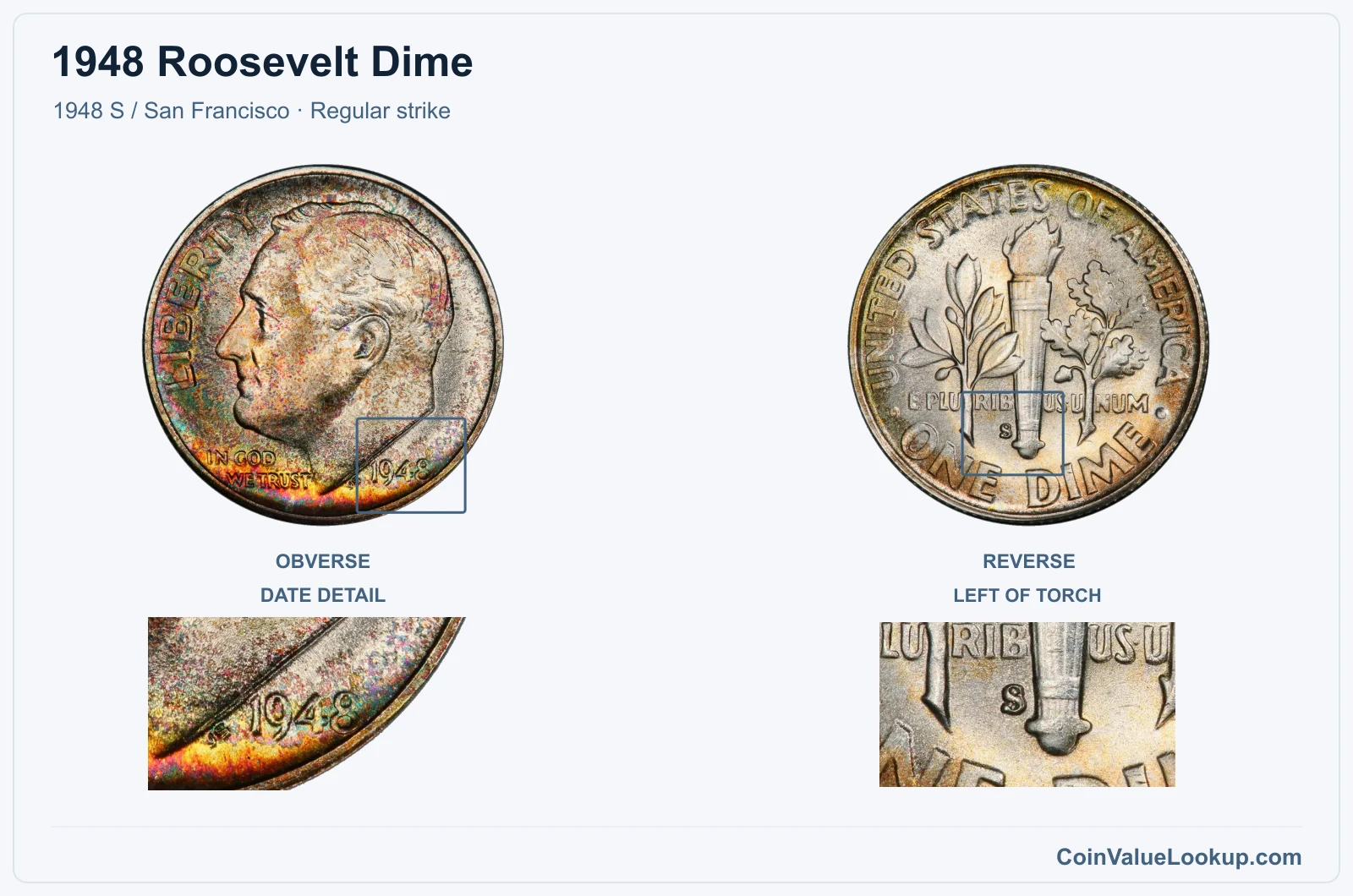
San Francisco's 1948-S dime shows an "S" near the torch base. Published guide values sit at roughly $5.81 in Good-4 and about $18 in MS65, similar to the other mints.
Several documented error varieties specific to this mint — clipped planchets, repunched mintmarks, die cracks, and a defective planchet — make 1948-S coins worth extra scrutiny under magnification.
In regular strikes, gem Full Bands examples with original surfaces are the ones collectors chase. A soft, incomplete strike on the torch bands does not necessarily mean wear, so compare carefully before downgrading your coin's condition.
Range Grade
Price Auction Records Appraisal PO PO 1
—
Coin Identifier FR FR 2
—
Coin Identifier AG AG 3
—
Coin Identifier G G 4
—
Coin Identifier
G 6
—
Coin Identifier VG VG 8
—
Coin Identifier
VG 10
—
Coin Identifier F F 12
—
Coin Identifier
F 15
—
Coin Identifier VF VF 20
—
Coin Identifier
VF 25
—
Coin Identifier
VF 30
—
Coin Identifier
VF 35
—
Coin Identifier XF XF 40
—
Coin Identifier
XF 45
—
Coin Identifier AU AU 50
—
Coin Identifier
AU 53
—
Coin Identifier
AU 55
—
Coin Identifier
AU 58
—
Coin Identifier MS MS 60
—
Coin Identifier
MS 61
—
Coin Identifier
MS 62
—
Coin Identifier
MS 63
—
Coin Identifier
MS 64
Coin Identifier
MS 65
Coin Identifier
MS 66
Coin Identifier
MS 67
Coin Identifier
MS 68
Coin Identifier
MS 69
—
—
—
MS 70
—
—
—
1948 Roosevelt Dime Error List
1. 1948 Roosevelt Dime — Curved Clipped Planchet
A curved clipped planchet occurs when the coin blank is punched from strip metal that overlaps a previously punched hole, leaving a crescent-shaped missing section. One documented 1948-S specimen has a substantial 20 percent clip near the 1 o'clock position, graded MS63 Full Bands by NGC.
To identify this, look for a smooth, curved bite out of the rim where the metal flow at the edge differs from a normal strike. The edge near the clip often shows a characteristic "Blakesley effect" — a weak area opposite the missing metal.
Do not confuse this with a coin that was ground down or filed after leaving the mint. Post-mint damage leaves tool marks and sharp edges, while a genuine clip has a smooth, flowing contour.
Value depends on the clip's size, the coin's condition, and authentication.
2. 1948 Roosevelt Dime — Repunched S Mintmark
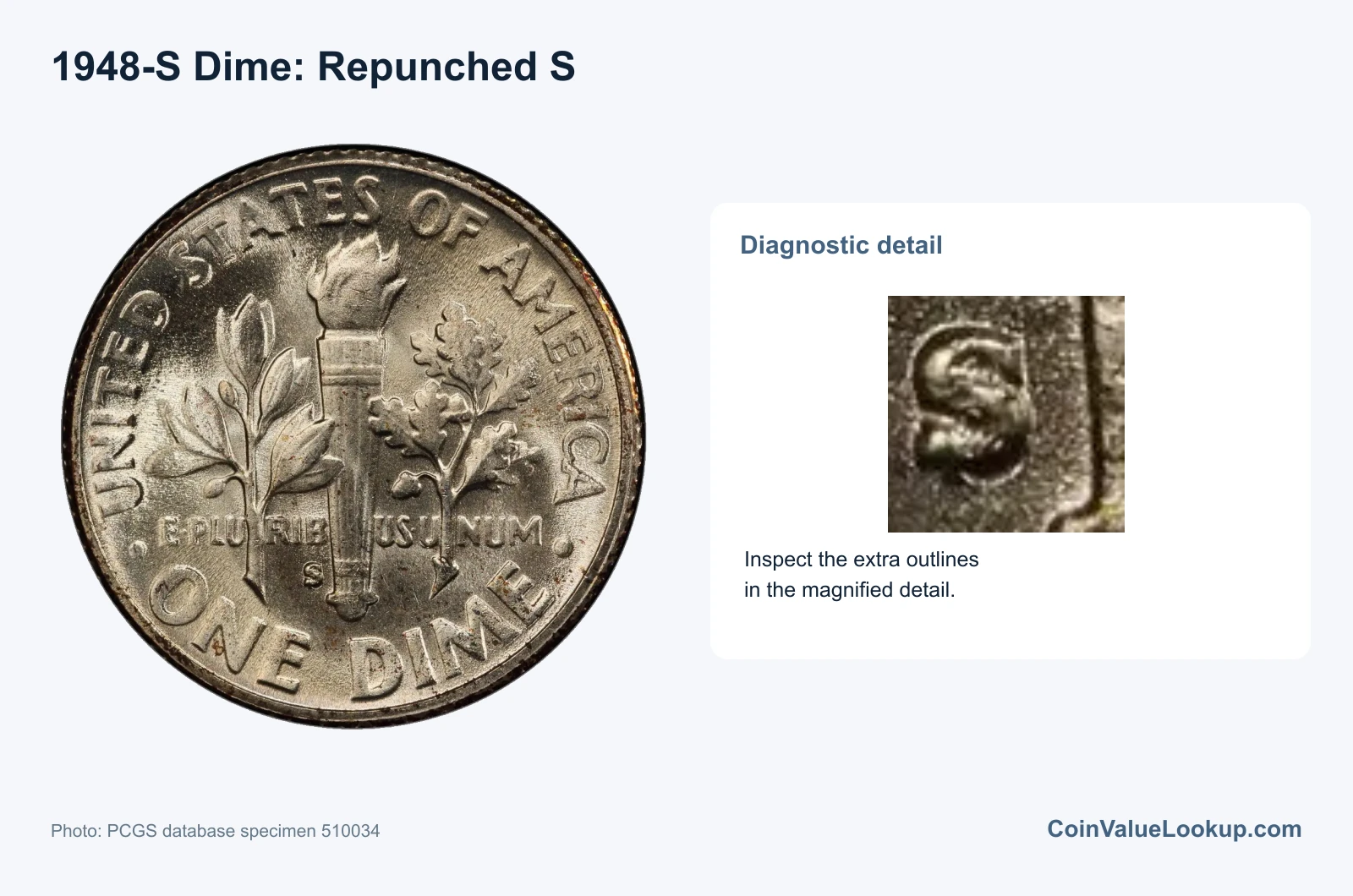
The repunched S mintmark variety on the 1948-S dime shows a secondary impression of the letter S offset from the primary punch. This happened because mintmarks in this era were hand-punched into working dies, so a misaligned first tap followed by correction left traces of the earlier position.
Under magnification, look for a rounded extra S outline slightly displaced from the main mintmark on the reverse. This is not the same as machine doubling, which tends to produce flat, shelf-like distortion rather than a distinct second letter shape.
Corrosion pitting or an added mintmark glued onto the surface can also mimic doubling at a glance. Confirmed specimens have been attributed by grading services.
Individual value depends on the clarity of the repunching and the coin's overall condition.
3. 1948 Roosevelt Dime — Defective Planchet with Crack
A defective planchet with a crack is a pre-strike flaw in the coin blank itself. On a documented 1948-S specimen, a crack runs through the planchet near the 7 o'clock position, visible on both the obverse and reverse faces and continuing through the edge.
This is fundamentally different from a die crack. A die crack leaves a raised line on the coin's surface transferred from a broken die.
A planchet crack is an opening within the metal of the coin — think of it as the blank splitting before or during striking. It can look like an incuse line or gap rather than a raised ridge.
Do not confuse this with a coin that was bent and snapped after leaving the mint, which will show sharp, unnatural break edges. Attribution from a specialist dealer or grading service helps confirm the defect originated at the mint.
Value depends on the severity, the coin's preservation, and professional verification.
4. 1948 Roosevelt Dime — Die Cracks
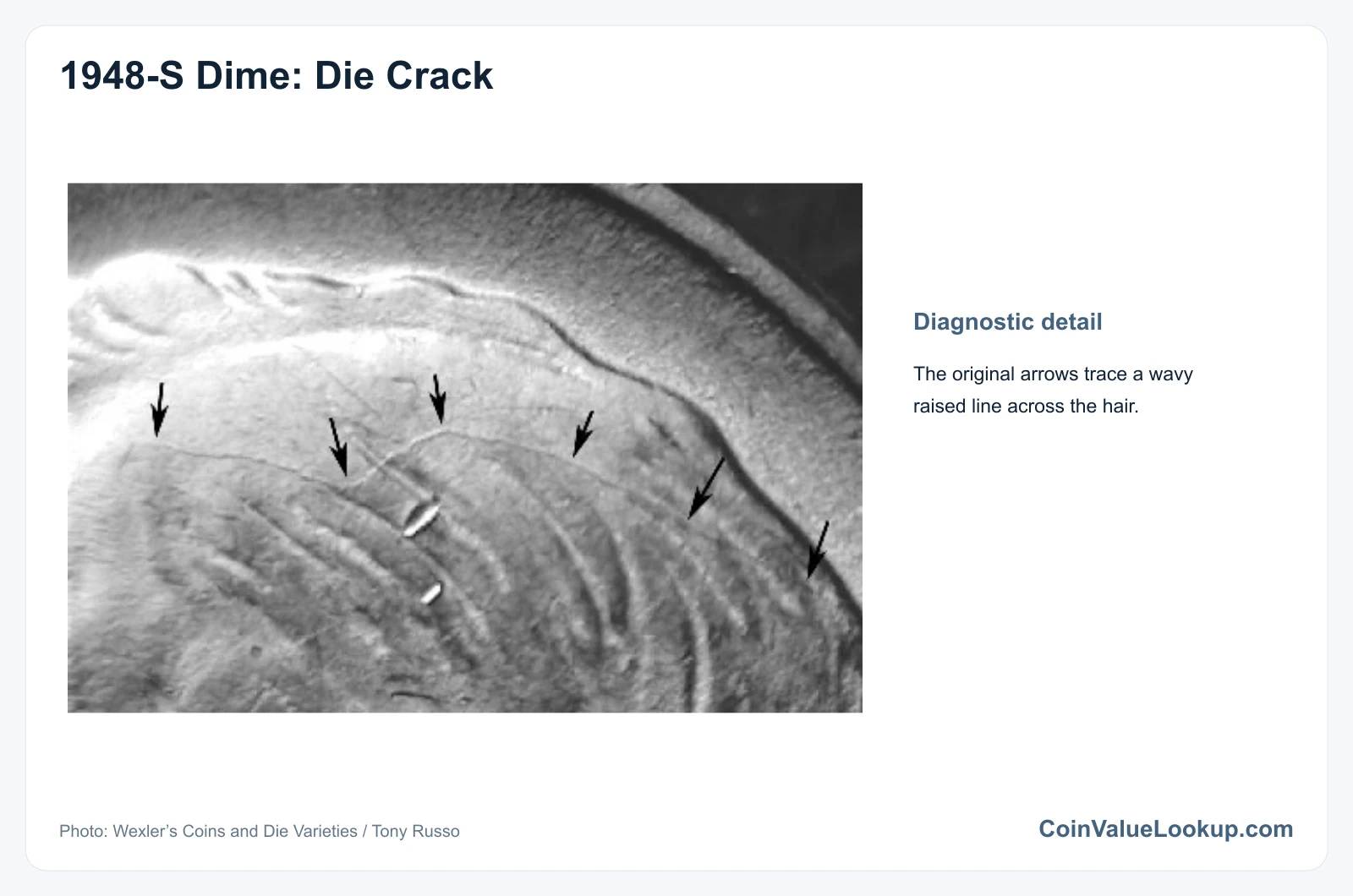
Die cracks show up as thin raised lines on the coin's surface because a crack in the steel die transfers as a ridge onto every coin it strikes. Documented 1948-S examples include a crack running from the rim through the last S of STATES and down into the torch flame, among other die states showing cracks near the head on the obverse.
These raised lines are distinct from scratches, which are incised into the surface, and from planchet cracks, which open through the coin's metal. Under magnification, a die crack appears as a slightly raised, irregular thread that follows no logical scratch pattern.
Small die cracks are common on late-state dies and may not carry a meaningful premium. More dramatic examples that span significant portions of the design attract specialist interest.
Value hinges on the crack's size, location, the coin's condition, and whether the variety has been documented.
5. 1948 Roosevelt Dime — Doubled Die Reverse
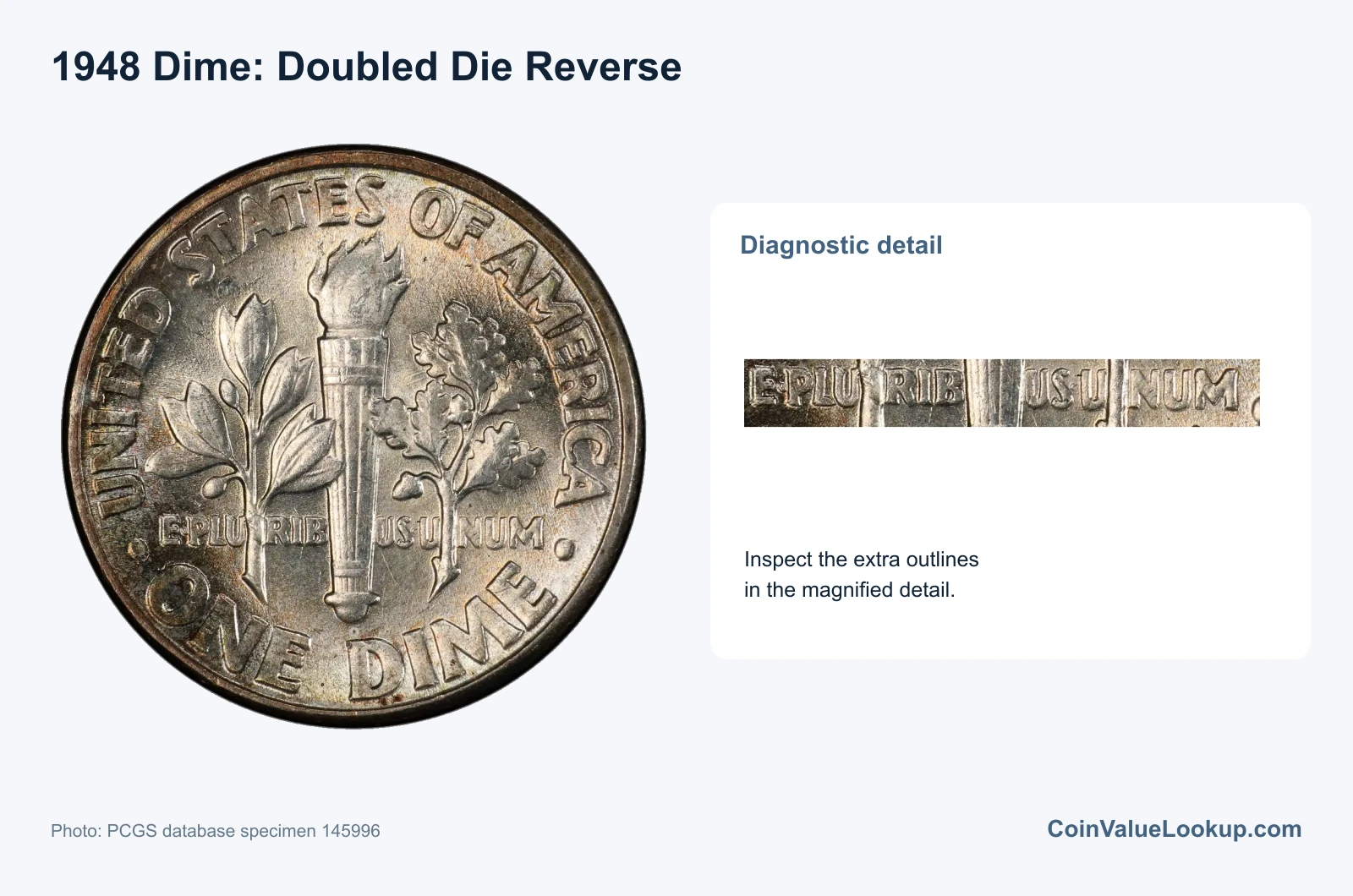
A doubled die reverse variety has been reported for the 1948 Roosevelt Dime. This type of error originates during die production, when a hub impression is misaligned on a second pass, doubling portions of the reverse design.
To check, compare your coin's reverse lettering and design elements against a normal 1948 dime. Look for consistent doubling on multiple letters or design features — genuine doubled dies affect the entire area of the die that shifted, not just one isolated spot.
Machine doubling, which creates flat shelf-like distortion, is far more common and carries little premium. Reflective lighting, surface damage, and wear can also mimic doubling.
Condition, the visibility of the doubling, and professional attribution all factor into value. No specific price range is established here; individual assessment is necessary.
6. 1948 Roosevelt Dime — Off-Center Strike
Off-center strikes have been reported for 1948 Roosevelt Dimes. This error happens when the planchet is not seated properly between the dies, so part of the design is missing and a blank crescent appears on the opposite side.
The key diagnostic is that unstruck crescent of bare metal alongside a displaced but otherwise sharp design. The date should still be readable for the coin to hold collector interest — dateless off-center pieces are very difficult to attribute.
Do not confuse an off-center strike with a curved clip, which removes metal from the blank before striking, or with post-mint flattening that distorts an already-complete coin. A one-sided misalignment of the dies can also look similar but will not produce that characteristic blank crescent.
Value depends on the percentage of offset, whether the date remains visible, and the coin's overall condition.