1953 Franklin Half Dollar Coin Value: How Much Is It Worth?
The 1953 Franklin Half Dollar is a 90% silver coin that continues to attract collectors for both its metal content and its classic mid-century design. Guide estimates for the year's branches range from about $32.00 in well-worn grades up to $256.00 for a gem proof, depending on mint, condition and strike quality.
These figures are guide anchors from USA Coin Book, not guaranteed selling prices or current silver-melt quotes.
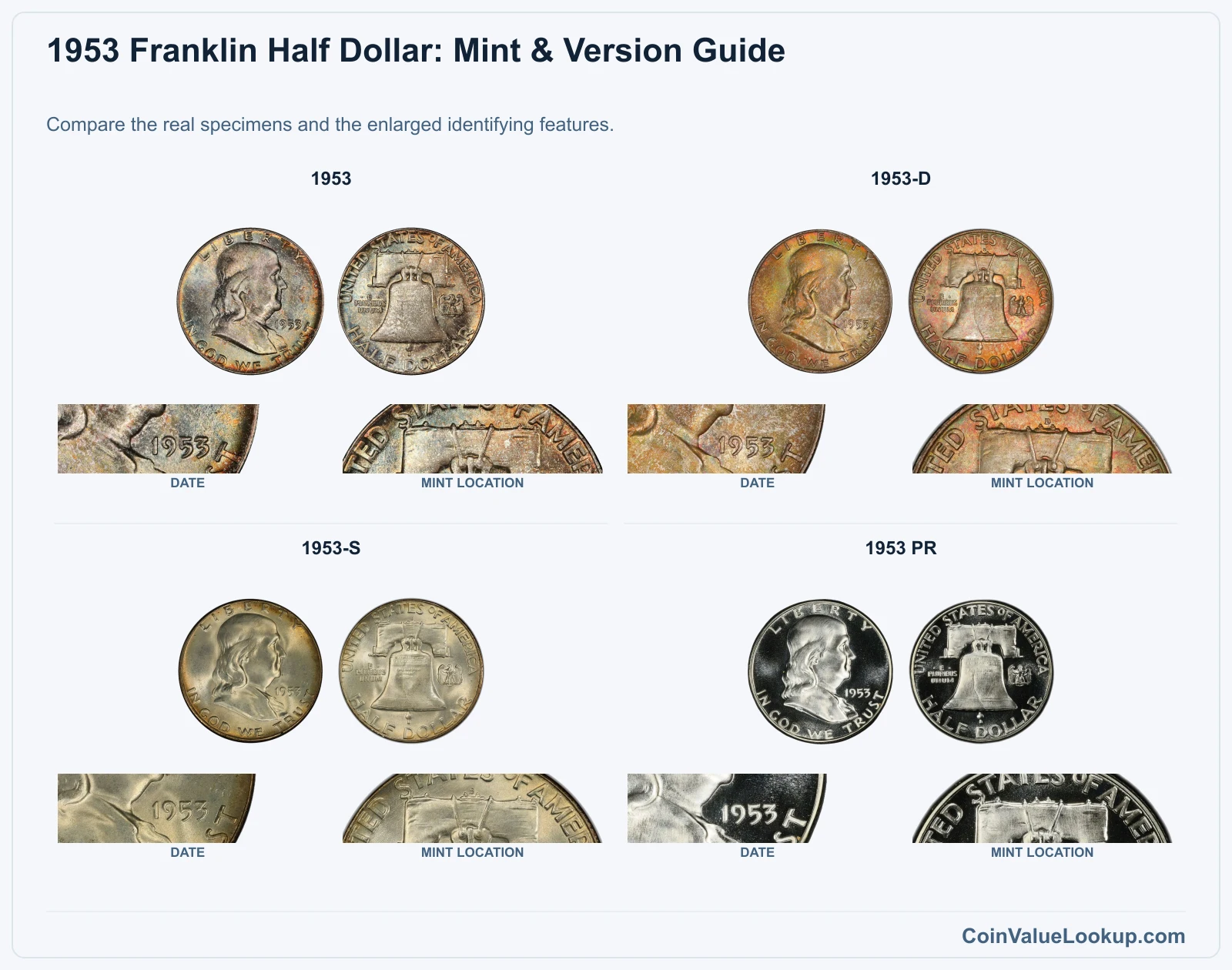
Four distinct branches exist for 1953: Philadelphia, Denver and San Francisco business strikes, plus Philadelphia proof issues. Condition matters a great deal, and so does whether the coin has original, problem-free surfaces.
Cleaned or damaged pieces trade well below the guides, even when the grade otherwise looks decent.
Fast Way to Identify Your 1953 Franklin Half Dollar
The quickest way to start figuring out what you have is to upload clear photos of both sides of your coin. A sharp image of the front lets us check wear on Franklin's portrait, and the reverse shot reveals the mintmark above the Liberty Bell.
This preliminary identification can help point you toward the right branch and a realistic value range, though it is not a substitute for professional certification.
1953 Franklin Half Dollar Value
Upload both sides of your 1953 Franklin Half Dollar.
Front Obverse
Upload photo
Back Reverse
Upload photo
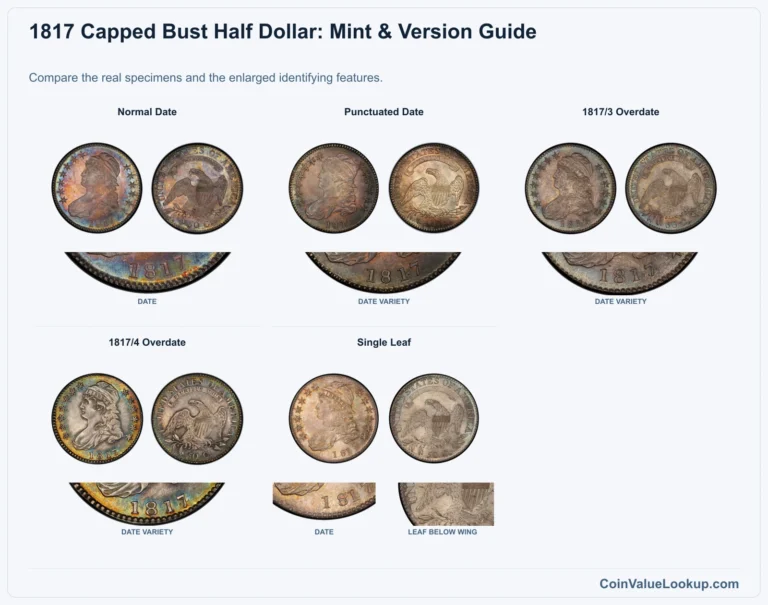
Which 1953 Franklin Half Dollar Versions Are Worth Money?
- 1953 Proof (PR65) carries the highest single guide anchor at $256.00, reflecting collector demand for gem proof survivors with clean mirror surfaces.
- 1953 Philadelphia and 1953-D business strikes share guide estimates of $32.00 in G4 and $140.00 in MS65, but original untouched surfaces in higher grades can separate a common coin from a desirable one.
- 1953-S business strikes guide slightly lower at MS65 ($109.00), so San Francisco coins in that grade are worth confirming carefully before assuming the same premium as Philadelphia or Denver issues.
- The Bugs Bunny die clash variety is a recognized error for 1953 that adds collector interest beyond the standard branch values.
- Full Bell Lines designation can raise a premium on any business-strike branch, but only when the bell-line detail is genuinely complete and the coin meets the relevant grading standard.
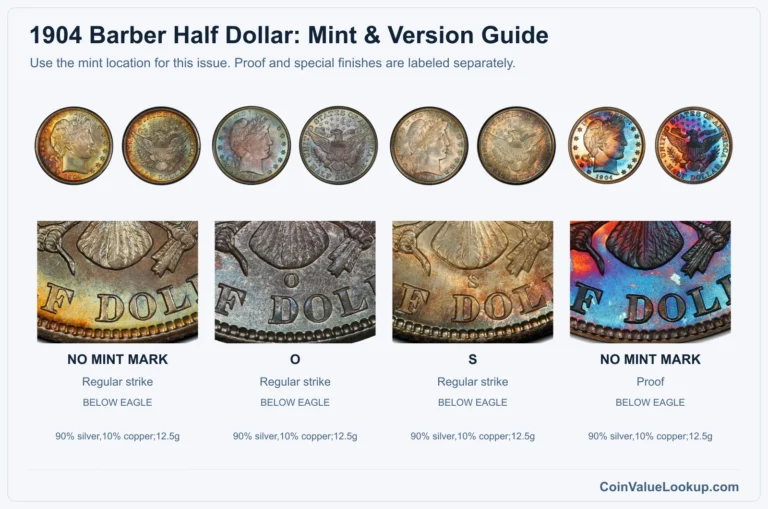
Step 1: Identify Your 1953 Franklin Half Dollar Mint Mark and Version
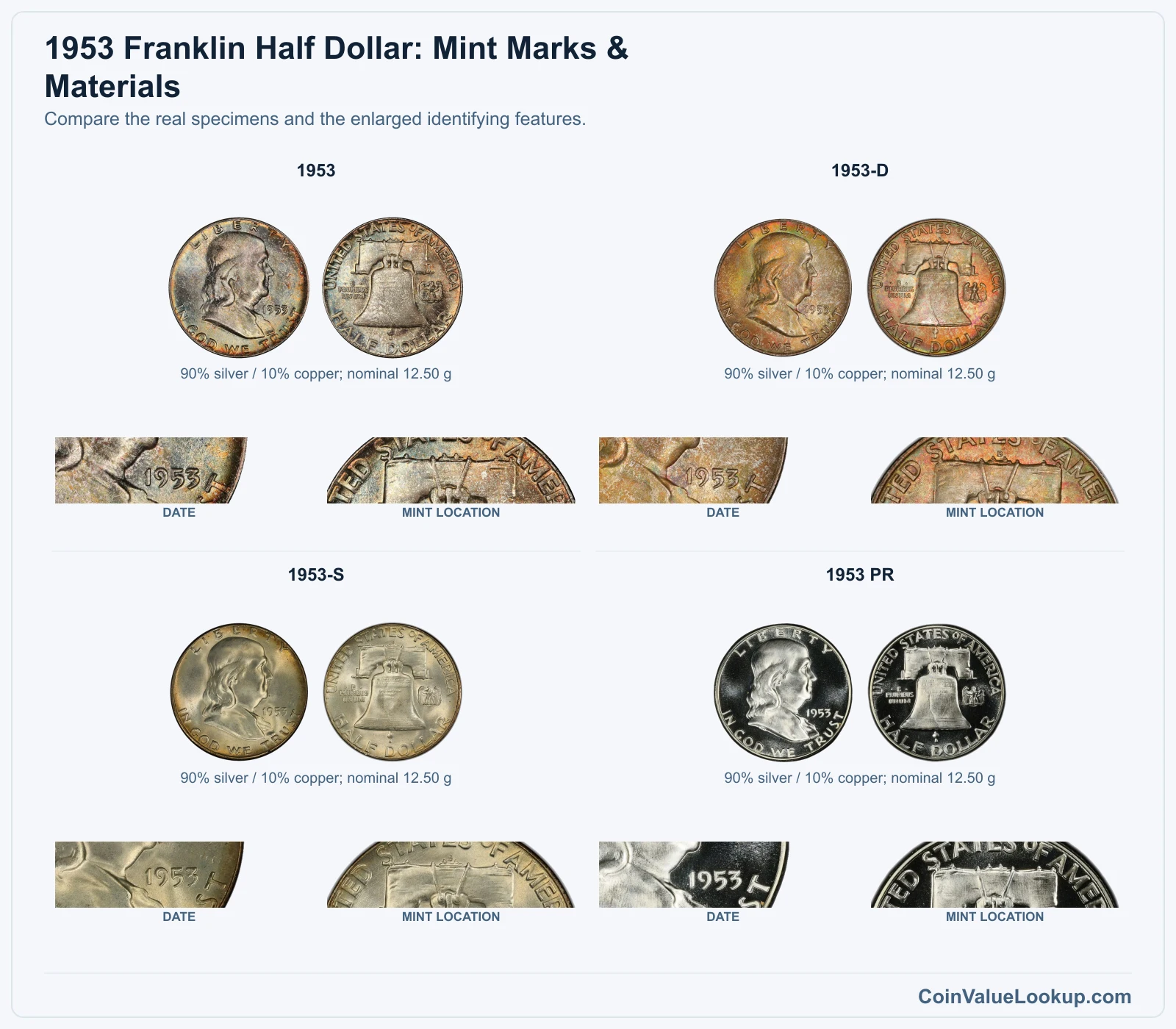
Every 1953 Franklin Half Dollar is struck in 90% silver and 10% copper, weighing about 12.50 grams. Toning, even heavy toning, does not change the underlying alloy.
To find the mintmark, flip the coin over. Look just above the Liberty Bell, below the words E PLURIBUS UNUM.
A "D" means Denver, an "S" means San Francisco, and no letter at all means Philadelphia.
Philadelphia also produced proof coins this year. Proofs have mirror-like fields and sharply defined devices, and they were sold directly to collectors, not released into circulation.
A polished circulation strike is not a proof, no matter how shiny it looks.
You may also hear about Full Bell Lines. That is a strike-quality designation referring to the complete lower horizontal lines on the Liberty Bell.
It is not a separate mint or metal, it is a detail filter that can affect premium. Confirm it under magnification before assuming your coin qualifies.
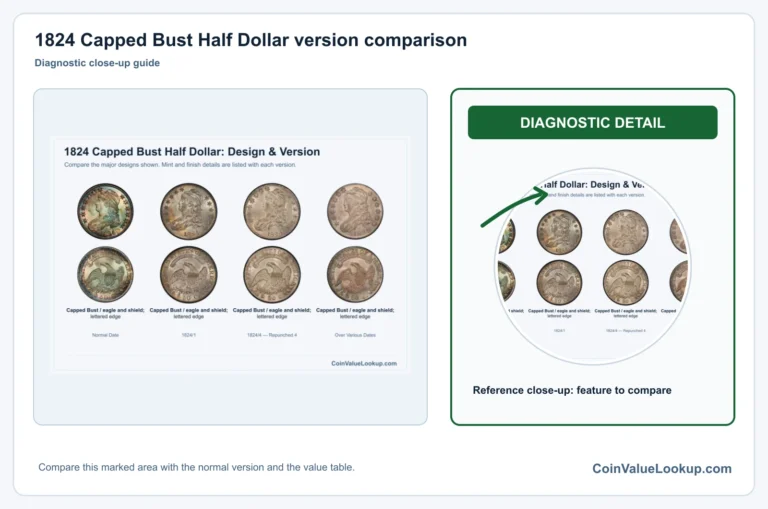
Step 2: Check Your 1953 Franklin Half Dollar Grade
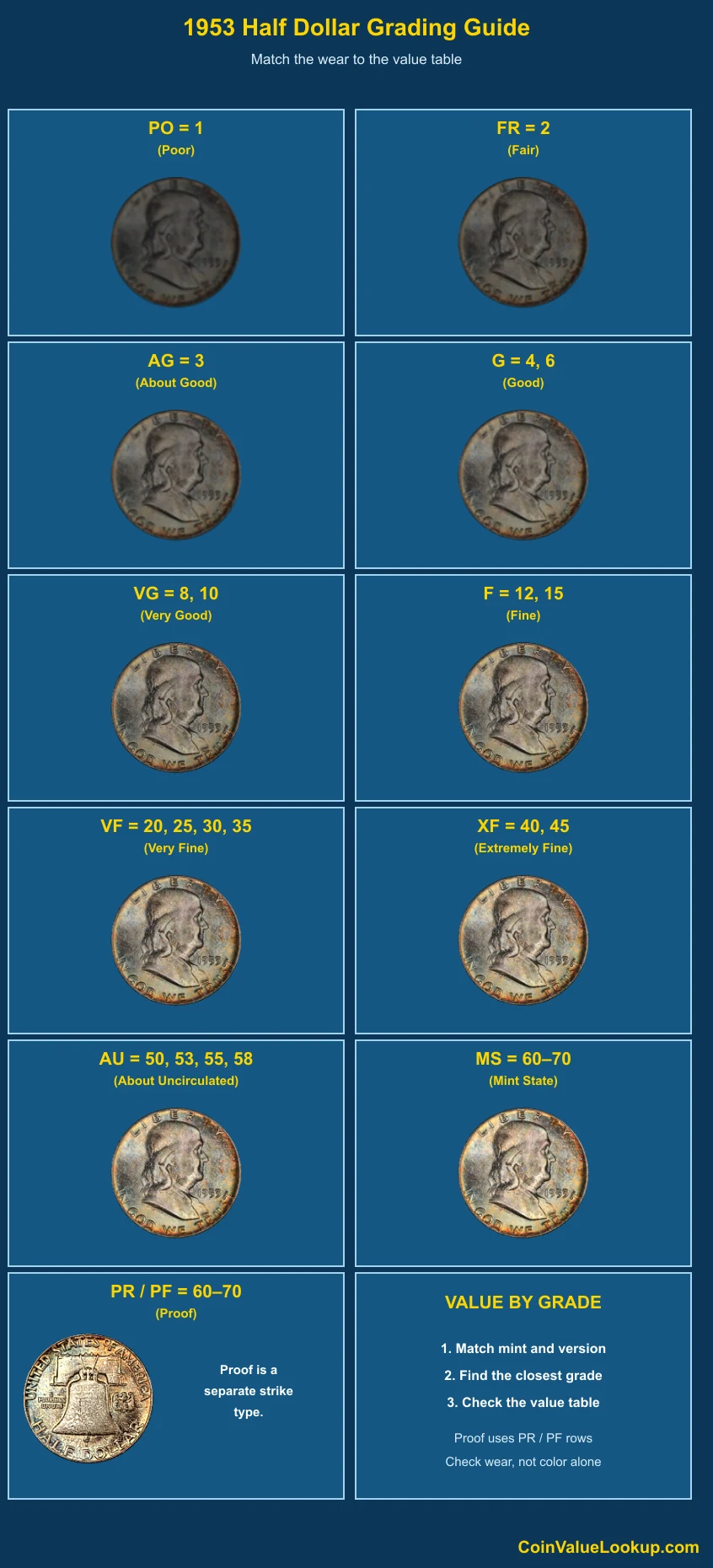
Start with Franklin's cheek and the hair behind his ear. On a lightly circulated coin these areas show slight smoothing first.
A well-worn piece will have a flat cheek and mushy hair detail. On the reverse, check the lettering around the Liberty Bell, the rim sharpness and the lower bell lines.
Contact marks and circulation wear are different problems. Bag marks, those small nicks from coins banging around in mint bags, show up even on uncirculated examples.
Actual wear from spending produces progressive flattening across the high points. Compare your coin to the reference image for this type to see where smoothing begins.
For proof coins, grade the surfaces separately. Look for hairlines from mishandling, haze from improper storage and whether cameo contrast exists between the devices and fields.
A proof with heavy hairlines grades much lower than one with clean mirrors.
Coin Value Lookup is a good starting point if you want to compare your Franklin to other half-dollar years and denominations. You can look up guides for the series and see where your coin fits in the bigger picture.
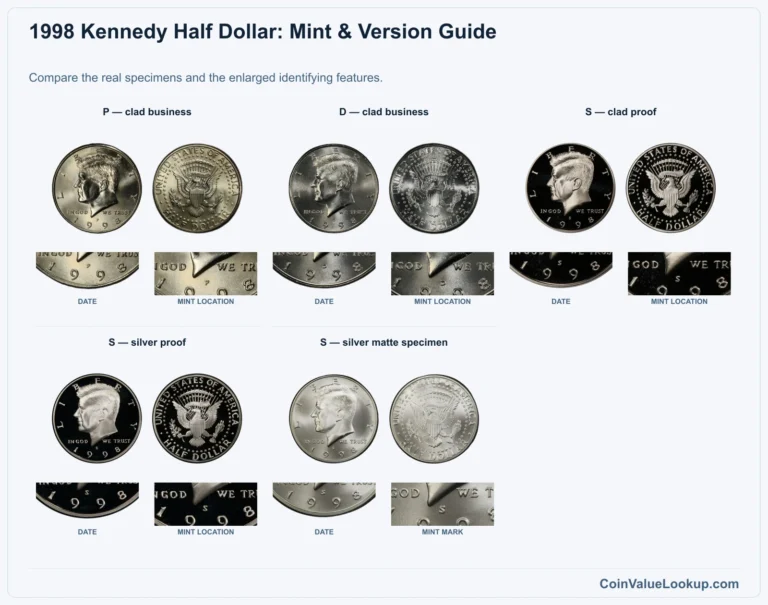
Step 3: Check 1953 Franklin Half Dollar Value by Mint and Version
1953 Franklin Half Dollar
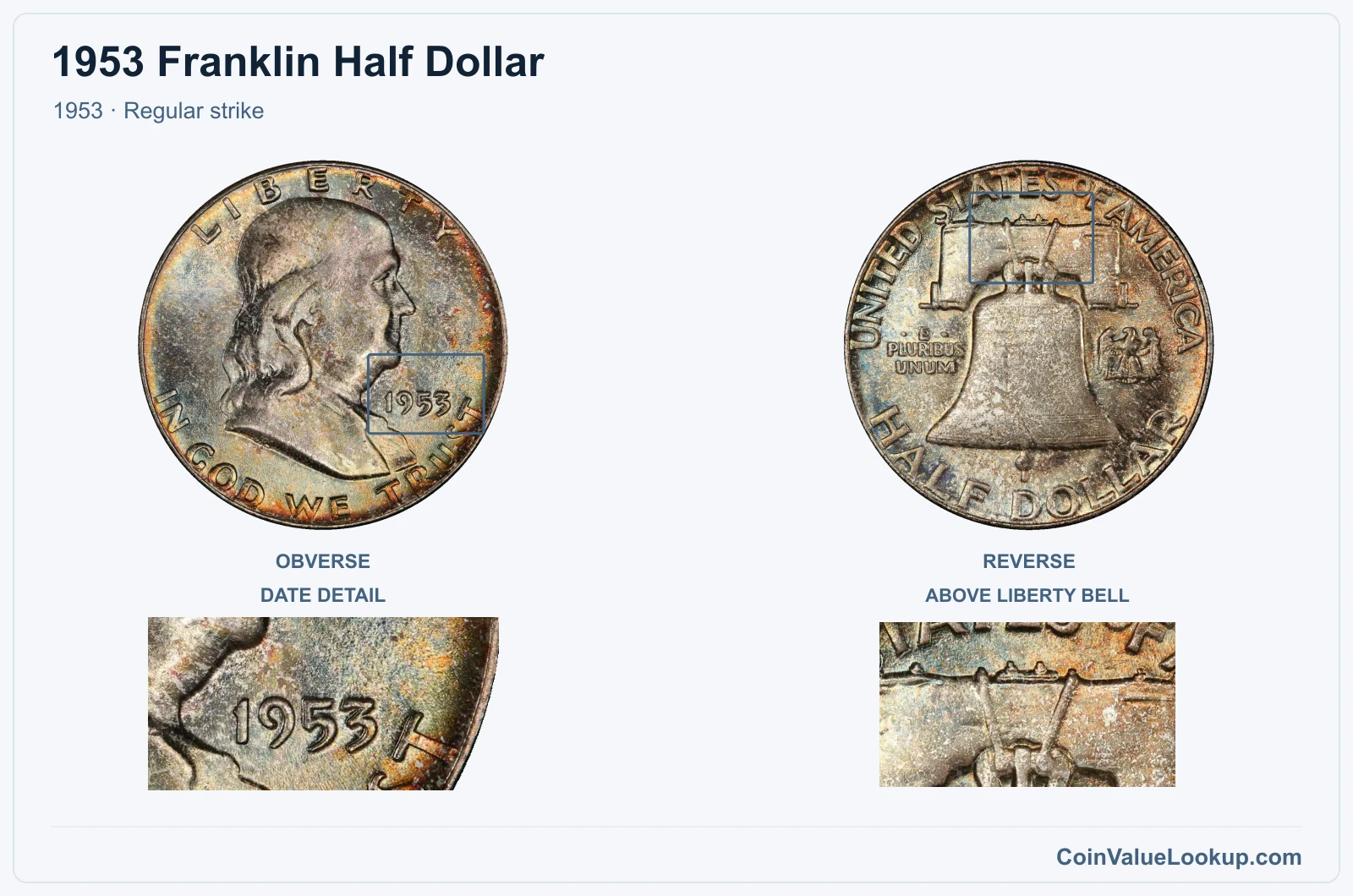
The 1953 Philadelphia half dollar carries no mintmark. Look above the Liberty Bell on the reverse; if the space below E PLURIBUS UNUM is blank, you have the Philly issue.
USA Coin Book guide estimates place this coin at about $32.00 in G4 (a heavily worn but readable coin) and $140.00 in MS65 (a gem uncirculated example with minimal contact marks). These are guide anchors, not offers.
Cleaned, scratched or otherwise damaged coins do not qualify for those figures even if the detail level seems comparable.
Silver content gives every 1953 half dollar a floor value tied to the metal market, but problem-free examples with original toning or luster trade above melt. Full Bell Lines is a separate strike designation that can increase the premium when the lower bell lines are fully intact.
Range Grade
Price Auction Records Appraisal PO PO 1
—
Coin Identifier FR FR 2
—
Coin Identifier AG AG 3
—
Coin Identifier G G 4
—
Coin Identifier
G 6
—
Coin Identifier VG VG 8
—
Coin Identifier
VG 10
—
Coin Identifier F F 12
—
Coin Identifier
F 15
—
Coin Identifier VF VF 20
—
Coin Identifier
VF 25
—
Coin Identifier
VF 30
—
Coin Identifier
VF 35
—
Coin Identifier XF XF 40
—
Coin Identifier
XF 45
—
Coin Identifier AU AU 50
—
Coin Identifier
AU 53
—
Coin Identifier
AU 55
—
Coin Identifier
AU 58
Coin Identifier MS MS 60
—
Coin Identifier
MS 61
—
Coin Identifier
MS 62
Coin Identifier
MS 63
Coin Identifier
MS 64
Coin Identifier
MS 65
Coin Identifier
MS 66
Coin Identifier
MS 67
Coin Identifier
MS 68
—
—
—
MS 69
—
—
—
MS 70
—
—
—
1953 Franklin Half Dollar — D
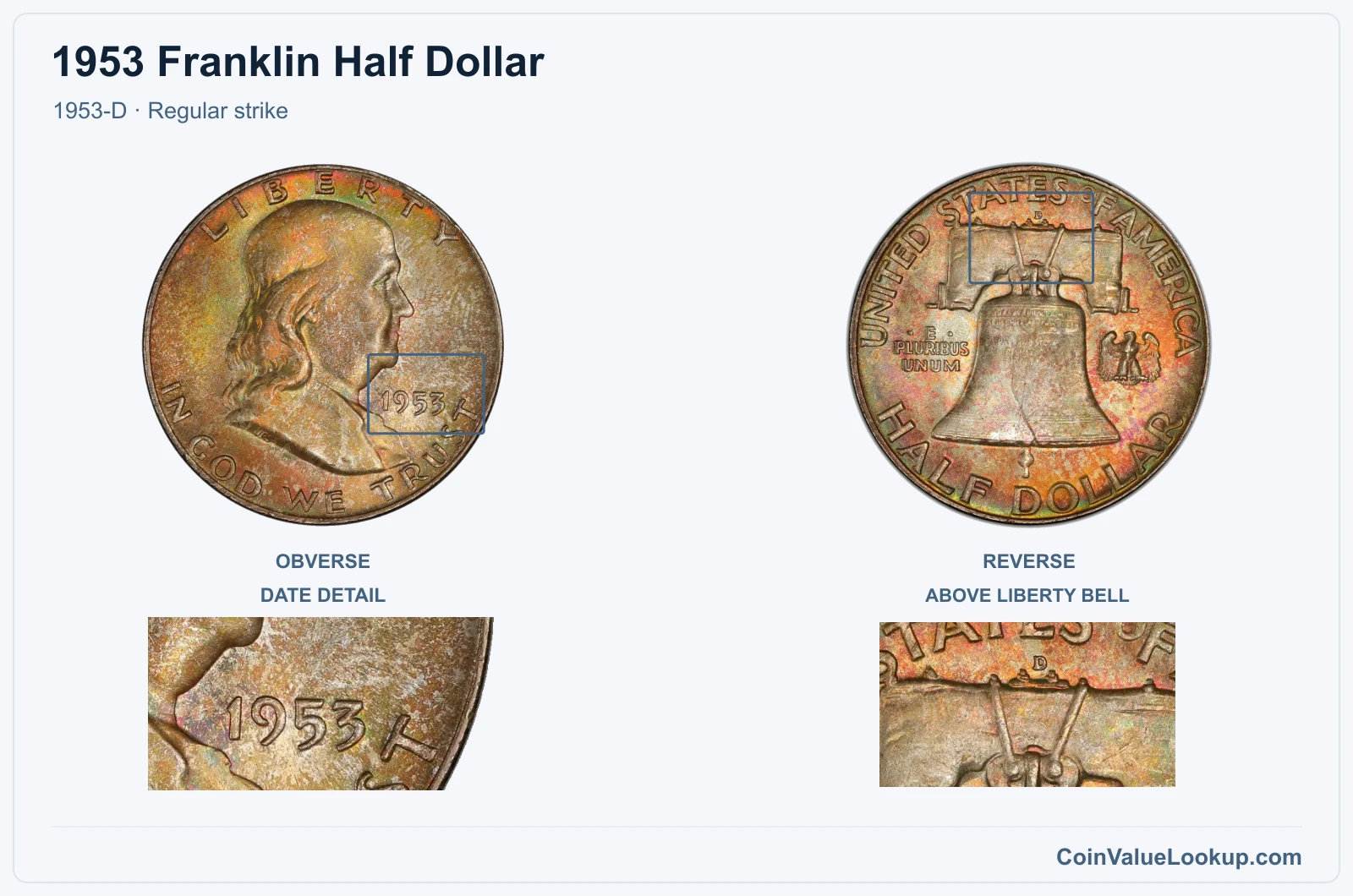
The 1953-D was struck in Denver. You will find a small "D" on the reverse, above the Liberty Bell and below E PLURIBUS UNUM.
Guide estimates from USA Coin Book are about $32.00 in G4 and $140.00 in MS65, matching the Philadelphia business strike at those benchmarks. That does not mean every grade is identical; the market cares about eye appeal, surface quality and strike sharpness at each level.
Denver half dollars from this era sometimes show softer strikes than Philadelphia issues, so check the bell lines closely. A coin that looks uncirculated but has mushy details may grade high for wear yet miss the Full Bell Lines designation.
Always confirm the mintmark before referencing a price chart, because mixing up a D and an S changes which row you should be looking at.
Range Grade
Price Auction Records Appraisal PO PO 1
—
Coin Identifier FR FR 2
—
Coin Identifier AG AG 3
—
Coin Identifier G G 4
—
Coin Identifier
G 6
—
Coin Identifier VG VG 8
—
Coin Identifier
VG 10
—
Coin Identifier F F 12
—
Coin Identifier
F 15
—
Coin Identifier VF VF 20
—
Coin Identifier
VF 25
—
Coin Identifier
VF 30
—
Coin Identifier
VF 35
—
Coin Identifier XF XF 40
—
Coin Identifier
XF 45
—
Coin Identifier AU AU 50
—
Coin Identifier
AU 53
—
Coin Identifier
AU 55
Coin Identifier
AU 58
Coin Identifier MS MS 60
—
Coin Identifier
MS 61
Coin Identifier
MS 62
Coin Identifier
MS 63
Coin Identifier
MS 64
Coin Identifier
MS 65
Coin Identifier
MS 66
Coin Identifier
MS 67
Coin Identifier
MS 68
—
—
—
MS 69
—
—
—
MS 70
—
—
—
1953 Franklin Half Dollar — S
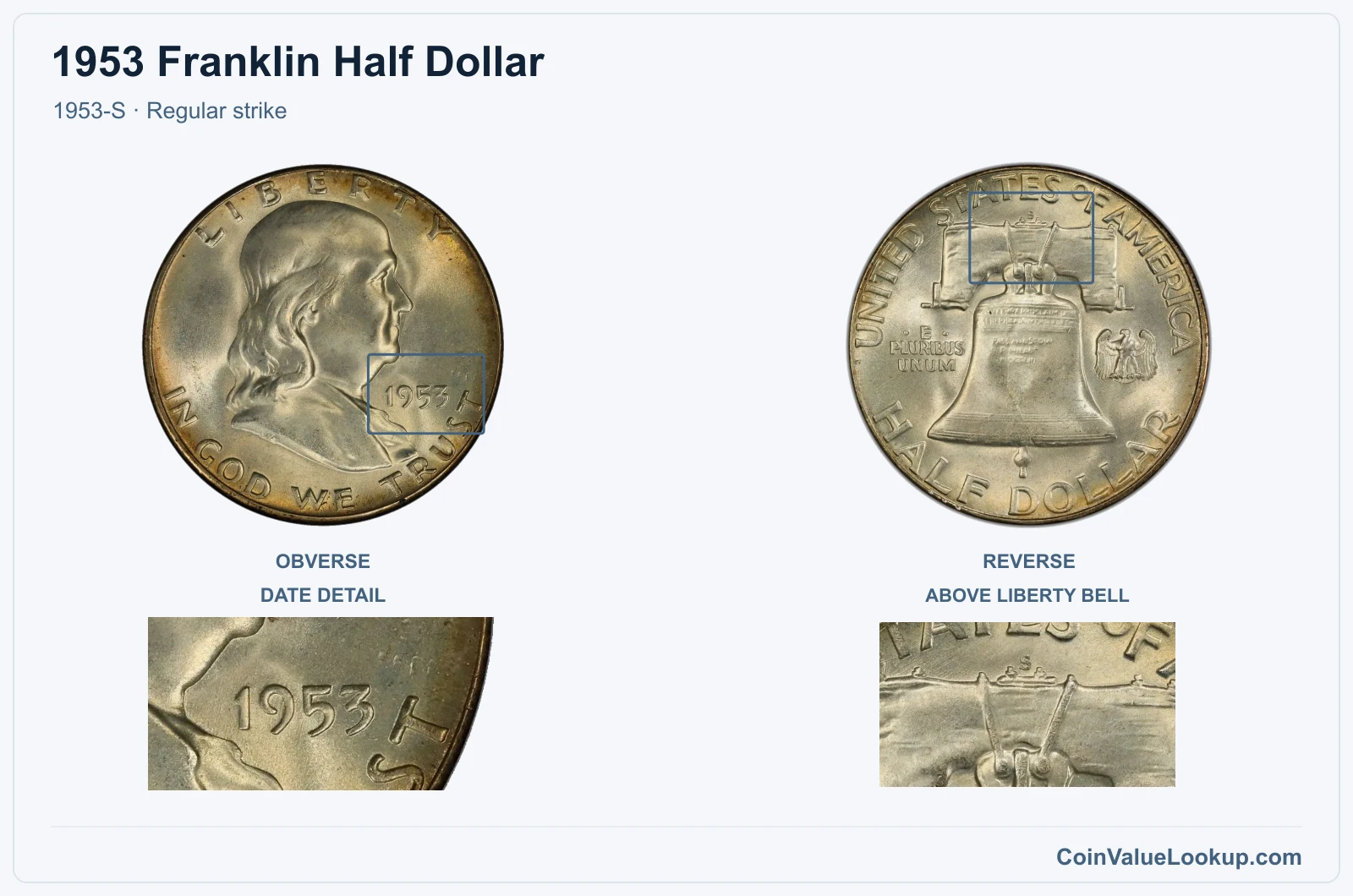
San Francisco's 1953-S carries an "S" mintmark in the same reverse location above the Liberty Bell. It is the third business-strike branch for the year.
USA Coin Book guide estimates come in at about $32.00 in G4 and $109.00 in MS65. That MS65 figure is noticeably lower than the Philadelphia and Denver branches at the same grade, so do not assume all three mints command equal premiums in uncirculated condition.
As with the other branches, original surfaces matter. A coin with natural luster or light toning will generally be more desirable than one that has been cleaned to look bright.
The silver content provides a base value, but collector premiums above melt depend on the specific condition and presentation of the coin.
Range Grade
Price Auction Records Appraisal PO PO 1
—
Coin Identifier FR FR 2
—
Coin Identifier AG AG 3
—
Coin Identifier G G 4
—
Coin Identifier
G 6
—
Coin Identifier VG VG 8
—
Coin Identifier
VG 10
—
Coin Identifier F F 12
—
Coin Identifier
F 15
—
Coin Identifier VF VF 20
—
Coin Identifier
VF 25
—
Coin Identifier
VF 30
—
Coin Identifier
VF 35
—
Coin Identifier XF XF 40
—
Coin Identifier
XF 45
—
Coin Identifier AU AU 50
—
Coin Identifier
AU 53
—
Coin Identifier
AU 55
—
Coin Identifier
AU 58
Coin Identifier MS MS 60
Coin Identifier
MS 61
Coin Identifier
MS 62
Coin Identifier
MS 63
Coin Identifier
MS 64
Coin Identifier
MS 65
Coin Identifier
MS 66
Coin Identifier
MS 67
Coin Identifier
MS 68
—
—
—
MS 69
—
—
—
MS 70
—
—
—
1953 Franklin Half Dollar — PR
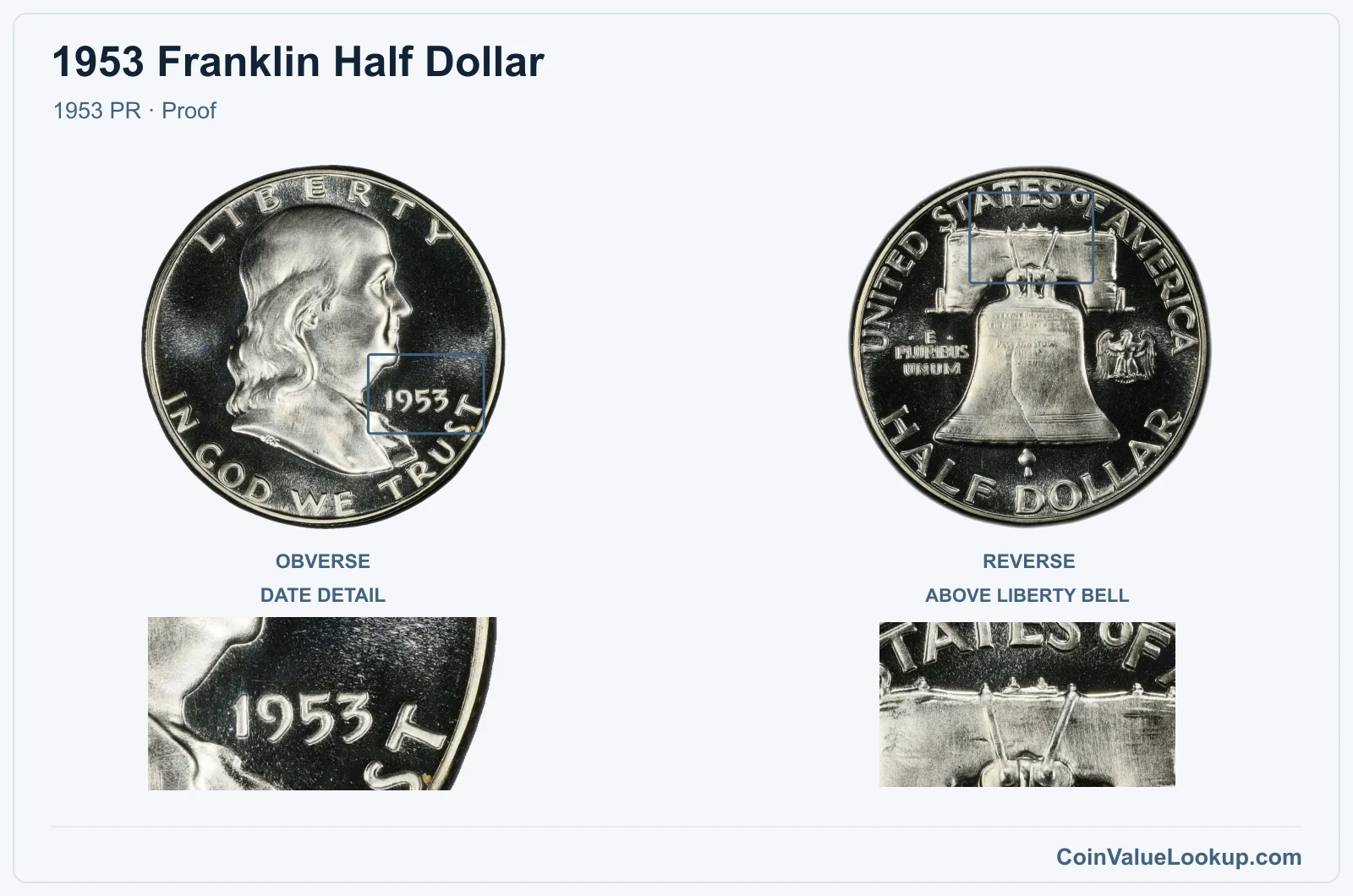
The 1953 proof was produced at Philadelphia for direct sale to collectors, not for circulation. There is no mintmark.
Proofs are identified by their mirrored fields and crisp, sharply struck devices. The surfaces should look distinctly different from even a well-preserved business strike.
If you have to squint and wonder whether it is a proof, it probably is not.
USA Coin Book estimates about $256.00 for a PR65 example. That is the highest single guide figure among this year's branches.
Hairlines from improper handling, haze and thumb prints all lower the grade. Some 1953 proofs show cameo contrast, where the devices appear frosty against the mirror fields, but the supplied guide figure is for a standard proof finish.
Proof is a method of manufacture, not a grade above Mint State, so it is graded on its own PR scale.
Range Grade
Price Auction Records Appraisal PR PR 1
—
Coin Identifier
PR 2
—
Coin Identifier
PR 3
—
Coin Identifier
PR 4
—
Coin Identifier
PR 6
—
Coin Identifier
PR 8
—
Coin Identifier
PR 10
—
Coin Identifier
PR 12
—
Coin Identifier
PR 15
—
Coin Identifier
PR 20
—
Coin Identifier
PR 25
—
Coin Identifier
PR 30
—
Coin Identifier
PR 35
—
Coin Identifier
PR 40
—
Coin Identifier
PR 45
—
Coin Identifier
PR 50
—
Coin Identifier
PR 53
—
Coin Identifier
PR 55
—
Coin Identifier
PR 58
—
Coin Identifier
PR 60
Coin Identifier
PR 61
Coin Identifier
PR 62
Coin Identifier
PR 63
Coin Identifier
PR 64
Coin Identifier
PR 65
Coin Identifier
PR 66
Coin Identifier
PR 67
Coin Identifier
PR 68
Coin Identifier
PR 69
Coin Identifier
PR 70
—
—
—
1953 Franklin Half Dollar Error List
1. 1953 Franklin Half Dollar — Bugs Bunny Die Clash
The "Bugs Bunny" die clash is one of the more visually entertaining errors in the Franklin series. It happens when obverse and reverse dies strike each other without a planchet between them, leaving ghost impressions of one die's design on the other.
On the 1953 Franklin, the result shows up as raised, tooth-like marks near Franklin's mouth and lip area, giving him a buck-toothed appearance.
To check for this, use magnification and compare the mouth area to a normal 1953 portrait. The clash marks should be raised and follow a consistent pattern, not random scratches or dings.
Scratches, stray raised lines or damage from a brockage can mimic the look at a glance but lack the specific shape and placement.
No numerical price range is adopted for this variety. Value depends on the visibility of the clash, overall coin condition and collector demand for the specific piece.
2. 1953 Franklin Half Dollar — Struck-Through Error
A struck-through error occurs when foreign material, whether grease, cloth fiber, a metal fragment or another obstruction, gets between the die and the planchet during striking. The result is a localized depression or incomplete area of the design where the obstruction blocked the die's impression.
On a 1953 Franklin Half Dollar, look for a distinct depression or impression that does not match normal wear patterns. Grease fill-ins tend to produce soft, shallow missing detail in a specific area, while a retained foreign object may leave a sharper, more defined impression.
Do not confuse this with ordinary weak strikes, wear from circulation, cleaning marks or scratches. Those affect the surface differently and lack the characteristic blocked-impression appearance.
No adopted price range is available for this error. Value depends on the size, location and clarity of the struck-through area, plus the coin's overall condition.
3. 1953 Franklin Half Dollar — Lamination / Split Planchet
Lamination flaws on a 1953 Franklin Half Dollar appear as peeling metal, a retained flap or a visible separation within the silver alloy. These occur during planchet preparation when impurities or gas pockets create weak spots in the metal that later split apart under striking pressure or afterward.
To identify one, look for a thin layer of metal lifting away from the surface or a crack-like split that reveals a lower layer. Photograph both the affected face and the edge of the coin together, since edge views often make the separation clearer.
Do not mistake scraping, corrosion pitting or a deliberately cut or filed coin for a lamination flaw. Corrosion tends to be rougher and more irregular, while deliberate damage usually shows tool marks.
No numerical price range is adopted for lamination errors on this date. The value depends on the size and visibility of the flaw, plus the coin's overall condition and eye appeal.