1924 Buffalo Nickel Coin Value: How Much Is It Worth?
A 1924 Buffalo Nickel in well-worn Good-4 condition starts around $1.88 for a Philadelphia issue, while a San Francisco piece in MS63 can reach $5,624 according to USA Coin Book guide estimates. The spread between mints is dramatic, so knowing which facility struck your coin matters a lot.
All 1924 Buffalo Nickels carry the Type 2 recessed "FIVE CENTS" reverse design — there is no Type 1 branch for this date.
Fast Way to Identify Your 1924 Buffalo Nickel
Snap clear photos of both sides of your 1924 Buffalo Nickel — front and back — and upload them here for a preliminary identification. Make sure the date is readable and the area below "FIVE CENTS" on the reverse is visible, since that is where a D or S mintmark would appear.
Good lighting at a slight angle helps capture surface detail.
1924 Buffalo Nickel Value
Upload both sides of your 1924 Buffalo Nickel.
Front Obverse
Upload photo
Back Reverse
Upload photo
Which 1924 Buffalo Nickel Versions Are Worth Money?
- The 1924-S (San Francisco) commands the highest guide values, from around $30 in G4 to $5,624 in MS63, making the mintmark check essential.
- Denver-mint 1924-D pieces also carry a solid premium, with guide estimates of $12 in G4 and $1,390 in MS63.
- Philadelphia no-mintmark coins are the most common, but still list at $249 in MS63 condition — original surfaces matter.
- Recognized error types for 1924 include off-center strikes, the missing designer initial F, and doubled die obverse varieties — each can add value depending on condition and visibility.
Step 1: Identify Your 1924 Buffalo Nickel Mint Mark and Version
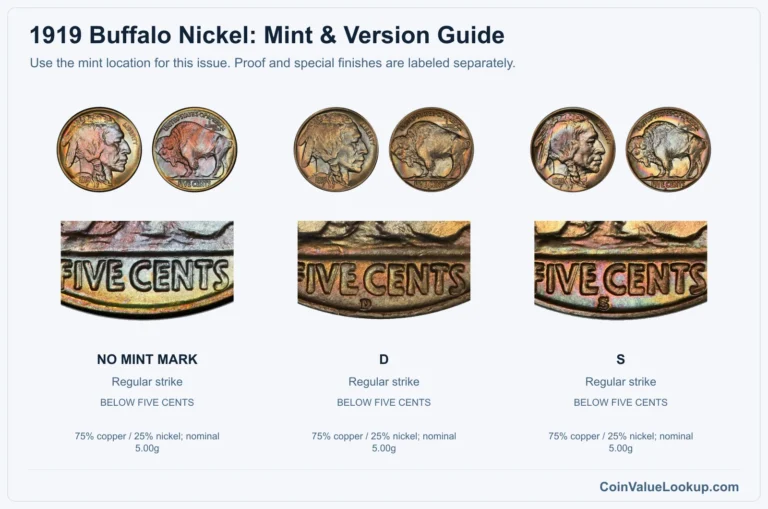
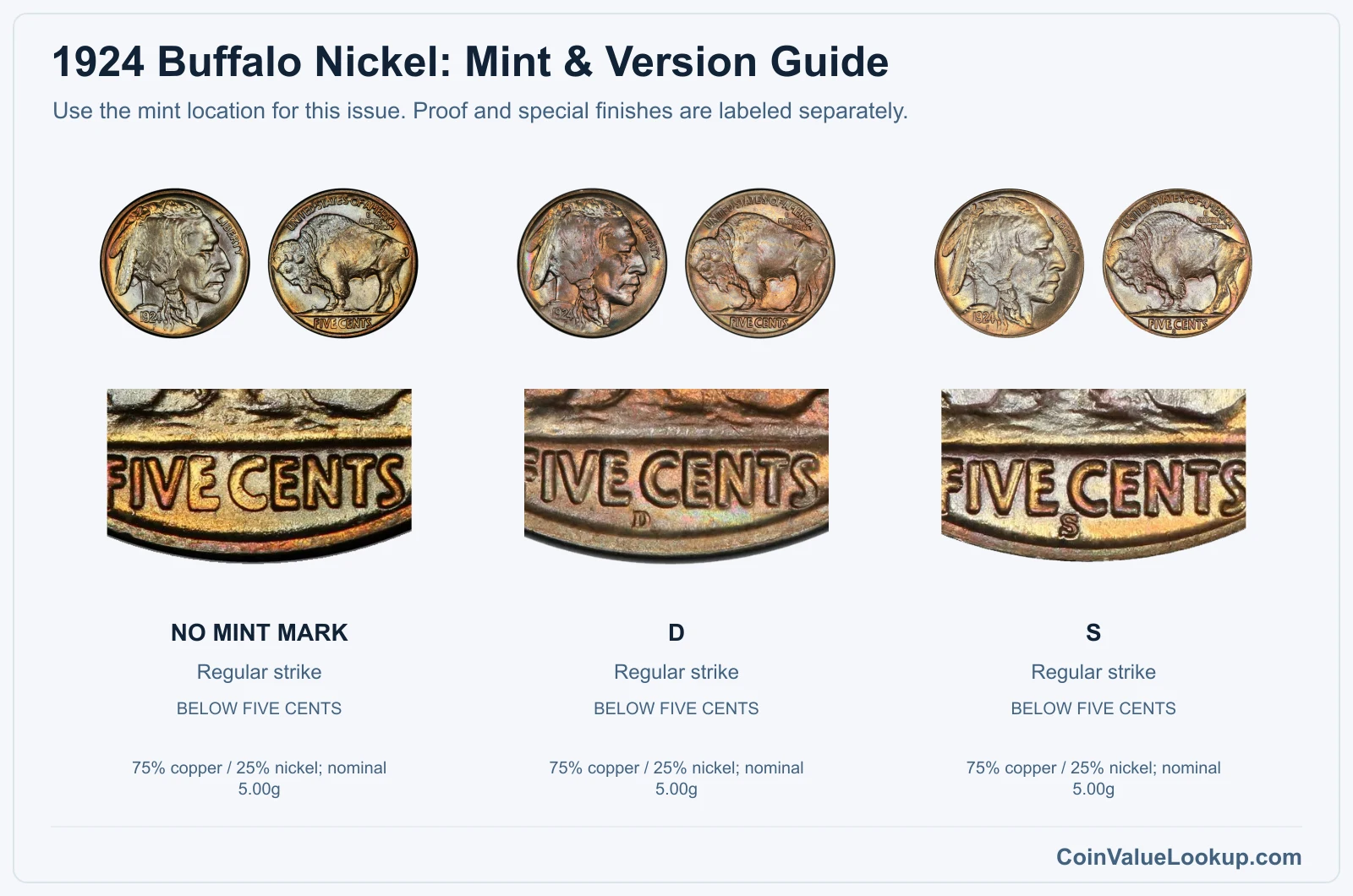
Three mints produced the 1924 Buffalo Nickel: Philadelphia, Denver, and San Francisco. A Philadelphia coin has no mintmark at all.
Denver pieces show a small "D" on the reverse, positioned just below the words "FIVE CENTS," and San Francisco coins display an "S" in the same spot.
All three are struck in 75% copper and 25% nickel, weigh about 5 grams, measure 21.2 mm across, and have a plain edge. There is no silver version of this coin — if someone tells you otherwise, walk away.
Every 1924 nickel uses the Type 2 reverse, where "FIVE CENTS" sits in a recessed area below the bison. The Type 1 design, with the denomination on a raised mound, was only used in 1913.
So if you are holding a 1924, you already know the reverse style.
Step 2: Check Your 1924 Buffalo Nickel Grade
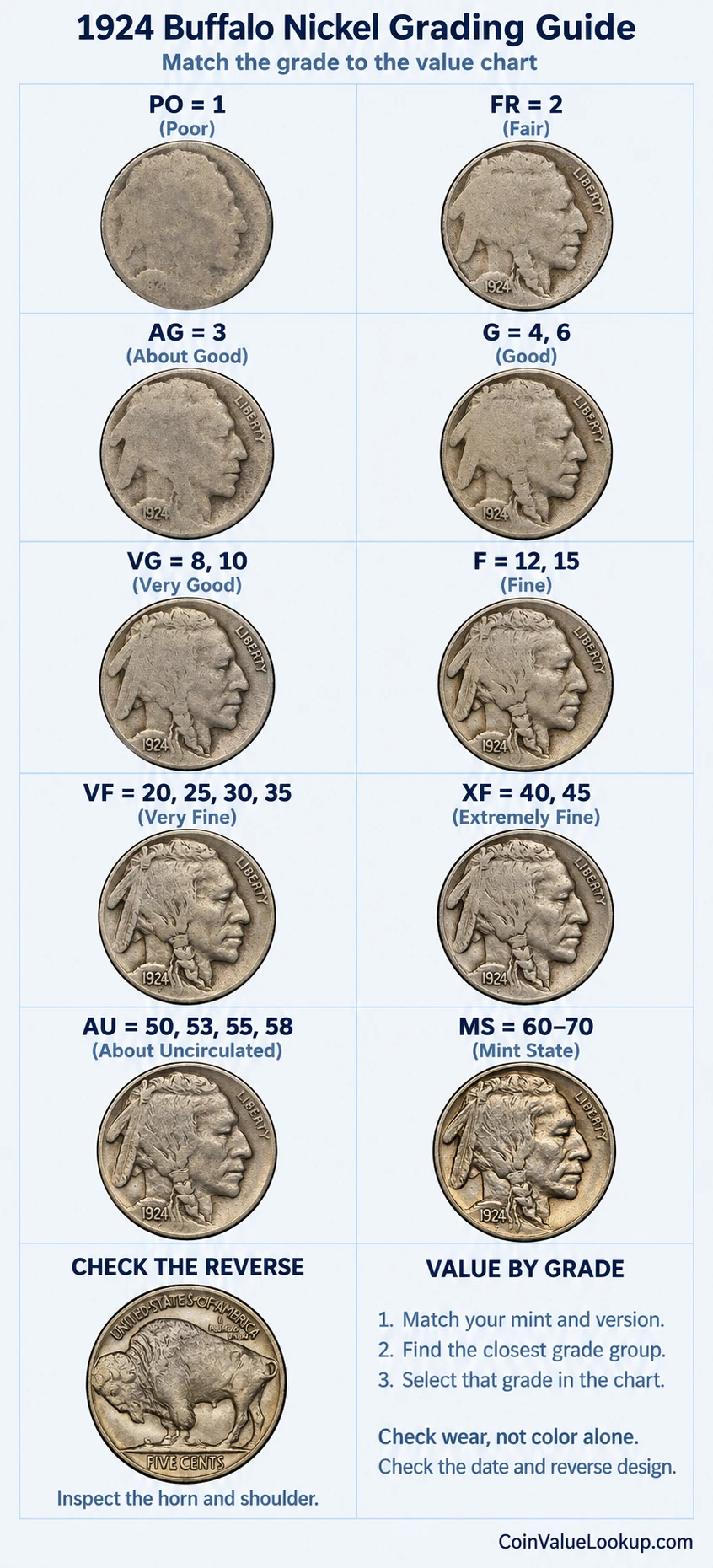
Focus on the Native American portrait first. In higher grades, individual strands of the hair braid remain sharp and the cheek shows no flatness.
As wear progresses, the braid merges into a smooth ribbon and the cheekbone loses definition.
On the reverse, the bison's shoulder and horn are your wear checkpoints. But here is the catch: 1920s Buffalo Nickels from branch mints often came weakly struck from the factory, so a soft horn does not automatically mean heavy wear.
Compare your coin to the grading image to separate genuine circulation loss from a lazy die.
Original mint luster — that cartwheel shimmer when you tilt the coin under a light — is a strong indicator of grade. Once it is gone from the high points, you are likely below Mint State.
And one firm rule: never use acid or chemicals to restore a faded date. It destroys the surface and tanks the value.
Step 3: Check 1924 Buffalo Nickel Value by Mint and Version
1924 Buffalo Nickel — No Mint Mark — Type2 Circulation
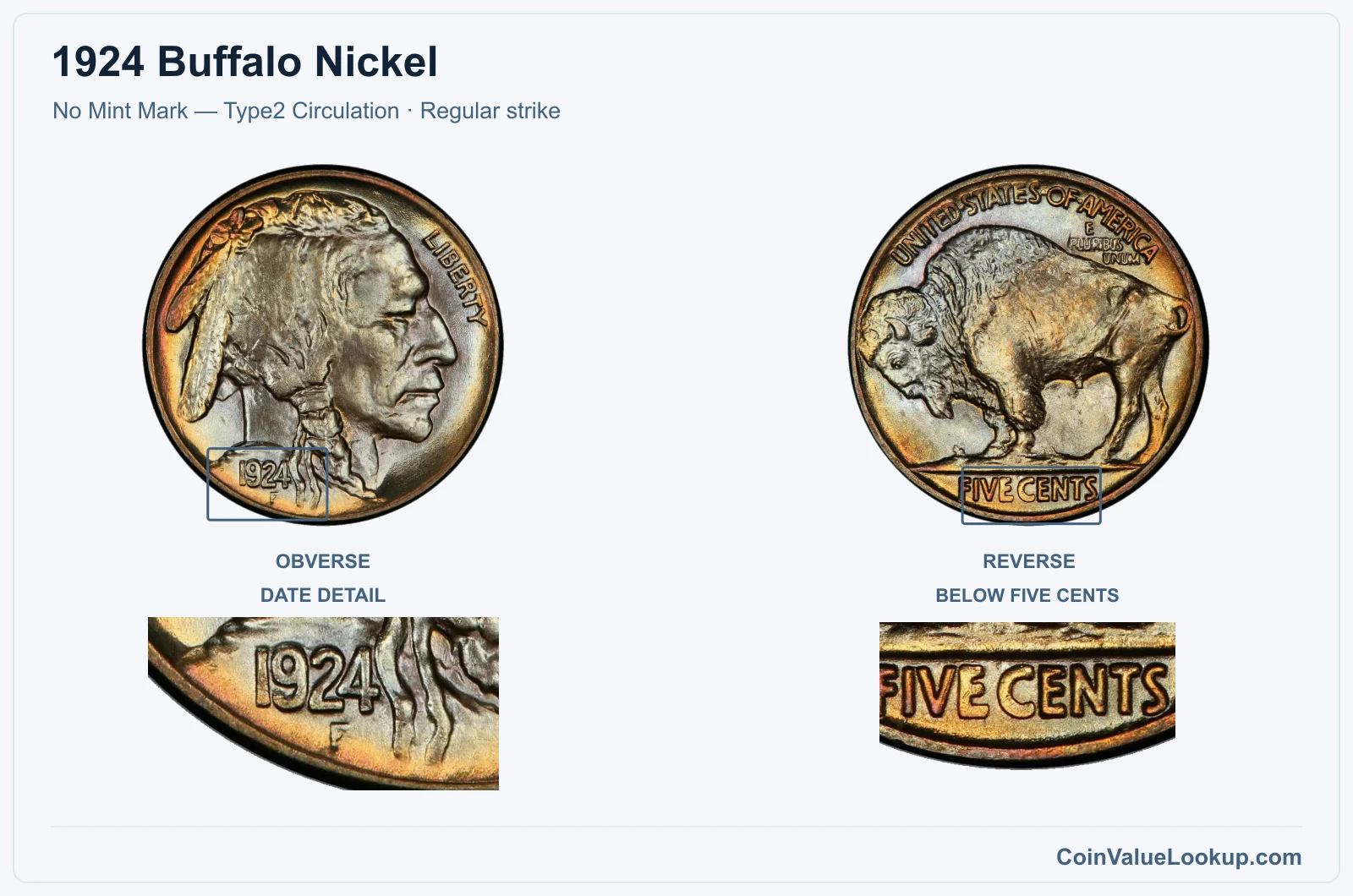
The 1924 Philadelphia Buffalo Nickel is the easiest of the three mints to find, which keeps its prices the most accessible. Look for the absence of any mintmark on the reverse below "FIVE CENTS" — if nothing is there, you have the Philadelphia issue.
USA Coin Book lists a guide estimate of about $1.88 in G4 and $249 in MS63. That MS63 jump is real: most survivors are well worn, so an original uncirculated example with full luster stands out.
Check both faces carefully for damage, cleaning, or environmental discoloration before assuming a high grade.
Range Grade
Price Auction Records Appraisal PO PO 1
—
Coin Identifier FR FR 2
—
Coin Identifier AG AG 3
—
Coin Identifier G G 4
—
Coin Identifier
G 6
—
Coin Identifier VG VG 8
—
Coin Identifier
VG 10
—
Coin Identifier F F 12
—
Coin Identifier
F 15
—
Coin Identifier VF VF 20
Coin Identifier
VF 25
—
Coin Identifier
VF 30
—
Coin Identifier
VF 35
—
Coin Identifier XF XF 40
—
Coin Identifier
XF 45
—
Coin Identifier AU AU 50
—
Coin Identifier
AU 53
Coin Identifier
AU 55
Coin Identifier
AU 58
Coin Identifier MS MS 60
Coin Identifier
MS 61
Coin Identifier
MS 62
Coin Identifier
MS 63
Coin Identifier
MS 64
Coin Identifier
MS 65
Coin Identifier
MS 66
Coin Identifier
MS 67
Coin Identifier
MS 68
—
—
—
MS 69
—
—
—
MS 70
—
—
—
1924 Buffalo Nickel — D — Type2 Circulation
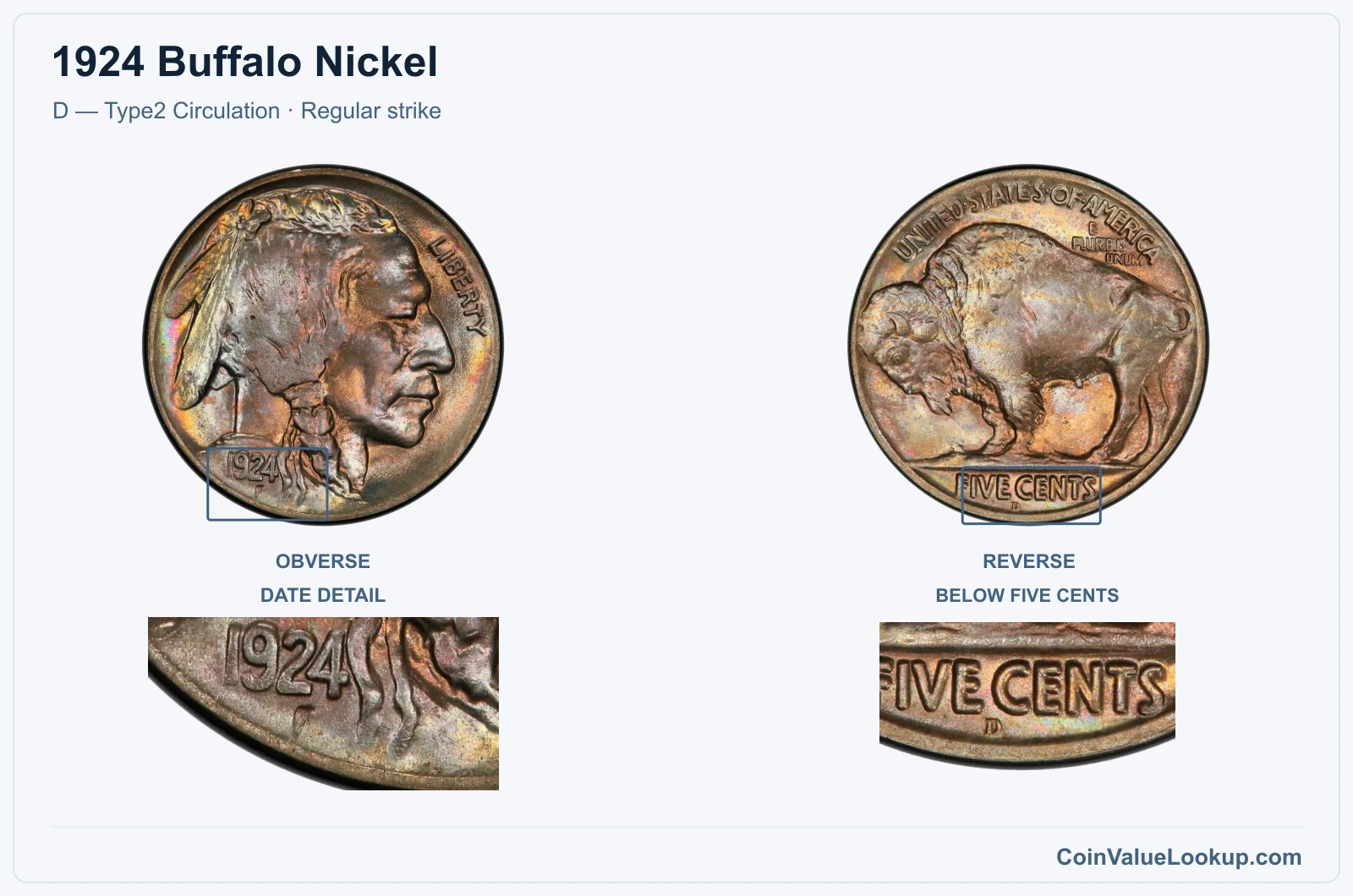
Denver struck 1924 Buffalo Nickels with a small "D" mintmark sitting below "FIVE CENTS" on the reverse. These carry a noticeable premium over Philadelphia coins at every grade level.
Guide estimates from USA Coin Book place the 1924-D at around $12 in G4 and $1,390 in MS63. That G4 price is already six times the Philadelphia equivalent, reflecting lower surviving populations in collector-quality condition.
Strike quality varies on Denver issues from this era, so do not mistake a weakly impressed horn or head detail for heavy wear — compare with the reference image to get an honest read on actual grade.
Coin Value Lookup is a handy starting point if you want to look up guide values for other dates and mints in the Buffalo Nickel series.
Range Grade
Price Auction Records Appraisal PO PO 1
—
Coin Identifier FR FR 2
—
Coin Identifier AG AG 3
—
Coin Identifier G G 4
—
Coin Identifier
G 6
—
Coin Identifier VG VG 8
Coin Identifier
VG 10
—
Coin Identifier F F 12
Coin Identifier
F 15
Coin Identifier VF VF 20
Coin Identifier
VF 25
Coin Identifier
VF 30
Coin Identifier
VF 35
Coin Identifier XF XF 40
Coin Identifier
XF 45
Coin Identifier AU AU 50
Coin Identifier
AU 53
Coin Identifier
AU 55
Coin Identifier
AU 58
Coin Identifier MS MS 60
Coin Identifier
MS 61
Coin Identifier
MS 62
Coin Identifier
MS 63
Coin Identifier
MS 64
Coin Identifier
MS 65
Coin Identifier
MS 66
Coin Identifier
MS 67
—
—
—
MS 68
—
—
—
MS 69
—
—
—
MS 70
—
—
—
1924 Buffalo Nickel — S — Type2 Circulation
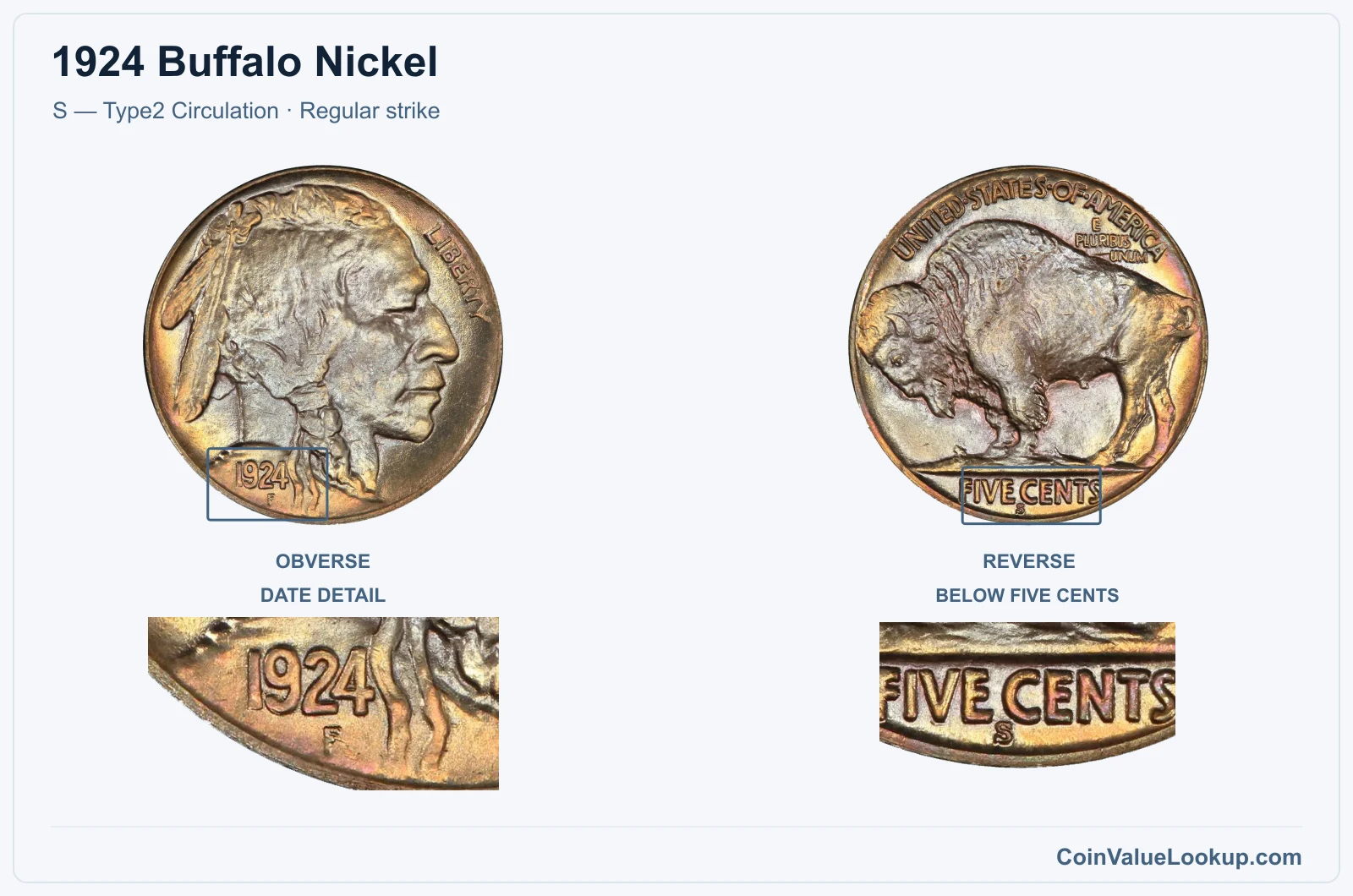
The 1924-S is the coin you want to find in your jar of old nickels. San Francisco's "S" mintmark sits in the usual spot on the reverse, just below the denomination.
USA Coin Book guide estimates run from about $30 in G4 up to $5,624 in MS63 — the highest listed values among the three 1924 mints by a wide margin. Even a well-circulated example carries a meaningful premium.
Mint-state survivors are genuinely scarce, which explains that steep climb. As with all 1920s San Francisco nickels, strike softness is common, so separate factory weakness from post-mint wear by examining luster and overall surface quality rather than relying on one detail like the horn alone.
Range Grade
Price Auction Records Appraisal PO PO 1
—
Coin Identifier FR FR 2
—
Coin Identifier AG AG 3
Coin Identifier G G 4
Coin Identifier
G 6
—
Coin Identifier VG VG 8
Coin Identifier
VG 10
Coin Identifier F F 12
Coin Identifier
F 15
Coin Identifier VF VF 20
Coin Identifier
VF 25
Coin Identifier
VF 30
Coin Identifier
VF 35
Coin Identifier XF XF 40
Coin Identifier
XF 45
Coin Identifier AU AU 50
Coin Identifier
AU 53
Coin Identifier
AU 55
Coin Identifier
AU 58
Coin Identifier MS MS 60
Coin Identifier
MS 61
Coin Identifier
MS 62
Coin Identifier
MS 63
Coin Identifier
MS 64
Coin Identifier
MS 65
Coin Identifier
MS 66
Coin Identifier
MS 67
—
—
—
MS 68
—
—
—
MS 69
—
—
—
MS 70
—
—
—
1924 Buffalo Nickel Error List
1. 1924 Buffalo Nickel — Off-Center Strike
An off-center strike happens when the coin blank is not seated properly between the dies, leaving part of the design missing and an unstruck crescent along one edge. For 1924 Buffalo Nickels, this error has been reported on both Philadelphia and Denver issues.
The key diagnostic is a shifted design paired with a blank, crescent-shaped area where metal was never impressed. The more dramatic the shift — and the more of the date that remains visible — the more desirable the piece becomes to error collectors.
Do not confuse a clipped planchet, a die misalignment that only affects one side, or post-mint damage from a vise or hammer with a genuine off-center strike. A true off-center coin shows the entire design displaced uniformly.
No specific price range is adopted here because value depends heavily on the percentage of off-center shift, date visibility, and overall condition.
2. 1924 Buffalo Nickel — Missing Designer Initial F
The designer's initial "F" — for James Earle Fraser — normally appears on the obverse beneath the date. On certain 1924 Philadelphia nickels, this letter is partially or completely absent due to an abraded die, meaning the mint's own finishing process ground the detail away before striking.
To identify this variety, examine the area just below the date under magnification. Compare it with a normal 1924 nickel: on an affected coin, the space where the "F" belongs looks smooth and flat, consistent with die abrasion rather than a rough gouge or uneven wear.
Several lookalikes exist. Heavy circulation wear can obscure the "F" naturally.
Grease-filled dies can also block it temporarily. A weak overall strike might reduce it, and deliberate removal after minting leaves tool marks.
The abraded-die version should show a clean, uniform absence. No specific price is adopted because value depends on the clarity of the missing initial and the coin's condition.
3. 1924 Buffalo Nickel — Doubled Die Obverse
A doubled die obverse on the 1924 Buffalo Nickel shows consistent doubling on design elements — letters, the date, or portions of the portrait — caused by a misalignment during the die-making process itself. This is a die variety, meaning every coin struck from that die carries the same doubling.
Under magnification, look for separation or notching on obverse lettering or design features. The doubling should appear in the same direction and magnitude across multiple elements.
Compare your coin to a normal 1924 nickel under identical lighting to spot the difference.
The most common lookalike is machine doubling, which produces a flat, shelf-like distortion rather than the rounded, separated profiles of a true doubled die. Reflections, worn die contours, and strike anomalies can also mimic doubling at first glance.
No specific price is adopted for this variety because value depends on the strength and visibility of the doubling, the coin's overall condition, and third-party verification.