2003 Jefferson Nickel Coin Value: How Much Is It Worth?
Most 2003 Jefferson nickels are worth only a little above face value. According to USA Coin Book guide estimates, standard Philadelphia and Denver business strikes range from roughly $0.30 in MS60 condition to about $1.24 at MS65.
San Francisco proofs and authenticated mint errors sit in a different category entirely, so the first step is always figuring out exactly what you have.
Fast Way to Identify Your 2003 Jefferson Nickel
The quickest way to start is to upload clear photos of both sides of your coin. A front and back image lets our identifier give you a preliminary read on the mint, finish, and any visible oddities.
Snap the photos under even lighting and avoid glare so the details come through.
2003 Jefferson Nickel Value
Upload both sides of your 2003 Jefferson Nickel.
Front Obverse
Upload photo
Back Reverse
Upload photo
Which 2003 Jefferson Nickel Versions Are Worth Money?
- San Francisco proof (2003-S) carries a PR65 guide value of about $3.62, well above face value and separate from circulated P/D pricing.
- Authenticated mint errors such as off-center strikes, wrong-planchet strikes, and double strikes have sold or been listed at prices far exceeding any standard-issue 2003 nickel.
- Condition matters: an MS65 Philadelphia or Denver coin is guided near $1.24, while lower-grade examples sit around $0.30, so sharp uncirculated pieces are the ones to set aside.
- Proof finish and error status must be confirmed by examining the actual coin; label or mintmark alone is not enough to assign premium value.
Step 1: Identify Your 2003 Jefferson Nickel Mint Mark and Version
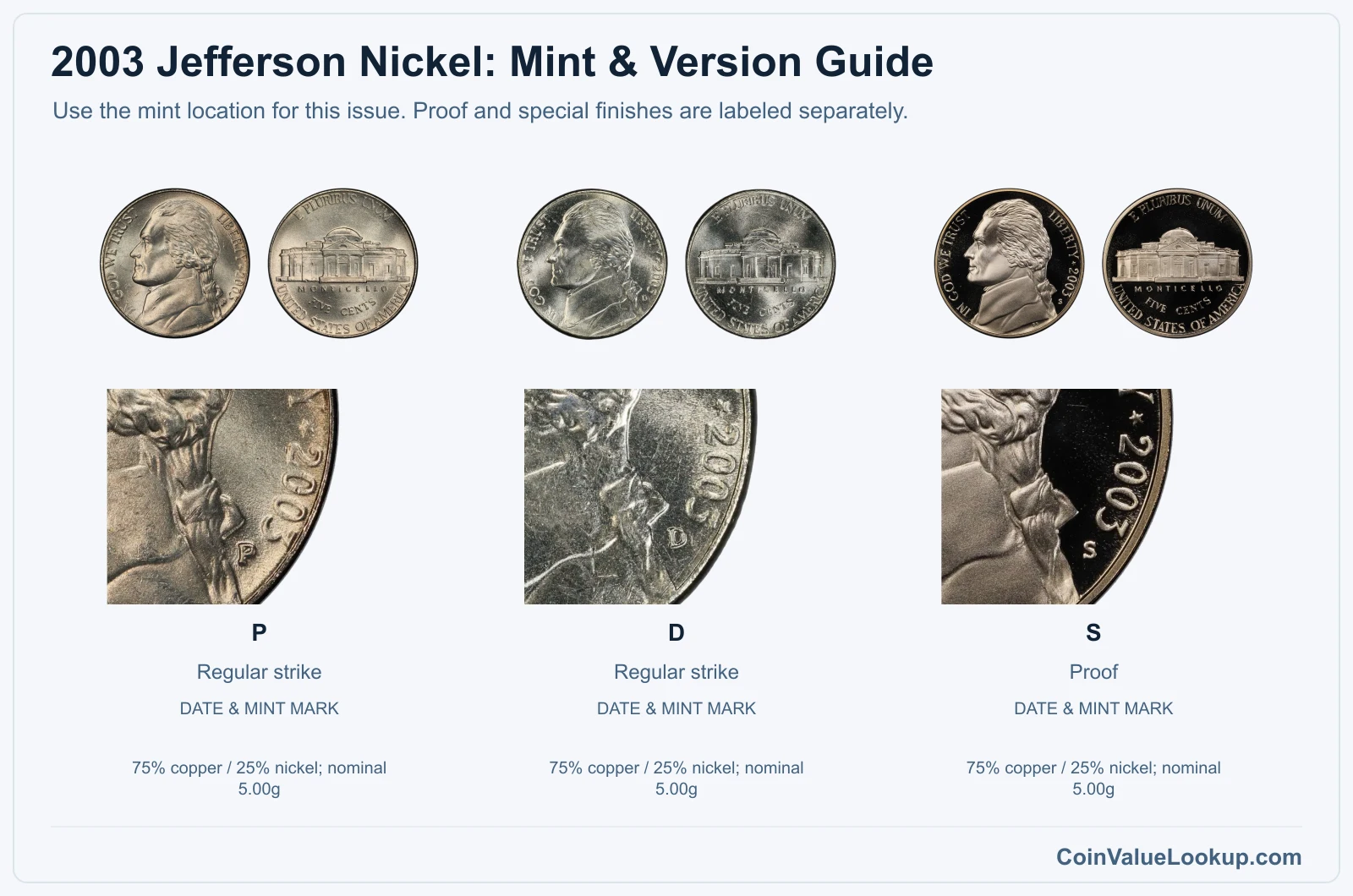
Flip your coin over and look for a small letter below the date on the obverse. A "P" means Philadelphia, a "D" means Denver, and an "S" means San Francisco proof.
All three share the classic Jefferson profile on the front and the Monticello building on the back, which distinguishes them from the Westward Journey designs that started in 2004.
The normal 2003 nickel is 75% copper and 25% nickel, weighing about 5 grams with a 21.2 mm diameter and a plain edge. Color alone does not confirm the alloy, so if your coin looks oddly coppery or thin, weigh it before jumping to conclusions.
Proofs from San Francisco have mirror-like fields and sharp detail straight from the die. Business strikes from P and D have a satiny or slightly frosty surface.
Mixing up a well-preserved business strike with a proof is a common beginner mistake, so check for that "S" mintmark first.
Step 2: Check Your 2003 Jefferson Nickel Grade
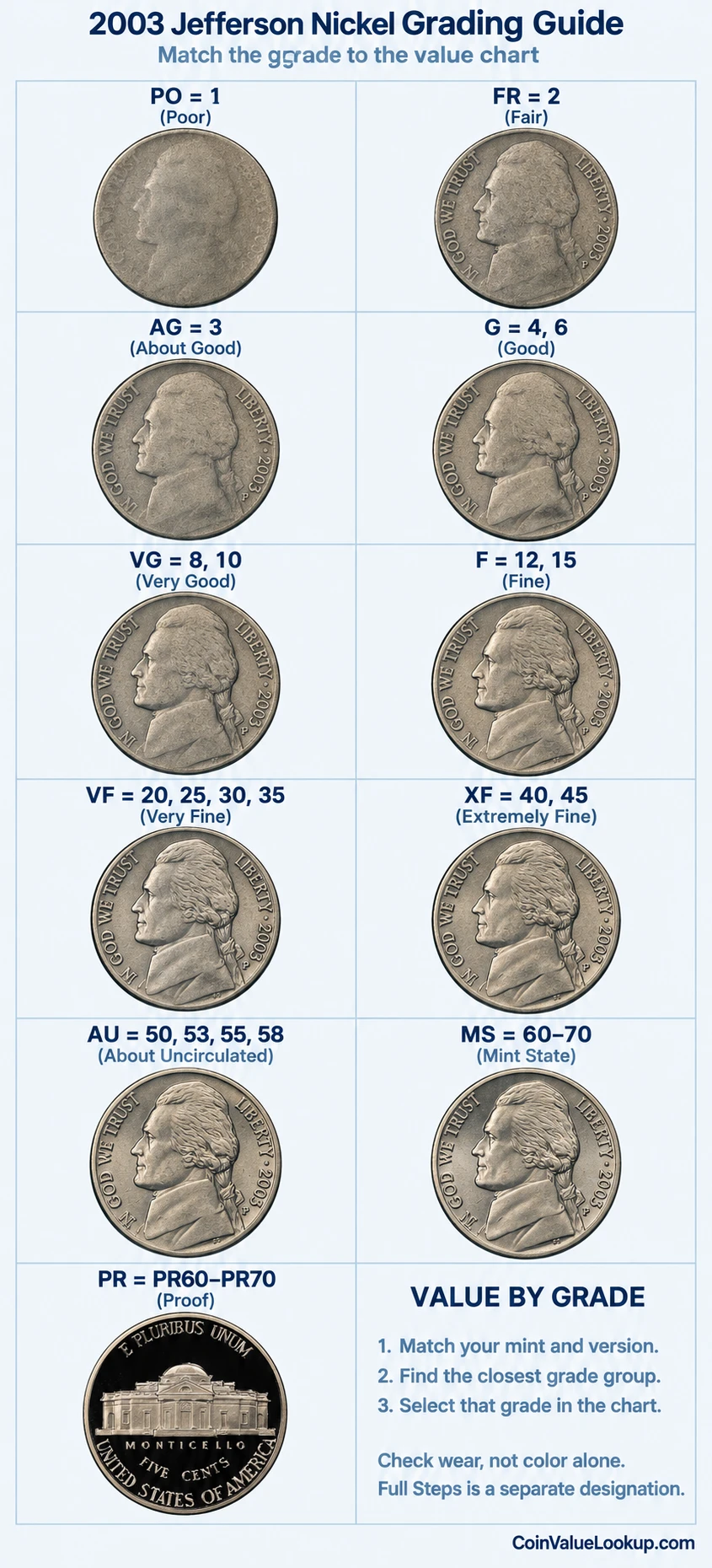
Start with Jefferson's cheek and the hair detail above his ear. On a well-worn coin those areas flatten first, losing their raised texture.
Then check overall luster: a coin with full original mint sheen and no contact marks grades much higher than one that has been through a cash register.
On the Monticello reverse, the steps at the base of the building can appear weak even on uncirculated coins. That is a strike-quality issue, not wear.
Full Steps is a separate designation that applies to sharp Monticello strikes, so do not confuse a soft strike with circulation damage.
Use the comparison image to gauge where your coin falls. Line up the cheek, hair waves, and pillar details side by side.
A coin at MS60 will show bag marks and reduced luster, while MS65 should look clean and lustrous to the unaided eye.
Step 3: Check 2003 Jefferson Nickel Value by Mint and Version
2003 Jefferson Nickel — P — Business strike
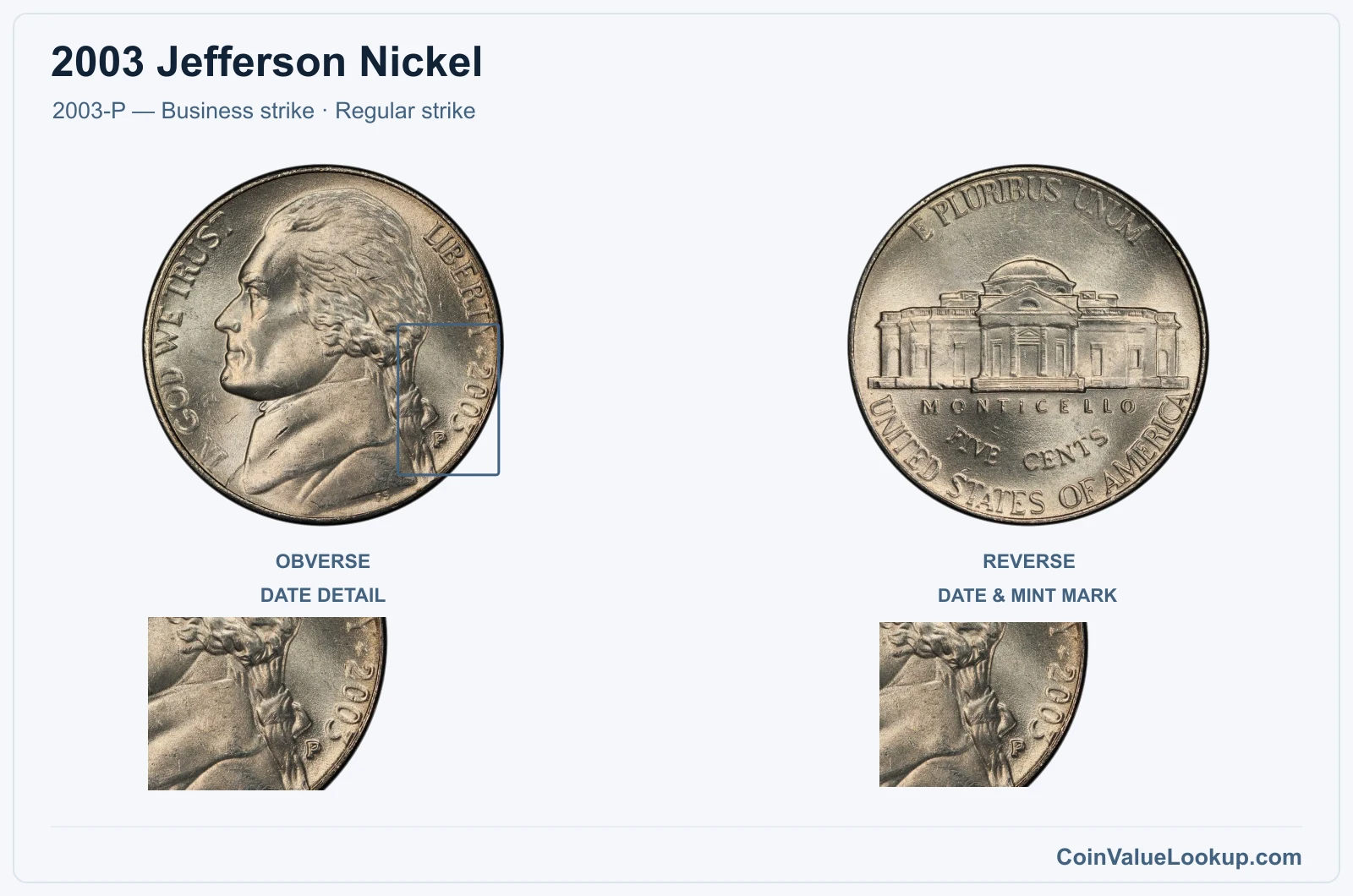
The 2003-P business strike is the Philadelphia issue, carrying a small "P" mintmark below the date. It is 75% copper and 25% nickel, weighing nominally 5.00 grams with a plain edge.
USA Coin Book guide estimates place this coin at about $0.30 in MS60 and around $1.24 in MS65. Those figures cover ordinary strikes and do not reflect Full Steps or other special designations.
If yours came from pocket change, it is almost certainly worth face value. The premium kicks in only for well-preserved uncirculated examples with clean surfaces.
| Range | Grade | Price | Auction Records | Appraisal |
|---|---|---|---|---|
| PO | PO 1 | — | Coin Identifier | |
| FR | FR 2 | — | Coin Identifier | |
| AG | AG 3 | — | Coin Identifier | |
| G | G 4 | — | Coin Identifier | |
| G 6 | — | Coin Identifier | ||
| VG | VG 8 | — | Coin Identifier | |
| VG 10 | — | Coin Identifier | ||
| F | F 12 | — | Coin Identifier | |
| F 15 | — | Coin Identifier | ||
| VF | VF 20 | — | Coin Identifier | |
| VF 25 | — | Coin Identifier | ||
| VF 30 | — | Coin Identifier | ||
| VF 35 | — | Coin Identifier | ||
| XF | XF 40 | — | Coin Identifier | |
| XF 45 | — | Coin Identifier | ||
| AU | AU 50 | — | Coin Identifier | |
| AU 53 | — | Coin Identifier | ||
| AU 55 | — | Coin Identifier | ||
| AU 58 | — | Coin Identifier | ||
| MS | MS 60 | — | Coin Identifier | |
| MS 61 | — | Coin Identifier | ||
| MS 62 | — | Coin Identifier | ||
| MS 63 | — | Coin Identifier | ||
| MS 64 | — | Coin Identifier | ||
| MS 65 | — | Coin Identifier | ||
| MS 66 | — | Coin Identifier | ||
| MS 67 | — | Coin Identifier | ||
| MS 68 | — | — | — | |
| MS 69 | — | — | — | |
| MS 70 | — | — | — |
2003 Jefferson Nickel — D — Business strike
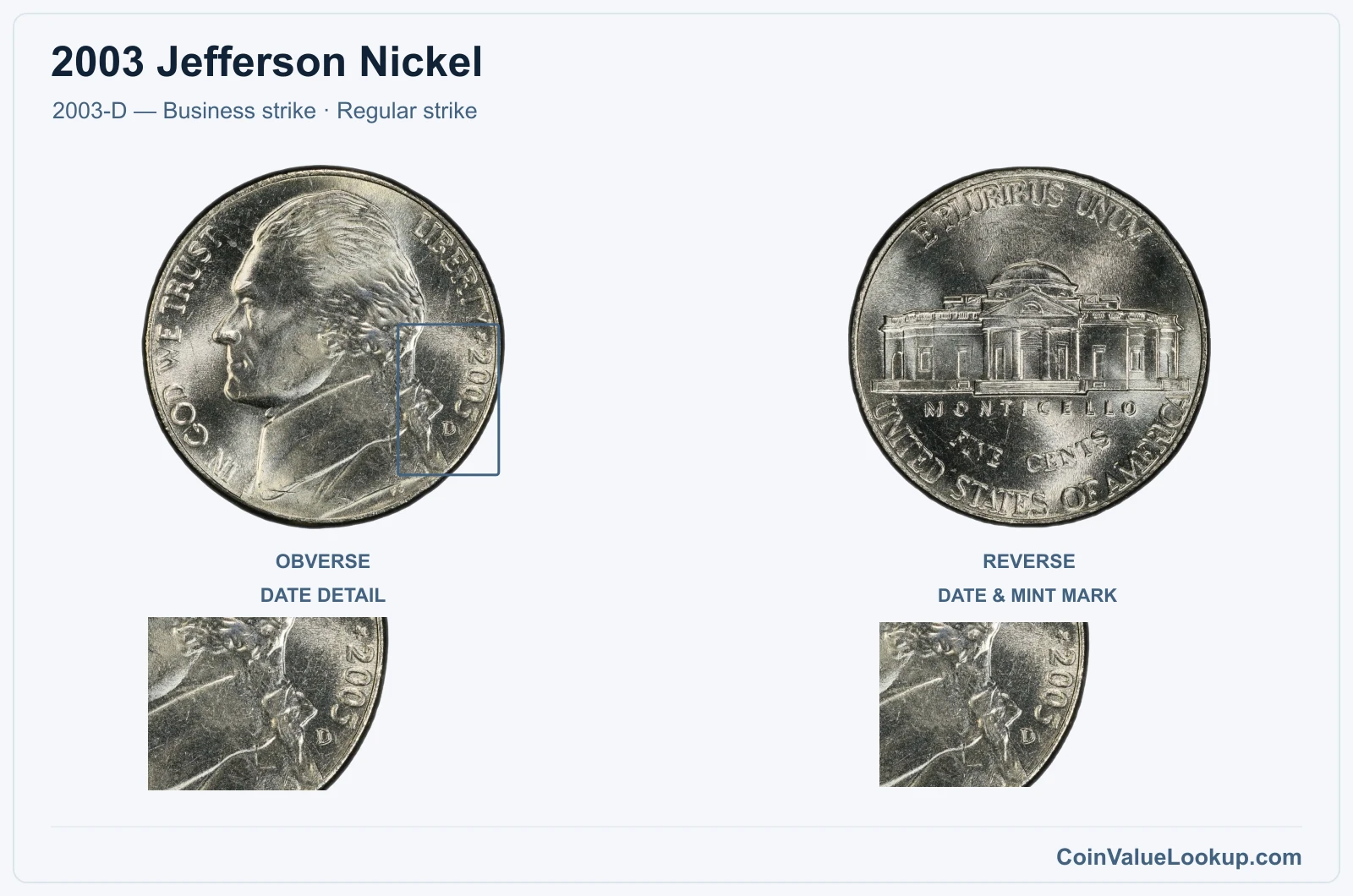
The 2003-D nickel was struck at Denver and shows a "D" mintmark below the date. Same alloy, same weight, same design as the Philadelphia version.
Guide estimates from USA Coin Book are identical: roughly $0.30 at MS60 and $1.24 at MS65.
Denver and Philadelphia mintages for this year are both large, so neither mintmark carries a scarcity premium. Focus on condition.
A lustrous, mark-free example pulled straight from a bank roll is your best bet for the higher end of that range.
Coin Value Lookup is a good starting point if you want to compare this nickel against other years or denominations in the Jefferson series.
| Range | Grade | Price | Auction Records | Appraisal |
|---|---|---|---|---|
| PO | PO 1 | — | Coin Identifier | |
| FR | FR 2 | — | Coin Identifier | |
| AG | AG 3 | — | Coin Identifier | |
| G | G 4 | — | Coin Identifier | |
| G 6 | — | Coin Identifier | ||
| VG | VG 8 | — | Coin Identifier | |
| VG 10 | — | Coin Identifier | ||
| F | F 12 | — | Coin Identifier | |
| F 15 | — | Coin Identifier | ||
| VF | VF 20 | — | Coin Identifier | |
| VF 25 | — | Coin Identifier | ||
| VF 30 | — | Coin Identifier | ||
| VF 35 | — | Coin Identifier | ||
| XF | XF 40 | — | Coin Identifier | |
| XF 45 | — | Coin Identifier | ||
| AU | AU 50 | — | Coin Identifier | |
| AU 53 | — | Coin Identifier | ||
| AU 55 | — | Coin Identifier | ||
| AU 58 | — | Coin Identifier | ||
| MS | MS 60 | — | Coin Identifier | |
| MS 61 | — | Coin Identifier | ||
| MS 62 | — | Coin Identifier | ||
| MS 63 | — | Coin Identifier | ||
| MS 64 | — | Coin Identifier | ||
| MS 65 | — | Coin Identifier | ||
| MS 66 | — | Coin Identifier | ||
| MS 67 | — | — | — | |
| MS 68 | — | — | — | |
| MS 69 | — | — | — | |
| MS 70 | — | — | — |
2003 Jefferson Nickel — S PR — Proof
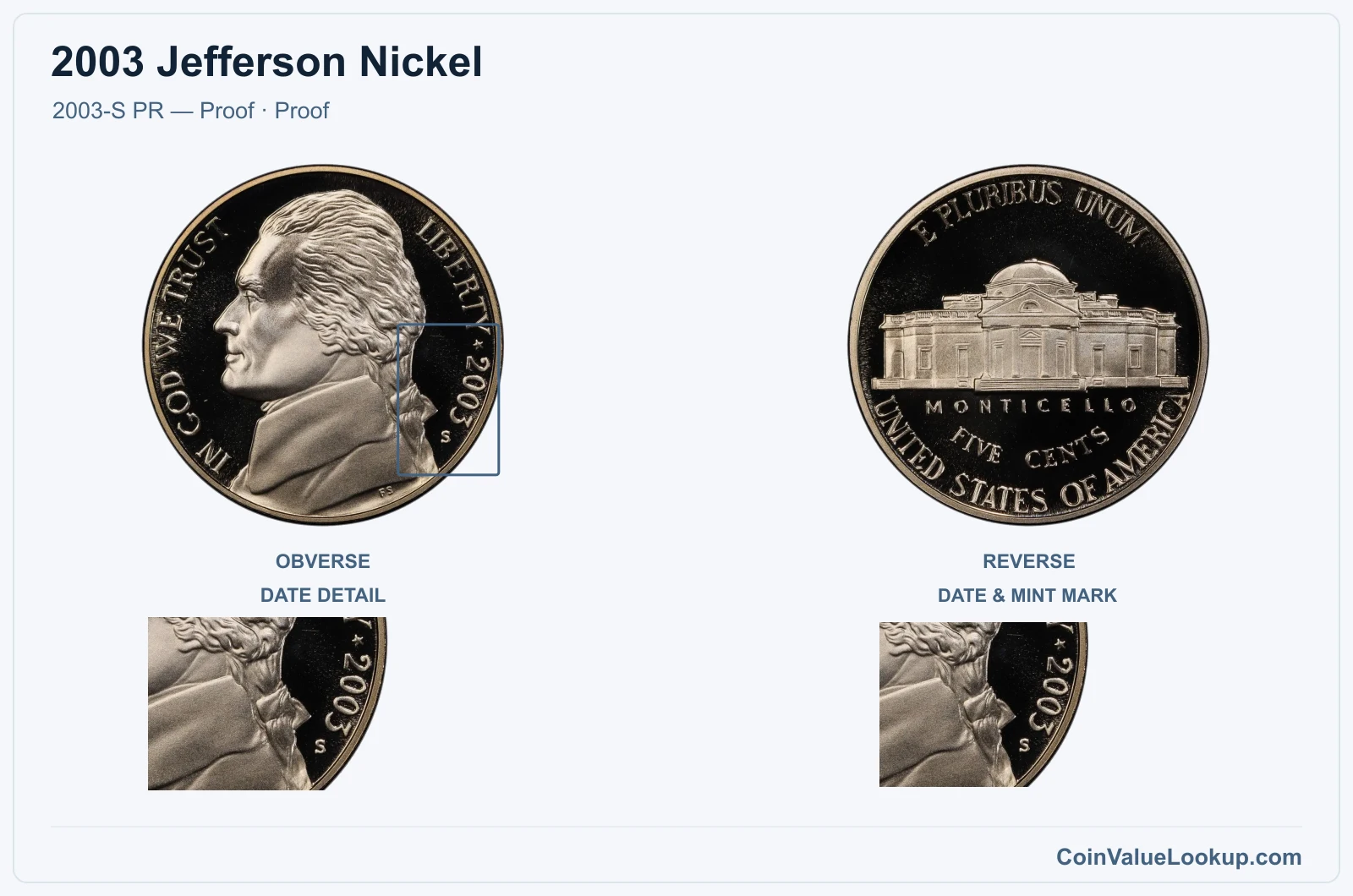
The 2003-S proof was made at San Francisco exclusively for collectors, not for circulation. It features the same Jefferson profile and Monticello reverse but struck with polished dies on a specially prepared planchet, giving it mirror-like fields and crisp detail.
USA Coin Book guides this coin at about $3.62 in PR65. That is a general guide figure for a standard proof and does not specifically cover Deep Cameo or other premium designations.
Proofs that have been mishandled or stored loosely can pick up haze and hairlines, dropping them below PR65.
Look for the "S" mintmark to confirm San Francisco origin. If your coin has proof-like surfaces but no "S," it may simply be a well-struck business issue.
| Range | Grade | Price | Auction Records | Appraisal |
|---|---|---|---|---|
| PR | PR 1 | — | Coin Identifier | |
| PR 2 | — | Coin Identifier | ||
| PR 3 | — | Coin Identifier | ||
| PR 4 | — | Coin Identifier | ||
| PR 6 | — | Coin Identifier | ||
| PR 8 | — | Coin Identifier | ||
| PR 10 | — | Coin Identifier | ||
| PR 12 | — | Coin Identifier | ||
| PR 15 | — | Coin Identifier | ||
| PR 20 | — | Coin Identifier | ||
| PR 25 | — | Coin Identifier | ||
| PR 30 | — | Coin Identifier | ||
| PR 35 | — | Coin Identifier | ||
| PR 40 | — | Coin Identifier | ||
| PR 45 | — | Coin Identifier | ||
| PR 50 | — | Coin Identifier | ||
| PR 53 | — | Coin Identifier | ||
| PR 55 | — | Coin Identifier | ||
| PR 58 | — | Coin Identifier | ||
| PR 60 | — | Coin Identifier | ||
| PR 61 | — | Coin Identifier | ||
| PR 62 | — | Coin Identifier | ||
| PR 63 | — | Coin Identifier | ||
| PR 64 | — | Coin Identifier | ||
| PR 65 | — | Coin Identifier | ||
| PR 66 | — | Coin Identifier | ||
| PR 67 | — | Coin Identifier | ||
| PR 68 | Coin Identifier | |||
| PR 69 | Coin Identifier | |||
| PR 70 | Coin Identifier |
2003 Jefferson Nickel Error List
1. 2003 Jefferson Nickel — Off-center strike
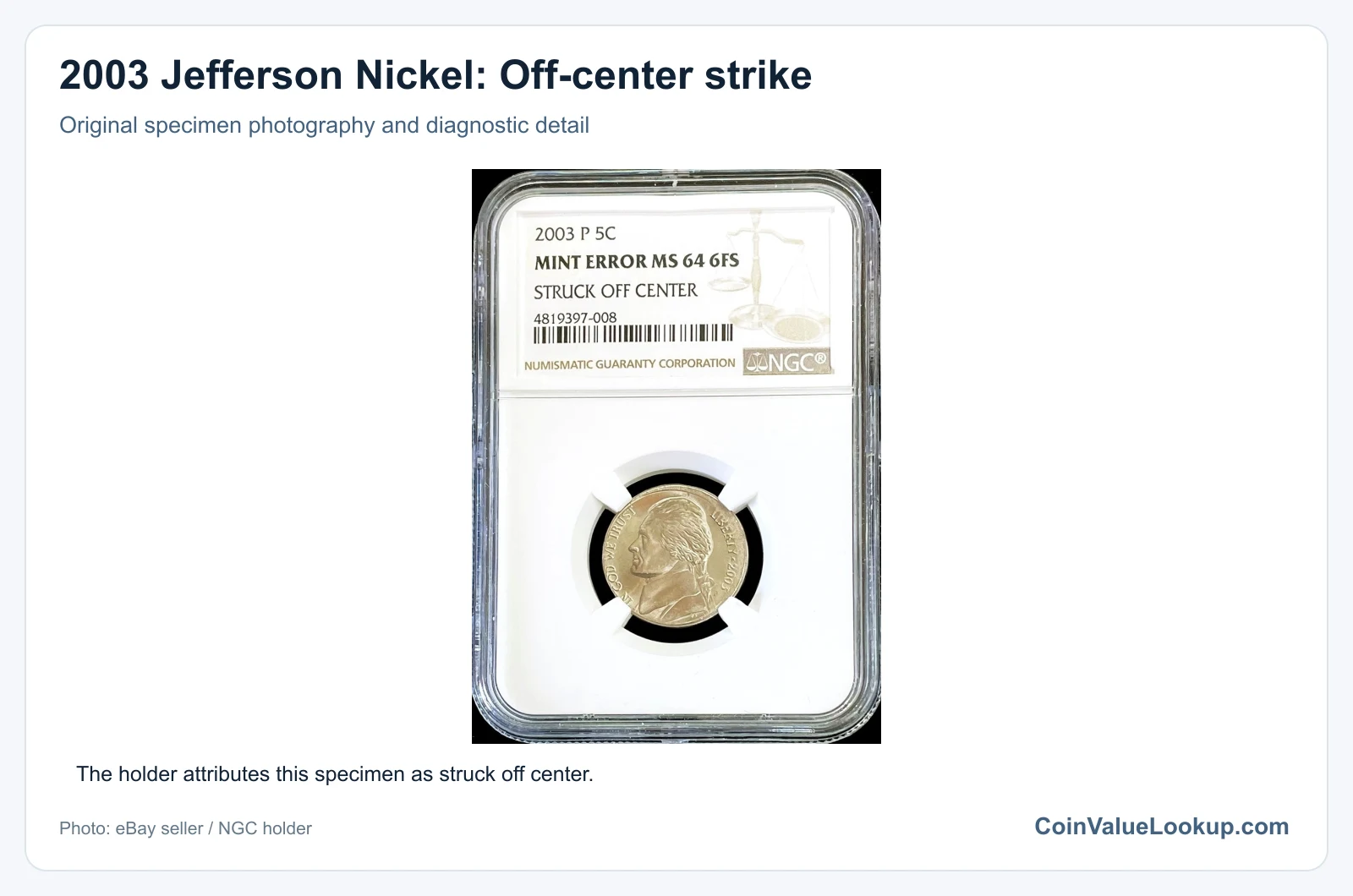
An off-center strike happens when the planchet is not seated properly in the collar before the dies come together. The result is a crescent-shaped blank area on one side and a corresponding shift of the entire design.
One known example is a 2003-P nickel graded ANACS MS63 with a 10% off-center displacement at the 9:00 position. It shows a clear unstruck crescent on one side and missing design elements opposite.
No specific sale price is adopted for this piece, because value depends heavily on the degree of offset, whether the date is fully visible, and the coin's overall condition.
If you think you have one, compare it carefully to a misaligned die strike, which shifts only one side's design slightly, or a coin with an altered rim filed down after leaving the mint.
2. 2003 Jefferson Nickel — Die Crack / Die Chip
Die cracks and die chips show up as thin raised lines or small raised blobs on the coin's surface. They form when a working die develops a fracture during production, and the crack fills with metal during striking.
A die chip is usually a small raised lump, often appearing on letters or inside design elements. A larger crack connecting to the rim is sometimes called a cud.
The 2003 nickel has been reported with die chip errors.
Value depends on size, location, and visibility. A tiny chip on a letter is less desirable than a dramatic cud that reshapes part of the rim.
No specific price range is adopted here. To rule out lookalikes, check that the feature is raised and not an incuse scratch, corrosion pit, or glob of foreign material stuck to the surface.
3. 2003 Jefferson Nickel — Clashed Dies
Clashed dies occur when the obverse and reverse dies slam together without a planchet between them. Each die picks up a faint impression of the opposite design, and that ghost image then transfers onto subsequent coins.
On a 2003 nickel, look for faint traces of Monticello's outline on Jefferson's portrait side, or Jefferson's profile ghosted onto the building side. The transferred elements should align with where the opposing design would sit during a normal strike.
No specific price range is adopted for this error. Condition and the strength of the clash impression both matter.
A bold, unmistakable clash is far more collectible than a faint one you need a loupe and faith to see. Rule out random scratches, raised lines from die polishing, or a brockage, which involves an actual struck coin rather than a bare die.
4. 2003 Jefferson Nickel — Die Cap / Capped-Die Strike
A die cap forms when a struck coin sticks to one of the dies and is carried upward, cupping around it like a bottle cap with each subsequent strike. The coins struck underneath that cap pick up a distorted, flattened impression from the trapped coin.
The 2003 nickel has been reported with die cap errors. On a capped-die coin itself, you will see a dramatically cupped shape with one side showing a spread, mirrored impression.
Coins struck through the cap look soft or mushy on the affected side.
No specific price is adopted, because severity varies widely. A deeply cupped cap that was on the die for many strikes is a different animal from one that detached after a couple of impressions.
Do not confuse a die cap with a coin that was simply bent, squeezed in a vise, or weakly struck due to worn dies.
5. 2003 Jefferson Nickel — Broadstrike
A broadstrike occurs when a coin is struck without the retaining collar that normally confines the planchet and forms the edge. The metal spreads outward freely, making the coin slightly larger in diameter with a smooth, undefined edge instead of the usual plain-edge profile.
The 2003 nickel has been reported with broadstrike errors. The full design is still present and centered, which distinguishes a broadstrike from an off-center strike where design elements are missing.
Check the edge carefully: a genuine broadstrike will be uniformly spread, not smashed flat on one side like post-mint damage from a hammer or press.
No numerical price range is adopted. The coin's overall condition and how dramatically the spread is visible both influence collector interest.
6. 2003 Jefferson Nickel — Bonded / Mated Pair
A bonded pair, sometimes called a mated pair, involves two coins that were struck together and fused by the force of the press. They may remain physically joined or may have separated but still show matching contact impressions that line up perfectly when reunited.
The 2003 nickel has been reported in this error category. On a bonded pair, you will see one coin's design impressed into the opposite face of the other coin, with corresponding contact areas that match.
That mirror-image relationship is the key diagnostic.
No numerical price is adopted. These are unusual errors and values depend on condition, how clearly the bonding evidence shows, and whether both pieces are present.
Be cautious of coins that have been glued, soldered, or mechanically pressed together outside the mint. Genuine bonded pairs show strike-force evidence, not adhesive residue or tool marks.
7. 2003 Jefferson Nickel — Wrong Planchet / Off-Metal Strike
A wrong-planchet error means the nickel dies struck a blank intended for a different denomination. The 2003 nickel has been reported struck on a cent planchet.
If genuine, the coin would be smaller, lighter, and possibly show incomplete design coverage because a cent blank is thinner and narrower than a standard nickel blank.
To check, weigh and measure your coin. A normal 2003 nickel is about 5 grams and 21.2 mm across.
A cent planchet would be noticeably different in both dimensions. The design may trail off at the edges where the smaller blank ran out of metal.
No specific price range is adopted. Authentication is critical here because plated, corroded, or acid-treated coins can mimic the copper color of a cent planchet.
Look for uniform design quality consistent with a mint strike, not a coin that has been chemically altered after the fact.
8. 2003 Jefferson Nickel — Double / Multiple Strike
A double strike occurs when a coin is hit by the dies a second time, often with the planchet slightly shifted or rotated between impressions. The result is two separate, overlapping design impressions clearly visible on the coin's surface.
The 2003 nickel has been reported with double-strike errors. Look for a second displaced or rotated set of design elements: a duplicate date, a second outline of Jefferson's profile, or a shifted Monticello image.
The two impressions should each show full die detail consistent with genuine die contact.
No numerical price is adopted. Dramatic displacement with a fully visible date on both impressions is more collectible than a subtle shift.
Do not confuse a double strike with a doubled die, which is a single strike from a die bearing a doubled design. Also watch for post-mint alterations where someone physically re-struck a coin outside the mint.