1824 Capped Bust Quarter Coin Value: How Much Is It Worth?
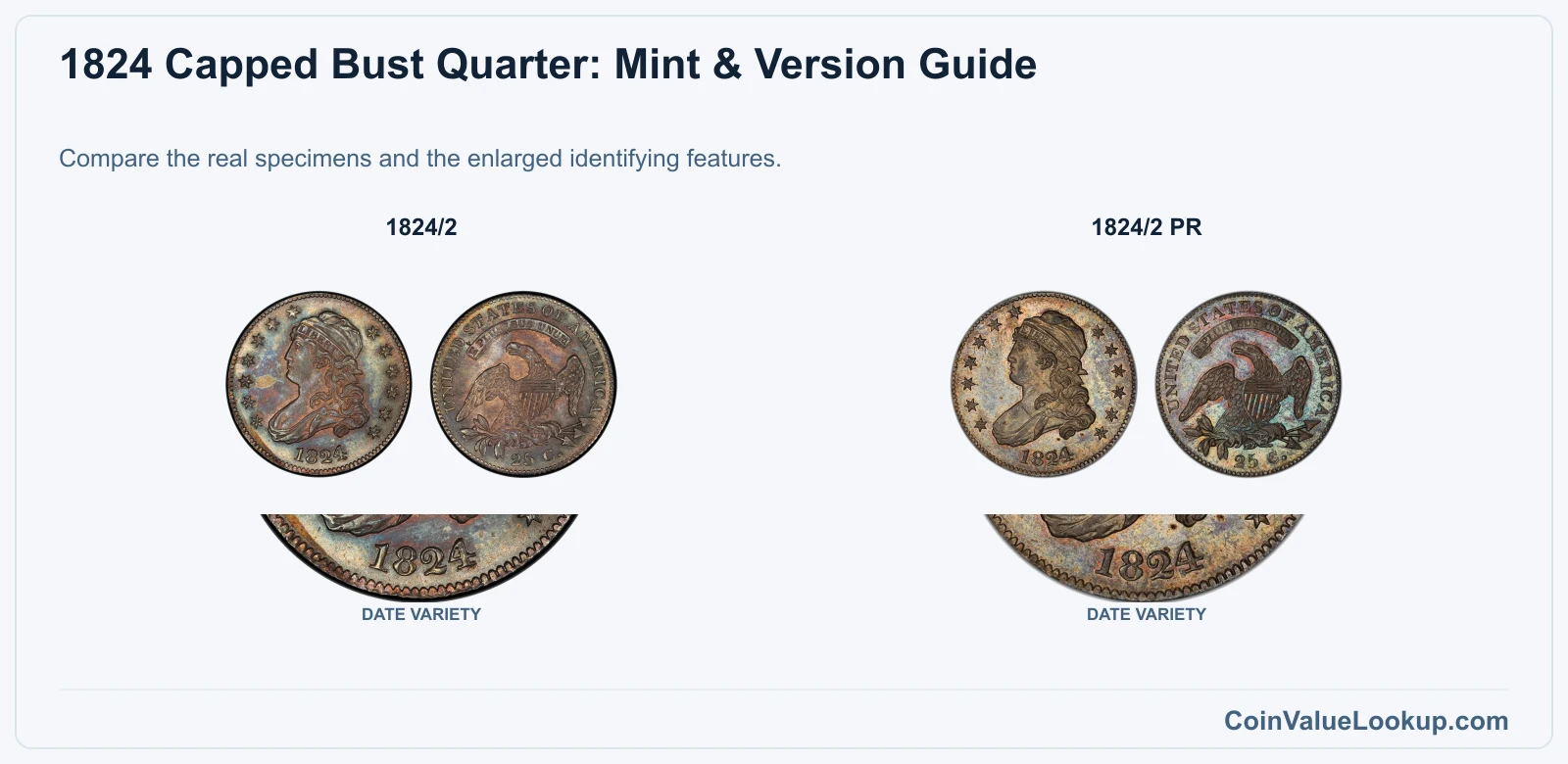
The 1824 Capped Bust Quarter is a scarce early American silver coin struck only at the Philadelphia Mint. Every known example is an overdate variety, with the "4" punched over a "2" in the date.
Guide estimates from USA Coin Book range from $1,073.00 in Good-4 to $74,990.00 in MS63, depending on condition and whether the coin is a business strike or proof. Condition, originality of surfaces and proof status determine where a specific coin falls.
Fast Way to Identify Your 1824 Capped Bust Quarter
The quickest way to get a preliminary identification of your 1824 quarter is to upload clear photos of both the front and back. Good lighting at a slight angle helps reveal the overdate detail and surface condition.
Our identifier can help you narrow down the version and approximate grade from your images, though professional authentication is recommended for a coin of this caliber.
1824 Capped Bust Quarter Value
Upload both sides of your 1824 Capped Bust Quarter.
Front Obverse
Upload photo
Back Reverse
Upload photo
Which 1824 Capped Bust Quarter Versions Are Worth Money?
- 1824/2 in MS63 carries a USA Coin Book guide estimate of $74,990.00 — the highest listed grade anchor for this year's business strikes.
- 1824/2 proof (PR) examples are extremely rare early proofs; no standard guide price is adopted, and each is assessed individually by condition and authenticated identity.
- Even a well-worn 1824/2 in Good-4 guides at $1,073.00, reflecting the overall scarcity of this date.
- Check whether your coin has original surfaces — cleaning or damage can significantly reduce value from these guide levels.
Step 1: Identify Your 1824 Capped Bust Quarter Mint Mark and Version
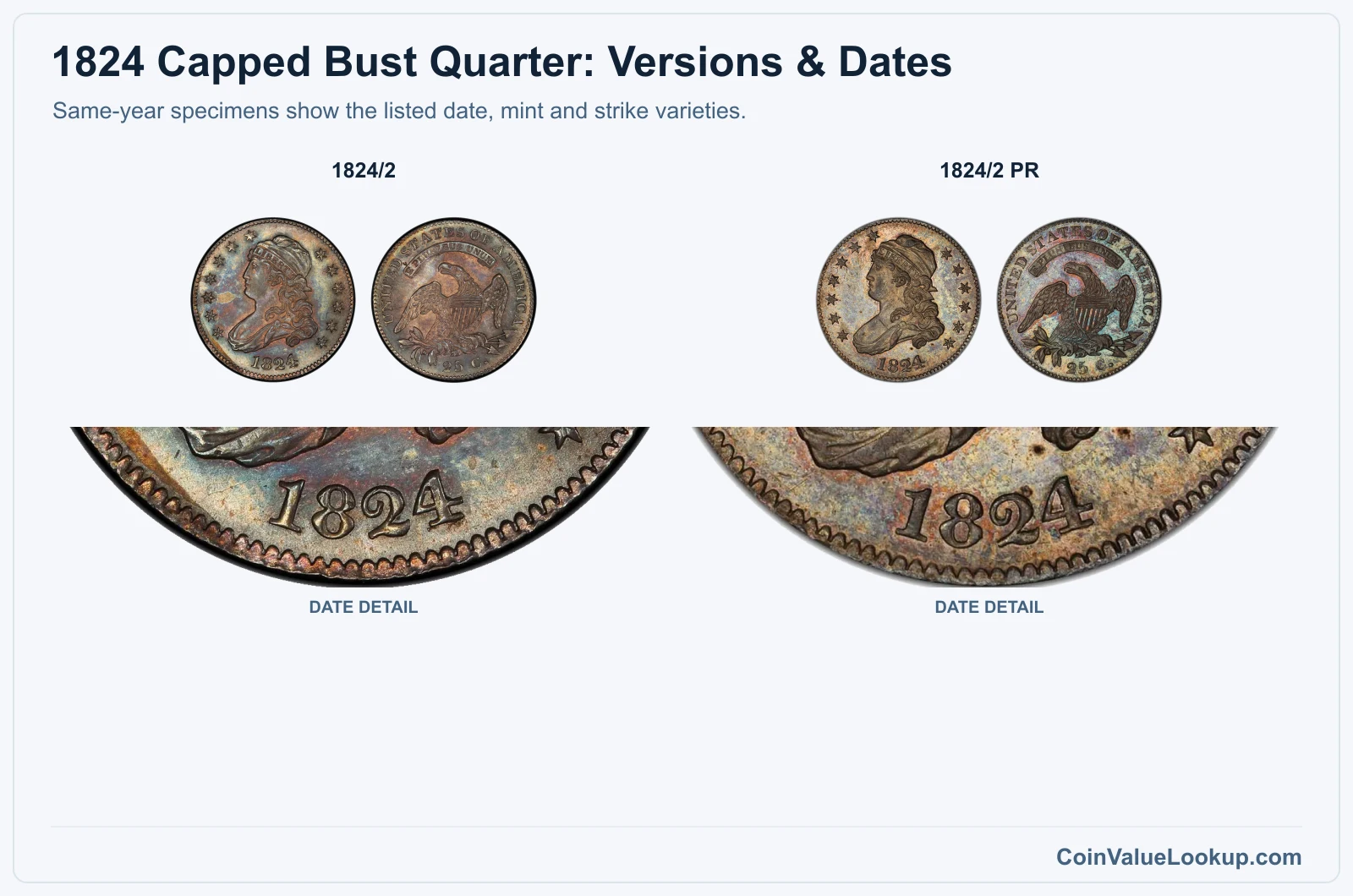
All 1824 Capped Bust Quarters were struck at Philadelphia, so there is no mintmark to look for. The coin is a silver-copper alloy, approximately 89.24% silver.
It uses the large-diameter Capped Bust design with a heraldic eagle on the reverse and the motto E PLURIBUS UNUM on a banner above.
The key identification point is the overdate. Look closely at the last digit of the date: the "4" was punched over a "2," and traces of the underlying "2" should be visible beneath or around the upright of the "4." A loupe or magnifying glass helps.
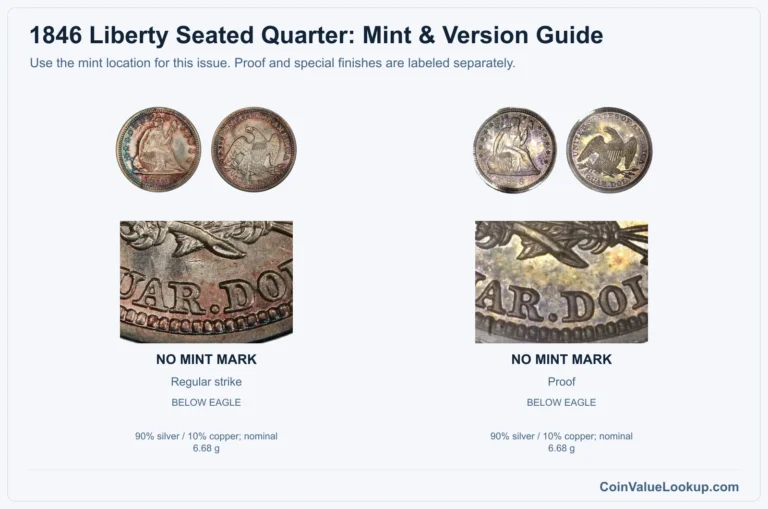
Two branches exist for 1824: the regular business strike (1824/2) and a proof version (1824/2 PR). Proof coins have deeply mirrored fields, sharp rims and squared-off edges from the die — they look fundamentally different from a business strike that just happens to be shiny.
A cleaned or polished coin is not a proof. If you suspect you have a proof, professional authentication is essential.
Coin Value Lookup is a useful starting point when you need quick reference guides for coins like this one. You can look up other dates in the Capped Bust Quarter series or explore different denominations entirely.
Step 2: Check Your 1824 Capped Bust Quarter Grade
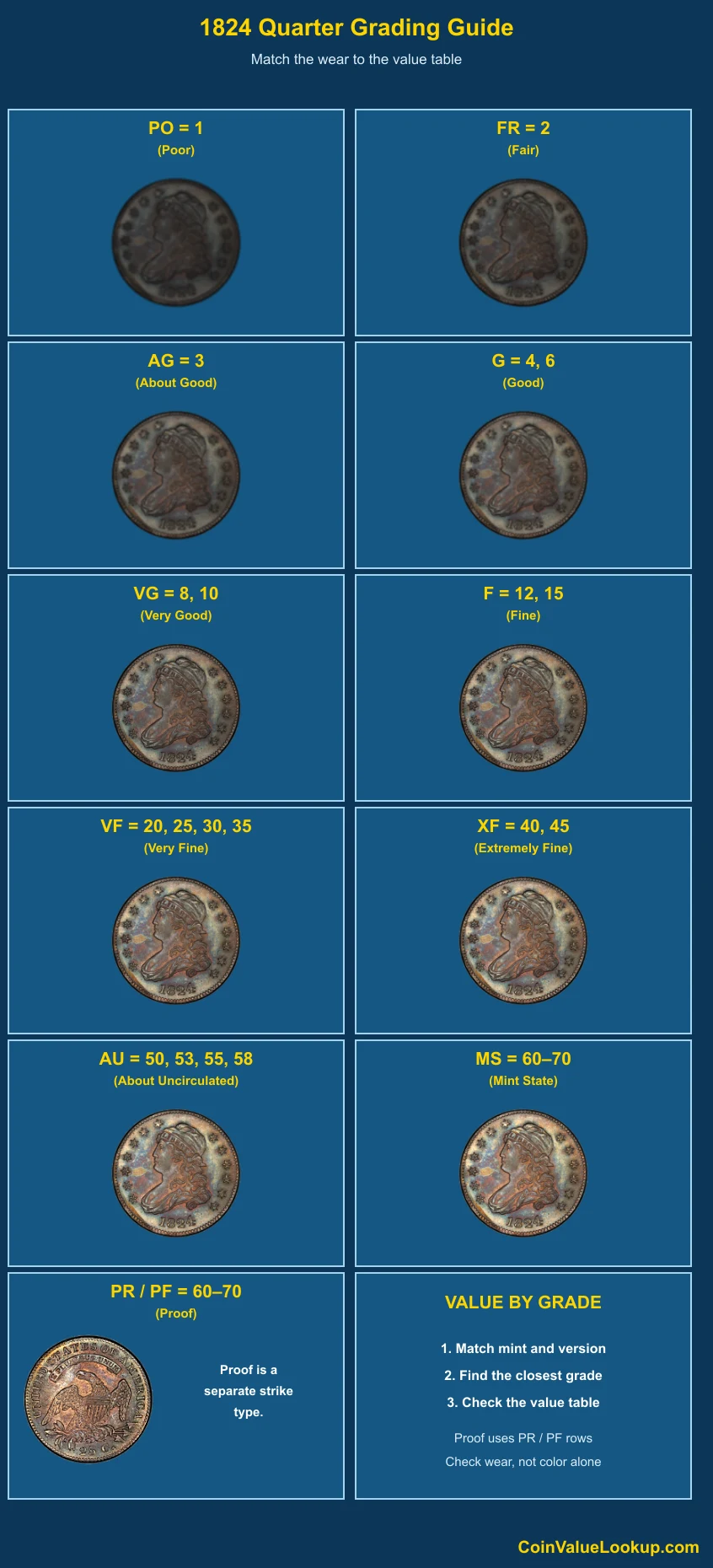
Focus on the hair detail above Liberty's ear and the folds in her cap — these are the first areas to show wear. On the reverse, check the eagle's breast feathers and the tops of the wing tips.
A coin in Good-4 will have the major design elements visible but heavily worn smooth in the high points.
As grade climbs toward Mint State, you should see increasing luster in the fields and sharper separation of the hair curls. Compare your coin against the reference image for this type.
Keep in mind that strike quality varies on early quarters; a softly struck coin can look worn even if it never circulated.
Hairlines from old cleanings or whizzing reduce value significantly, even if the underlying detail looks sharp. Original toning and undisturbed surfaces are what experienced collectors want to see.
Step 3: Check 1824 Capped Bust Quarter Value by Mint and Version
1824 Capped Bust Quarter — /2
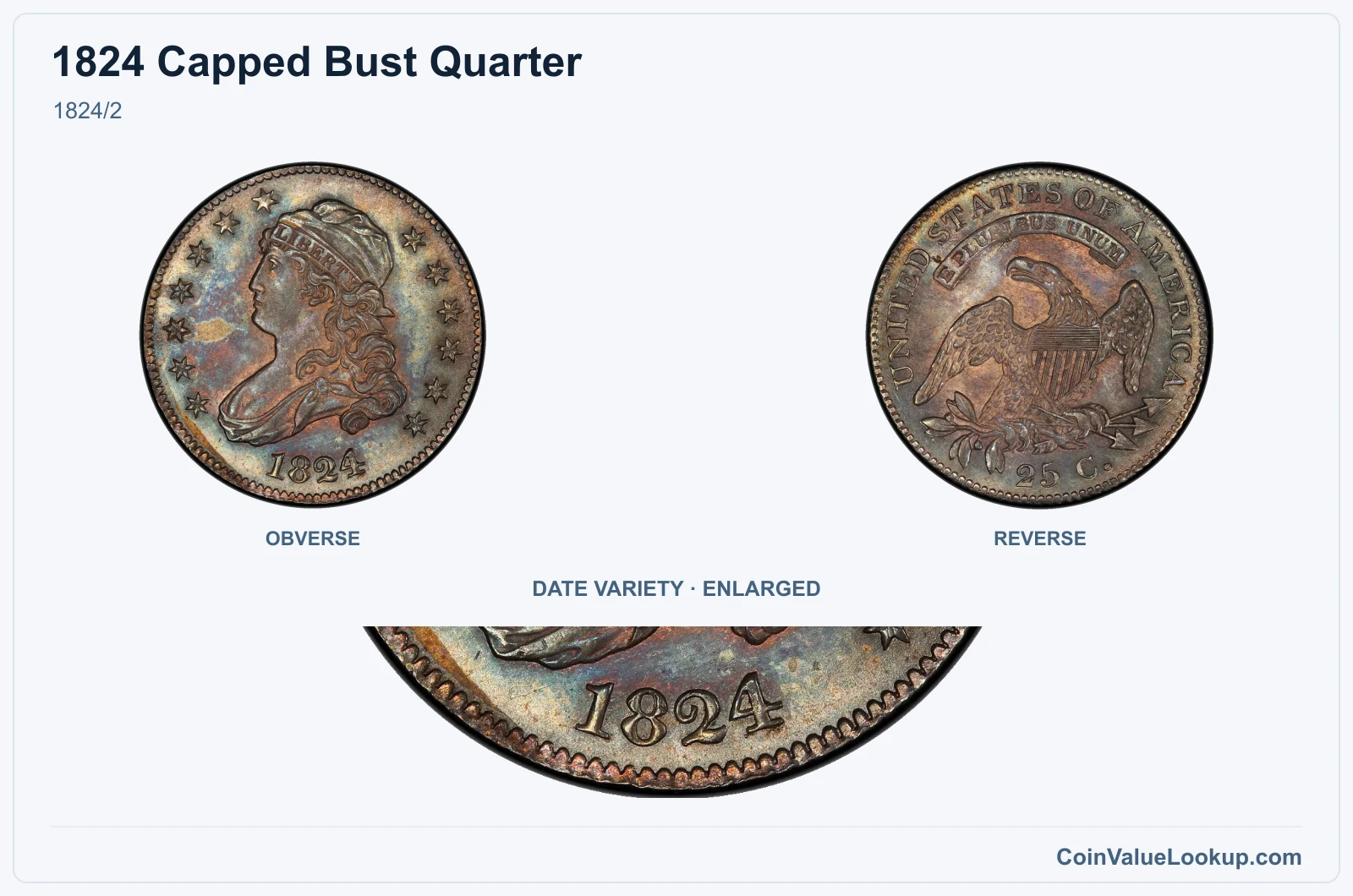
The 1824/2 is the standard business-strike version. You can identify it by the remnants of a "2" visible beneath the final "4" in the date — this was a common die-economy practice at the early Philadelphia Mint.
The coin is struck in a silver-copper alloy of approximately 89.24% silver and uses the large-diameter Capped Bust design.
USA Coin Book guide estimates place this version at $1,073.00 in Good-4, $34,434.00 in MS60, and $74,990.00 in MS63. These are retail guide estimates, not guaranteed purchase offers.
Original surfaces matter enormously at every grade level. A cleaned or damaged example will trade well below these figures, so compare your coin's surfaces carefully before drawing conclusions about value.
Range Grade
Price Auction Records Appraisal PO PO 1
—
Coin Identifier FR FR 2
Coin Identifier AG AG 3
Coin Identifier G G 4
Coin Identifier
G 6
Coin Identifier VG VG 8
Coin Identifier
VG 10
Coin Identifier F F 12
Coin Identifier
F 15
Coin Identifier VF VF 20
Coin Identifier
VF 25
Coin Identifier
VF 30
Coin Identifier
VF 35
Coin Identifier XF XF 40
Coin Identifier
XF 45
Coin Identifier AU AU 50
Coin Identifier
AU 53
Coin Identifier
AU 55
Coin Identifier
AU 58
Coin Identifier MS MS 60
—
Coin Identifier
MS 61
Coin Identifier
MS 62
Coin Identifier
MS 63
—
Coin Identifier
MS 64
Coin Identifier
MS 65
—
Coin Identifier
MS 66
—
—
—
MS 67
—
—
—
MS 68
—
—
—
MS 69
—
—
—
MS 70
—
—
—
1824 Capped Bust Quarter — /2 PR
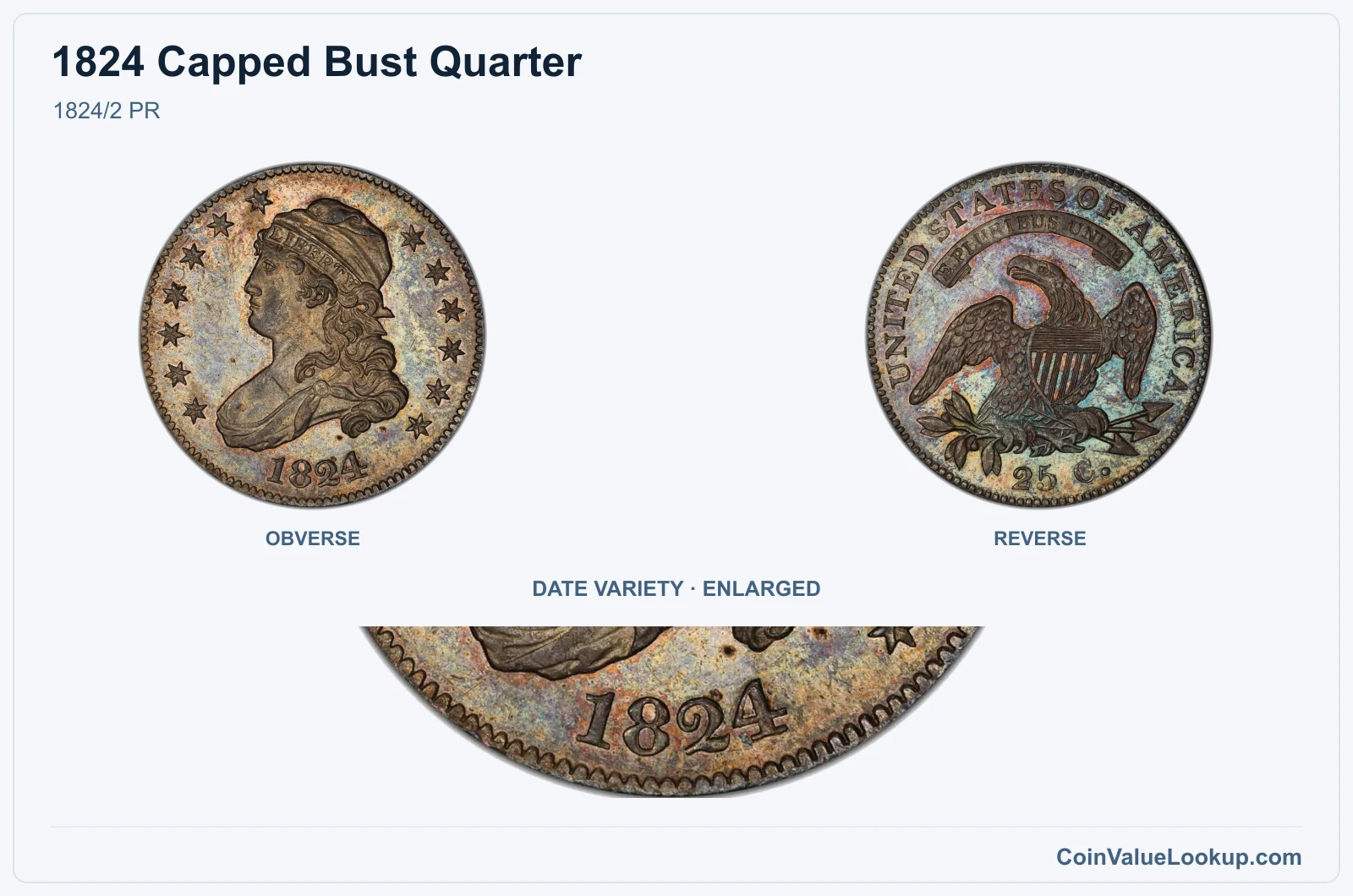
The 1824/2 PR is a proof striking of the same overdate die. Proof Capped Bust Quarters from the 1820s are exceptionally rare — these were made in tiny quantities, likely for presentation or VIP purposes, not for general sale to collectors as later proofs were.
A genuine proof will show deeply reflective mirror-like fields, razor-sharp design details and squared die rims. Do not confuse a lightly circulated business strike with flashy luster for a proof; the manufacturing process is entirely different.
Surface haze, old hairlines from cabinet friction, and any environmental damage all affect collector value.
No standard guide price is adopted for this version. Each example must be assessed individually based on its authenticated identity and condition.
Professional third-party certification is essentially mandatory for any coin claimed as a proof from this era.
Range Grade
Price Auction Records Appraisal PR PR 1
—
Coin Identifier
PR 2
—
Coin Identifier
PR 3
—
Coin Identifier
PR 4
—
Coin Identifier
PR 6
—
Coin Identifier
PR 8
—
Coin Identifier
PR 10
—
Coin Identifier
PR 12
—
Coin Identifier
PR 15
—
Coin Identifier
PR 20
—
Coin Identifier
PR 25
—
Coin Identifier
PR 30
—
Coin Identifier
PR 35
—
Coin Identifier
PR 40
—
Coin Identifier
PR 45
—
Coin Identifier
PR 50
—
Coin Identifier
PR 53
—
Coin Identifier
PR 55
—
Coin Identifier
PR 58
—
Coin Identifier
PR 60
—
Coin Identifier
PR 61
—
Coin Identifier
PR 62
—
Coin Identifier
PR 63
—
Coin Identifier
PR 64
—
—
—
PR 65
—
—
—
PR 66
—
—
—
PR 67
—
—
—
PR 68
—
—
—
PR 69
—
—
—
PR 70
—
—
—
1824 Capped Bust Quarter Error List
1. 1824 Capped Bust Quarter — Overdate
The 1824 Capped Bust Quarter is itself an overdate variety — the date reads 1824/2, with the final digit punched over a "2" from an earlier-dated die. This was a cost-saving measure at the Mint, reusing a die rather than sinking a new one.
Under magnification, you can see the curved contours of the original "2" peeking out beneath and around the vertical stroke of the "4."
This is a die variety, not a striking error in the usual sense, and it applies broadly to the 1824 business strikes. Do not confuse ordinary machine doubling or post-strike damage to the date area with an overdate — those show flat, shelf-like doubling rather than the distinct outline of a different numeral underneath.
The visibility of the underlying "2" and the coin's overall condition both affect desirability. No separate numerical price is adopted for this as an error category, since the overdate is integral to the 1824/2 version pricing already discussed.