2008 Lincoln Penny Coin Value: How Much Is It Worth?
A circulated 2008 Lincoln penny is worth about one cent. That is not a typo.
In uncirculated condition around MS65, a guide estimate from USA Coin Book places the value near $0.36, while San Francisco proofs carry a PR65 guide estimate of roughly $4.96. Collector finishes, recognized varieties and mint errors each occupy their own pricing lane, so the version matters more than the date alone.
Fast Way to Identify Your 2008 Lincoln Penny
Snap a clear photo of the front and back of your 2008 penny and upload both images here. Our identifier can provide a preliminary identification of mint, finish type and general condition so you know which version you are holding.
It is not a substitute for professional authentication, but it is a solid first step before digging deeper.
2008 Penny Value
Upload both sides of your 2008 Lincoln Penny.
Front Obverse
Upload photo
Back Reverse
Upload photo
Which 2008 Lincoln Penny Versions Are Worth Money?
- Philadelphia and Denver business strikes in MS65 carry a USA Coin Book guide estimate of about $0.36; circulated examples stay near face value.
- San Francisco proof cents at PR65 have a guide estimate around $4.96, and they were sold in collector proof sets, not released into circulation.
- Satin finish versions from Philadelphia and Denver mint sets are distinct collectibles whose value depends on authenticated identity and condition.
- Recognized mint errors such as doubled dies, off-center strikes and wrong-planchet coins can trade well above normal values depending on severity and authentication.
Step 1: Identify Your 2008 Lincoln Penny Mint Mark and Version
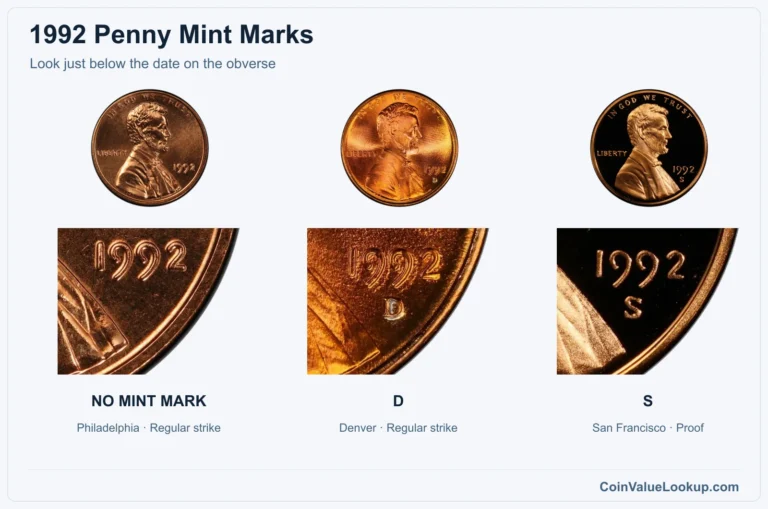
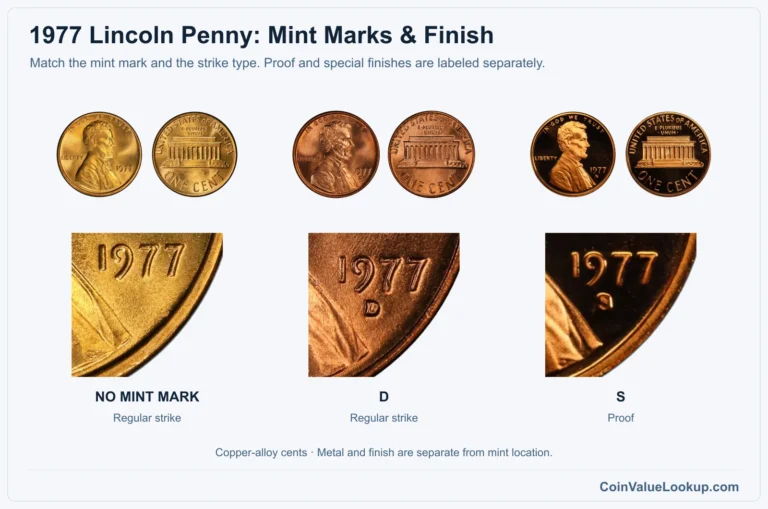
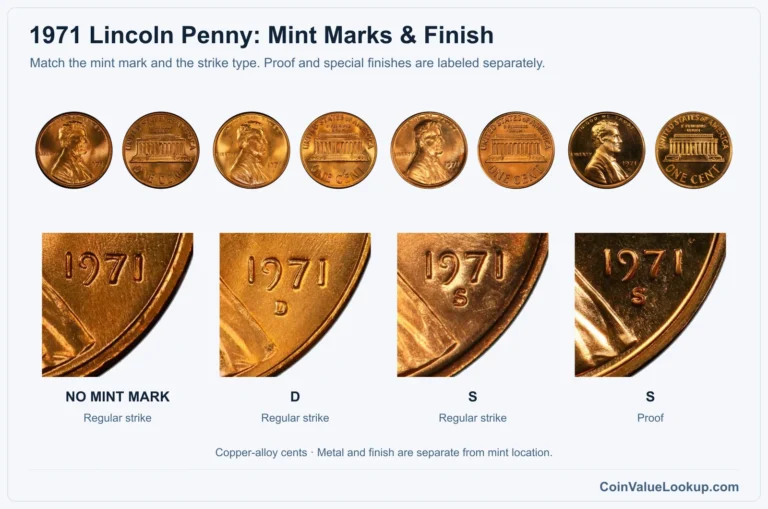
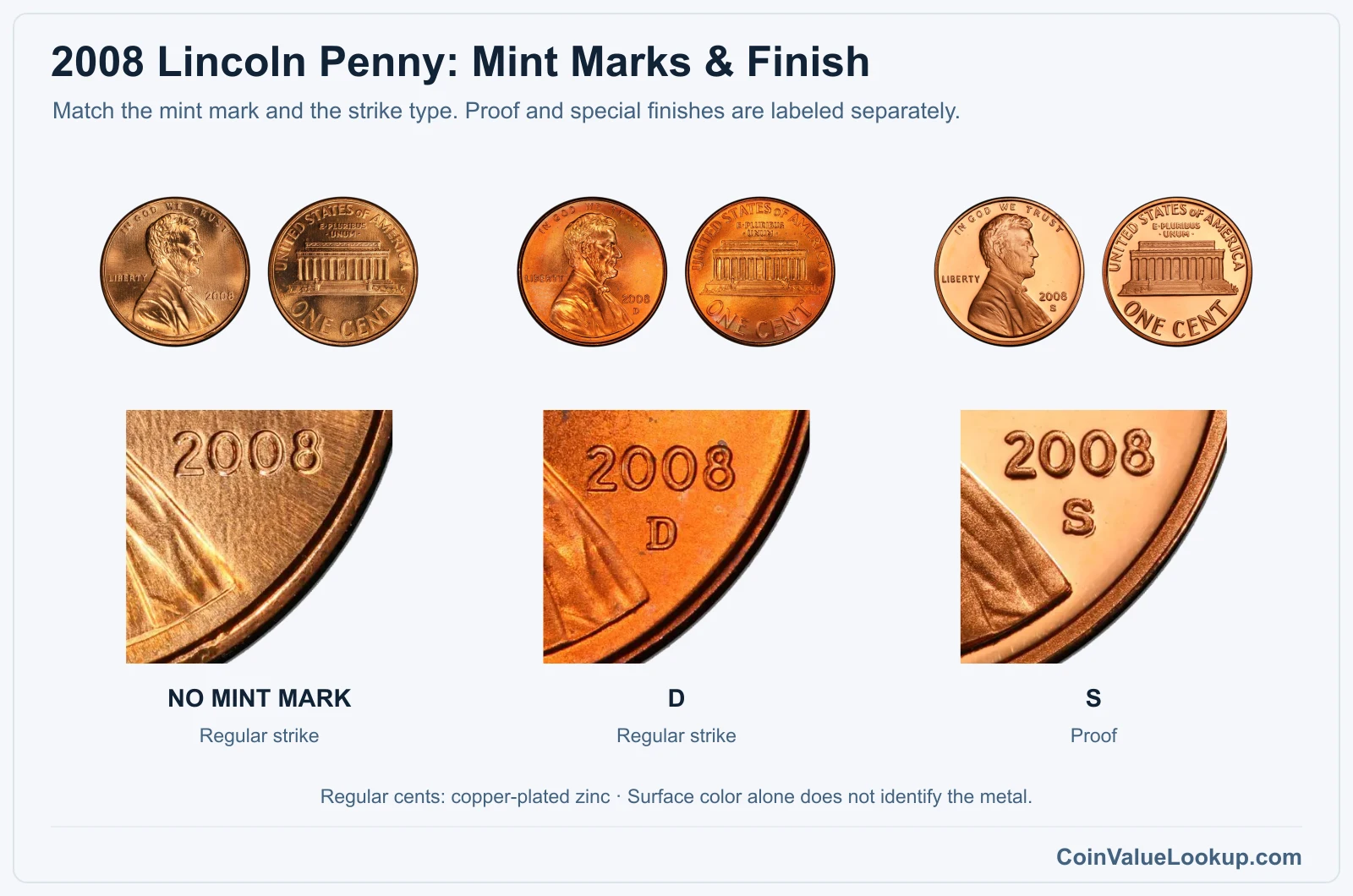
Start below the date. No mintmark means Philadelphia.
A small D means Denver. An S means San Francisco, and those coins are almost always proofs sold in sets, not found in pocket change.
All standard 2008 cents are copper-plated zinc, weighing a nominal 2.50 grams. The obverse is Lincoln's portrait; the reverse shows the Lincoln Memorial.
That Memorial design ran through 2008, replaced by four new reverses in 2009.
There is a separate satin finish version for both Philadelphia and Denver, issued only in that year's uncirculated mint sets. Satin coins have a distinctive soft sheen rather than the cartridge-brass brightness of a regular business strike or the mirror fields of a proof.
Do not lump satin pieces together with regular strikes when comparing value. If your coin came from a sealed mint set with a matte, almost velvety look, you likely have the satin version.
Step 2: Check Your 2008 Lincoln Penny Grade
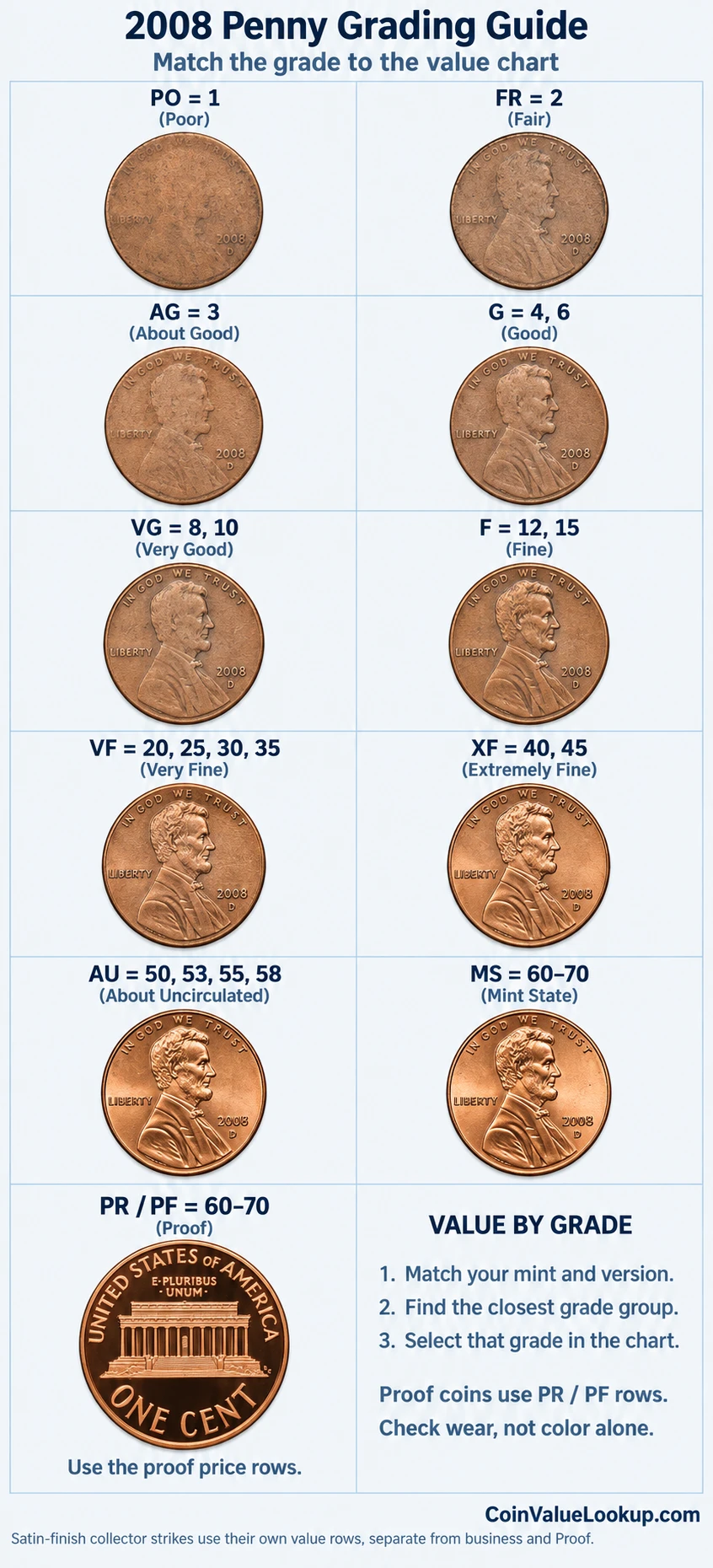
Check Lincoln's cheekbone and jawline first. On a well-worn coin these areas flatten into a smooth plane, and the hair detail behind the ear blurs together.
A coin with full separation in the hair strands and no wear on the cheek high point is heading into Mint State territory.
On the reverse, look at the tiny statue inside the Memorial and the sharpness of the columns. Luster matters too: an MS65 coin retains original mint brilliance across most surfaces with only minor contact marks.
Color designations, RD for red, RB for red-brown, and BN for brown, describe the toning of the copper plating. They are graded alongside wear but tracked separately.
A full-red coin at a given grade typically commands a higher premium than one that has toned brown.
Proof is a manufacturing finish with mirror-like fields, not a grade higher than Mint State. Satin finish is also a production method, not a wear level.
Compare your coin to the reference image to gauge where it falls on the wear spectrum.
Step 3: Check 2008 Lincoln Penny Value by Mint and Version
2008 Lincoln Penny
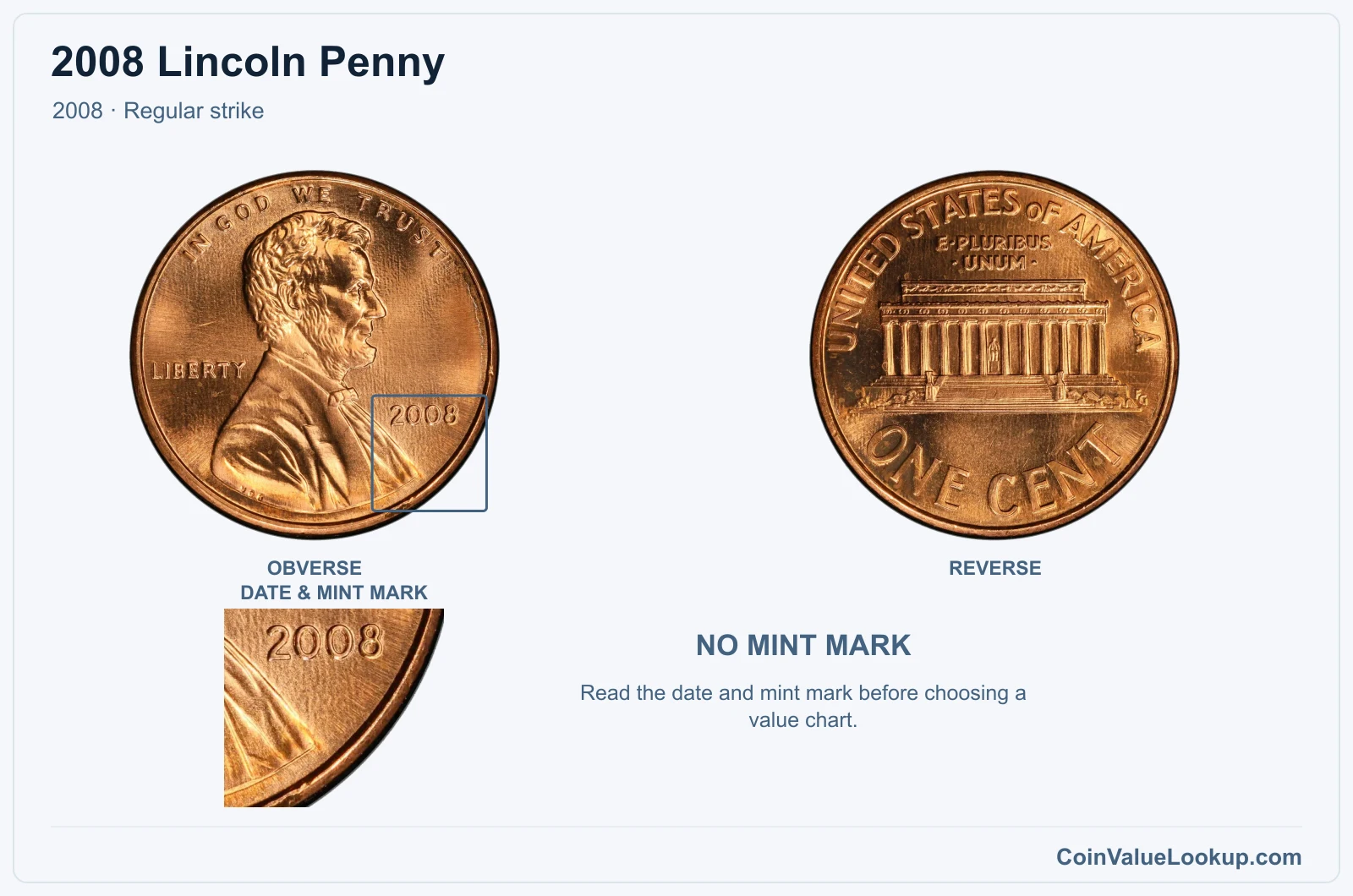
This is the standard Philadelphia business strike with no mintmark. Billions were produced, so circulated examples are worth face value.
In MS65 condition with original surfaces, a USA Coin Book guide estimate puts it at about $0.36. The premium is modest, but coins retaining full red color can edge higher within the grade.
To confirm this version, look for the absence of a mintmark below the date and the typical bright, slightly glossy finish of a business strike rather than the softer look of a satin coin.
| Range | Grade | Price | Auction Records | Appraisal |
|---|---|---|---|---|
| PO | PO 1 | — | Coin Identifier | |
| FR | FR 2 | — | Coin Identifier | |
| AG | AG 3 | — | Coin Identifier | |
| G | G 4 | — | Coin Identifier | |
| G 6 | — | Coin Identifier | ||
| VG | VG 8 | — | Coin Identifier | |
| VG 10 | — | Coin Identifier | ||
| F | F 12 | — | Coin Identifier | |
| F 15 | — | Coin Identifier | ||
| VF | VF 20 | — | Coin Identifier | |
| VF 25 | — | Coin Identifier | ||
| VF 30 | — | Coin Identifier | ||
| VF 35 | — | Coin Identifier | ||
| XF | XF 40 | — | Coin Identifier | |
| XF 45 | — | Coin Identifier | ||
| AU | AU 50 | — | Coin Identifier | |
| AU 53 | — | Coin Identifier | ||
| AU 55 | — | Coin Identifier | ||
| AU 58 | — | Coin Identifier | ||
| MS | MS 60 | — | Coin Identifier | |
| MS 61 | — | Coin Identifier | ||
| MS 62 | — | Coin Identifier | ||
| MS 63 | — | Coin Identifier | ||
| MS 64 | — | Coin Identifier | ||
| MS 65 | — | Coin Identifier | ||
| MS 66 | Coin Identifier | |||
| MS 67 | Coin Identifier | |||
| MS 68 | — | Coin Identifier | ||
| MS 69 | — | — | — | |
| MS 70 | — | — | — |
2008 Lincoln Penny — D
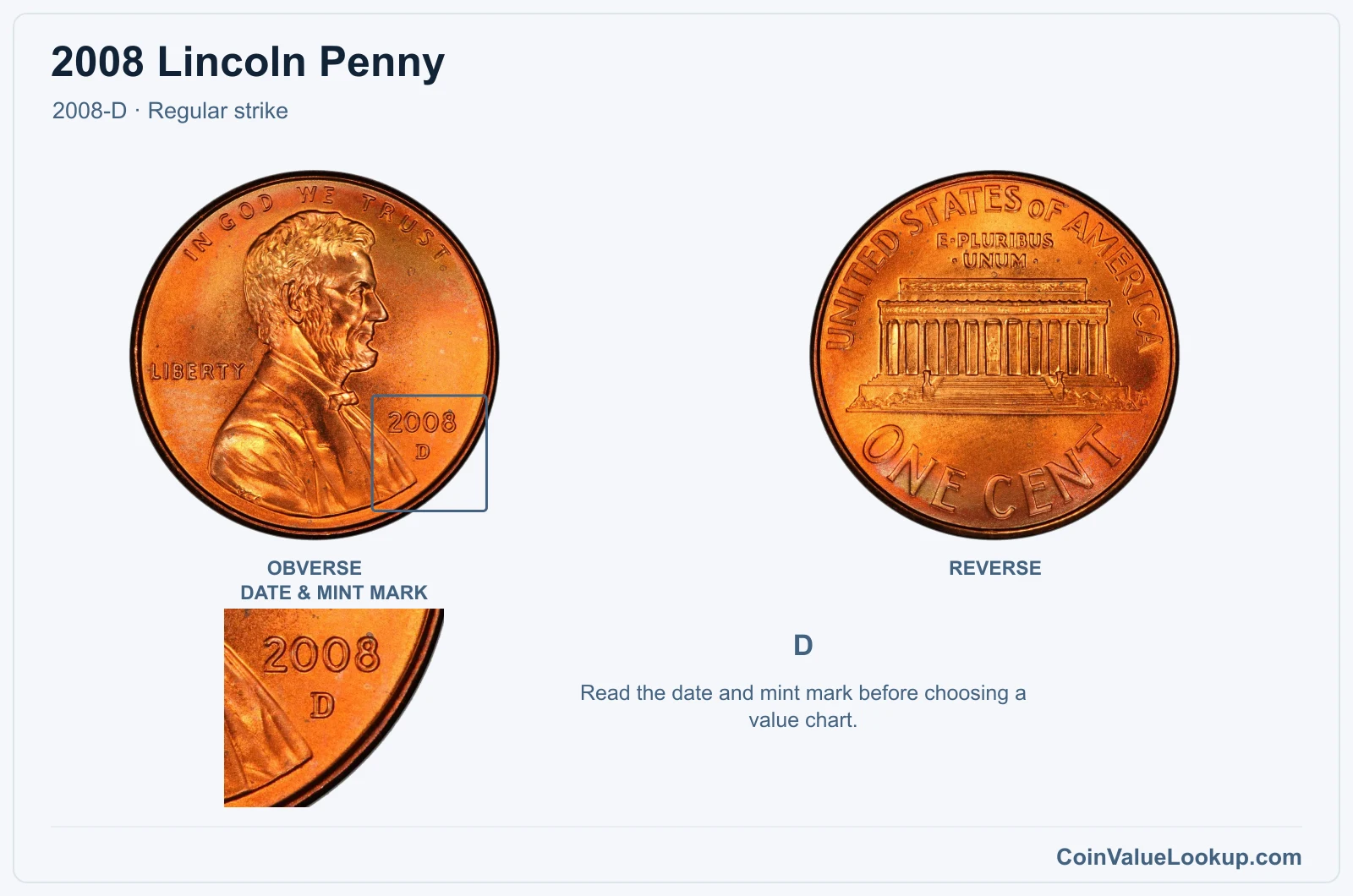
Denver's 2008 cent carries a small D mintmark below the date. Like its Philadelphia sibling, it is extremely common in circulation and worth one cent in worn grades.
At MS65 the USA Coin Book guide estimate is around $0.36.
Separate this from the Denver satin version by examining the surface texture. A business strike has a conventional luster; the satin coin has a muted, almost frosted sheen across both faces.
| Range | Grade | Price | Auction Records | Appraisal |
|---|---|---|---|---|
| PO | PO 1 | — | Coin Identifier | |
| FR | FR 2 | — | Coin Identifier | |
| AG | AG 3 | — | Coin Identifier | |
| G | G 4 | — | Coin Identifier | |
| G 6 | — | Coin Identifier | ||
| VG | VG 8 | — | Coin Identifier | |
| VG 10 | — | Coin Identifier | ||
| F | F 12 | — | Coin Identifier | |
| F 15 | — | Coin Identifier | ||
| VF | VF 20 | — | Coin Identifier | |
| VF 25 | — | Coin Identifier | ||
| VF 30 | — | Coin Identifier | ||
| VF 35 | — | Coin Identifier | ||
| XF | XF 40 | — | Coin Identifier | |
| XF 45 | — | Coin Identifier | ||
| AU | AU 50 | — | Coin Identifier | |
| AU 53 | — | Coin Identifier | ||
| AU 55 | — | Coin Identifier | ||
| AU 58 | — | Coin Identifier | ||
| MS | MS 60 | — | Coin Identifier | |
| MS 61 | — | Coin Identifier | ||
| MS 62 | — | Coin Identifier | ||
| MS 63 | — | Coin Identifier | ||
| MS 64 | — | Coin Identifier | ||
| MS 65 | — | Coin Identifier | ||
| MS 66 | Coin Identifier | |||
| MS 67 | Coin Identifier | |||
| MS 68 | Coin Identifier | |||
| MS 69 | — | — | — | |
| MS 70 | — | — | — |
2008 Lincoln Penny — S PR
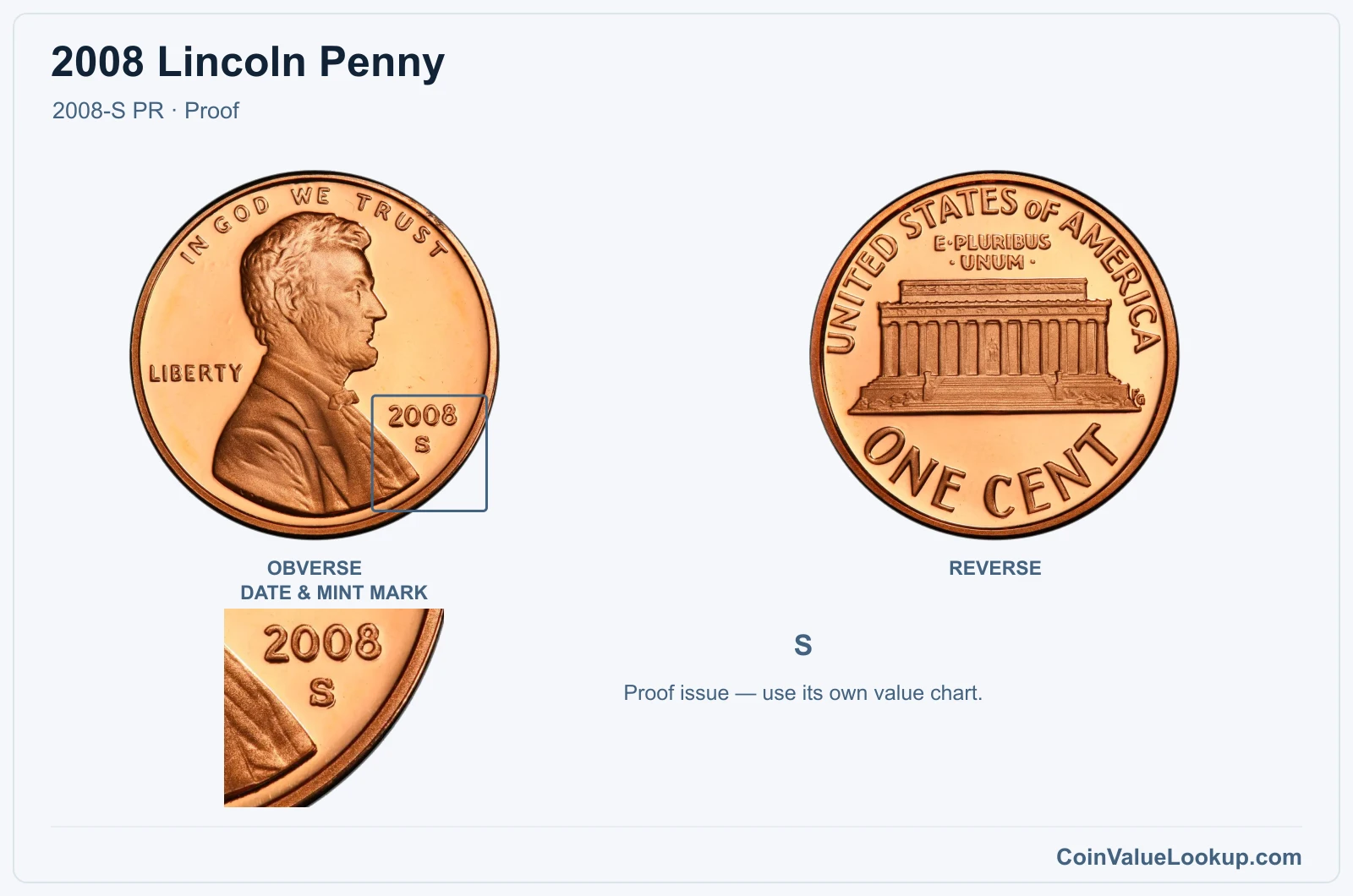
The 2008-S proof was struck at San Francisco for collector sets. Look for the S mintmark and deeply mirrored fields that reflect like glass.
At PR65, the USA Coin Book guide estimate is approximately $4.96.
Proof pennies were not released into circulation. If you find one in the wild, someone broke open a set.
Cameo or deep cameo contrast, where Lincoln's portrait appears frosted against the mirror field, is tracked separately from the base proof designation. These coins should show no wear; any contact marks affect the assigned proof grade.
| Range | Grade | Price | Auction Records | Appraisal |
|---|---|---|---|---|
| PR | PR 1 | — | Coin Identifier | |
| PR 2 | — | Coin Identifier | ||
| PR 3 | — | Coin Identifier | ||
| PR 4 | — | Coin Identifier | ||
| PR 6 | — | Coin Identifier | ||
| PR 8 | — | Coin Identifier | ||
| PR 10 | — | Coin Identifier | ||
| PR 12 | — | Coin Identifier | ||
| PR 15 | — | Coin Identifier | ||
| PR 20 | — | Coin Identifier | ||
| PR 25 | — | Coin Identifier | ||
| PR 30 | — | Coin Identifier | ||
| PR 35 | — | Coin Identifier | ||
| PR 40 | — | Coin Identifier | ||
| PR 45 | — | Coin Identifier | ||
| PR 50 | — | Coin Identifier | ||
| PR 53 | — | Coin Identifier | ||
| PR 55 | — | Coin Identifier | ||
| PR 58 | — | Coin Identifier | ||
| PR 60 | — | Coin Identifier | ||
| PR 61 | — | Coin Identifier | ||
| PR 62 | — | Coin Identifier | ||
| PR 63 | — | Coin Identifier | ||
| PR 64 | — | Coin Identifier | ||
| PR 65 | — | Coin Identifier | ||
| PR 66 | — | Coin Identifier | ||
| PR 67 | — | Coin Identifier | ||
| PR 68 | — | Coin Identifier | ||
| PR 69 | Coin Identifier | |||
| PR 70 | Coin Identifier |
2008 Lincoln Penny — Satin Finish SP
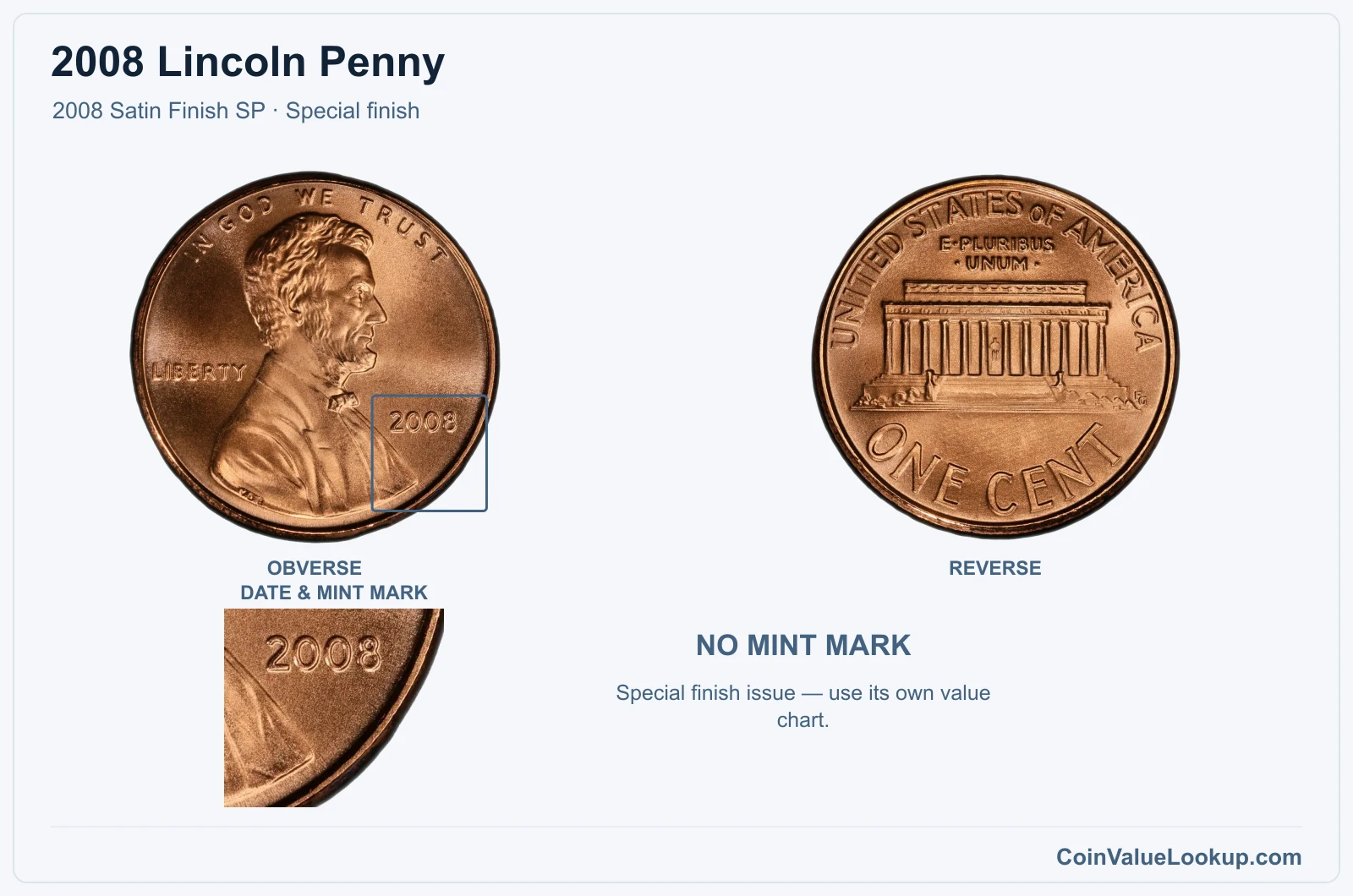
Philadelphia satin finish cents were included in the 2005 through 2010 uncirculated mint sets. They have no mintmark, same as the regular Philly strike, so surface texture is your main clue.
The satin finish looks soft and even, lacking the sharp reflective luster of a business strike.
Coin Value Lookup is a handy place to look up guides for different versions and years of Lincoln cents if you are trying to compare your satin coin against other branches.
No specific guide price was adopted for this version. Value depends on authenticated identity, condition and whether the original satin surfaces remain unimpaired.
| Range | Grade | Price | Auction Records | Appraisal |
|---|---|---|---|---|
| SP | SP 1 | — | Coin Identifier | |
| SP 2 | — | Coin Identifier | ||
| SP 3 | — | Coin Identifier | ||
| SP 4 | — | Coin Identifier | ||
| SP 6 | — | Coin Identifier | ||
| SP 8 | — | Coin Identifier | ||
| SP 10 | — | Coin Identifier | ||
| SP 12 | — | Coin Identifier | ||
| SP 15 | — | Coin Identifier | ||
| SP 20 | — | Coin Identifier | ||
| SP 25 | — | Coin Identifier | ||
| SP 30 | — | Coin Identifier | ||
| SP 35 | — | Coin Identifier | ||
| SP 40 | — | Coin Identifier | ||
| SP 45 | — | Coin Identifier | ||
| SP 50 | — | Coin Identifier | ||
| SP 53 | — | Coin Identifier | ||
| SP 55 | — | Coin Identifier | ||
| SP 58 | — | Coin Identifier | ||
| SP 60 | — | Coin Identifier | ||
| SP 61 | — | Coin Identifier | ||
| SP 62 | — | Coin Identifier | ||
| SP 63 | — | Coin Identifier | ||
| SP 64 | — | Coin Identifier | ||
| SP 65 | — | Coin Identifier | ||
| SP 66 | — | Coin Identifier | ||
| SP 67 | — | Coin Identifier | ||
| SP 68 | Coin Identifier | |||
| SP 69 | — | Coin Identifier | ||
| SP 70 | — | — | — |
2008 Lincoln Penny — D Satin Finish SP
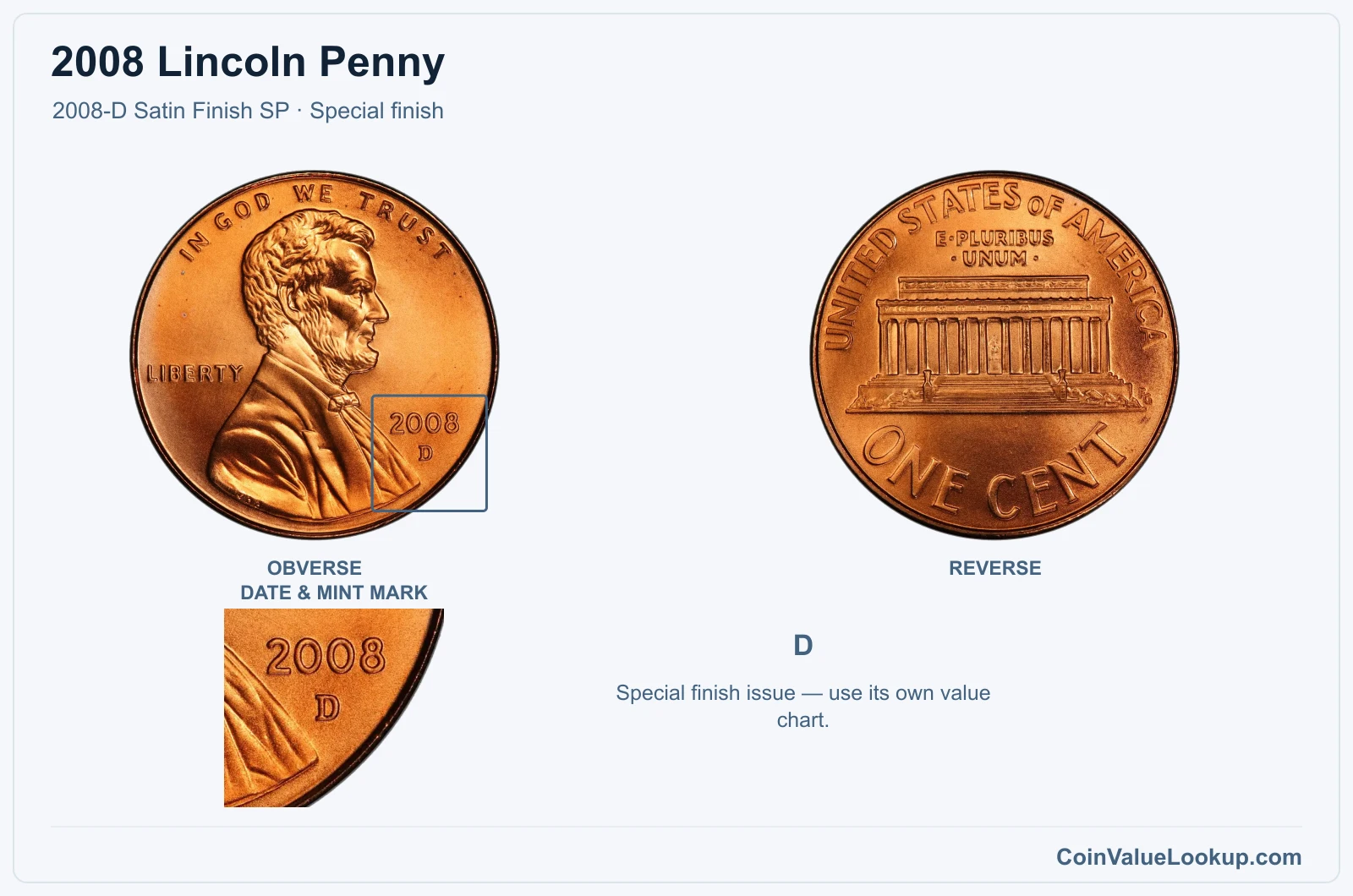
Denver's satin finish cent carries the D mintmark and the same soft, even surface texture as the Philadelphia satin version. It was available only through the 2008 uncirculated mint set.
Distinguishing it from a regular Denver business strike requires examining the luster under good light. The satin coin lacks the sharp cartridge-brass gleam of a circulation strike and instead shows a uniform matte-like sheen.
No specific guide price was adopted for this version. Its value is determined by authenticated identity, preservation of the original satin surfaces and overall condition.
| Range | Grade | Price | Auction Records | Appraisal |
|---|---|---|---|---|
| SP | SP 1 | — | Coin Identifier | |
| SP 2 | — | Coin Identifier | ||
| SP 3 | — | Coin Identifier | ||
| SP 4 | — | Coin Identifier | ||
| SP 6 | — | Coin Identifier | ||
| SP 8 | — | Coin Identifier | ||
| SP 10 | — | Coin Identifier | ||
| SP 12 | — | Coin Identifier | ||
| SP 15 | — | Coin Identifier | ||
| SP 20 | — | Coin Identifier | ||
| SP 25 | — | Coin Identifier | ||
| SP 30 | — | Coin Identifier | ||
| SP 35 | — | Coin Identifier | ||
| SP 40 | — | Coin Identifier | ||
| SP 45 | — | Coin Identifier | ||
| SP 50 | — | Coin Identifier | ||
| SP 53 | — | Coin Identifier | ||
| SP 55 | — | Coin Identifier | ||
| SP 58 | — | Coin Identifier | ||
| SP 60 | — | Coin Identifier | ||
| SP 61 | — | Coin Identifier | ||
| SP 62 | — | Coin Identifier | ||
| SP 63 | — | Coin Identifier | ||
| SP 64 | — | Coin Identifier | ||
| SP 65 | — | Coin Identifier | ||
| SP 66 | — | Coin Identifier | ||
| SP 67 | — | Coin Identifier | ||
| SP 68 | Coin Identifier | |||
| SP 69 | Coin Identifier | |||
| SP 70 | — | — | — |
2008 Lincoln Penny Error List
1. 2008 Lincoln Penny — Doubled Die Obverse
A doubled die obverse on a 2008 Lincoln cent shows consistent separation or notching on obverse design elements, typically visible in the lettering or date. Under magnification, compare the letters of LIBERTY and IN GOD WE TRUST against a normal coin under matching lighting.
Genuine doubling appears as a uniform shift or split across multiple letters, with a consistent direction. Machine doubling, by contrast, tends to produce flat, shelf-like distortions without true separation.
Reflections and worn die marks can also mimic doubling.
No specific price was adopted for this category. Value depends on the strength and location of the doubling, confirmed by professional authentication.
2. 2008 Lincoln Penny — Doubled Die Reverse
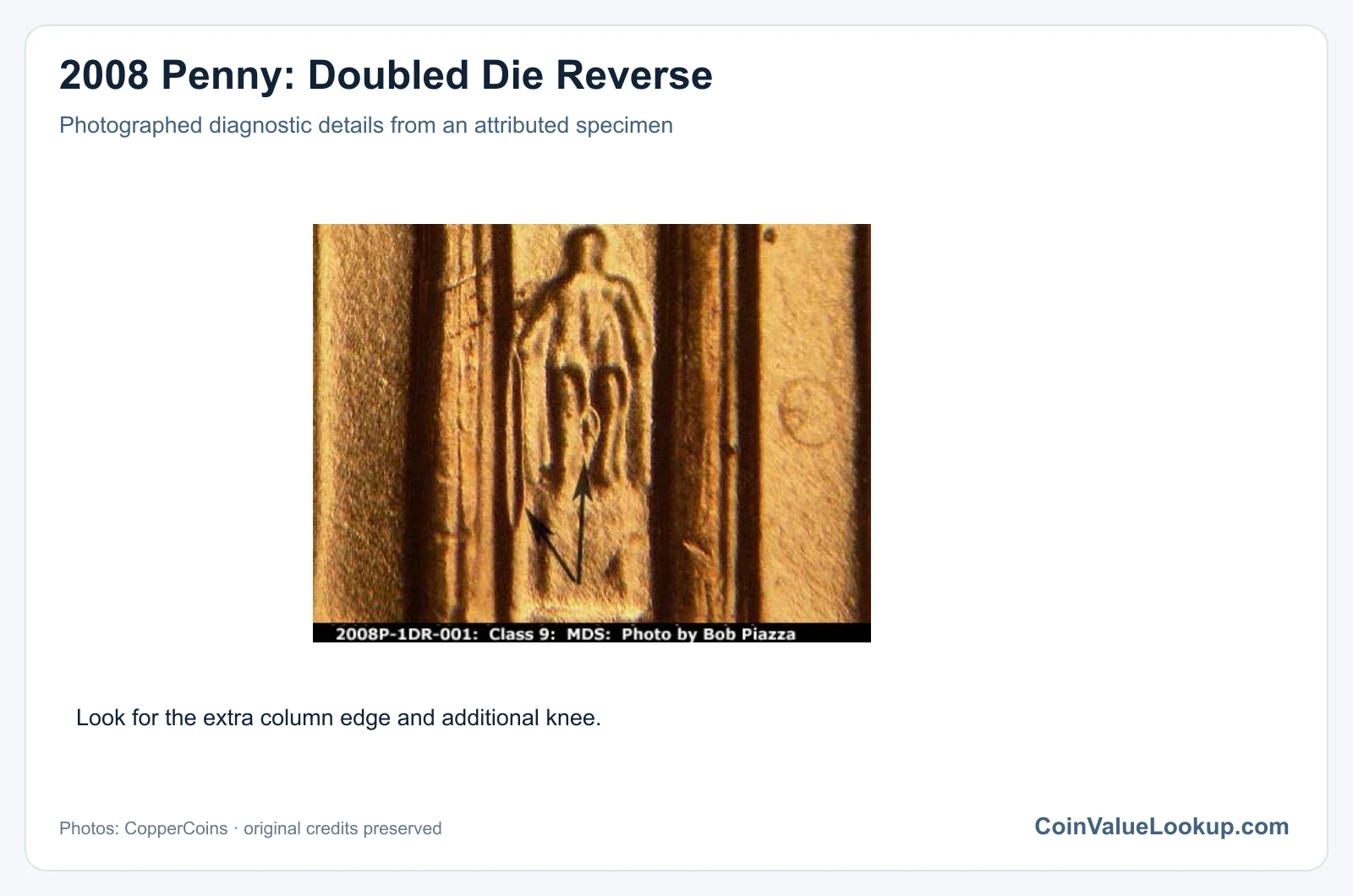
A doubled die reverse shows repeated or split design details on the Memorial side. Look at the reverse legends, particularly E PLURIBUS UNUM and UNITED STATES OF AMERICA, for consistent separation that matches across multiple letters.
Compare closely with a normal 2008 reverse under the same magnification. Machine doubling creates a flat, mushy look rather than the crisp secondary image of a true doubled die.
Random damage or scratches can also create misleading raised lines.
No specific price was adopted. Professional authentication determines whether the doubling is a recognized die variety and what premium, if any, it carries.
3. 2008 Lincoln Penny — Flip-Over Double Strike
A flip-over double strike happens when a coin fails to eject and gets struck a second time after flipping in the collar. The result is dramatic: you will see overlapping obverse and reverse design elements on the same face, often at an angle to each other.
This is a whole-coin error that is impossible to fake convincingly. Look for complete design impressions from both strikes, with metal flow consistent throughout.
Post-mint impressions from vises or hammers lack the depth and die-finish texture of a genuine second strike.
No specific price was adopted. These are scarce errors, and value depends on the degree of overlap, visual impact and third-party authentication.
4. 2008 Lincoln Penny — Brockage
A brockage occurs when a previously struck coin sticks to a die and impresses its design, in mirror image and incuse, onto the next blank that feeds into the press. One side of the affected coin shows a normal strike; the other carries a sunken, reversed copy of the opposing coin's design.
Do not confuse a brockage with a die clash. A clash transfers only faint ghost outlines, while a brockage reproduces deep, recognizable design details in incuse relief.
Post-mint squeezing of two coins together also lacks the proper metal flow.
No specific price was adopted. Authentication is essential, as the error must show characteristics consistent with in-press production.
5. 2008 Lincoln Penny — Clashed Dies
Clashed dies happen when the hammer and anvil dies strike each other without a planchet between them. The result is faint ghost impressions of one die's design transferred onto the opposing die, then stamped onto subsequent coins.
On the obverse you might spot traces of the Memorial columns or reverse lettering in the fields around Lincoln. On the reverse, Lincoln's profile outline or parts of LIBERTY may appear faintly.
These traces align with where the opposite die's features would contact.
Scratches, raised lines from die polish, and brockage remnants can look similar. No specific price was adopted for clashed-die 2008 cents.
Strength of the transferred image and professional confirmation affect value.
6. 2008 Lincoln Penny — Saddle Strike
A saddle strike occurs when a planchet is struck twice with the two impressions offset from each other, leaving a raised, unstruck bridge of metal between them. The coin looks like a small saddle shape when viewed from the edge.
Both strike impressions are visible, but neither is complete, and the unstruck ridge in the middle has no design detail at all. A bent coin or a plain double strike without the characteristic raised bridge is not a saddle strike.
No specific price was adopted. Saddle strikes on modern cents are unusual, and value depends on how distinctly the two impressions and the bridge are preserved.
Professional authentication is recommended.
7. 2008 Lincoln Penny — Broadstrike
A broadstrike happens when the retaining collar fails and the planchet spreads outward under striking pressure. The coin retains a full design on both faces but is wider than normal, with a smooth or irregular edge instead of the usual reeded-free rim.
Measure the diameter. A genuine broadstrike will exceed the standard 19.05 mm.
The design may appear slightly spread, and the rim will be weak or absent in places. A coin that was simply flattened after leaving the mint will show distorted details and damage inconsistent with die contact.
No specific price was adopted. The degree of spread, centering and overall eye appeal influence value.
Authentication confirms the error originated during production.
8. 2008 Lincoln Penny — Die-Adjustment / Low-Pressure Strike
A die-adjustment or low-pressure strike shows weak, incomplete design detail across both faces even though the coin is full diameter and has not been worn. High points and lettering appear mushy or partially formed, and the overall impression is shallow.
This category is tricky because circulation wear also softens details. The key difference: a genuine low-pressure strike retains unworn, flat surfaces in areas that did strike up, while a worn coin shows friction and luster loss on high points.
Grease-filled dies can mimic weakness but typically affect only localized areas.
No specific price was adopted. These are reported as a recognized error category, but confirming the cause requires professional examination.
9. 2008 Lincoln Penny — Wrong Planchet / Off-Metal Strike
A wrong-planchet error means the 2008 cent dies struck a blank intended for a different denomination or even a different country's coin. The result is a coin with Lincoln cent designs on a planchet of unexpected weight, diameter, color or edge.
Weigh and measure the coin carefully. A standard cent planchet is 2.50 grams and 19.05 mm.
Significant deviation, combined with complete or nearly complete design, points toward a possible wrong-planchet strike. Do not assume based on appearance alone: plating loss, corrosion, acid treatment and deliberate alteration can all make a normal cent look unusual.
No specific price was adopted. Professional authentication with weight and composition testing is essential for this error category.
10. 2008 Lincoln Penny — Off-Center Strike
An off-center strike occurs when the planchet is not properly seated between the dies, so part of the design is missing and a blank crescent of unstruck metal appears along one edge. The percentage off-center and whether the date remains visible are the two biggest factors collectors care about.
A coin struck 5% off-center is mildly interesting. One struck 50% off-center with a full, readable date is far more dramatic.
Compare the blank crescent area: it should show smooth, original planchet surface, not a cut or filed edge. Clipped planchets and post-mint damage can superficially resemble an off-center strike.
No specific price was adopted. Value scales with the percentage of displacement, date visibility and authentication.
11. 2008 Lincoln Penny — Die Crack / Die Chip
Die cracks appear as thin raised lines on the coin's surface where the die developed a fracture. Die chips show up as small raised blobs where a tiny piece of the die face broke away, leaving a void that fills with metal during striking.
These are raised features, not incuse scratches. Run a fingernail across the suspected line: if it is raised above the field, it could be a die crack.
Incuse scratches, corrosion pits and foreign material sitting on the surface are common lookalikes. An interior chip is different from a rim-connected cud, which is a larger break.
No specific price was adopted. Most minor die cracks add little premium, but dramatic examples on key design areas may attract interest with authentication.
12. 2008 Lincoln Penny — Die Break / Cud
A cud is a major die break that connects to the rim, leaving a raised, featureless blob of metal where part of the design should be. It forms when a chunk of the die edge fractures and falls away.
Look at the boundary between the cud and the normal design. On a genuine cud, the transition is sharp on the design side and the blob itself is smooth and slightly convex.
A rim dent or corrosion lump does not have this clean boundary. Interior die chips that do not reach the rim are classified as die chips, not cuds.
No specific price was adopted. Size, location and visual impact determine collector interest, and professional authentication confirms the break originated from the die.
13. 2008 Lincoln Penny — BIE Die Break
The BIE error is a specific type of die break found on Lincoln cents where a small raised vertical line or blob appears between the letters B and E in LIBERTY. It is caused by a die crack or chip in that particular area of the die.
Under magnification, the raised bridge should be consistent with the surface texture of the surrounding letters. Dirt, adhesive residue, a scratch or a tiny piece of foreign metal lodged in the recessed area can mimic the BIE look.
Gently cleaning the area sometimes reveals the impostor.
No specific price was adopted. BIE errors are a popular collecting niche among Lincoln cent enthusiasts, but value depends on the clarity of the break and confirmation through professional examination.
14. 2008 Lincoln Penny — Clipped Planchet
A clipped planchet error occurs when the blank is punched from strip metal that overlaps a previously punched hole or the edge of the strip. The result is a coin missing a curved, straight or irregularly shaped portion of its edge.
The Blakesley effect is a helpful diagnostic: look for weakness in the rim and design detail directly opposite the clip. This weakness results from reduced metal flow during striking and is hard to fake.
A filed notch, deliberate cut or corroded edge will not produce that opposite-side weakness.
No specific price was adopted. The size and shape of the clip, along with how much design is affected, determine collector interest.
Professional authentication confirms the clip happened before striking.