1841 Liberty Seated Dime Coin Value: How Much Is It Worth?
The 1841 Liberty Seated Dime spans a retail guide range from about $29 at G4 to $1,750 at MS63 across normal business-strike issues from Philadelphia and New Orleans. Proofs and special varieties sit in their own pricing territory entirely.
This year also produced rare Closed Bud transitional reverse dies paired with the New Orleans mint, plus an extremely scarce No Drapery Proof — so knowing exactly which branch you hold matters a lot.
Fast Way to Identify Your 1841 Liberty Seated Dime
Snap a clear photo of both the front and back of your coin and upload them for a preliminary identification. This helps narrow down whether you have a Philadelphia or New Orleans issue, whether the reverse shows Open Bud or Closed Bud details, and what condition range your piece falls into.
Sharp, well-lit images make all the difference.
1841 Liberty Seated Dime Value
Upload both sides of your 1841 Liberty Seated Dime.
Front Obverse
Upload photo
Back Reverse
Upload photo
Which 1841 Liberty Seated Dime Versions Are Worth Money?
- New Orleans O-mint coins with Closed Bud transitional reverses (Small O or Large O) are rare die pairings worth identifying separately from the normal Open Bud reverse.
- The No Drapery Proof from Philadelphia is catalogued as a distinct rare Proof issue by PCGS — not a regular circulation coin.
- Proof With Drapery examples carry a PCGS guide value around $60,000 at PR63, reflecting extreme rarity for this early date.
- O-mint business strikes in high grades (MS63 range) guide near $1,750, substantially above their Philadelphia counterparts at that level.
- Repunched date varieties exist and can carry premiums depending on visibility and condition.
Step 1: Identify Your 1841 Liberty Seated Dime Mint Mark and Version
Start by confirming you have a seated Liberty obverse paired with a ONE DIME reverse inside a small wreath — this rules out half dimes and other denominations. The coin should measure 17.9 mm in diameter with a reeded edge and weigh approximately 2.67 grams in 90% silver and 10% copper.
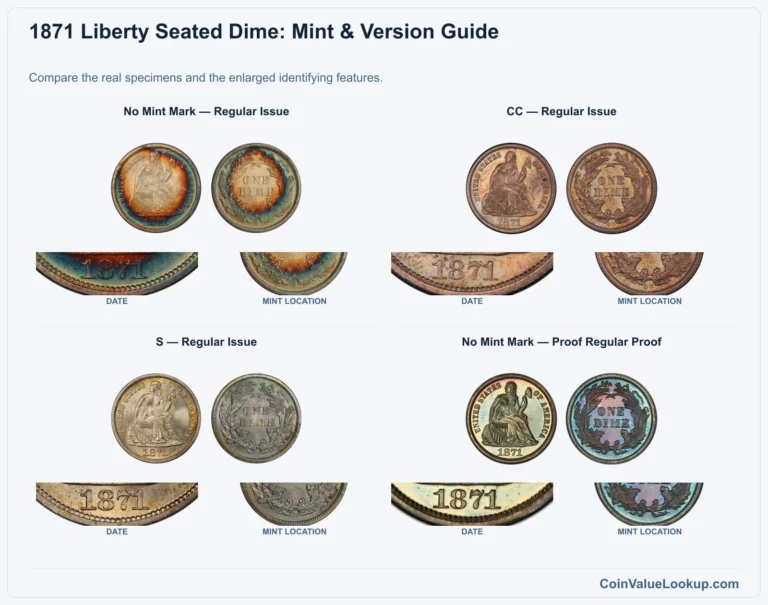
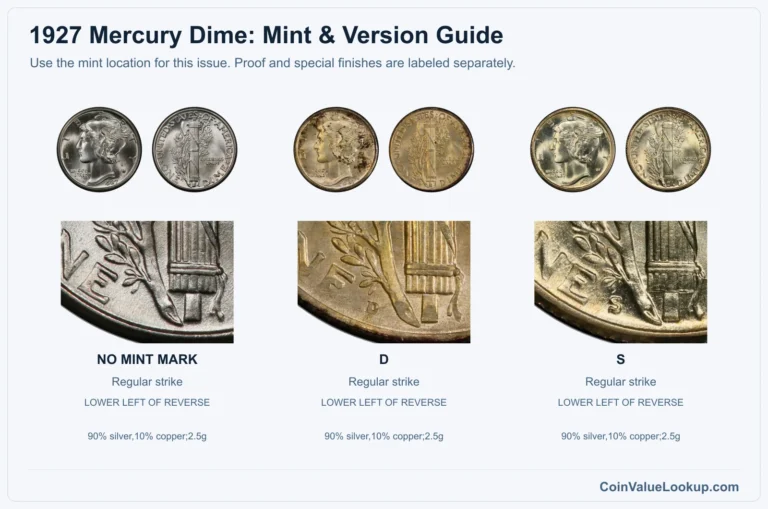
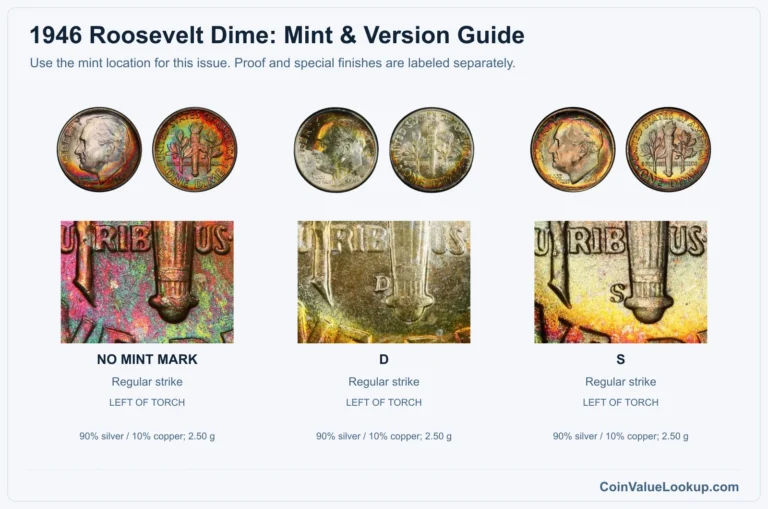
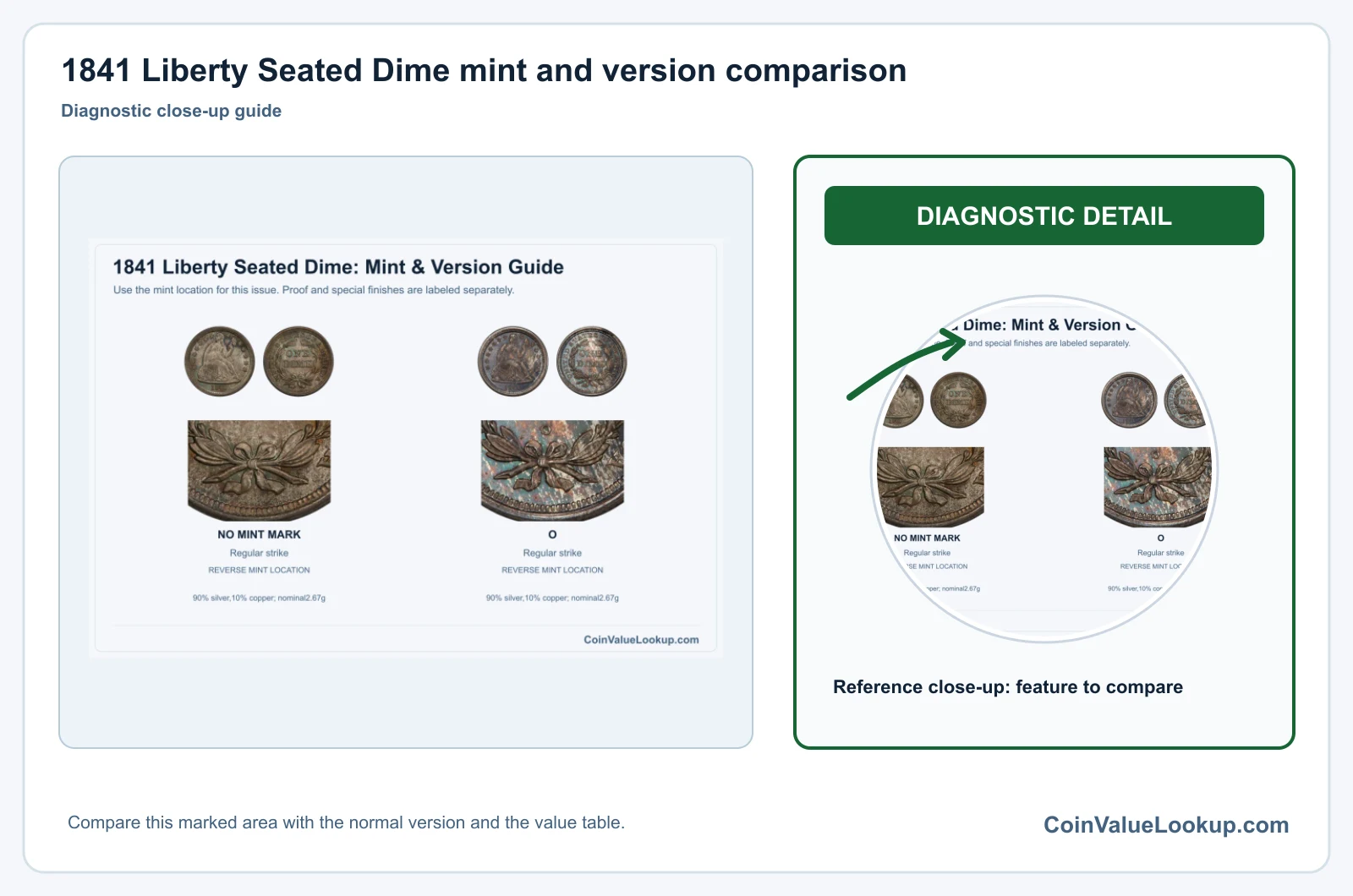
Flip to the reverse and look below the wreath for a mintmark. Philadelphia coins carry no letter at all; New Orleans coins show an O.
That single letter changes your coin's identity and value path.
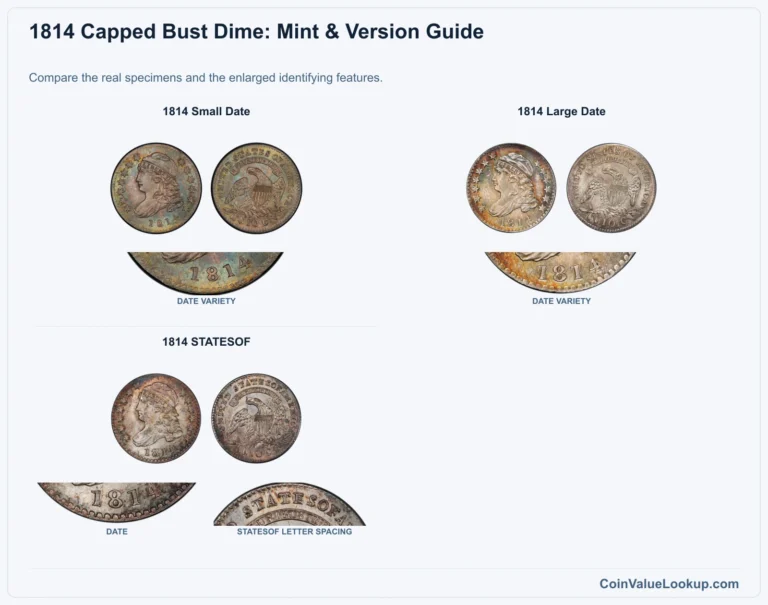
The 1841 dimes all use the With Drapery obverse design — look for extra fabric folds near Liberty's elbow. On O-mint coins, the normal reverse has Open Buds on the wreath flowers.
However, two rare transitional reverse dies exist with Closed Buds, distinguished by either a Small O or Large O mintmark. These are deliberate die pairings at the mint, not damage or missing-metal errors.
A separate No Drapery Proof exists for 1841 struck at Philadelphia, catalogued independently. Do not confuse a worn business strike with a Proof; mirror-like fields from polishing are not proof of Proof manufacture.
Step 2: Check Your 1841 Liberty Seated Dime Grade
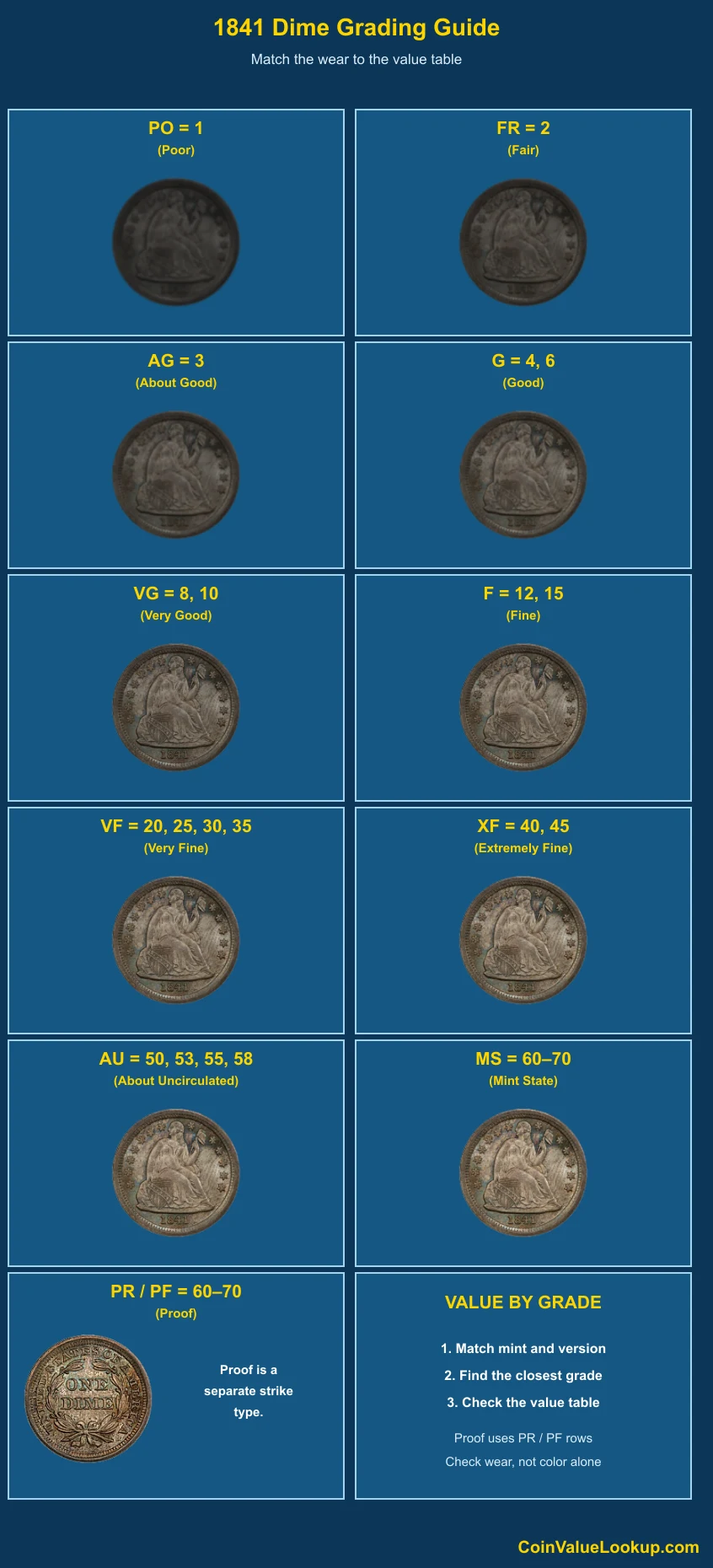
Use the comparison image to check Liberty's shield, gown folds, head detail, and feet against known grade benchmarks for the With Drapery subtype. On the reverse, evaluate the wreath leaves and legend sharpness.
Separate actual circulation wear from original strike weakness. Some 1841 dimes left the press with soft spots — particularly on Liberty's head or the wreath base — because the dies were already tired.
That is not the same as a coin worn smooth in pockets.
Luster matters. A coin with original frosty or satiny surfaces in the protected areas grades differently from one that has been cleaned to look shiny.
Hairlines from cleaning are a red flag.
Proof coins get their own grading scale. A business strike with mirror-like surfaces from harsh polishing is still a business strike.
True Proofs from this era show squared rims, full mirror fields, and typically come with documented provenance.
Step 3: Check 1841 Liberty Seated Dime Value by Mint and Version
1841 Liberty Seated Dime — No Mint Mark — Regular Issue
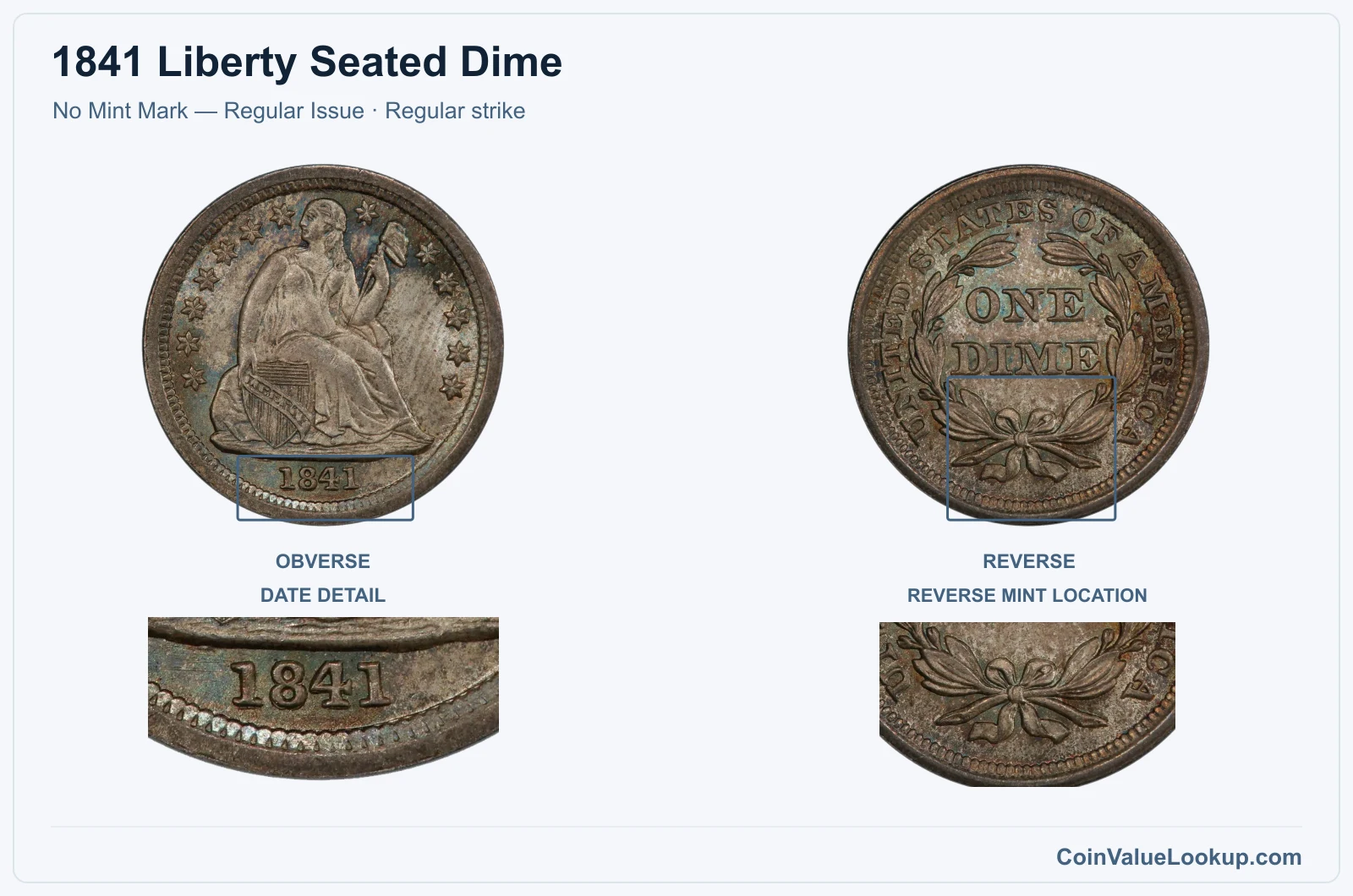
Philadelphia struck the 1841 dime without a mintmark, using the With Drapery obverse and a small wreath reverse bearing the denomination legend. Look for the absence of any letter below the wreath to confirm this mint.
Retail guide estimates run from about $29 at G4 up to around $967 at MS63, per USA Coin Book. These figures reflect a numismatic snapshot and fluctuate with the market.
Condition and original surfaces drive value far more than a shiny appearance, so compare your coin carefully to the grading references for this subtype before drawing conclusions.
Range Grade
Price Auction Records Appraisal PO PO 1
—
Coin Identifier FR FR 2
—
Coin Identifier AG AG 3
—
Coin Identifier G G 4
—
Coin Identifier
G 6
—
Coin Identifier VG VG 8
—
Coin Identifier
VG 10
—
Coin Identifier F F 12
—
Coin Identifier
F 15
—
Coin Identifier VF VF 20
—
Coin Identifier
VF 25
—
Coin Identifier
VF 30
—
Coin Identifier
VF 35
—
Coin Identifier XF XF 40
—
Coin Identifier
XF 45
Coin Identifier AU AU 50
Coin Identifier
AU 53
Coin Identifier
AU 55
Coin Identifier
AU 58
Coin Identifier MS MS 60
Coin Identifier
MS 61
—
Coin Identifier
MS 62
Coin Identifier
MS 63
Coin Identifier
MS 64
Coin Identifier
MS 65
Coin Identifier
MS 66
Coin Identifier
MS 67
Coin Identifier
MS 68
Coin Identifier
MS 69
—
—
—
MS 70
—
—
—
1841 Liberty Seated Dime — O — Regular Issue
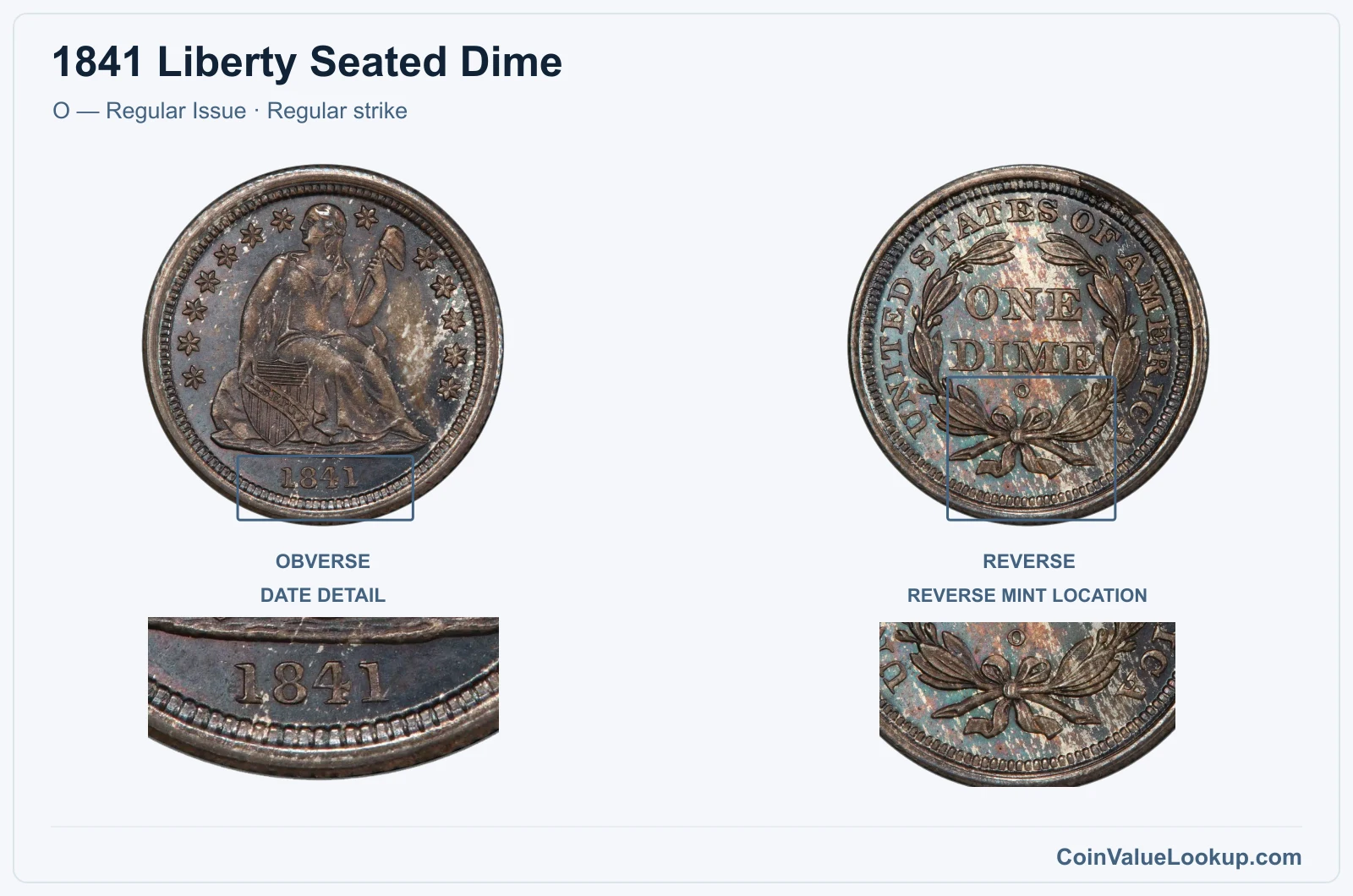
The New Orleans issue carries a small O mintmark below the wreath on the reverse. The standard 1841-O uses an Open Bud wreath design — the flower buds at the top of the wreath are visibly open.
Guide estimates from USA Coin Book place this coin at roughly $34 in G4 and around $1,750 in MS63. That MS63 figure is noticeably higher than the Philadelphia equivalent, reflecting lower survival rates in top condition for New Orleans production.
Make sure you distinguish the normal Open Bud reverse from the rarer Closed Bud transitional varieties, which are separate issues entirely.
Range Grade
Price Auction Records Appraisal PO PO 1
—
Coin Identifier FR FR 2
—
Coin Identifier AG AG 3
—
Coin Identifier G G 4
—
Coin Identifier
G 6
—
Coin Identifier VG VG 8
—
Coin Identifier
VG 10
—
Coin Identifier F F 12
—
Coin Identifier
F 15
Coin Identifier VF VF 20
Coin Identifier
VF 25
Coin Identifier
VF 30
Coin Identifier
VF 35
Coin Identifier XF XF 40
Coin Identifier
XF 45
Coin Identifier AU AU 50
Coin Identifier
AU 53
Coin Identifier
AU 55
Coin Identifier
AU 58
Coin Identifier MS MS 60
—
Coin Identifier
MS 61
Coin Identifier
MS 62
Coin Identifier
MS 63
Coin Identifier
MS 64
Coin Identifier
MS 65
Coin Identifier
MS 66
Coin Identifier
MS 67
—
—
—
MS 68
—
—
—
MS 69
—
—
—
MS 70
—
—
—
1841 Liberty Seated Dime — No Mint Mark — Proof Regular Issue
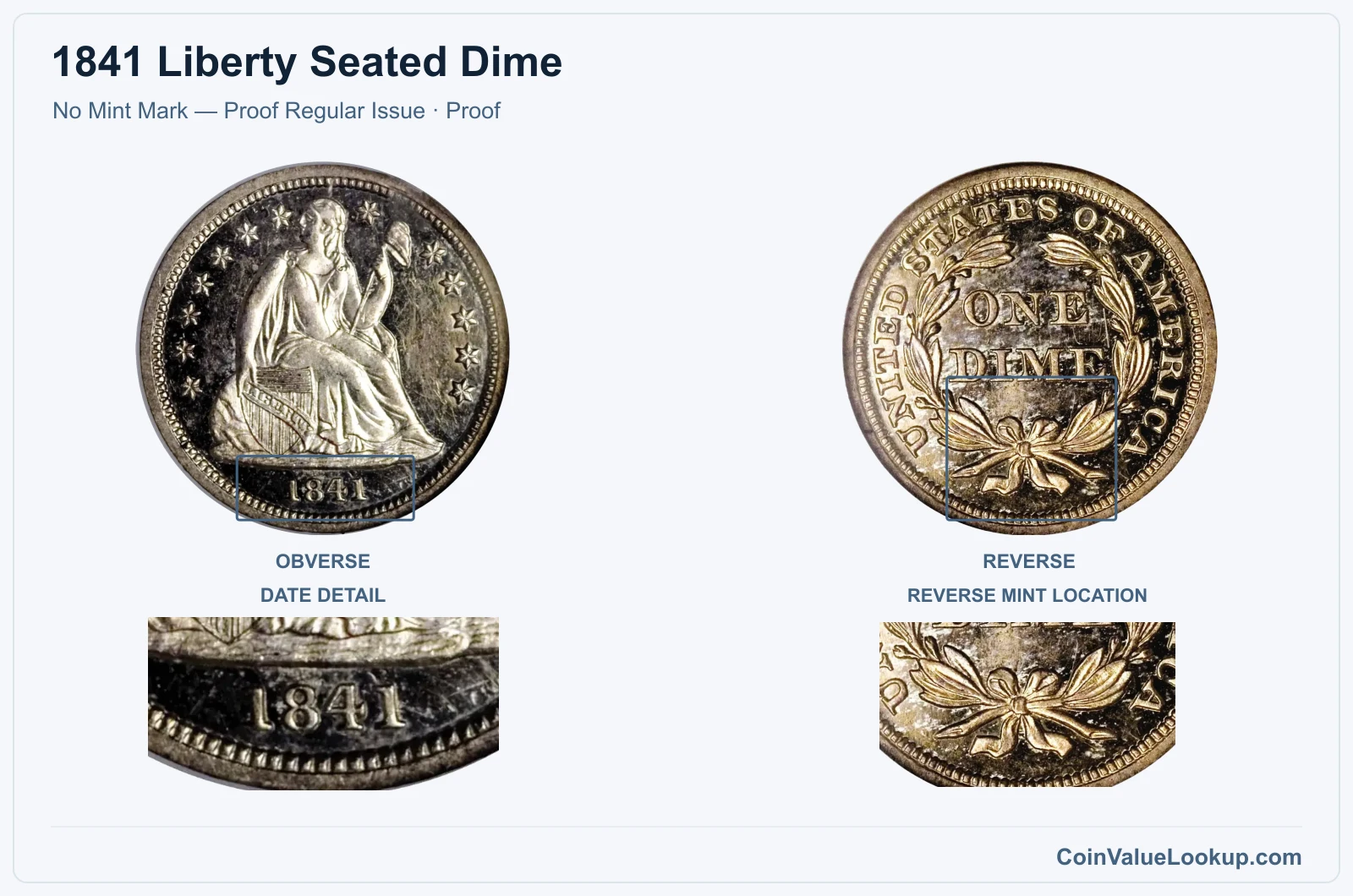
Proof 1841 dimes from Philadelphia are genuinely rare early-date pieces, not the routine collector Proofs of later decades. These coins show fully mirrored fields, squared rims, and crisp design details that set them apart from even the best business strikes.
The PCGS guide lists a value around $60,000 at PR63. That is a single-grade anchor from a guide publisher, not a guaranteed sale price.
Coins of this vintage in Proof finish appear at auction infrequently, and individual results depend heavily on eye appeal, toning, and provenance.
If you think you have one, get it professionally attributed. A polished circulation coin is not a Proof, regardless of how reflective it looks.
Range Grade
Price Auction Records Appraisal PR PR 1
—
Coin Identifier
PR 2
—
Coin Identifier
PR 3
—
Coin Identifier
PR 4
—
Coin Identifier
PR 6
—
Coin Identifier
PR 8
—
Coin Identifier
PR 10
—
Coin Identifier
PR 12
—
Coin Identifier
PR 15
—
Coin Identifier
PR 20
—
Coin Identifier
PR 25
—
Coin Identifier
PR 30
—
Coin Identifier
PR 35
—
Coin Identifier
PR 40
—
Coin Identifier
PR 45
—
Coin Identifier
PR 50
—
Coin Identifier
PR 53
—
Coin Identifier
PR 55
—
Coin Identifier
PR 58
—
Coin Identifier
PR 60
—
Coin Identifier
PR 61
—
Coin Identifier
PR 62
Coin Identifier
PR 63
—
Coin Identifier
PR 64
—
Coin Identifier
PR 65
—
Coin Identifier
PR 66
—
Coin Identifier
PR 67
—
Coin Identifier
PR 68
—
—
—
PR 69
—
—
—
PR 70
—
—
—
1841 Liberty Seated Dime — Small O — Closed Bud Transitional Reverse
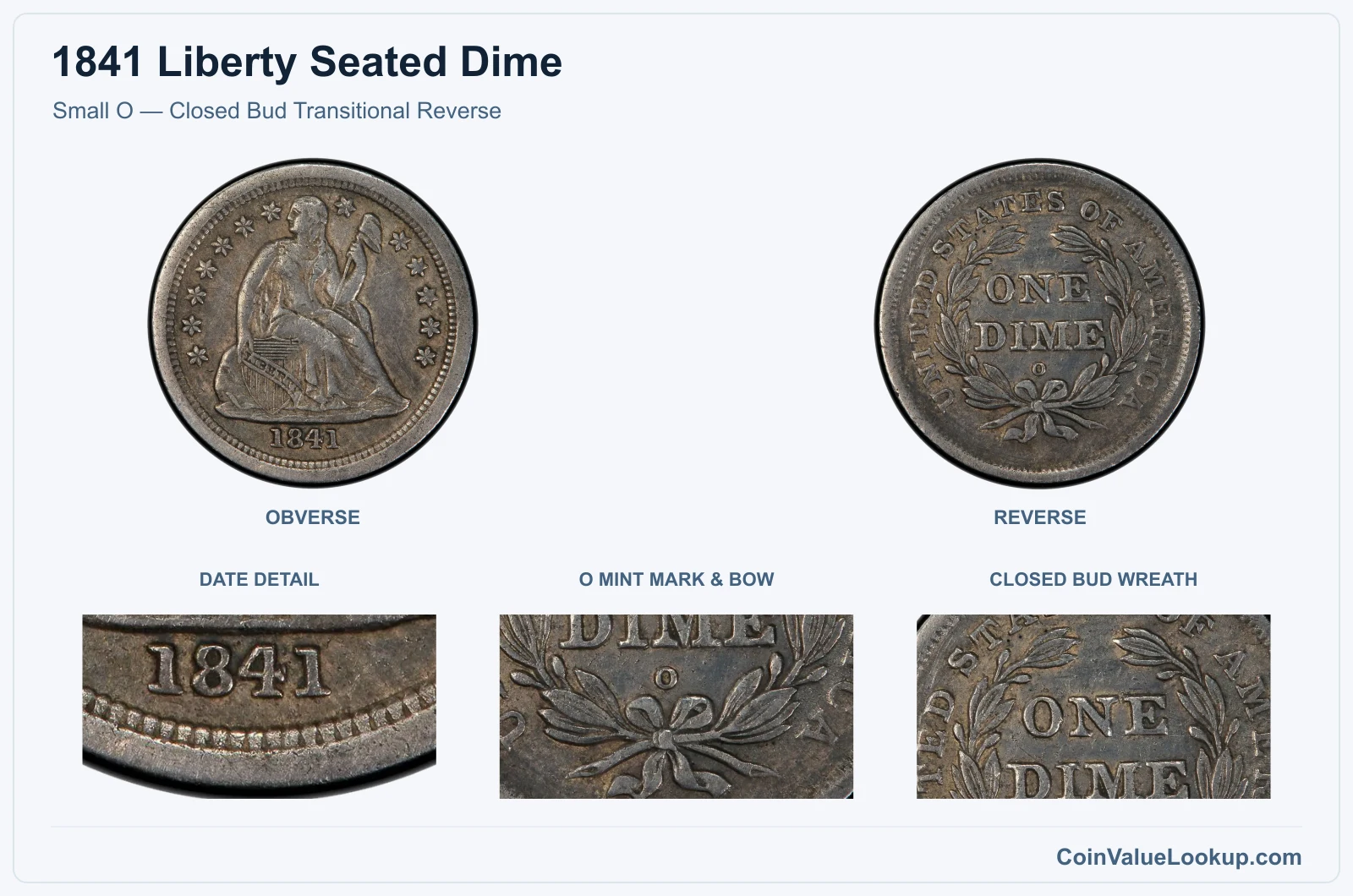
This is one of two transitional reverse varieties struck at New Orleans. The Small O Closed Bud reverse pairs the With Drapery obverse with an older reverse die whose wreath flower buds are closed rather than open.
The O mintmark is noticeably smaller than on the Large O variety.
To identify the Closed Bud reverse, examine the flower buds atop the wreath — they should appear tight and unopened. Also check the lower left wreath leaf relative to the U in UNITED; its position differs from the normal Open Bud die.
This is a deliberate die pairing from the mint, not post-strike damage.
No separate numerical price range has been adopted for this variety. Normal Open Bud prices do not apply here; use attributed Closed Bud comparisons instead.
These pieces are scarce enough that individual assessment matters.
Coin Value Lookup is a good starting point if you want to look up guides for other Liberty Seated dates and mints while you research your coin.
Range Grade
Price Auction Records Appraisal PO PO 1
—
Coin Identifier FR FR 2
—
Coin Identifier AG AG 3
—
Coin Identifier G G 4
—
Coin Identifier
G 6
Coin Identifier VG VG 8
Coin Identifier
VG 10
—
Coin Identifier F F 12
—
Coin Identifier
F 15
Coin Identifier VF VF 20
Coin Identifier
VF 25
—
Coin Identifier
VF 30
—
Coin Identifier
VF 35
—
Coin Identifier XF XF 40
—
Coin Identifier
XF 45
—
—
— AU AU 50
—
—
—
AU 53
—
—
—
AU 55
—
—
—
AU 58
—
—
— MS MS 60
—
—
—
MS 61
—
—
—
MS 62
—
—
—
MS 63
—
—
—
MS 64
—
—
—
MS 65
—
—
—
MS 66
—
—
—
MS 67
—
—
—
MS 68
—
—
—
MS 69
—
—
—
MS 70
—
—
—
1841 Liberty Seated Dime — Large O — Closed Bud Transitional Reverse
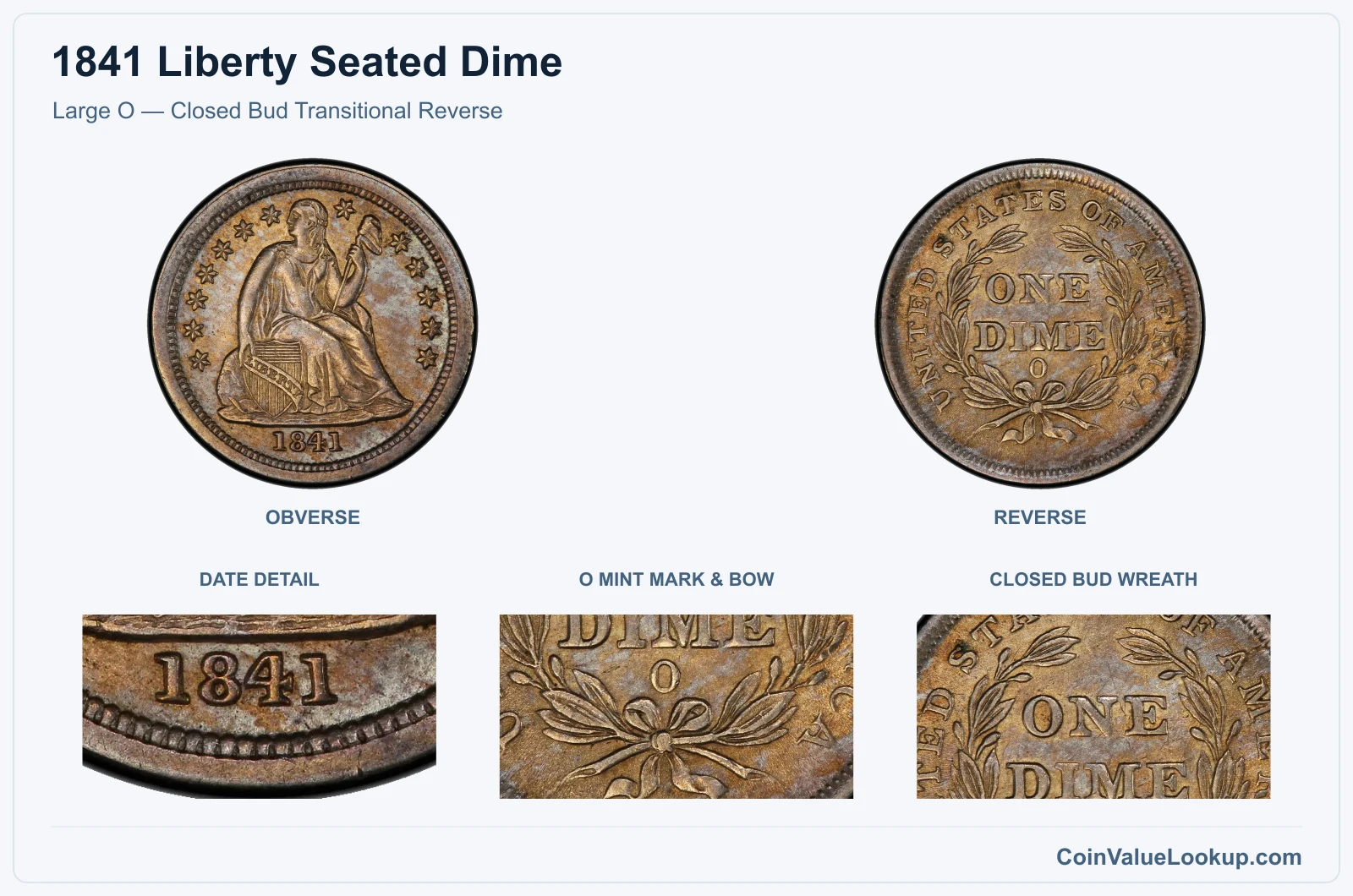
The second transitional reverse variety from New Orleans pairs the same With Drapery obverse with a Closed Bud reverse die carrying a distinctly larger O mintmark. Side by side with the Small O version, the size difference is clear.
Identification follows the same path: look for closed flower buds on the wreath and check the lower left leaf position near the U. Then compare the mintmark size.
The Large O is visibly bigger and rounder. Keep both Closed Bud varieties distinct in your notes — they come from different reverse dies.
No separate numerical price range has been adopted for this variety. Do not apply standard Open Bud pricing.
These are uncommon die pairings whose value depends on attribution, condition, and the specific market for Seated dime varieties.
Range Grade
Price Auction Records Appraisal PO PO 1
—
Coin Identifier FR FR 2
—
Coin Identifier AG AG 3
—
Coin Identifier G G 4
Coin Identifier
G 6
Coin Identifier VG VG 8
—
Coin Identifier
VG 10
Coin Identifier F F 12
Coin Identifier
F 15
Coin Identifier VF VF 20
Coin Identifier
VF 25
—
Coin Identifier
VF 30
Coin Identifier
VF 35
—
Coin Identifier XF XF 40
Coin Identifier
XF 45
—
—
— AU AU 50
—
—
—
AU 53
—
—
—
AU 55
—
Coin Identifier
AU 58
—
Coin Identifier MS MS 60
—
Coin Identifier
MS 61
Coin Identifier
MS 62
Coin Identifier
MS 63
—
—
—
MS 64
—
—
—
MS 65
—
—
—
MS 66
—
—
—
MS 67
—
—
—
MS 68
—
—
—
MS 69
—
—
—
MS 70
—
—
—
1841 Liberty Seated Dime — No Mint Mark — No Drapery Proof Rarity
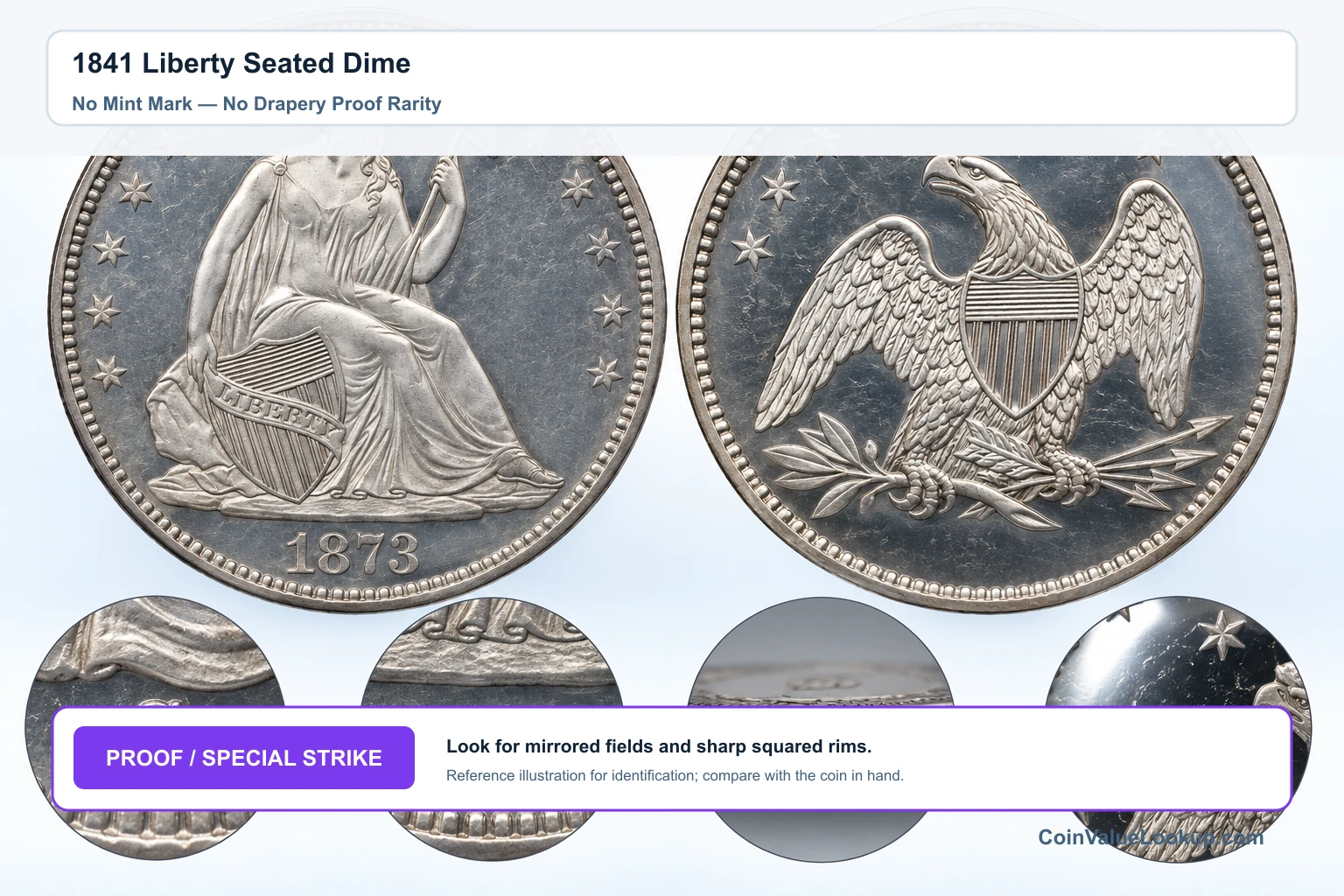
This is a separately catalogued Philadelphia Proof that uses the earlier No Drapery obverse design — meaning Liberty's elbow area lacks the extra fabric folds seen on the standard 1841 With Drapery coins. PCGS lists it as its own rare Proof issue.
No numerical price range has been adopted for this variety. Survival numbers are extremely small, and any example would need professional attribution to confirm both the Proof finish and the No Drapery design.
Do not treat this as an ordinary 1841 circulation dime that happens to look shiny.
Examine the elbow area carefully and compare it against known With Drapery examples. The absence of drapery folds, combined with true Proof field characteristics, distinguishes this piece.
Range Grade
Price Auction Records Appraisal PR PR 1
—
Coin Identifier
PR 2
—
Coin Identifier
PR 3
—
Coin Identifier
PR 4
—
Coin Identifier
PR 6
—
Coin Identifier
PR 8
—
Coin Identifier
PR 10
—
Coin Identifier
PR 12
—
Coin Identifier
PR 15
—
Coin Identifier
PR 20
—
Coin Identifier
PR 25
—
Coin Identifier
PR 30
—
Coin Identifier
PR 35
—
Coin Identifier
PR 40
—
Coin Identifier
PR 45
—
Coin Identifier
PR 50
—
Coin Identifier
PR 60
—
—
—
PR 61
—
—
—
PR 62
—
—
—
PR 63
—
—
—
PR 64
—
—
—
PR 65
—
—
—
PR 66
—
—
—
PR 67
—
—
—
PR 68
—
—
—
PR 69
—
—
—
PR 70
—
—
—
1841 Liberty Seated Dime Error List
1. 1841 Liberty Seated Dime — Repunched Date
A repunched date on an 1841 dime shows remnants of an earlier position of one or more date numerals beside the final digits. You may see traces of a shadow 1, 8, 4, or 1 slightly offset from the accepted placement.
This is a die variety created during manufacture when the date punch was applied more than once at slightly different positions.
Do not confuse this with machine doubling, which produces flat, shelf-like displacement on many design elements at once. A repunched date affects only the date numerals and shows raised, distinct remnants of the first punch.
Damaged or corroded dates can also mimic this look, so examine the area under magnification for sharp, deliberate punch outlines rather than mushy or irregular distortion.
No specific price range has been adopted for this variety. Value depends on visibility of the repunching, overall coin condition, and collector demand for the particular die pairing.
2. 1841 Liberty Seated Dime — Die Crack / Die Chip
Die cracks appear as raised lines on the coin's surface, running across the design or connecting to the rim. Die chips show up as small raised blobs where a piece of the die face broke away.
On an 1841 dime, these features come from stress fractures in the steel dies used during striking.
A crack that extends from the interior to the rim is different from a full cud, where a larger section of the die breaks away and leaves a raised, featureless lump at the edge. Look at the whole coin in context — a single hairline crack is less dramatic than a major break across Liberty's head.
Do not mistake incuse scratches, corrosion lines, or debris stuck to the surface for die cracks. True die cracks are raised above the field, follow consistent paths, and appear on every coin struck from that damaged die.
No specific price has been adopted; value depends on the crack's size, location, and the coin's overall condition.
3. 1841 Liberty Seated Dime — Struck-Through Error
A struck-through error occurs when foreign material — grease, thread, metal fragment, or other debris — sits between the die and the planchet during striking. The result is a localized depression or incomplete area in the design where the obstruction blocked the die's impression.
Grease-filled dies typically produce soft, rounded voids in specific design elements. A retained foreign object leaves a sharper, more defined impression of whatever intervened.
These look quite different from each other, so note what kind of obstruction mark you see.
The main lookalikes are ordinary wear, cleaning scratches, and weak strikes from tired dies. A struck-through area will have a distinctly different texture or depth compared to the surrounding design, and it will not follow the pattern of normal circulation wear.
No numerical price range has been adopted for this error on the 1841 dime. Condition, the size of the affected area, and the type of obstruction all influence collector interest.