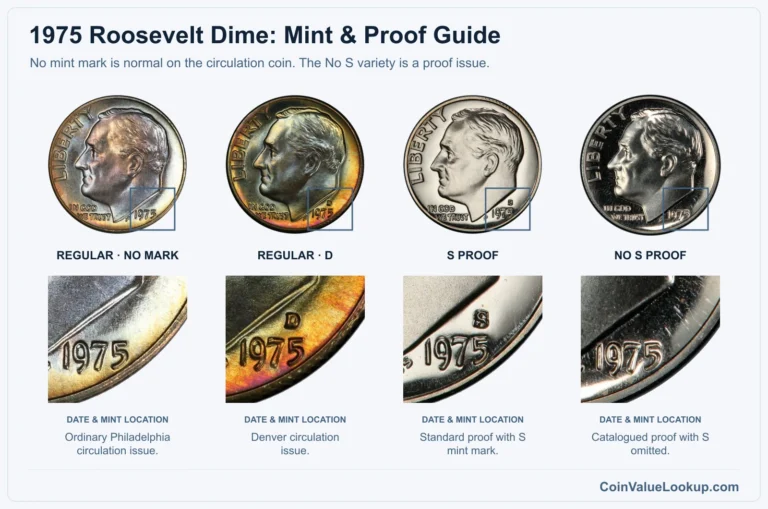
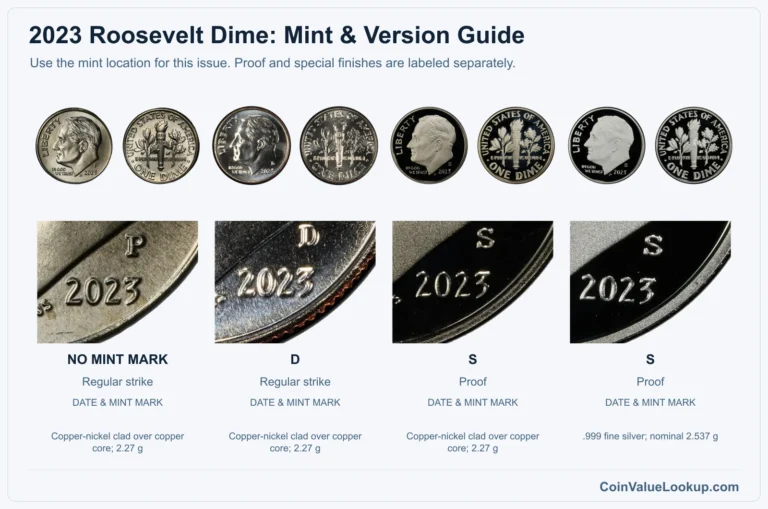
1962 Roosevelt Dime Coin Value: How Much Is It Worth?
The 1962 Roosevelt Dime is a 90% silver coin that still turns up in old collections and pocket change finds. According to USA Coin Book guide estimates, ordinary circulated examples start around $5.81 at G4, while uncirculated pieces can reach about $10.91 at MS65.
Philadelphia proofs carry a guide value near $9.87 at PR65. Silver content alone gives every 1962 dime a floor value, but specific versions and errors can push things higher.
Fast Way to Identify Your 1962 Roosevelt Dime
Want a quick read on your 1962 dime? Upload clear photos of the front and back, and our identifier can give you a preliminary take on which version you have.
Good lighting and a steady shot help — try to capture the mintmark area beside the torch base on the reverse. This is not a substitute for professional authentication, but it is a solid starting point.
1962 Roosevelt Dime Value
Upload both sides of your 1962 Roosevelt Dime.
Front Obverse
Upload photo
Back Reverse
Upload photo
Which 1962 Roosevelt Dime Versions Are Worth Money?
- Philadelphia business strikes with original luster and strong Full Bands torch detail can bring a premium over typical examples at the same grade.
- Philadelphia proofs with deep mirror fields and undisturbed surfaces; cameo contrast, if present, requires separate comparison to standard proofs.
- Off-Center Strike errors on 1962 no-mintmark business strikes — a roughly 75% off-center specimen has been professionally certified.
- Large Straight Clip errors on 1962 no-mintmark business strikes — one certified example lost about half its planchet, weighing only 1.37 grams.
- Reverse Lamination errors on 1962-D business strikes — a flaking or missing layer on this solid silver alloy coin is a genuine mint error.
- Repunched Mintmark (1962-D/D) — remnants of a second mintmark punch position can add collector interest above a normal D-mint coin.
Step 1: Identify Your 1962 Roosevelt Dime Mint Mark and Version
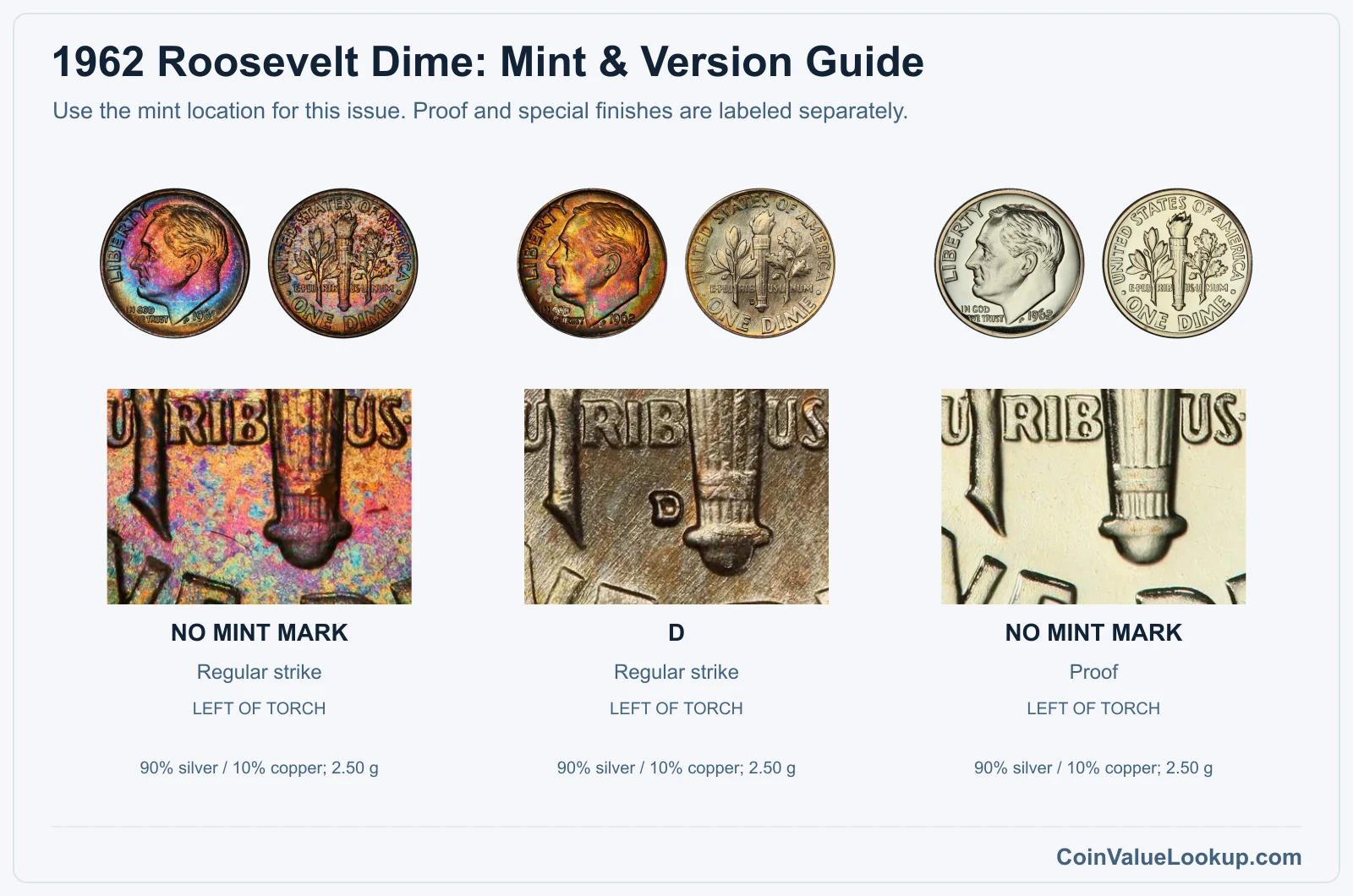
All regular 1962 Roosevelt Dimes are struck in 90% silver with 10% copper, weighing about 2.50 grams and measuring roughly 17.9 mm across. Two business-strike mints produced coins this year: Philadelphia (no mintmark) and Denver (D mintmark).
Proofs came only from Philadelphia, also without a mintmark.
To tell a proof from a business strike, look at the fields — the flat areas around Roosevelt's portrait. Proofs show mirror-like reflective surfaces and sharply defined rims, while business strikes have a satiny or frosty luster.
Both share the same obverse portrait and torch-with-branches reverse.
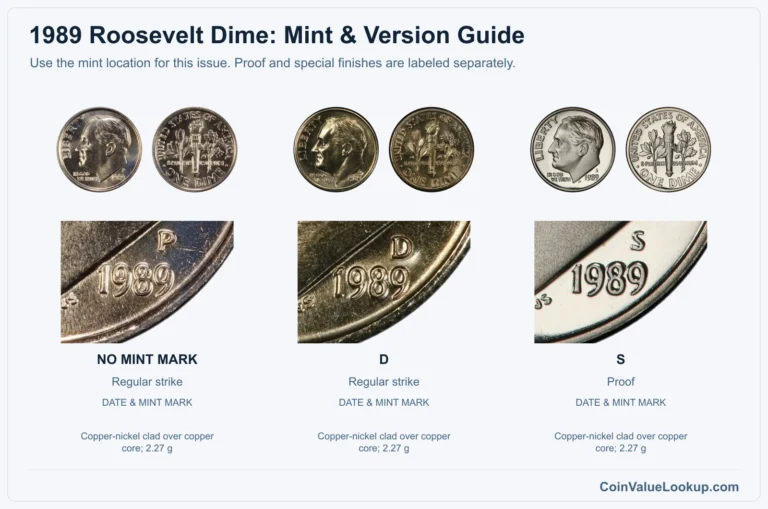
The mintmark sits on the reverse, near the base of the torch, just above the E in ONE. No letter means Philadelphia.
A small D means Denver. That single detail determines which branch your coin belongs to, so grab a magnifier and check.
Step 2: Check Your 1962 Roosevelt Dime Grade
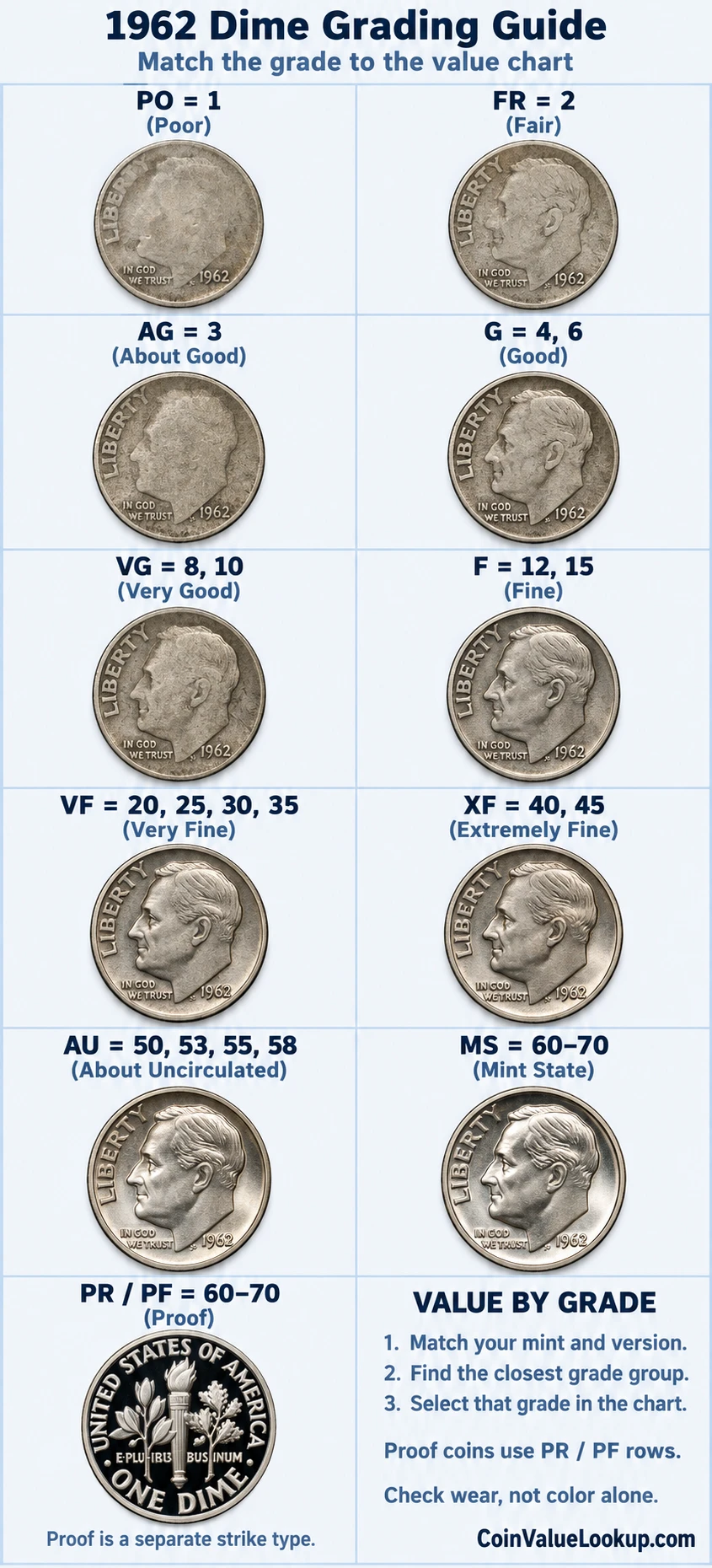
Start with Roosevelt's cheek and jawline — these are the highest points on the obverse and show wear first. Next, look at the hair detail above the ear.
On the reverse, check the torch bands and the leaf details.
Tilt the coin under a direct light source. Broken luster across the high points means actual wear, not just a weak strike.
Cleaning hairlines — fine parallel scratches visible under magnification — will lower a coin's grade and desirability even if the detail looks sharp.
Full Bands is a strike designation, not a grade. It refers to clear separation of both horizontal band pairs on the torch.
A coin can be MS65 without Full Bands, or MS63 with them. Grade and strike designation are assessed independently, so compare your coin to known examples at the same grade and designation for an accurate read.
Step 3: Check 1962 Roosevelt Dime Value by Mint and Version
1962 Roosevelt Dime — No Mintmark / Philadelphia Business Strike
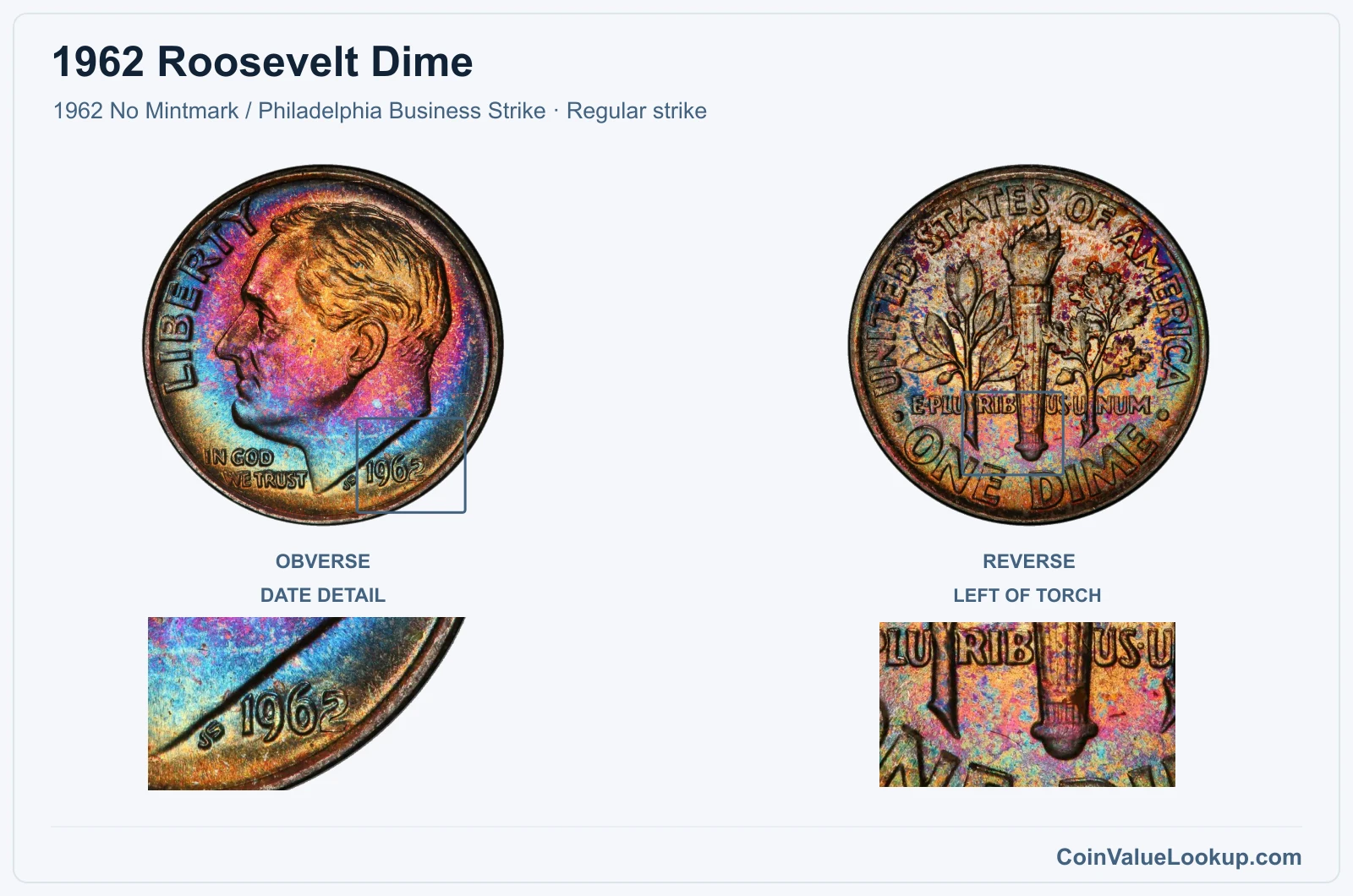
The 1962 Philadelphia business strike carries no mintmark. Look beside the torch base on the reverse — if the space is blank, you have the Philly issue.
USA Coin Book lists guide values around $5.81 at G4 and $10.91 at MS65.
Because this is a 90% silver coin, even well-worn pieces hold melt-related value. For collectors, the premium comes from condition and, on mint-state coins, the Full Bands designation.
Compare only against other Philadelphia strikes at the same grade and designation to judge whether yours stands out.
Range Grade
Price Auction Records Appraisal PO PO 1
—
Coin Identifier FR FR 2
—
Coin Identifier AG AG 3
—
Coin Identifier G G 4
—
Coin Identifier
G 6
—
Coin Identifier VG VG 8
—
Coin Identifier
VG 10
—
Coin Identifier F F 12
—
Coin Identifier
F 15
—
Coin Identifier VF VF 20
—
Coin Identifier
VF 25
—
Coin Identifier
VF 30
—
Coin Identifier
VF 35
—
Coin Identifier XF XF 40
—
Coin Identifier
XF 45
—
Coin Identifier AU AU 50
—
Coin Identifier
AU 53
—
Coin Identifier
AU 55
—
Coin Identifier
AU 58
—
Coin Identifier MS MS 60
—
Coin Identifier
MS 61
—
Coin Identifier
MS 62
—
Coin Identifier
MS 63
—
Coin Identifier
MS 64
Coin Identifier
MS 65
Coin Identifier
MS 66
Coin Identifier
MS 67
Coin Identifier
MS 68
—
—
—
MS 69
—
—
—
MS 70
—
—
—
1962 Roosevelt Dime — D Mintmark Business Strike
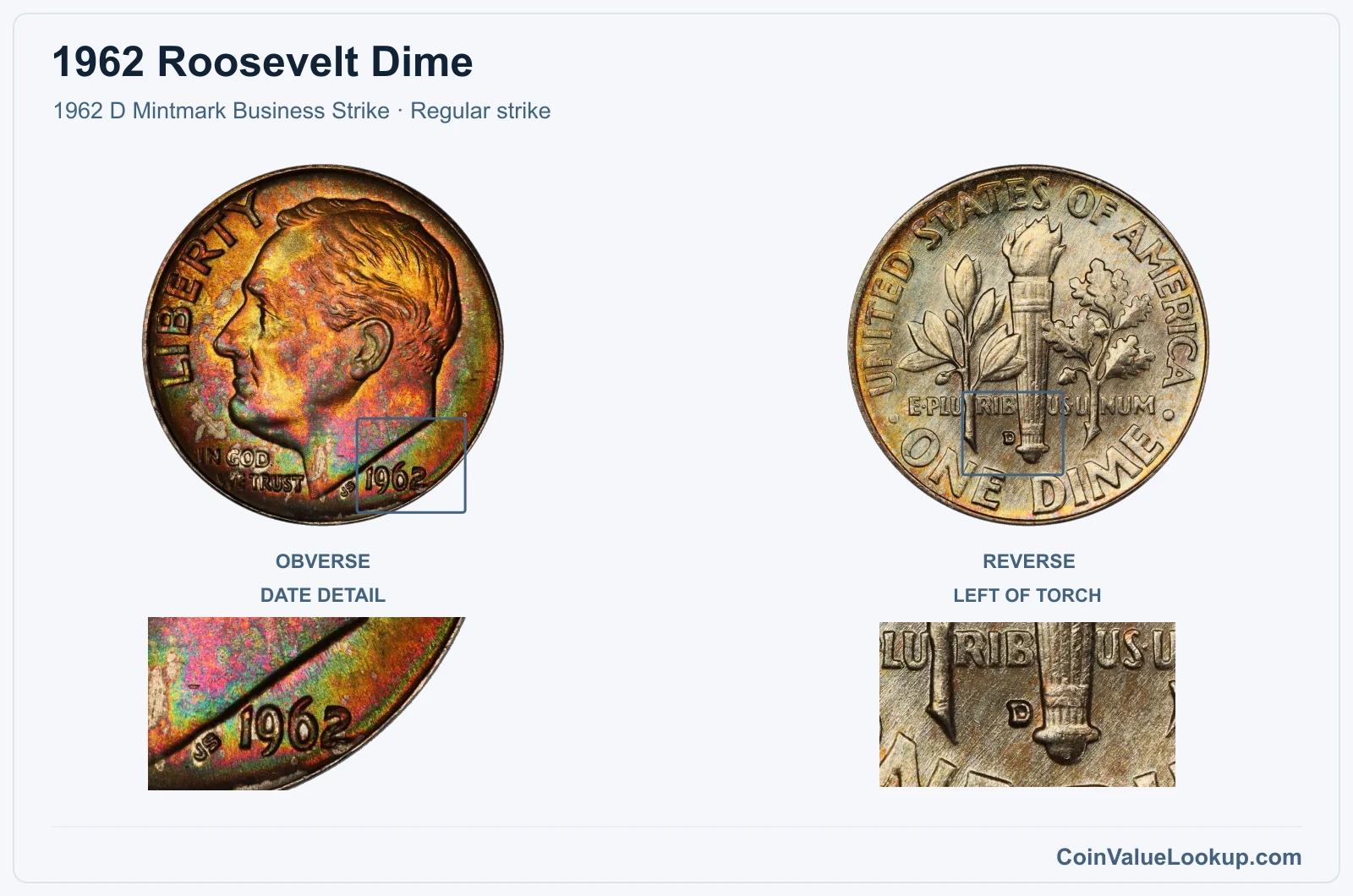
The 1962-D dime was struck at the Denver Mint and shows a small D beside the torch base. Guide estimates from USA Coin Book sit at about $5.81 in G4 and $10.91 at MS65 — the same ballpark as Philadelphia strikes.
Coin Value Lookup is a handy place to look up guides for Roosevelt Dimes and other series if you are working through a collection. Just match the year, mint and denomination to find what you need.
As with the Philadelphia version, silver content sets the floor. Original surfaces and a Full Bands strike designation can add collector appeal above that baseline.
Range Grade
Price Auction Records Appraisal PO PO 1
—
Coin Identifier FR FR 2
—
Coin Identifier AG AG 3
—
Coin Identifier G G 4
—
Coin Identifier
G 6
—
Coin Identifier VG VG 8
—
Coin Identifier
VG 10
—
Coin Identifier F F 12
—
Coin Identifier
F 15
—
Coin Identifier VF VF 20
—
Coin Identifier
VF 25
—
Coin Identifier
VF 30
—
Coin Identifier
VF 35
—
Coin Identifier XF XF 40
—
Coin Identifier
XF 45
—
Coin Identifier AU AU 50
—
Coin Identifier
AU 53
—
Coin Identifier
AU 55
—
Coin Identifier
AU 58
—
Coin Identifier MS MS 60
—
Coin Identifier
MS 61
—
Coin Identifier
MS 62
—
Coin Identifier
MS 63
—
Coin Identifier
MS 64
Coin Identifier
MS 65
Coin Identifier
MS 66
Coin Identifier
MS 67
Coin Identifier
MS 68
—
—
—
MS 69
—
—
—
MS 70
—
—
—
1962 Roosevelt Dime — No Mintmark / Philadelphia Proof
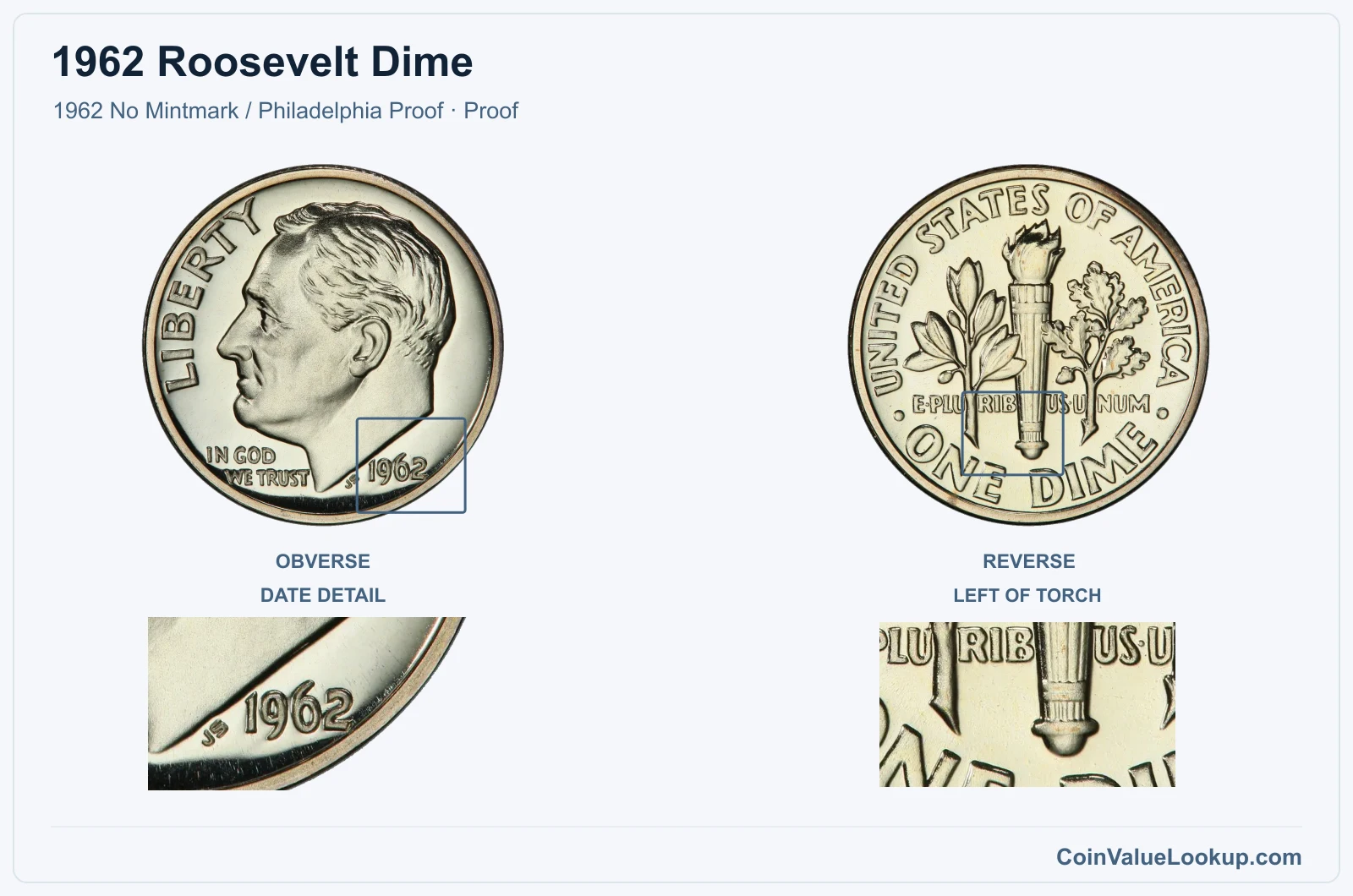
Philadelphia also produced proof dimes in 1962, sold in official proof sets. These coins have mirror fields and frosted devices, struck with specially prepared dies.
There is no mintmark — same as the business strike — so surface quality is how you tell them apart.
USA Coin Book places the ordinary PR65 proof at about $9.87. Coins with cameo contrast — where the frosted portrait stands out sharply against deep mirrors — need to be evaluated separately from standard proofs.
Keep proof coins in their original holders when possible; handling marks on mirror surfaces are brutally visible and reduce eye appeal fast.
Range Grade
Price Auction Records Appraisal PR PR 1
—
Coin Identifier
PR 2
—
Coin Identifier
PR 3
—
Coin Identifier
PR 4
—
Coin Identifier
PR 6
—
Coin Identifier
PR 8
—
Coin Identifier
PR 10
—
Coin Identifier
PR 12
—
Coin Identifier
PR 15
—
Coin Identifier
PR 20
—
Coin Identifier
PR 25
—
Coin Identifier
PR 30
—
Coin Identifier
PR 35
—
Coin Identifier
PR 40
—
Coin Identifier
PR 45
—
Coin Identifier
PR 50
—
Coin Identifier
PR 53
—
Coin Identifier
PR 55
—
Coin Identifier
PR 58
—
Coin Identifier
PR 60
—
Coin Identifier
PR 61
—
Coin Identifier
PR 62
Coin Identifier
PR 63
Coin Identifier
PR 64
—
Coin Identifier
PR 65
Coin Identifier
PR 66
Coin Identifier
PR 67
Coin Identifier
PR 68
Coin Identifier
PR 69
Coin Identifier
PR 70
Coin Identifier
1962 Roosevelt Dime Error List
1. 1962 Roosevelt Dime — Off-Center Strike
An off-center strike happens when the planchet is not seated properly in the collar during striking, leaving a blank crescent on one side. A certified 1962 Philadelphia business strike exists with roughly 75% of the design displaced, graded MS64 by PCGS.
To confirm this error, look for a large unimpressed area opposite the surviving design. The date and enough design to identify the coin should still be readable — that matters for attribution and value.
Percentage alone does not set the premium; legibility of the date and overall condition play a big role.
Watch out for coins that were cut, bent or corroded after leaving the mint. Post-mint damage creates irregular edges and surface marks that differ from the clean blank area of a genuine off-center strike.
Compare against a certified example rather than judging by appearance alone.
2. 1962 Roosevelt Dime — Large Straight Clip
A straight clip error occurs when a planchet is cut from strip stock that overlaps a previously punched area or a straight edge of the strip. On one documented 1962 Philadelphia business strike, roughly half the planchet is missing in a straight line, leaving the coin at just 1.37 grams instead of the normal 2.50 grams.
That specimen was graded MS65 by NGC.
Examine the edge carefully. A genuine straight clip will show a factory-consistent edge and the design will weaken near the missing area because the planchet did not fully fill the die.
Post-mint cutting leaves tool marks, burrs or a jagged profile that looks nothing like the smooth geometry of a mint-made clip.
No specific price range is adopted for this error. Value depends on authentication, the severity of the clip and the coin's overall condition, so professional attribution matters.
3. 1962 Roosevelt Dime — Reverse Lamination
On a 1962-D business strike, a reverse lamination error appears as a flaking or peeling layer of metal on the back of the coin. Because this is a solid 90% silver alloy — not a clad sandwich — the lamination results from impurities or gas pockets trapped during the rolling process.
One example was certified MS64 by NGC.
Look for a raised flap or a missing patch of metal on the reverse with original fracture texture underneath. The surrounding design should remain intact, and the exposed area should show a grainy, natural metal surface rather than smooth gouging.
Corrosion pitting and post-mint scrapes can mimic a lamination at first glance, so compare your coin's texture and pattern against certified examples. Individual value depends on the size of the affected area, the coin's grade and professional attribution.
4. 1962 Roosevelt Dime — Repunched Mintmark
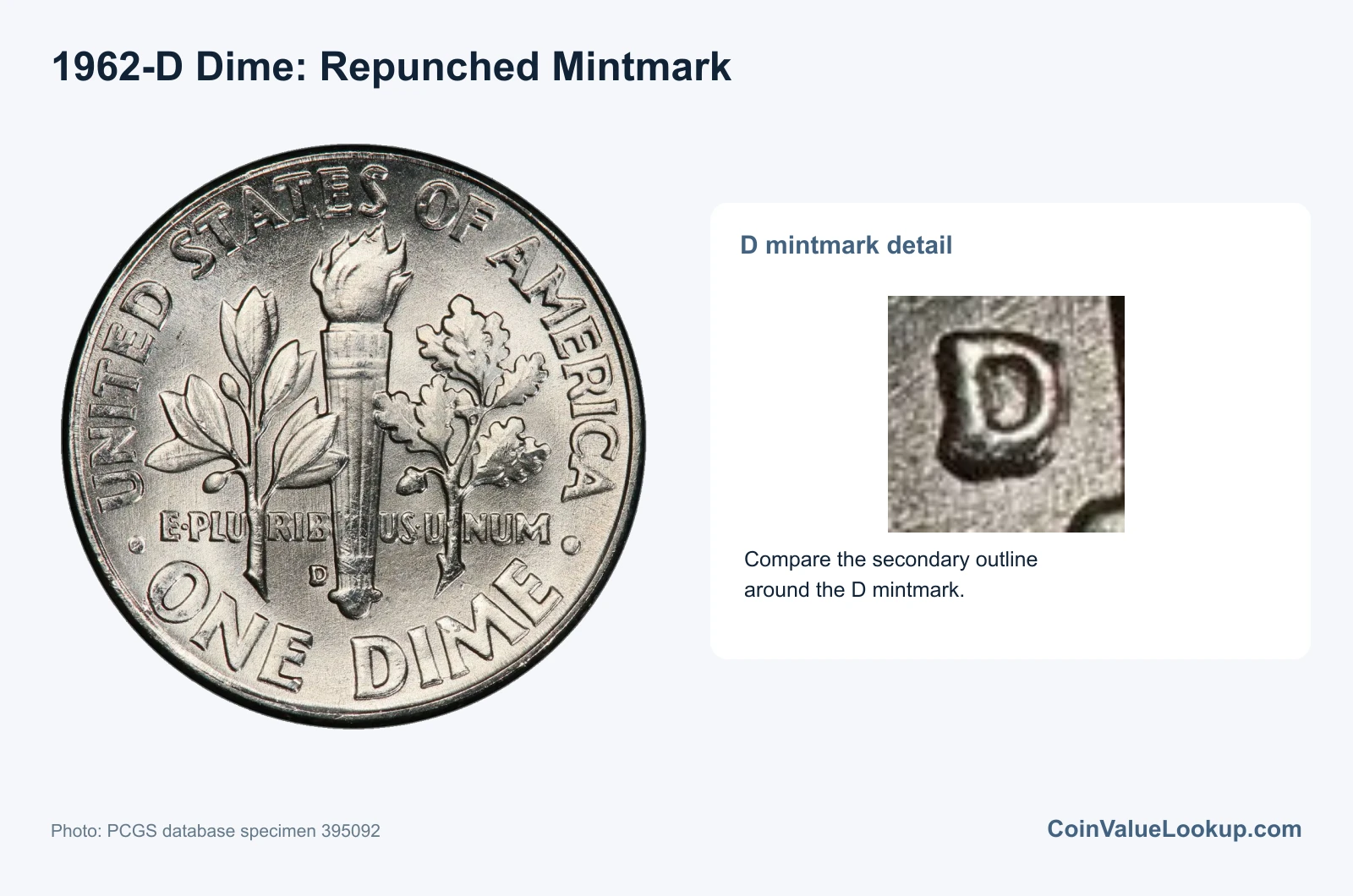
The 1962-D/D Repunched Mintmark is a variety where the D mintmark was punched into the working die more than once, leaving visible traces of the earlier position. Under magnification, look for a secondary shadow or partial outline near the primary D beside the torch base.
A normal D will be clean and singular. Machine doubling, die chips or corrosion around the mintmark can create misleading shapes, so compare at matching magnification to a known normal example.
Genuine repunching shows consistent, slightly offset letter contours rather than a flat shelf.
No specific price range is adopted here. The value of a confirmed RPM depends on how visible the doubling is, the coin's overall condition, and professional attribution by a grading service.
5. 1962 Roosevelt Dime — Doubled Die Reverse
A Doubled Die Reverse on the 1962 dime shows consistent doubling in the reverse legends or design elements, caused by a misaligned hub impression during die production. This is distinct from machine doubling, which produces flat, shelf-like distortions without the sharp secondary contour of a true doubled die.
Compare your coin's reverse lettering — ONE DIME, UNITED STATES, E PLURIBUS UNUM — to a normal example under the same magnification and lighting. Look for separation, notching or thickened serifs that repeat in a predictable direction.
Reflections, toning and general wear can all trick you into seeing doubling that is not there. If the apparent doubling disappears when you change the light angle, it is probably not genuine.
No price range is adopted for this variety; value hinges on the specific die, the clarity of the doubling and the coin's condition.
6. 1962 Roosevelt Dime — Doubled Die Obverse
A Doubled Die Obverse on a 1962 dime displays consistent separation or notching in the obverse lettering or design, again caused by a hub misalignment during die manufacture. Check IN GOD WE TRUST, LIBERTY and the date for any signs of doubled contours.
The key word is consistent. True hub doubling shows the same directional offset across multiple letters or design features.
Machine doubling, by contrast, produces a flat, mushy shelf on one side of a letter and lacks the crisp secondary image.
Tilt the coin under good directional light and compare letter profiles to a known normal strike. Worn dies can also thicken letters, but that wear tends to soften details rather than create distinct parallel outlines.
No numerical price range is adopted; condition, the strength of the doubling and professional confirmation all factor into any premium.