1998 Jefferson Nickel Coin Value: How Much Is It Worth?
Most 1998 Jefferson nickels you pull from a jar are worth face value, give or take a shrug. In uncirculated condition, guide estimates from USA Coin Book place these between about $0.43 at MS60 and $1.24 at MS65 for business strikes.
Proofs and authenticated mint errors occupy their own pricing lane entirely. The figures here are retail guide anchors for specific grades, not blanket cash offers for every circulated coin.
Fast Way to Identify Your 1998 Jefferson Nickel
The quickest way to get a preliminary read on your 1998 nickel is to snap clear photos of the front and back, then upload them to our identifier. Good lighting and a steady hand help more than an expensive camera.
This step covers basic identification of mint, finish, and general condition, though it does not replace professional authentication or exact grading.
1998 Jefferson Nickel Value
Upload both sides of your 1998 Jefferson Nickel.
Front Obverse
Upload photo
Back Reverse
Upload photo
Which 1998 Jefferson Nickel Versions Are Worth Money?
- High-grade Philadelphia and Denver business strikes with certified Full Steps can carry premiums above ordinary uncirculated examples.
- San Francisco proofs, especially those with deep cameo contrast, trade on a separate scale from business strikes.
- Confirmed wrong-planchet errors, such as a nickel struck on a cent-sized blank, have brought individual auction results in the thousands.
- Multiple-strike and capped-die errors authenticated by a grading service deserve individual assessment, as severity and condition vary widely.
Step 1: Identify Your 1998 Jefferson Nickel Mint Mark and Version
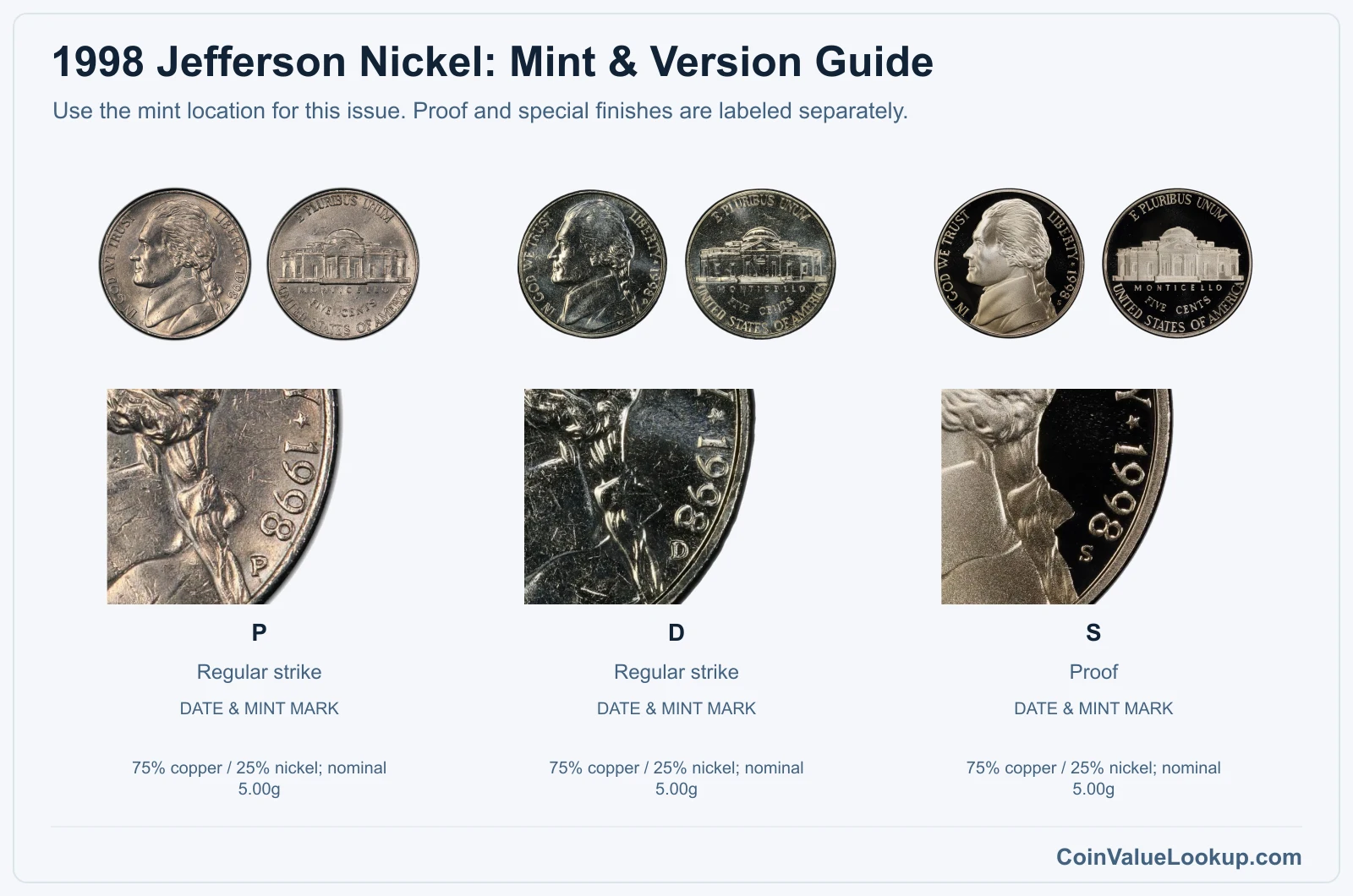
Three versions of the 1998 Jefferson nickel exist: the Philadelphia (P) business strike, the Denver (D) business strike, and the San Francisco (S) proof. Flip the coin to the obverse and look just below the date for a small letter.
A "P" means Philadelphia, a "D" means Denver, and an "S" means it is a proof struck in San Francisco.
All three share the same alloy: 75% copper and 25% nickel, weighing about 5.00 grams with a 21.2 mm diameter and a plain edge. The design is the standard Jefferson portrait on the obverse with Monticello on the reverse.
If a coin looks unusually shiny or frosted, do not assume it is a proof based on appearance alone. Proof attribution requires correct provenance and finish, not just brightness.
Record the date, mintmark, and finish before comparing your coin to any value chart. Getting these basics right saves you from chasing the wrong numbers.
Step 2: Check Your 1998 Jefferson Nickel Grade
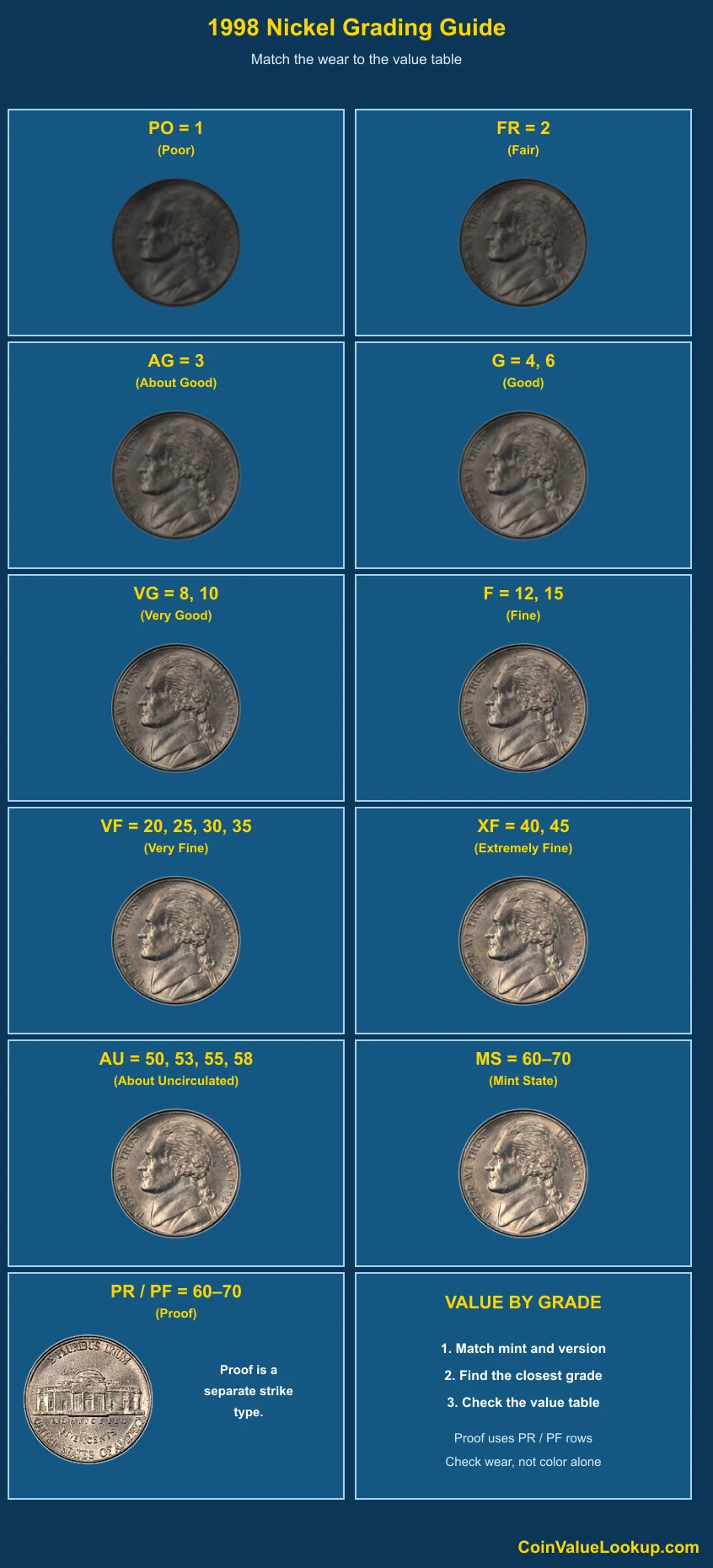
Focus on Jefferson's cheek and the hair detail above his ear. These are the first areas to show wear.
On a well-circulated piece, the cheek flattens and loses texture, while a coin that never entered circulation retains full luster across both faces.
On the reverse, check the columns and steps of Monticello. Step detail can be soft even on uncirculated coins because of a weak strike, so do not confuse strike quality with wear.
Full Steps is a separate designation applied to Mint State coins that show complete, unbroken step lines. It is not a numerical grade or an error.
Proof cameo is also a separate filter describing contrast between frosted devices and mirror fields. Use the comparison image to judge your coin's overall surface preservation, and remember that luster, marks, and eye appeal all factor into where a coin lands on the grading scale.
Step 3: Check 1998 Jefferson Nickel Value by Mint and Version
1998 Jefferson Nickel — P Business strike
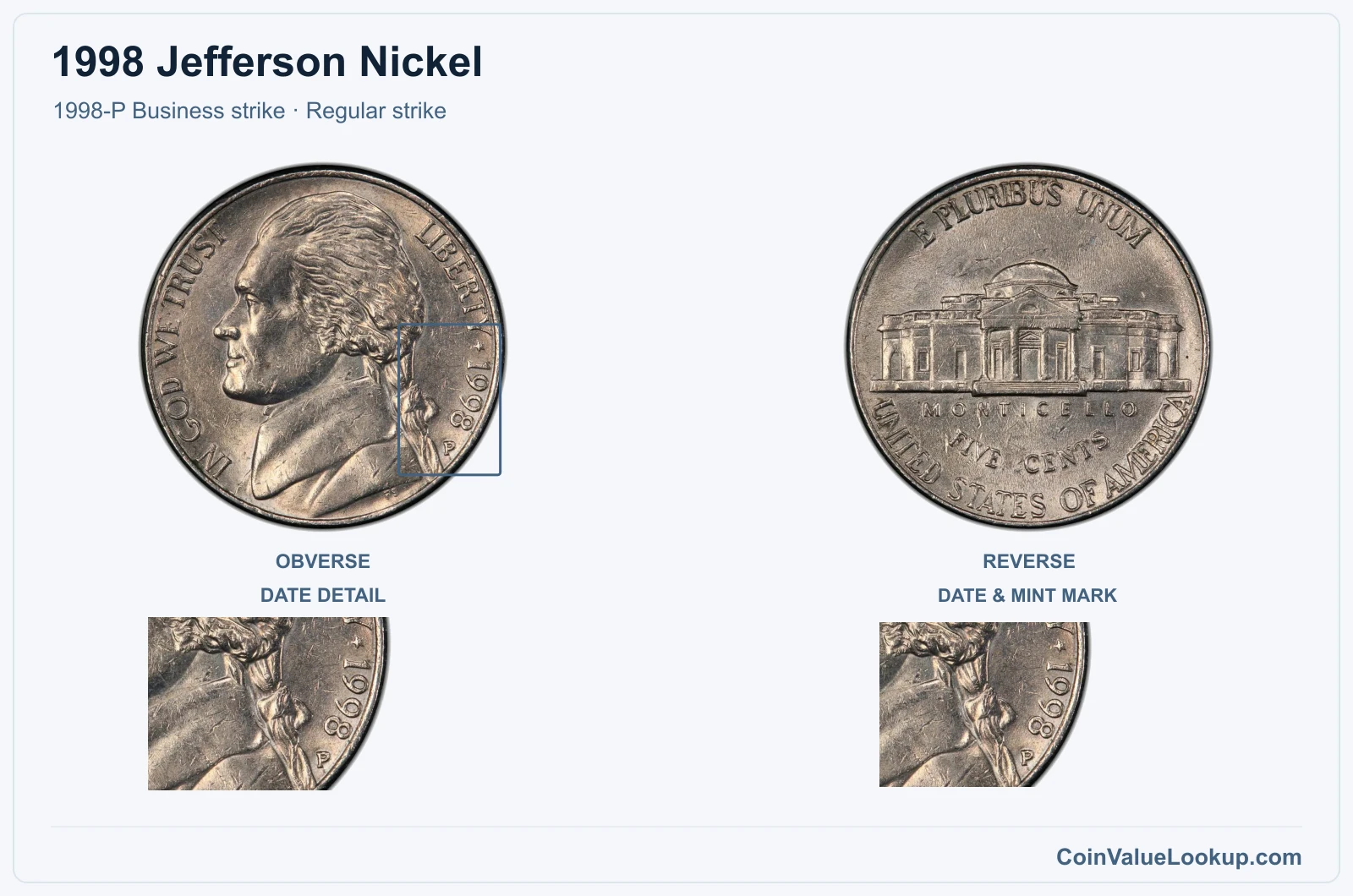
The 1998-P is the Philadelphia business strike, carrying a small "P" mintmark on the obverse below the date. It uses the standard 75% copper and 25% nickel composition at 5.00 grams.
USA Coin Book lists a retail guide estimate of about $0.43 in MS60 and $1.24 in MS65. Circulated examples are worth face value.
Coins with fully defined, uninterrupted steps on the Monticello reverse can earn a Full Steps designation from a grading service, and those pieces sometimes command a premium above the generic uncirculated price. Without that designation, an average mint-state 1998-P is a common coin.
| Range | Grade | Price | Auction Records | Appraisal |
|---|---|---|---|---|
| PO | PO 1 | — | Coin Identifier | |
| FR | FR 2 | — | Coin Identifier | |
| AG | AG 3 | — | Coin Identifier | |
| G | G 4 | — | Coin Identifier | |
| G 6 | — | Coin Identifier | ||
| VG | VG 8 | — | Coin Identifier | |
| VG 10 | — | Coin Identifier | ||
| F | F 12 | — | Coin Identifier | |
| F 15 | — | Coin Identifier | ||
| VF | VF 20 | — | Coin Identifier | |
| VF 25 | — | Coin Identifier | ||
| VF 30 | — | Coin Identifier | ||
| VF 35 | — | Coin Identifier | ||
| XF | XF 40 | — | Coin Identifier | |
| XF 45 | — | Coin Identifier | ||
| AU | AU 50 | — | Coin Identifier | |
| AU 53 | — | Coin Identifier | ||
| AU 55 | — | Coin Identifier | ||
| AU 58 | — | Coin Identifier | ||
| MS | MS 60 | — | Coin Identifier | |
| MS 61 | — | Coin Identifier | ||
| MS 62 | — | Coin Identifier | ||
| MS 63 | Coin Identifier | |||
| MS 64 | Coin Identifier | |||
| MS 65 | Coin Identifier | |||
| MS 66 | Coin Identifier | |||
| MS 67 | Coin Identifier | |||
| MS 68 | — | — | — | |
| MS 69 | — | — | — | |
| MS 70 | — | — | — |
1998 Jefferson Nickel — D Business strike
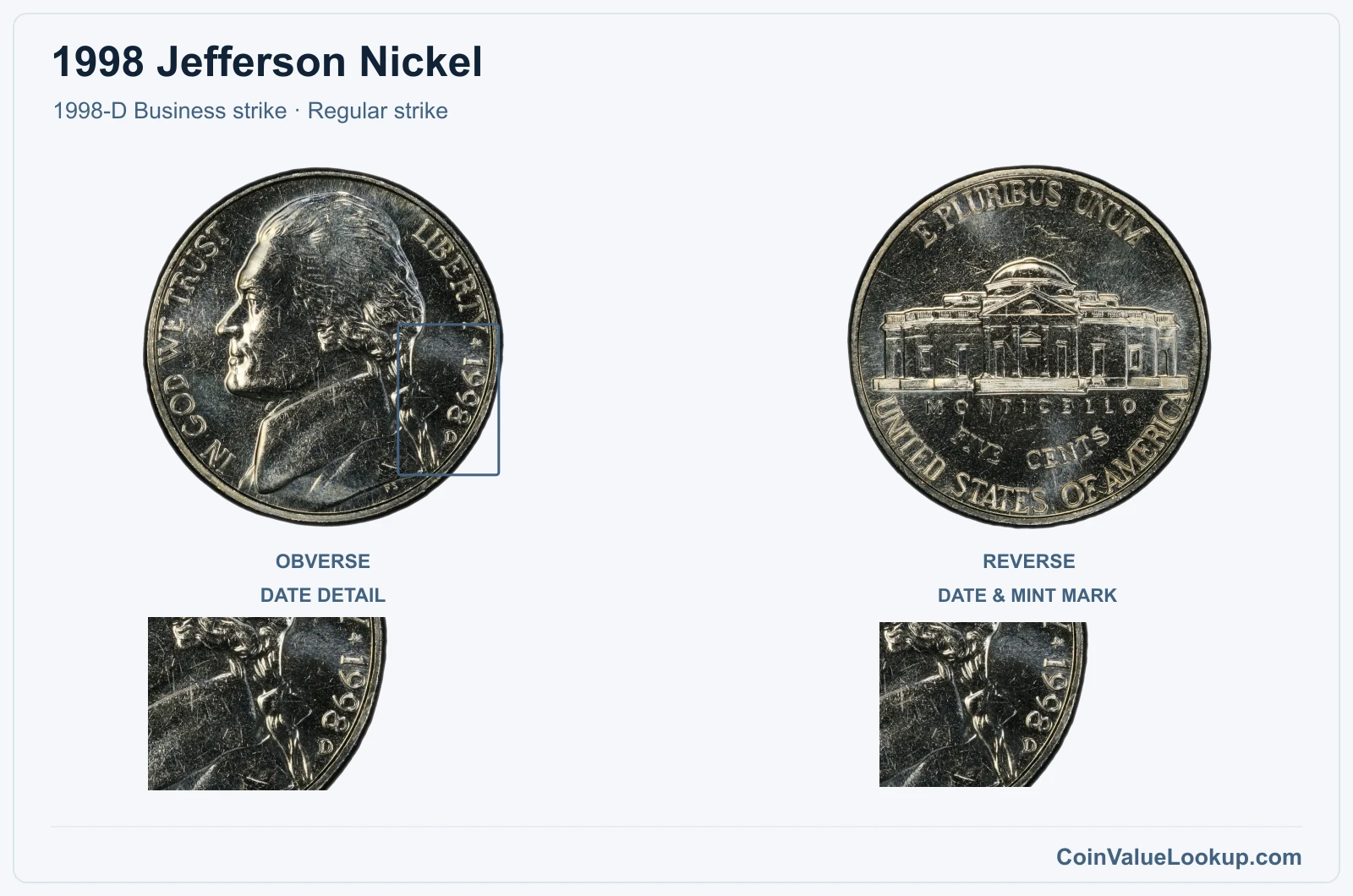
The 1998-D was struck at Denver and shows a "D" mintmark below the date. Same alloy, same weight, same design as its Philadelphia sibling.
Guide estimates from USA Coin Book sit at roughly $0.43 in MS60 and $1.24 in MS65.
If you are sorting through rolls, look at the Monticello steps. A crisp, fully struck reverse with unbroken steps is more appealing to registry-set collectors than a mushy one, even if both coins technically grade the same number.
Worn examples from circulation are plentiful and spend at five cents.
Coin Value Lookup is a handy starting point if you want to look up other years or denominations while you are sorting.
| Range | Grade | Price | Auction Records | Appraisal |
|---|---|---|---|---|
| PO | PO 1 | — | Coin Identifier | |
| FR | FR 2 | — | Coin Identifier | |
| AG | AG 3 | — | Coin Identifier | |
| G | G 4 | — | Coin Identifier | |
| G 6 | — | Coin Identifier | ||
| VG | VG 8 | — | Coin Identifier | |
| VG 10 | — | Coin Identifier | ||
| F | F 12 | — | Coin Identifier | |
| F 15 | — | Coin Identifier | ||
| VF | VF 20 | — | Coin Identifier | |
| VF 25 | — | Coin Identifier | ||
| VF 30 | — | Coin Identifier | ||
| VF 35 | — | Coin Identifier | ||
| XF | XF 40 | — | Coin Identifier | |
| XF 45 | — | Coin Identifier | ||
| AU | AU 50 | — | Coin Identifier | |
| AU 53 | — | Coin Identifier | ||
| AU 55 | — | Coin Identifier | ||
| AU 58 | — | Coin Identifier | ||
| MS | MS 60 | — | Coin Identifier | |
| MS 61 | — | Coin Identifier | ||
| MS 62 | — | Coin Identifier | ||
| MS 63 | — | Coin Identifier | ||
| MS 64 | — | Coin Identifier | ||
| MS 65 | — | Coin Identifier | ||
| MS 66 | Coin Identifier | |||
| MS 67 | — | — | — | |
| MS 68 | — | — | — | |
| MS 69 | — | — | — | |
| MS 70 | — | — | — |
1998 Jefferson Nickel — S Proof
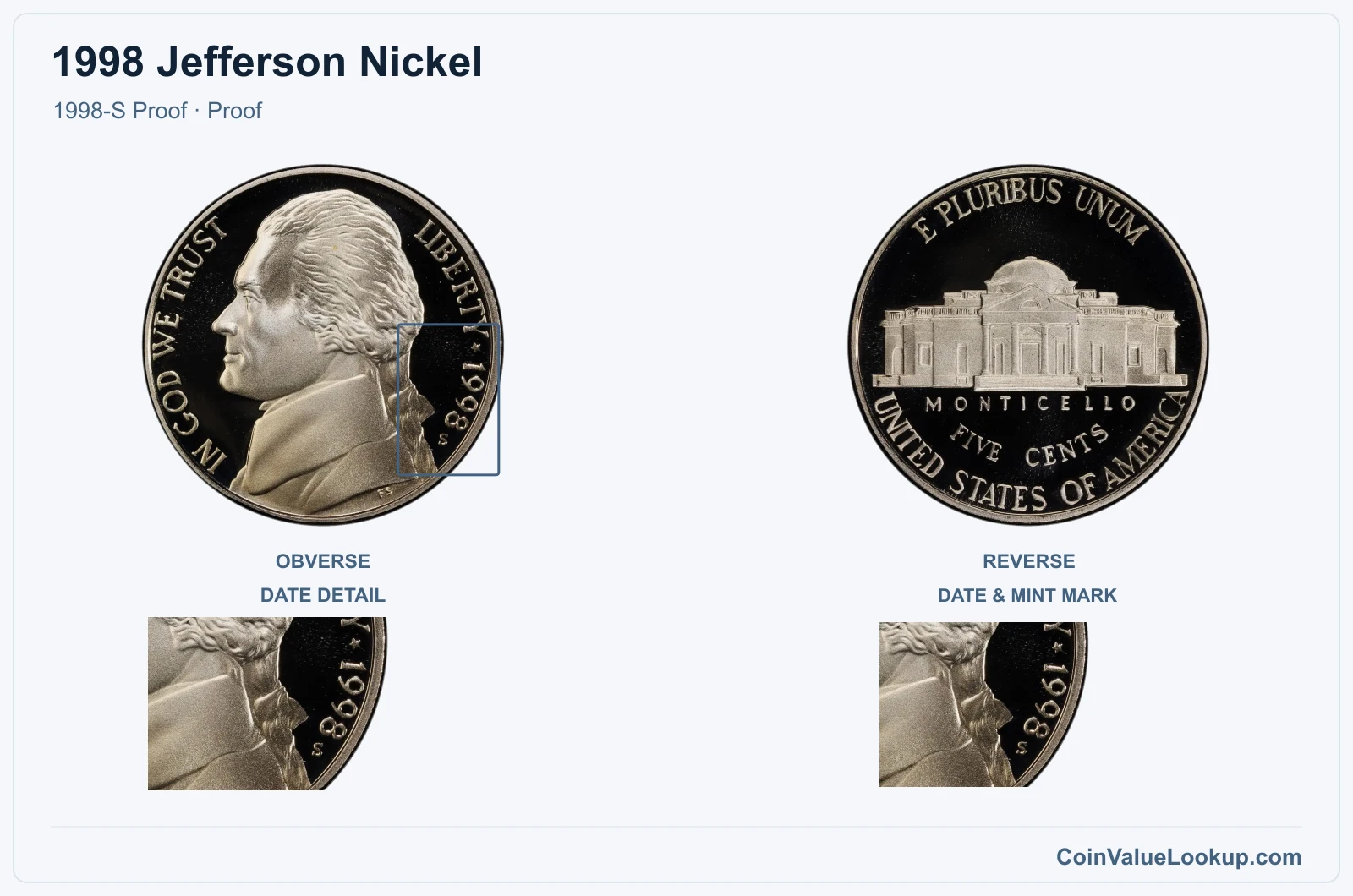
The 1998-S proof was produced at the San Francisco Mint for collectors, not for pocket change. It carries an "S" mintmark and has the same copper-nickel composition as the business strikes.
USA Coin Book places the generic PR65 guide anchor at about $3.62.
That figure is not specific to deep-cameo examples, which trade on their own scale depending on the degree of frosted contrast between the raised design and the mirror fields. If your proof has strong cameo contrast and you want an accurate value, professional grading with a cameo or deep-cameo designation is the path to take.
A loose proof with fingerprints or haze will not command the same interest.
| Range | Grade | Price | Auction Records | Appraisal |
|---|---|---|---|---|
| PR | PR 1 | — | Coin Identifier | |
| PR 2 | — | Coin Identifier | ||
| PR 3 | — | Coin Identifier | ||
| PR 4 | — | Coin Identifier | ||
| PR 6 | — | Coin Identifier | ||
| PR 8 | — | Coin Identifier | ||
| PR 10 | — | Coin Identifier | ||
| PR 12 | — | Coin Identifier | ||
| PR 15 | — | Coin Identifier | ||
| PR 20 | — | Coin Identifier | ||
| PR 25 | — | Coin Identifier | ||
| PR 30 | — | Coin Identifier | ||
| PR 35 | — | Coin Identifier | ||
| PR 40 | — | Coin Identifier | ||
| PR 45 | — | Coin Identifier | ||
| PR 50 | — | Coin Identifier | ||
| PR 53 | — | Coin Identifier | ||
| PR 55 | — | Coin Identifier | ||
| PR 58 | — | Coin Identifier | ||
| PR 60 | — | Coin Identifier | ||
| PR 61 | — | Coin Identifier | ||
| PR 62 | — | Coin Identifier | ||
| PR 63 | — | Coin Identifier | ||
| PR 64 | — | Coin Identifier | ||
| PR 65 | — | Coin Identifier | ||
| PR 66 | — | Coin Identifier | ||
| PR 67 | — | Coin Identifier | ||
| PR 68 | — | Coin Identifier | ||
| PR 69 | Coin Identifier | |||
| PR 70 | Coin Identifier |
1998 Jefferson Nickel Error List
1. 1998 Jefferson Nickel — Struck on cent planchet
A 1998 nickel struck on a cent planchet is a wrong-planchet error. The coin carries the Jefferson nickel design but was struck on a smaller, lighter zinc-era cent blank weighing about 2.5 grams instead of the normal 5.00 grams.
Because the blank is smaller, the outer portions of the design, including peripheral lettering, get cropped off.
Do not assume every copper-colored nickel is this error. Chemical exposure, environmental damage, and copper plating can all change a coin's surface color.
The real diagnostic is the reduced diameter, lighter weight, and truncated design. An authenticated example graded NGC MS67 Red from the Philadelphia mint sold at Heritage Auctions in August 2010 for $2,875.
That is a single recorded result, not a guaranteed market value for every specimen.
2. 1998 Jefferson Nickel — Multiple strikes
A 1998-P nickel struck multiple times shows overlapping impressions where the coin was hit by the dies more than once. The documented example, graded NGC MS63 Full Steps, received at least four impressions.
The first strike was roughly centered, while later strikes landed about 20% off-center toward the 8:00 position, creating repeated outlines of the designer's initials and other design elements.
This is different from machine doubling, which produces flat, shelf-like distortion from die bounce rather than fully separated design images. A doubled die is also distinct because it results from a single misaligned hubbing of the die itself.
Condition, the number of strikes, and how dramatically they are offset all affect what an authenticated piece is worth, so individual assessment by a grading service matters here.
3. 1998 Jefferson Nickel — Struck through capped die
A capped-die strike happens when a previously struck coin sticks to the die face and acts as a barrier during subsequent strikes. On the documented 1998-P example, graded PCGS MS64 Full Steps, the obverse impression was obstructed by the cap while the reverse came through intact.
The obverse will look distorted or partially obliterated, which can be mistaken for a coin that was ground down or that simply received a weak strike. The key difference is that a capped-die piece still shows a normal, well-struck reverse and may display a slightly cupped or bowl-shaped obverse from the repeated pressure.
Value depends on the severity of the cap impression and overall condition, so professional authentication and grading are the practical route to an accurate assessment.
4. 1998 Jefferson Nickel — Struck on dime planchet
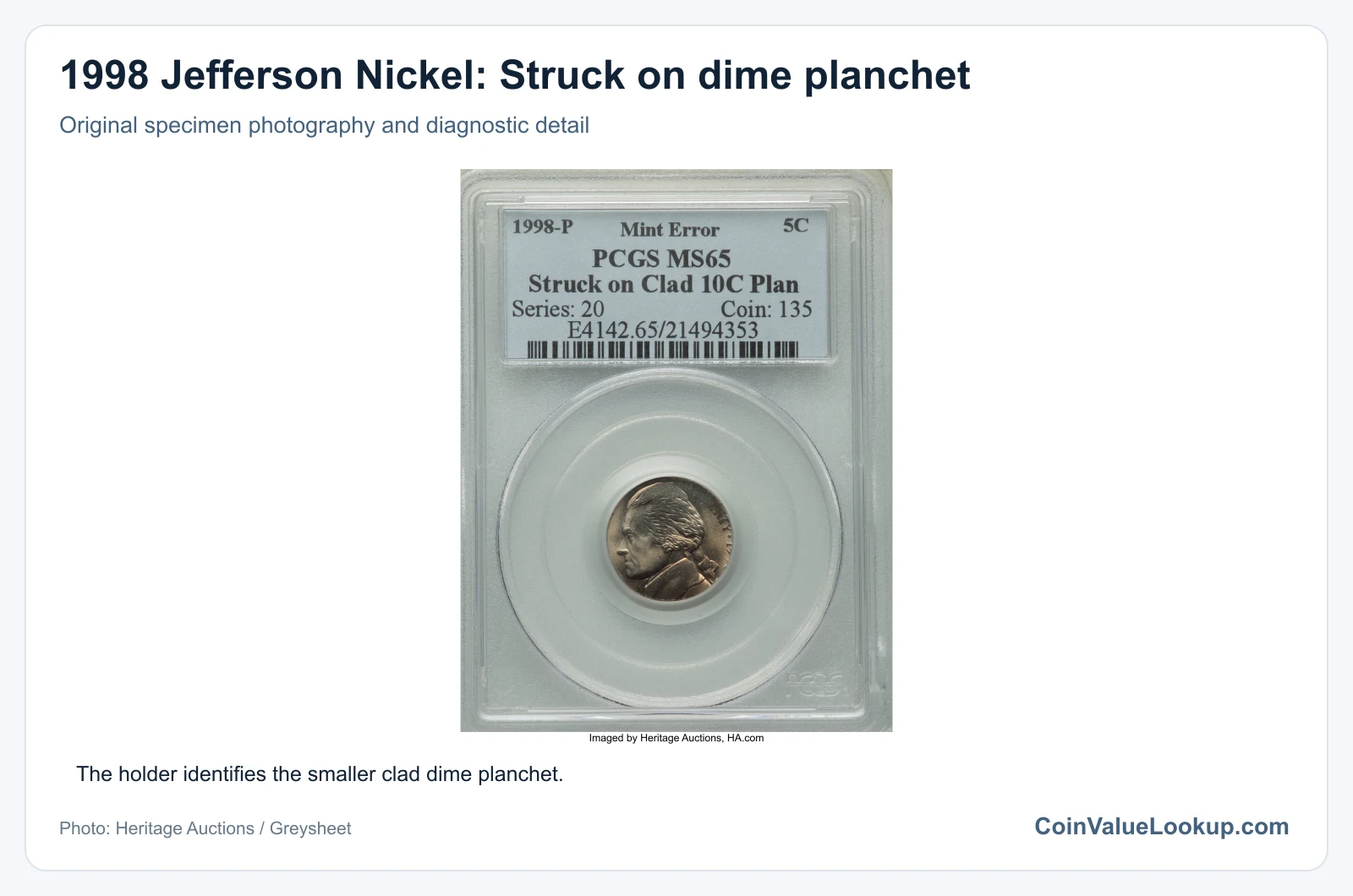
A 1998 nickel struck on a dime planchet is another wrong-planchet error. The smaller clad dime blank means the outer portions of the Jefferson design are missing, and the finished coin is noticeably thinner and lighter than a standard nickel.
A documented 1998-P example was graded PCGS MS65.
Do not confuse this with a nickel that has been filed or trimmed down after leaving the mint. A genuine wrong-planchet piece shows design truncation consistent with the smaller blank, not tool marks at the edge.
Heritage Auctions sold a two-coin lot containing a 1997 and a 1998 nickel on dime planchets for $630 in August 2023. That lot price cannot be assigned to the 1998 coin alone.
5. 1998 Jefferson Nickel — Broadstrike
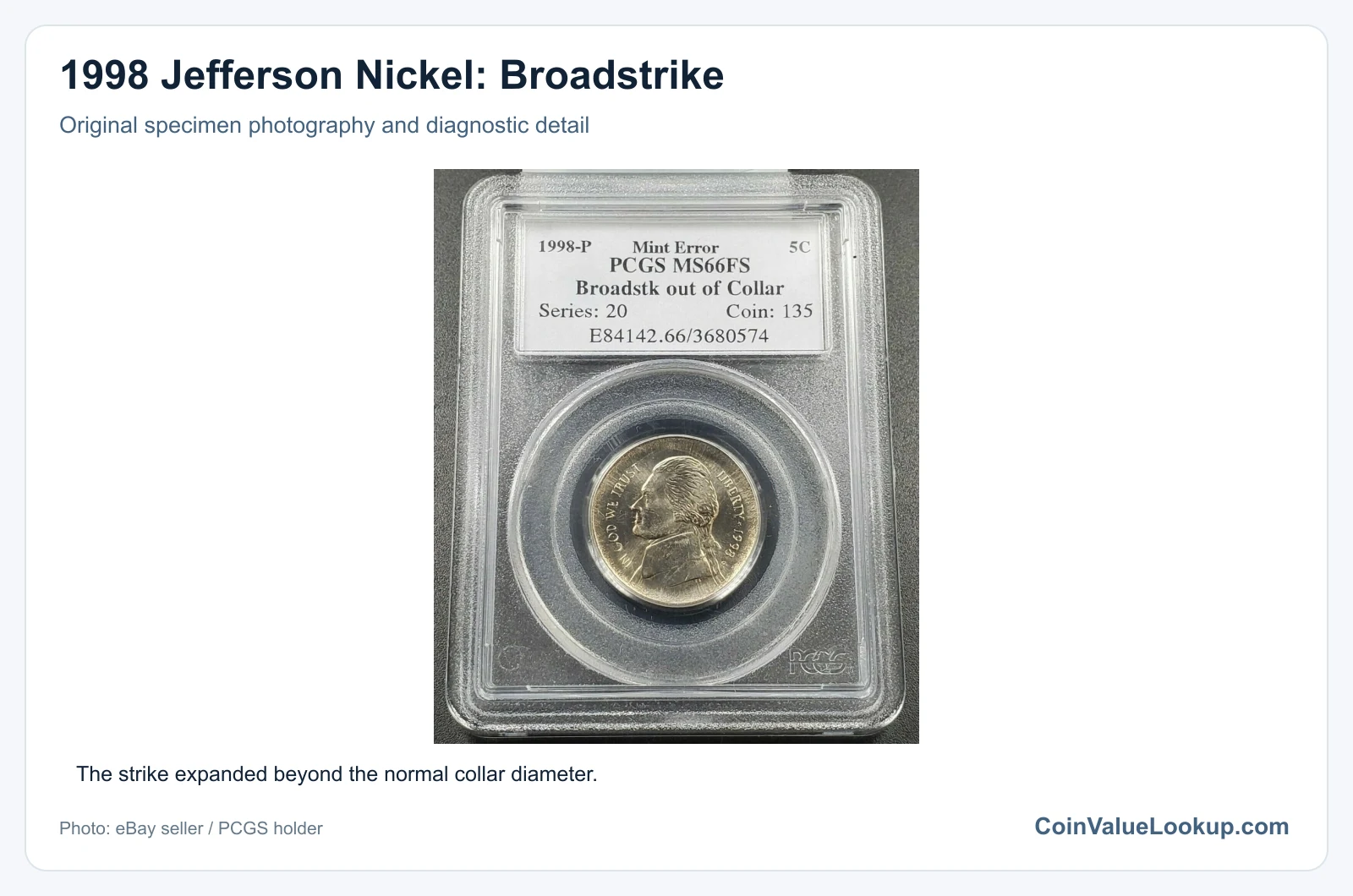
A broadstrike occurs when the retaining collar that normally confines the planchet during striking is absent or fails. Without that collar, the metal spreads outward, producing a coin that is slightly wider than normal with a smooth, undefined edge instead of the usual sharp rim.
The full design is generally present but may appear slightly stretched or softened at the periphery. Look at the edge profile: a broadstruck coin lacks the neat, squared-off rim of a normal strike.
Do not confuse this with a coin that was flattened by a hammer or vice after minting, which tends to distort the design unevenly. Condition, the degree of spread, and proper authentication all affect what a broadstruck 1998 nickel might bring.
6. 1998 Jefferson Nickel — Indented Strike
An indented strike shows a distinct depressed area on one side of the coin, caused when another blank or object overlapped the planchet during the strike. Part of the die's impression lands on the intruding blank instead of the coin itself, leaving a bounded, unstruck depression.
The shape and depth of the indent are the main diagnostics. Compare it against post-mint dents, which tend to be irregular, lack clean borders, and may show displaced metal or surface scratches.
A brockage is also different: it carries an actual mirrored design impression, not a featureless depression. The size of the indent, its position relative to the date and main design, and the coin's overall condition all contribute to how collectors evaluate a piece like this.
7. 1998 Jefferson Nickel — Off-Center Strike
An off-center strike happens when the planchet is not properly seated between the dies, so the design is shifted to one side and a blank crescent of unstruck metal appears opposite. The percentage off-center and whether the date remains visible are the two biggest factors collectors consider.
A coin with a visible date is far more attributable and therefore more collectible than one where the date got clipped off. Do not mistake a straight-clipped planchet or a one-sided die misalignment for an off-center strike.
Post-mint flattening can also create an odd shape, but it will not leave a clean unstruck crescent. Individual value depends on the degree of displacement, condition, and authenticated identity.
8. 1998 Jefferson Nickel — Die Crack / Die Chip
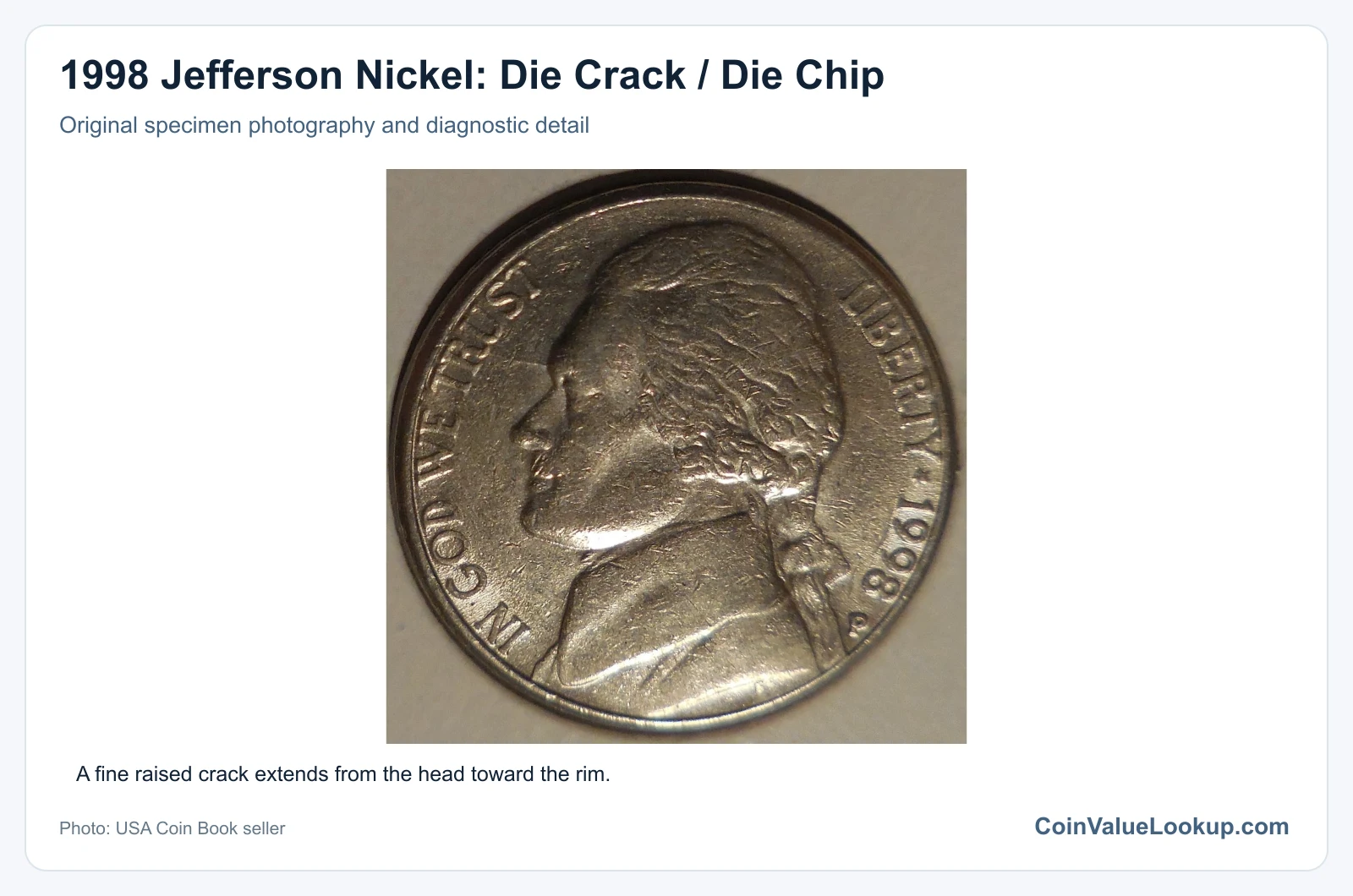
Die cracks appear as raised lines on the coin's surface, formed when a crack in the steel die fills with metal during striking. A die chip is a small raised blob from a broken-away piece of the die face.
When a crack extends to the rim and a chunk of the die breaks away entirely, the result is called a cud: a raised, featureless lump connected to the rim.
These are all raised features. If you see lines that are incuse, meaning pressed into the surface, you are looking at scratches, not die cracks.
Corrosion bumps and foreign material stuck to the surface can also mimic small die chips. Size, location, and whether the feature is a minor interior crack or a full rim cud all matter when assessing a 1998 nickel with this type of error.