1937 Buffalo Nickel Coin Value: How Much Is It Worth?
A 1937 Buffalo Nickel in ordinary circulated condition starts around $1.56 in Good-4, according to USA Coin Book guide estimates. Mint-state examples climb to the $50–$56 range at MS63 depending on the mint.
Proof strikes and the famous 1937-D Three Legs variety occupy a different tier entirely, so identifying your exact coin matters.
Fast Way to Identify Your 1937 Buffalo Nickel
The quickest way to start figuring out what you have is to upload clear photos of both sides of your coin. Make sure the date is readable and the area below FIVE CENTS on the reverse is in focus — that is where the mintmark lives.
A preliminary identification based on your images can point you toward the right branch and price range.
1937 Buffalo Nickel Value
Upload both sides of your 1937 Buffalo Nickel.
Front Obverse
Upload photo
Back Reverse
Upload photo
Which 1937 Buffalo Nickel Versions Are Worth Money?
- The 1937-D Three Legs variety is the standout, with USA Coin Book guide estimates of roughly $559 in G4 and $5,221 in MS63 — genuine examples require specific die diagnostics beyond just a missing leg.
- Brilliant Proof strikes from Philadelphia carry a guide estimate around $1,127 at PR63; these are specially made coins with mirror fields, not simply high-grade circulation pieces.
- Mint-state circulation strikes from any mint jump significantly over worn examples; an MS63 Philadelphia coin guides near $50 versus $1.56 in G4.
- Denver and San Francisco mint coins can carry repunched mintmark varieties worth investigating under magnification.
Step 1: Identify Your 1937 Buffalo Nickel Mint Mark and Version
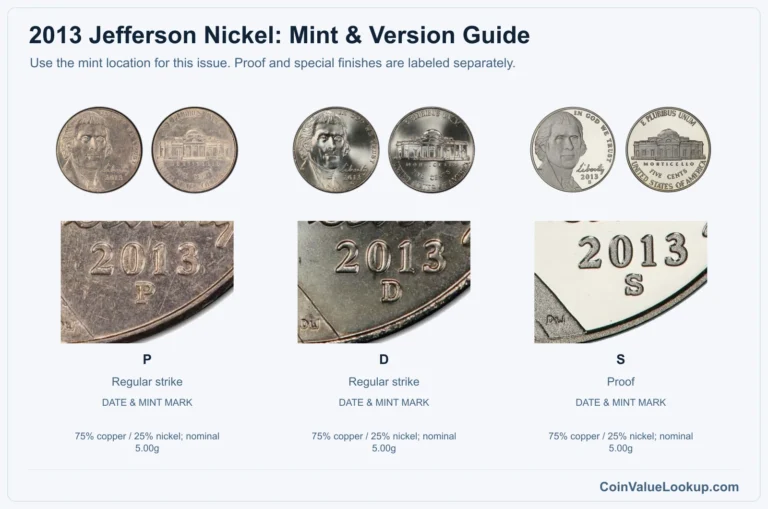
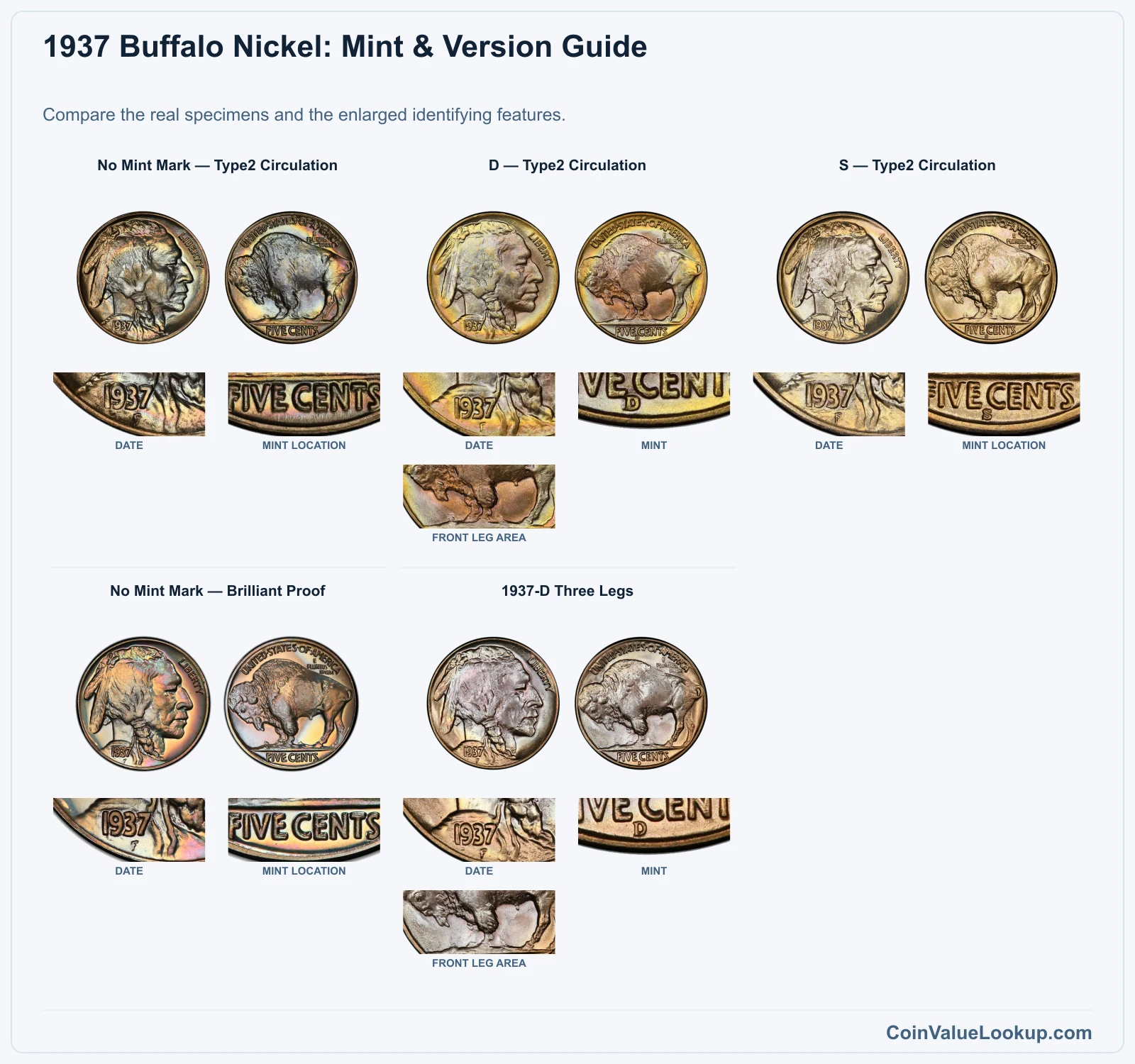
Three mints produced the 1937 Buffalo Nickel: Philadelphia, Denver, and San Francisco. Philadelphia coins carry no mintmark.
Denver coins show a small D and San Francisco coins show a small S, both located on the reverse beneath the words FIVE CENTS.
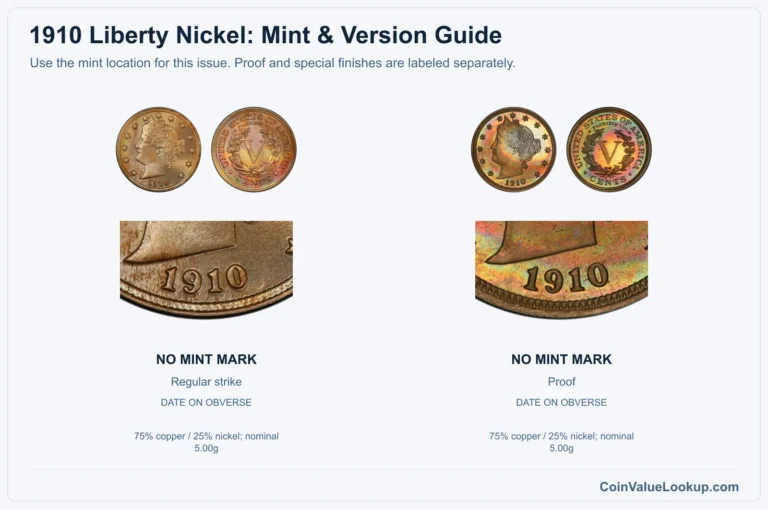
All regular 1937 nickels use the Type 2 reverse design with the denomination recessed below a flat ground line. The Type 1 raised-mound reverse was exclusive to 1913, so you will not encounter it here.
The composition is 75% copper and 25% nickel, weighing about 5 grams with a 21.2 mm diameter and a plain edge. There is no regular silver version of this coin — if yours sticks to a magnet or looks silver-white, that is the normal copper-nickel alloy.
The major variety to watch for is the 1937-D Three Legs, where a die-polishing error removed most of the bison's front right leg. Only Denver-mint coins can be the genuine Three Legs variety.
A weak or partially visible leg on a Philadelphia or San Francisco strike is wear or a weak strike, not this famous error.
Step 2: Check Your 1937 Buffalo Nickel Grade
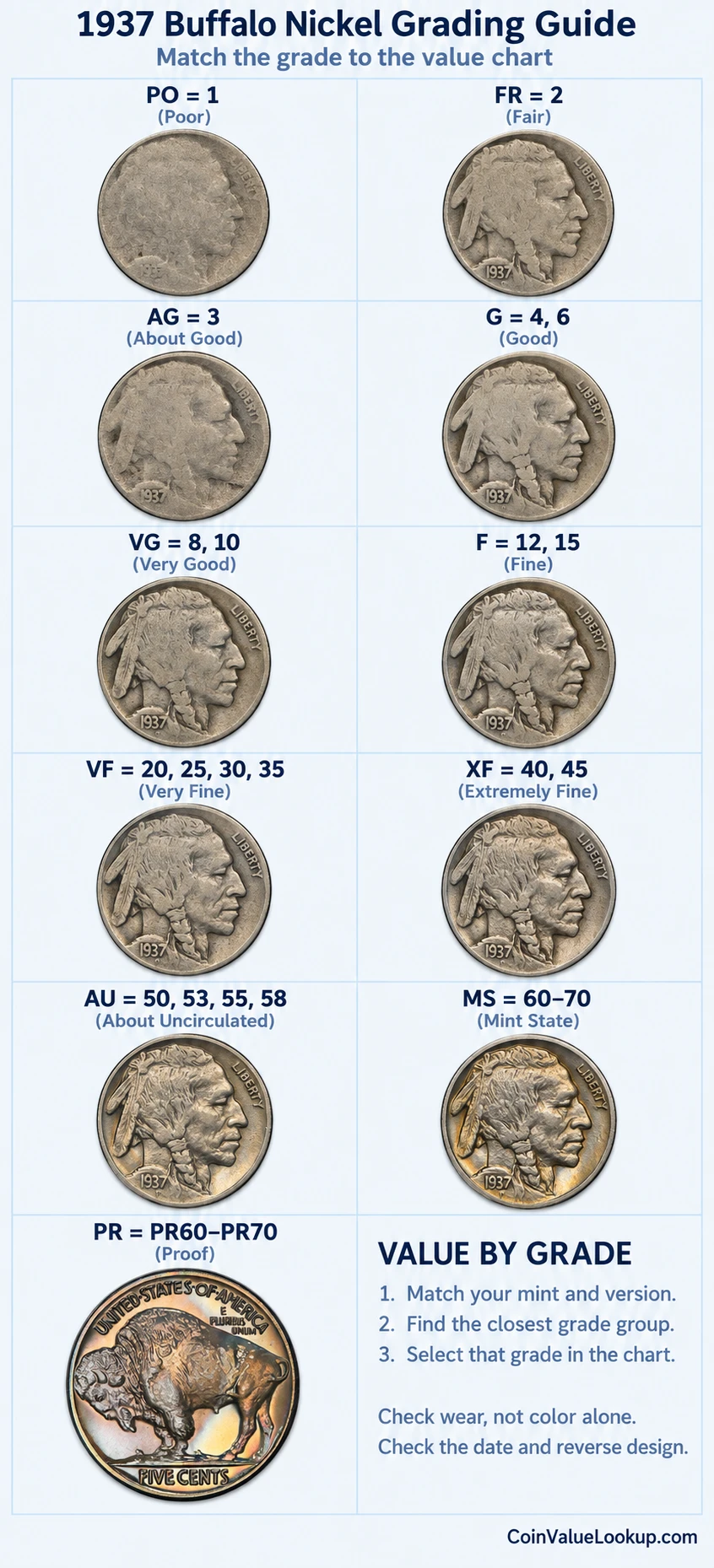
Start with the bison's shoulder and horn on the reverse. On a well-worn coin, the shoulder flattens first and the horn blends into the head.
On the obverse, check the hair braid detail above the neck tie and the cheekbone — these are the highest relief points and show wear earliest.
A coin in Good-4 will have a readable date and a mostly flat bison with an outline of the horn. By MS63, you should see full original luster with only minor contact marks.
Do not confuse a weak strike with actual wear. Buffalo Nickels were notorious for soft strikes, and a coin can leave the mint with an incomplete horn or soft braid.
Look at the overall luster: if the fields still have cartwheel shine but the horn is soft, that is likely a strike issue, not circulation damage.
Compare your coin against the grading image for a realistic side-by-side. Never clean or acid-treat a Buffalo Nickel to restore the date — it destroys the surface and any collector premium.
Step 3: Check 1937 Buffalo Nickel Value by Mint and Version
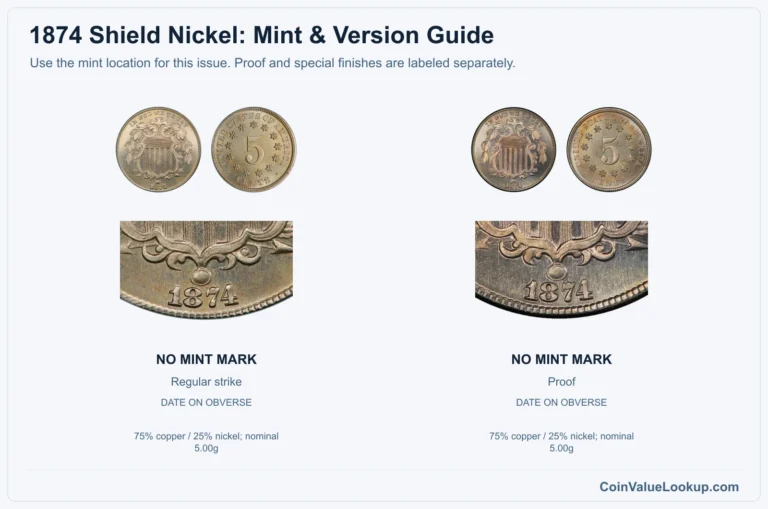
1937 Buffalo Nickel — No Mint Mark — Type2 Circulation
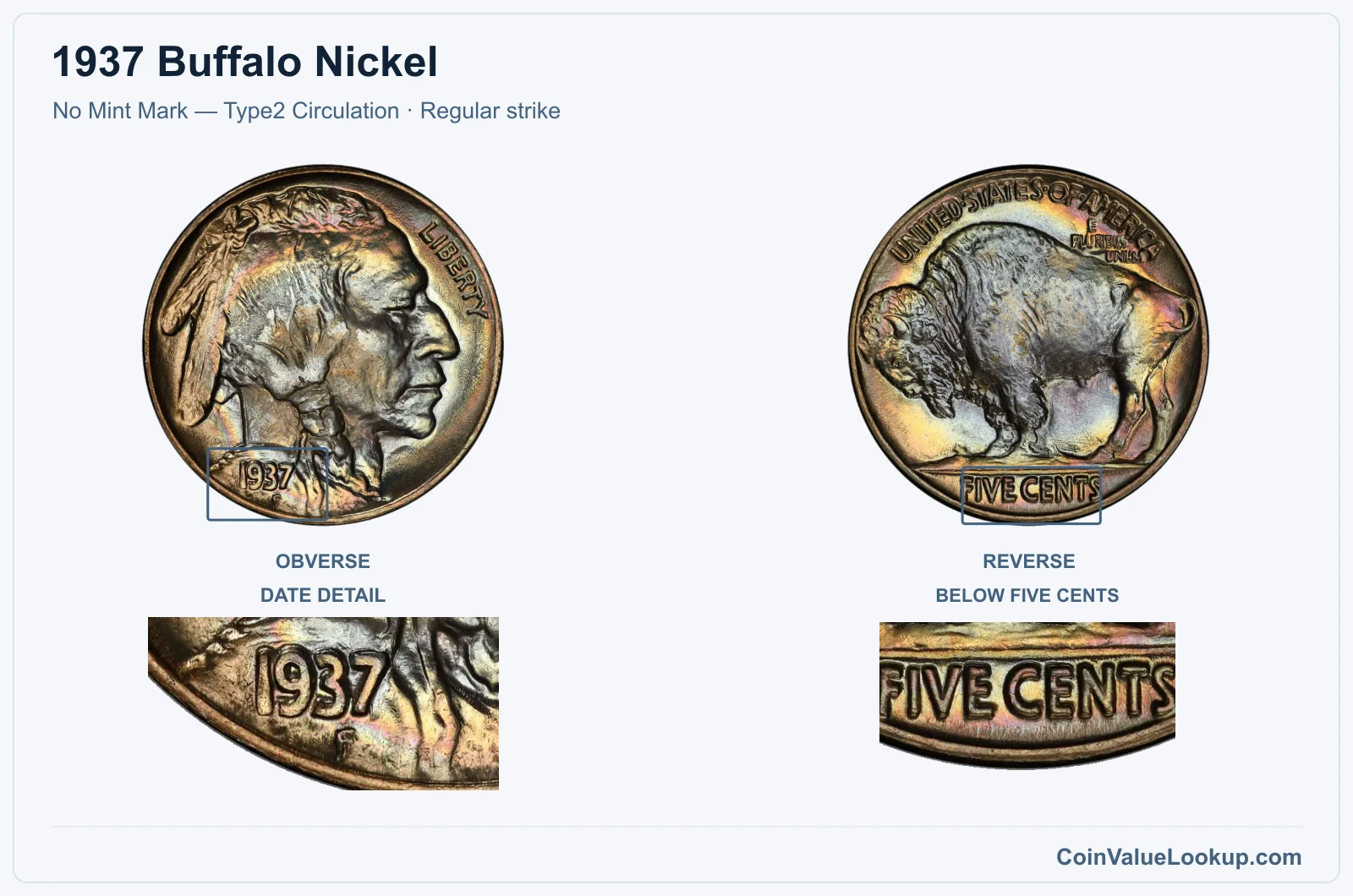
The Philadelphia issue carries no mintmark and is the most common 1937 nickel you will encounter in change jars and albums. USA Coin Book guide estimates place it at about $1.56 in Good-4 and $50 in MS63.
Look for full original luster and sharp braid detail if you think yours might be uncirculated. Even common-date Buffalo Nickels gain real value once they cross into mint-state territory with clean surfaces.
Range Grade
Price Auction Records Appraisal PO PO 1
—
Coin Identifier FR FR 2
—
Coin Identifier AG AG 3
—
Coin Identifier G G 4
—
Coin Identifier
G 6
—
Coin Identifier VG VG 8
—
Coin Identifier
VG 10
—
Coin Identifier F F 12
—
Coin Identifier
F 15
—
Coin Identifier VF VF 20
—
Coin Identifier
VF 25
—
Coin Identifier
VF 30
—
Coin Identifier
VF 35
—
Coin Identifier XF XF 40
—
Coin Identifier
XF 45
—
Coin Identifier AU AU 50
—
Coin Identifier
AU 53
—
Coin Identifier
AU 55
Coin Identifier
AU 58
Coin Identifier MS MS 60
—
Coin Identifier
MS 61
Coin Identifier
MS 62
Coin Identifier
MS 63
Coin Identifier
MS 64
Coin Identifier
MS 65
Coin Identifier
MS 66
Coin Identifier
MS 67
Coin Identifier
MS 68
Coin Identifier
MS 69
—
—
—
MS 70
—
—
—
1937 Buffalo Nickel — D — Type2 Circulation
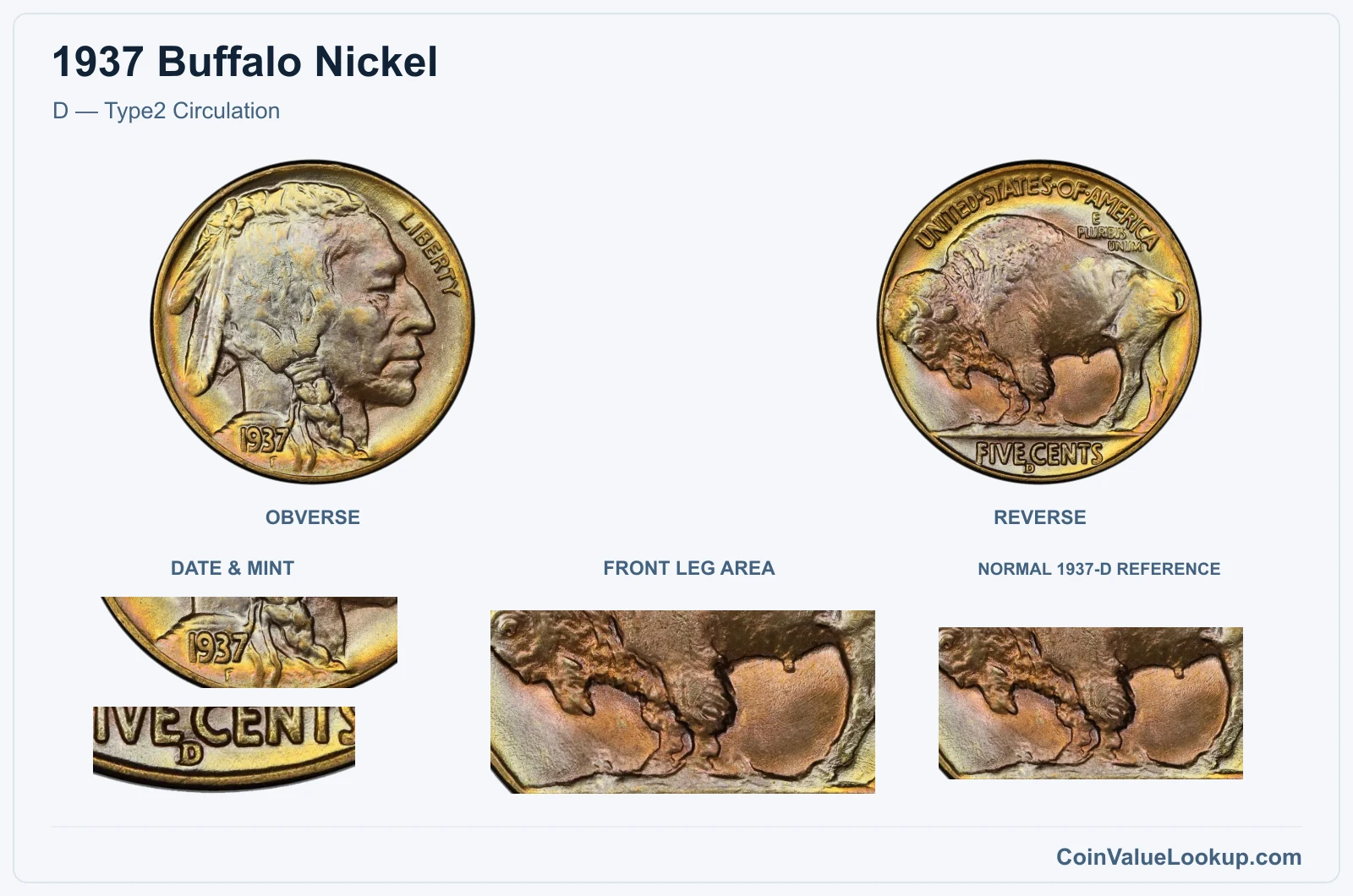
The Denver mint struck 1937-D nickels with a small D below FIVE CENTS on the reverse. Guide estimates run from roughly $1.56 in G4 to $56 in MS63 per USA Coin Book.
This is also the mint responsible for the famous Three Legs variety, so every 1937-D deserves a close look at the bison's front legs before you toss it in the "common" pile. A normal 1937-D will show four complete legs with distinct separation between them.
Range Grade
Price Auction Records Appraisal PO PO 1
—
Coin Identifier FR FR 2
—
Coin Identifier AG AG 3
—
Coin Identifier G G 4
—
Coin Identifier
G 6
—
Coin Identifier VG VG 8
—
Coin Identifier
VG 10
—
Coin Identifier F F 12
—
Coin Identifier
F 15
—
Coin Identifier VF VF 20
—
Coin Identifier
VF 25
—
Coin Identifier
VF 30
—
Coin Identifier
VF 35
—
Coin Identifier XF XF 40
—
Coin Identifier
XF 45
—
Coin Identifier AU AU 50
—
Coin Identifier
AU 53
—
Coin Identifier
AU 55
Coin Identifier
AU 58
Coin Identifier MS MS 60
—
Coin Identifier
MS 61
—
Coin Identifier
MS 62
Coin Identifier
MS 63
Coin Identifier
MS 64
Coin Identifier
MS 65
Coin Identifier
MS 66
Coin Identifier
MS 67
Coin Identifier
MS 68
Coin Identifier
MS 69
—
—
—
MS 70
—
—
—
1937 Buffalo Nickel — S — Type2 Circulation
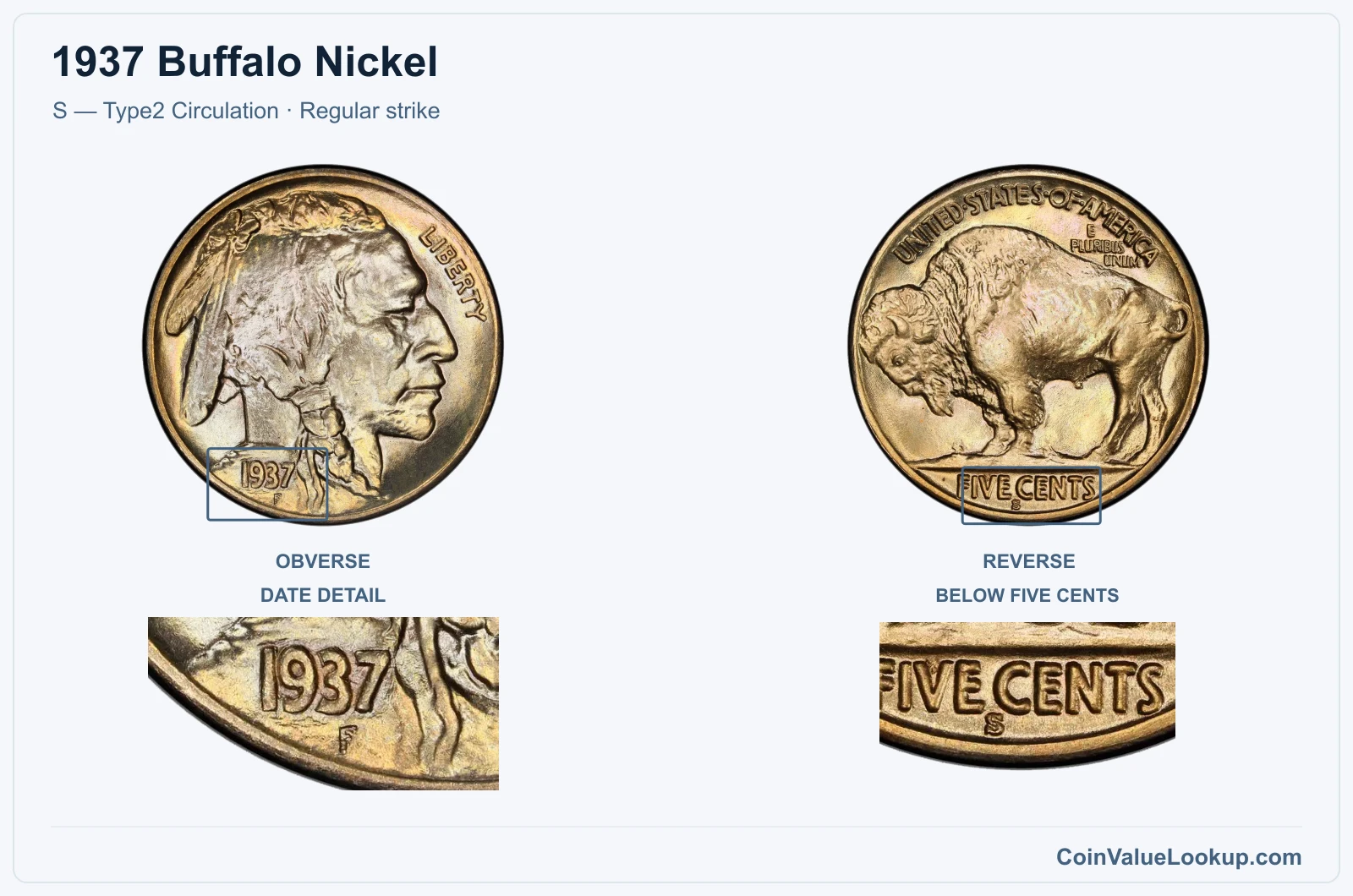
San Francisco's 1937-S carries an S mintmark below FIVE CENTS. USA Coin Book estimates guide it at about $1.56 in G4 and $52 in MS63.
While not as headline-grabbing as the Denver issue, the S-mint coin in true uncirculated condition with original surfaces still commands a solid premium over its worn counterparts. Confirm the mintmark is a clear S and not a damaged or filled D.
Range Grade
Price Auction Records Appraisal PO PO 1
—
Coin Identifier FR FR 2
—
Coin Identifier AG AG 3
—
Coin Identifier G G 4
—
Coin Identifier
G 6
—
Coin Identifier VG VG 8
—
Coin Identifier
VG 10
—
Coin Identifier F F 12
—
Coin Identifier
F 15
—
Coin Identifier VF VF 20
—
Coin Identifier
VF 25
—
Coin Identifier
VF 30
—
Coin Identifier
VF 35
—
Coin Identifier XF XF 40
—
Coin Identifier
XF 45
—
Coin Identifier AU AU 50
—
Coin Identifier
AU 53
—
Coin Identifier
AU 55
—
Coin Identifier
AU 58
Coin Identifier MS MS 60
—
Coin Identifier
MS 61
—
Coin Identifier
MS 62
Coin Identifier
MS 63
Coin Identifier
MS 64
Coin Identifier
MS 65
Coin Identifier
MS 66
Coin Identifier
MS 67
Coin Identifier
MS 68
Coin Identifier
MS 69
—
—
—
MS 70
—
—
—
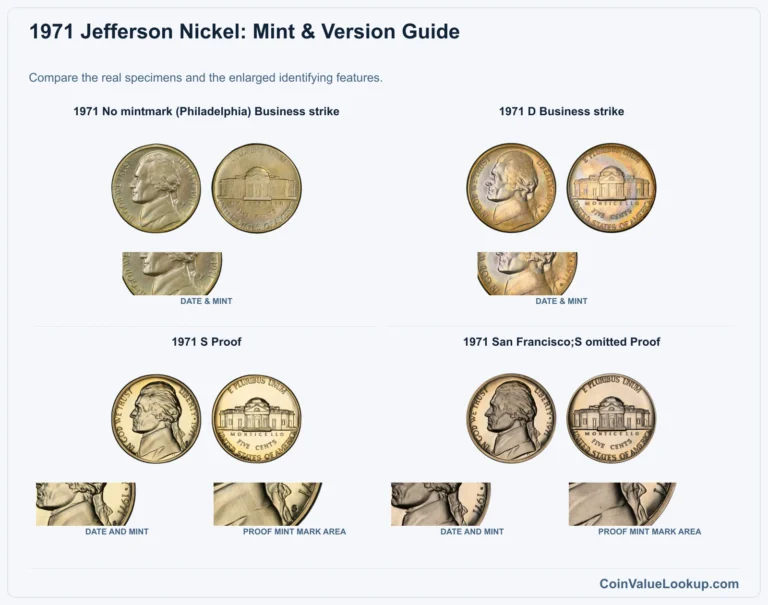
1937 Buffalo Nickel — No Mint Mark — Brilliant Proof
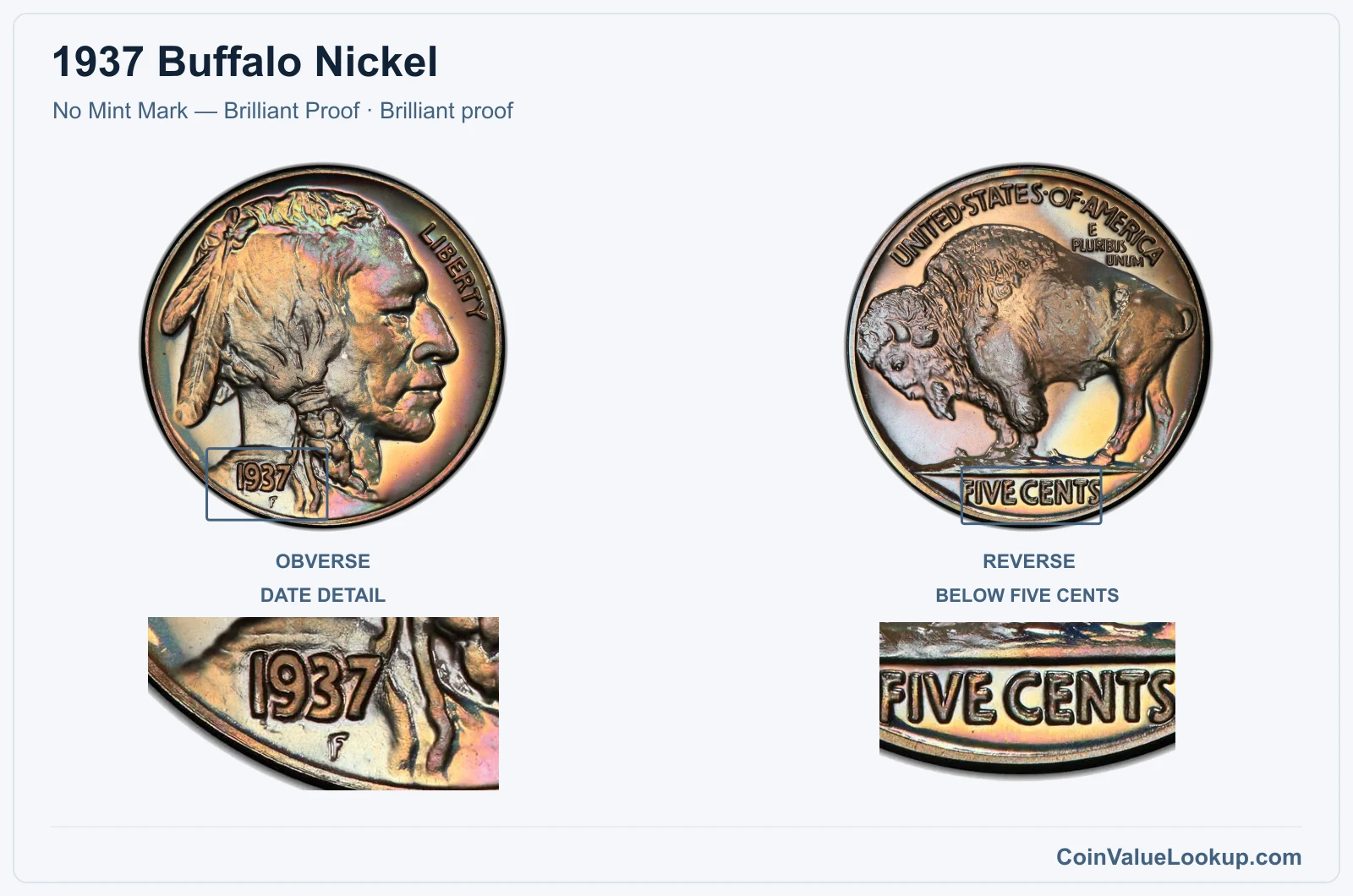
Philadelphia struck Brilliant Proof Buffalo Nickels in 1937, continuing the proof program that resumed in 1936 after a long gap. These coins have deeply mirrored fields, sharp rims, and fully struck details that no circulation strike can match.
USA Coin Book's guide estimate sits near $1,127 at PR63.
Proof is a method of manufacture, not a grade above Mint State. A polished or cleaned circulation coin is not a proof — look for the distinctive mirror finish in the fields and squared-off rim profile.
If you are comparing coins across the Buffalo Nickel series, Coin Value Lookup is a useful starting point for pulling up guides by year and type.
Range Grade
Price Auction Records Appraisal PR PR 1
—
Coin Identifier
PR 2
—
Coin Identifier
PR 3
—
Coin Identifier
PR 4
—
Coin Identifier
PR 6
—
Coin Identifier
PR 8
—
Coin Identifier
PR 10
—
Coin Identifier
PR 12
—
Coin Identifier
PR 15
—
Coin Identifier
PR 20
—
Coin Identifier
PR 25
—
Coin Identifier
PR 30
—
Coin Identifier
PR 35
—
Coin Identifier
PR 40
—
Coin Identifier
PR 45
—
Coin Identifier
PR 50
—
Coin Identifier
PR 53
—
Coin Identifier
PR 55
—
Coin Identifier
PR 58
—
Coin Identifier
PR 60
—
Coin Identifier
PR 61
—
Coin Identifier
PR 62
Coin Identifier
PR 63
Coin Identifier
PR 64
Coin Identifier
PR 65
Coin Identifier
PR 66
Coin Identifier
PR 67
Coin Identifier
PR 68
Coin Identifier
PR 69
—
Coin Identifier
PR 70
—
—
—
1937 Buffalo Nickel — D Three Legs
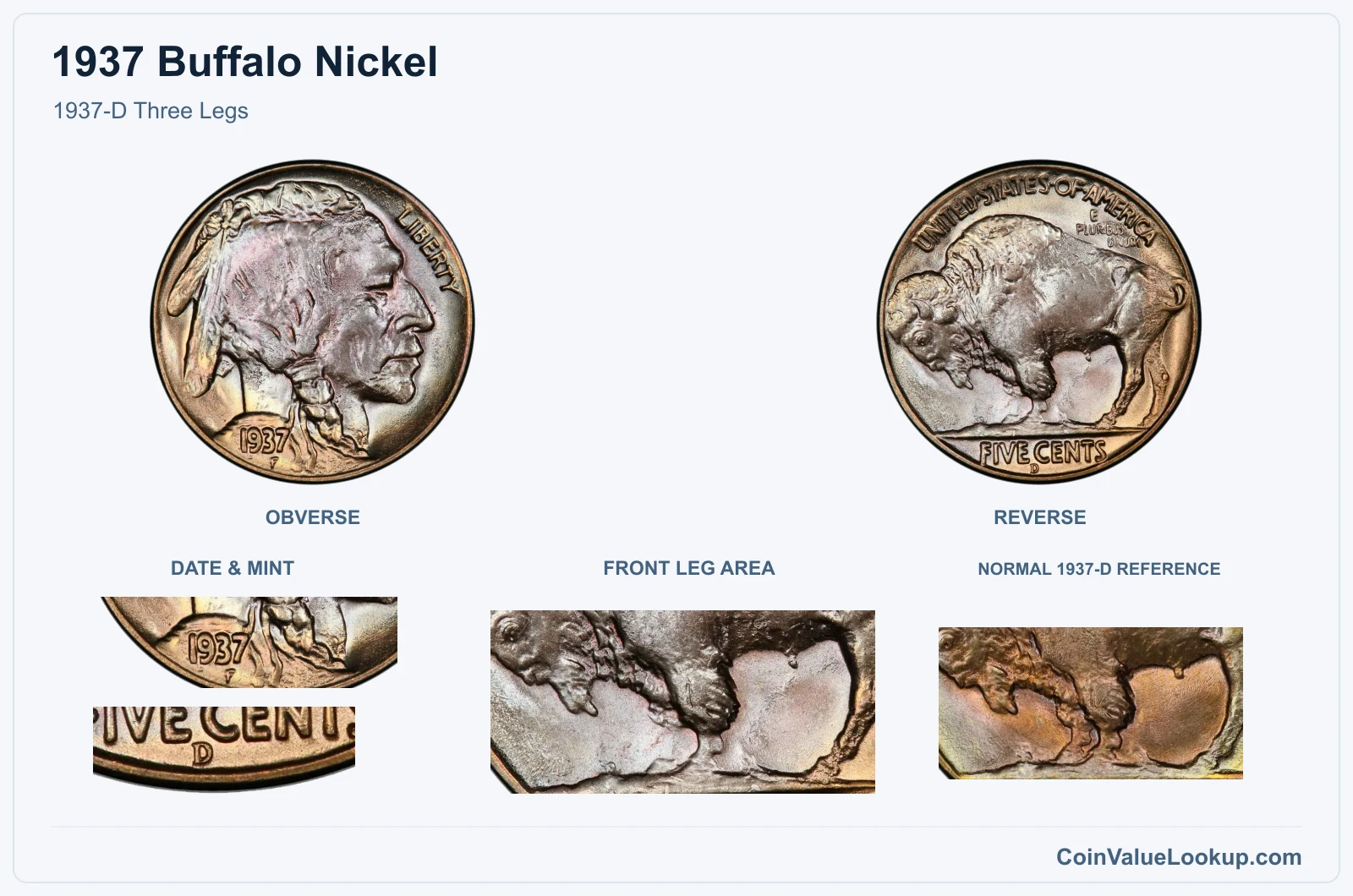
The 1937-D Three Legs is one of the most recognized error varieties in all of U.S. coinage. During production, an overly aggressive die polishing at the Denver mint removed most of the bison's front right leg.
What remains is the hoof, still visible at the ground line, and a faint streaky impression where the leg should be.
USA Coin Book guide estimates range from about $559 in G4 to $5,221 in MS63. Those prices attract fakes.
Genuine examples show specific die diagnostics: look for a raised line or streak on the bison's belly area consistent with the polished die, and confirm that the hoof is still present. A coin where the leg has been physically scraped away will show tool marks and disturbed metal rather than smooth, struck surfaces.
Only Denver-mint coins — with a D mintmark — can be the real thing.
Range Grade
Price Auction Records Appraisal PO PO 1
—
Coin Identifier FR FR 2
—
Coin Identifier AG AG 3
—
Coin Identifier G G 4
Coin Identifier
G 6
Coin Identifier VG VG 8
Coin Identifier
VG 10
Coin Identifier F F 12
Coin Identifier
F 15
Coin Identifier VF VF 20
Coin Identifier
VF 25
Coin Identifier
VF 30
Coin Identifier
VF 35
Coin Identifier XF XF 40
Coin Identifier
XF 45
Coin Identifier AU AU 50
Coin Identifier
AU 53
Coin Identifier
AU 55
Coin Identifier
AU 58
Coin Identifier MS MS 60
Coin Identifier
MS 61
Coin Identifier
MS 62
Coin Identifier
MS 63
Coin Identifier
MS 64
Coin Identifier
MS 65
Coin Identifier
MS 66
Coin Identifier
MS 67
Coin Identifier
MS 68
—
—
—
MS 69
—
—
—
MS 70
—
—
—
1937 Buffalo Nickel Error List
1. 1937 Buffalo Nickel — Off-Center Strike
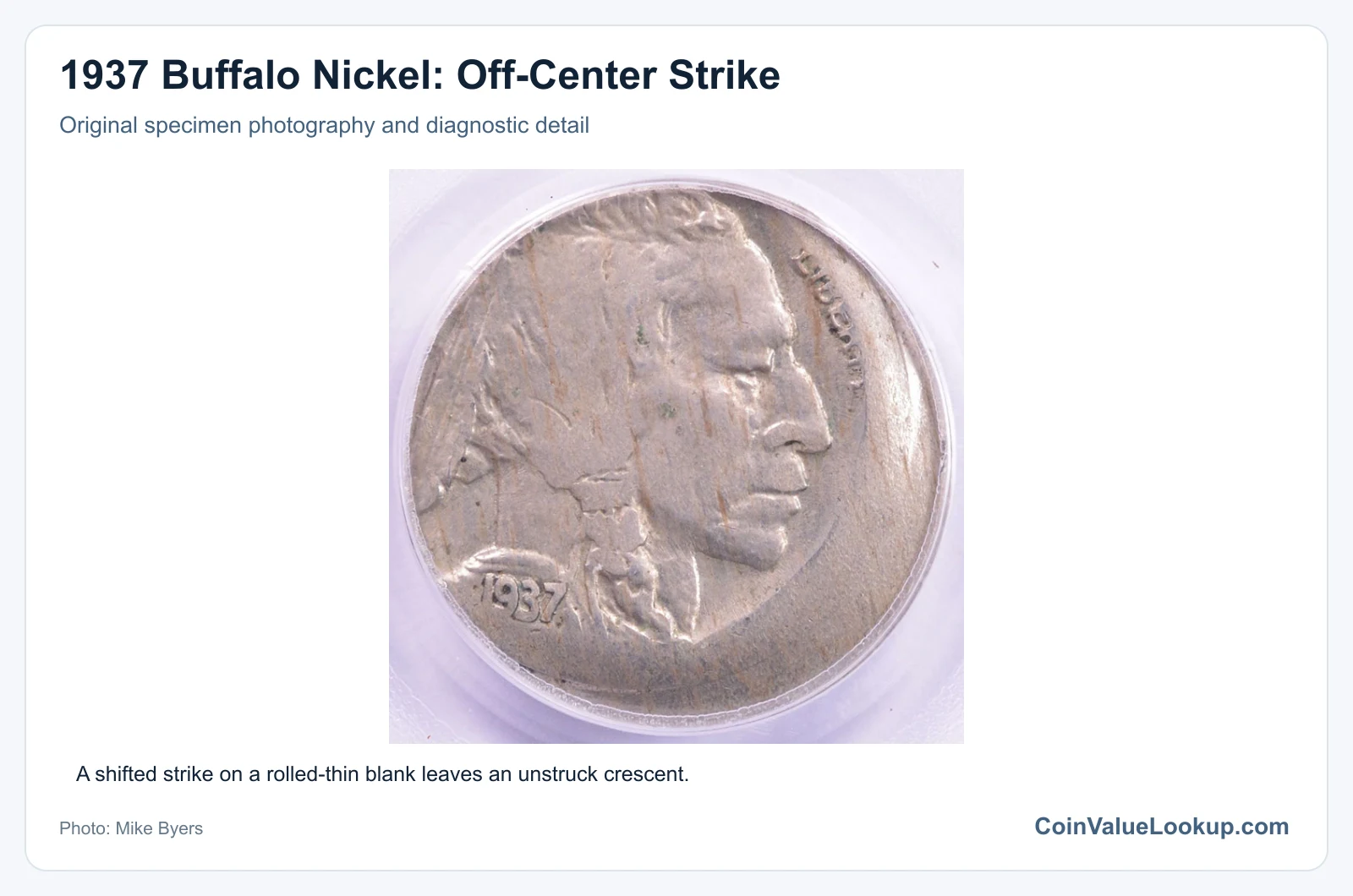
An off-center strike happens when the planchet is not seated properly between the dies, producing a crescent-shaped blank area and a shifted design. On a 1937 Philadelphia nickel, look for a displaced Native American portrait or bison with a corresponding unstruck arc on the opposite side.
The date needs to be visible for the coin to be attributable and carry meaningful value. Condition, the percentage of off-center shift, and whether the date survived all influence what a collector will pay — no single fixed price applies.
Do not confuse this with a clipped planchet, which has a curved bite out of the edge but a normally centered design. Post-mint damage from a vise or hammer can also flatten one side and mimic an off-center look, but the metal flow and rim profile will differ from a genuine mis-fed strike.
2. 1937 Buffalo Nickel — Wrong Planchet / Off-Metal Strike
A wrong-planchet or off-metal strike occurs when a blank intended for a different denomination feeds into the nickel press. A 1937-D example struck on a cent-sized planchet has been reported.
To check, compare your coin's weight, diameter, and edge against a normal Buffalo Nickel — 5 grams, 21.2 mm, plain edge.
A coin on the wrong blank may show an incomplete design because the planchet was too small or too thin to fill the dies fully. Value depends on condition, the degree of design completeness, and the specific wrong planchet involved, so no single price applies.
Look out for coins that have been plated, corroded, acid-treated, or intentionally shaved down to appear different. Genuine off-metal errors will have consistent metal through any edge nicks, not a layered or peeling surface.
3. 1937 Buffalo Nickel — Repunched Mintmark
Repunched mintmark varieties exist on both 1937-D and 1937-S Buffalo Nickels. These occur when the mintmark punch was applied more than once in slightly different positions, leaving traces of the earlier impression.
Under magnification, you will see remnants of a second D or S overlapping or offset from the primary mark. Compare your mintmark to a normal example at the same magnification — the extra impression should be consistent and raised, not flat or mushy.
Machine doubling can produce a similar look but typically leaves a flat, shelf-like outline rather than a distinctly separated second punch. Die chips or corrosion near the mintmark can also fool you.
Value depends on the strength and clarity of the repunching as well as overall coin condition.
4. 1937 Buffalo Nickel — Doubled Die Obverse
A doubled die obverse has been reported for the 1937-S Buffalo Nickel, sometimes appearing alongside a repunched mintmark. This type of error results from a misalignment during die creation, producing consistent doubling across design elements on the obverse.
Look at the lettering — LIBERTY and the date — and the profile details for separation, notching, or split serifs. The doubling should be uniform in direction across multiple elements, not confined to one spot.
Machine doubling is the most common lookalike and shows as a flat, shelf-like displacement rather than the rounded, raised secondary image of a true doubled die. Worn die contours or reflective lighting tricks can also create the illusion of doubling.
Value depends on the visibility and condition of the coin, so no fixed price range applies here.
5. 1937 Buffalo Nickel — Struck-Through Error
A struck-through error occurs when foreign material — grease, a metal fragment, cloth fiber, or debris — sits between the die and the planchet during striking. The result is a localized depression, an impression of the obstruction, or an area of missing design detail on the finished coin.
On a 1937 nickel, look for an area where the design simply did not transfer, sometimes with a slightly different surface texture inside the affected zone. Grease-filled dies tend to obscure entire design elements smoothly, while a retained foreign object may leave a sharper, more defined impression.
Do not mistake ordinary wear, cleaning scratches, or a weak strike for a struck-through error. Wear removes metal gradually across high points, while a struck-through affects a specific, often irregular area.
Value depends on the size, location, and visual impact of the obstruction mark, along with overall coin condition.