1909 Barber Dime Coin Value: How Much Is It Worth?
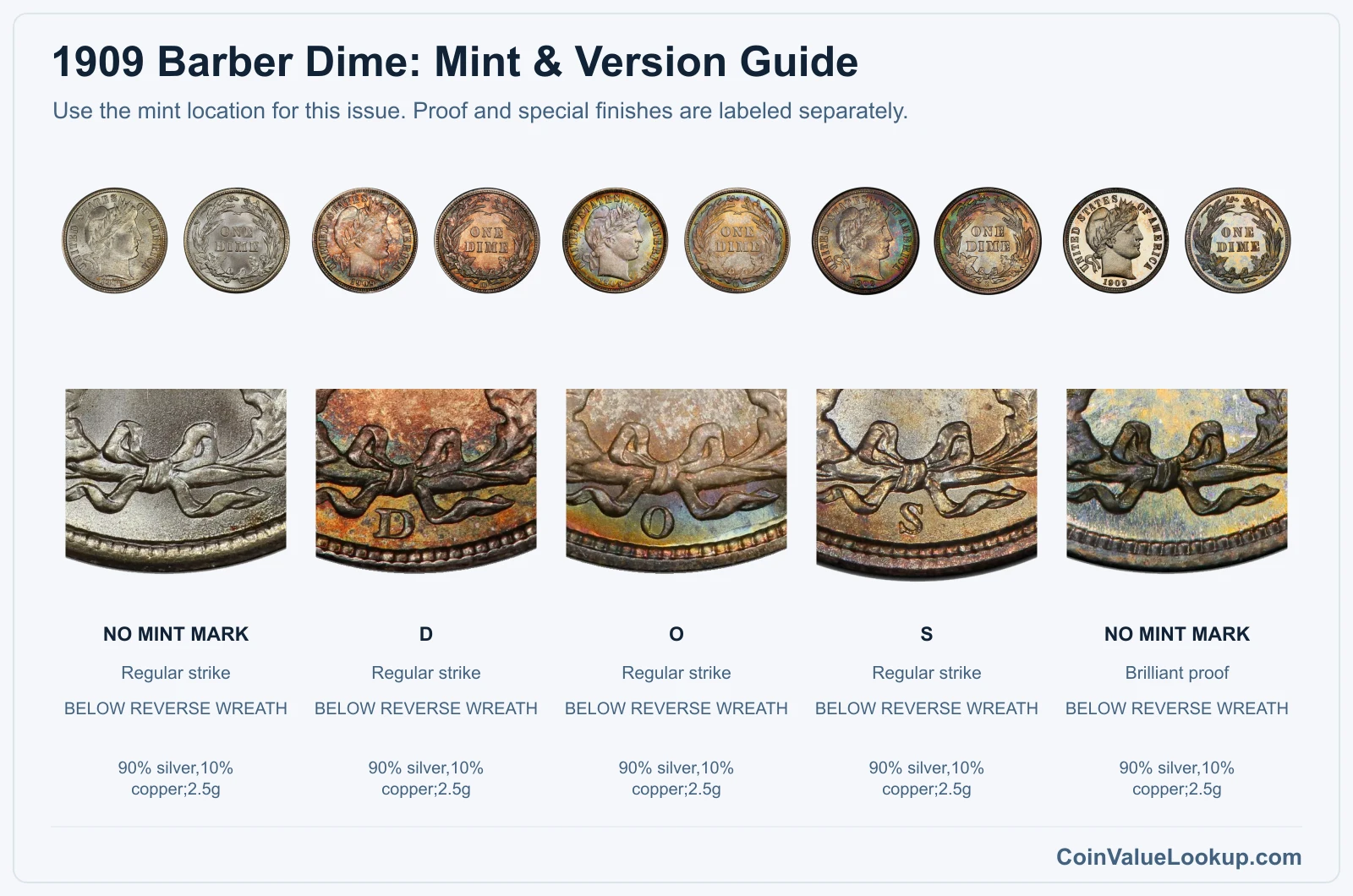
The 1909 Barber dime is the final year the New Orleans Mint struck dimes, making it a natural stopping point for collectors of that facility. Four business-strike mints — Philadelphia, Denver, New Orleans, and San Francisco — plus a Philadelphia proof give you five distinct coins to hunt.
Guide estimates for ordinary circulation strikes run from about $10.91 at G4 up to $1,882 at MS63, depending on the mint.
Fast Way to Identify Your 1909 Barber Dime
Snap a clear photo of the front and back of your coin and upload both images here. Our identifier can give you a preliminary read on which mint and version you have.
It works from the photos alone, so good lighting and a steady hand help. This is not a substitute for professional authentication, but it gets you pointed in the right direction quickly.
1909 Barber Dime Value
Upload both sides of your 1909 Barber Dime.
Front Obverse
Upload photo
Back Reverse
Upload photo
Which 1909 Barber Dime Versions Are Worth Money?
- San Francisco (S) business strikes carry the highest guide values in this set, listed at about $21 in G4 and $1,882 in MS63.
- Denver (D) pieces are also above average, with guide estimates around $19 in G4 and $1,001 in MS63.
- New Orleans (O) dimes are the last dimes ever struck at that mint, adding historical demand beyond the silver content.
- Philadelphia proofs in PR63 are listed near $616 and represent a distinct collectible finish separate from circulation strikes.
- A reported 1909-O lamination error exists; if confirmed, such planchet flaws can carry a premium depending on size and visibility.
Step 1: Identify Your 1909 Barber Dime Mint Mark and Version
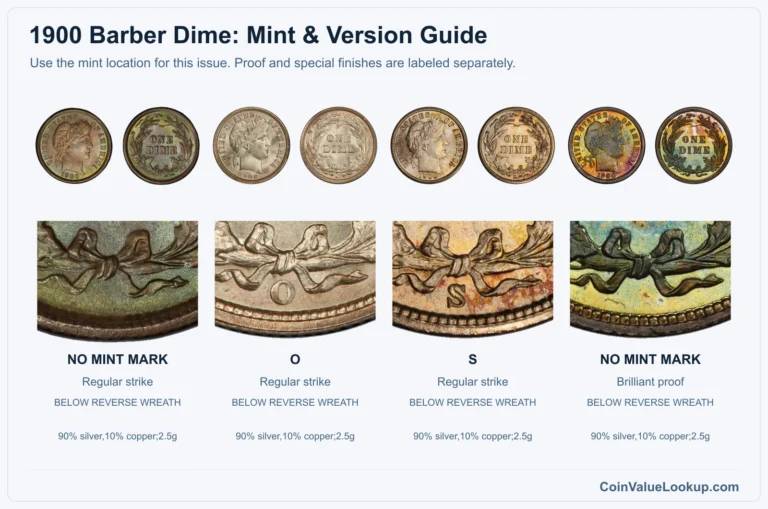
The obverse shows Liberty facing right wearing a headband inscribed LIBERTY, with a laurel wreath and Phrygian cap. The reverse reads ONE DIME inside an open wreath tied with a bow at the bottom.
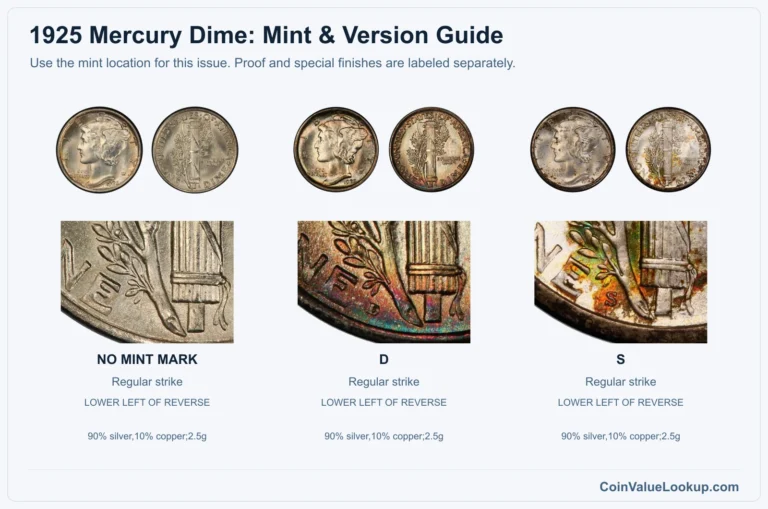
Your mintmark — D, O, or S — sits just below that bow on the reverse. No mintmark means Philadelphia.
All normal 1909 Barber dimes are 90% silver and 10% copper, weighing 2.5 grams with a 17.9 mm diameter and a reeded edge. Don't confuse this design with the Mercury dime that replaced the Barber series in 1916, or with earlier half-dime types.
Four mints produced business strikes in 1909, and Philadelphia also struck proofs. The New Orleans coin carries an "O" mintmark and holds the distinction of being the very last dime from that facility.
Step 2: Check Your 1909 Barber Dime Grade
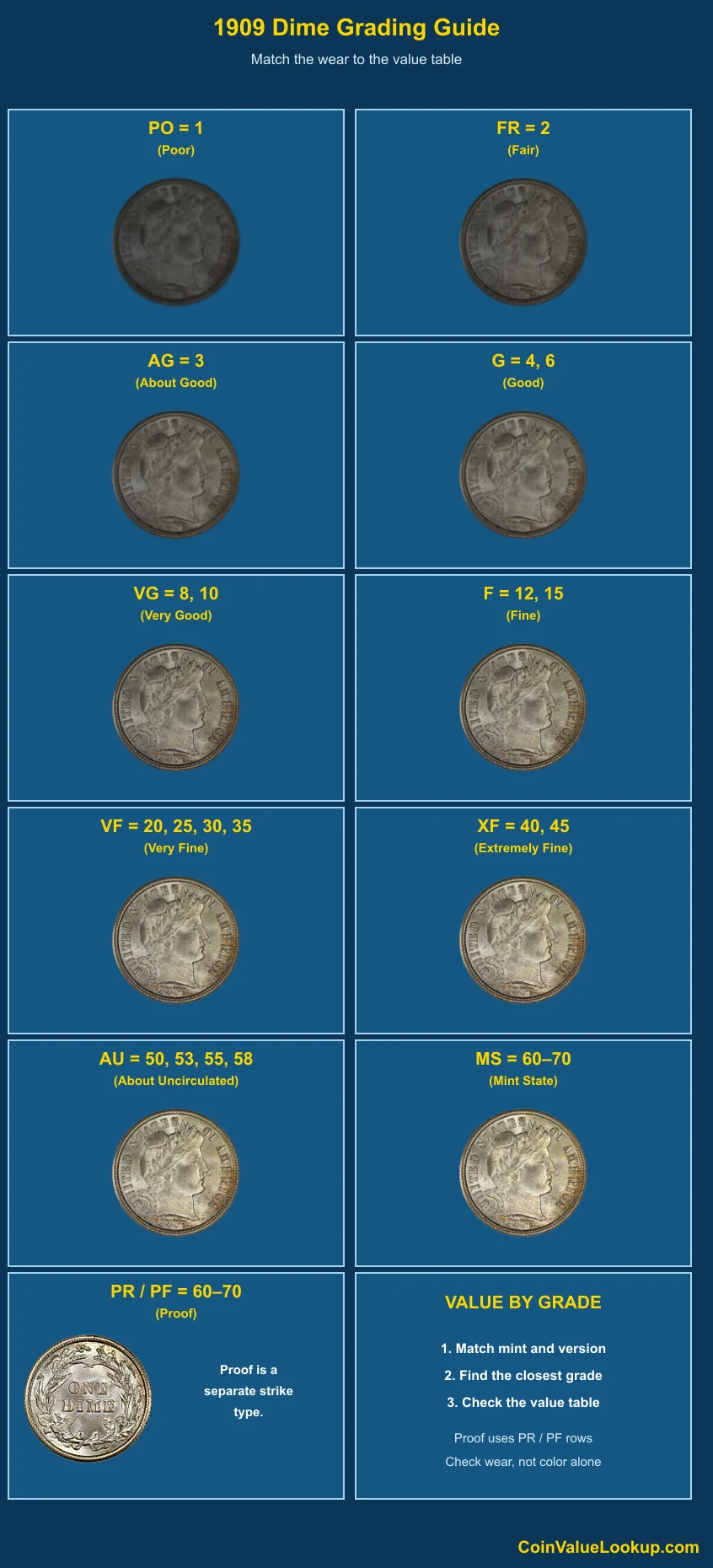
Start with the LIBERTY headband on the obverse. In lower grades the letters merge and disappear; a fully readable LIBERTY generally puts the coin at VF or above.
But don't rely on letter count alone — check the hair detail above the ear, the smoothness of the cheek, and the sharpness of the wreath leaves on the reverse.
New Orleans strikes can show soft detail even on unworn coins because the dies were sometimes not fully impressed. So a mushy headband on an O-mint piece might be strike weakness, not wear.
Compare both sides and look at the rims before jumping to conclusions.
Mint State means unbroken original luster across the entire surface. Hairlines from old cleaning, thumbprint residue, or uneven toning can all drag down the effective grade.
Use the comparison image provided to match your coin's wear pattern against known grade benchmarks.
Proof is a method of manufacture — polished planchets and specially prepared dies — not simply a step above Mint State. The mirrored fields and sharp rims are the giveaway.
Step 3: Check 1909 Barber Dime Value by Mint and Version
1909 Barber Dime — No Mint Mark — Silver Circulation
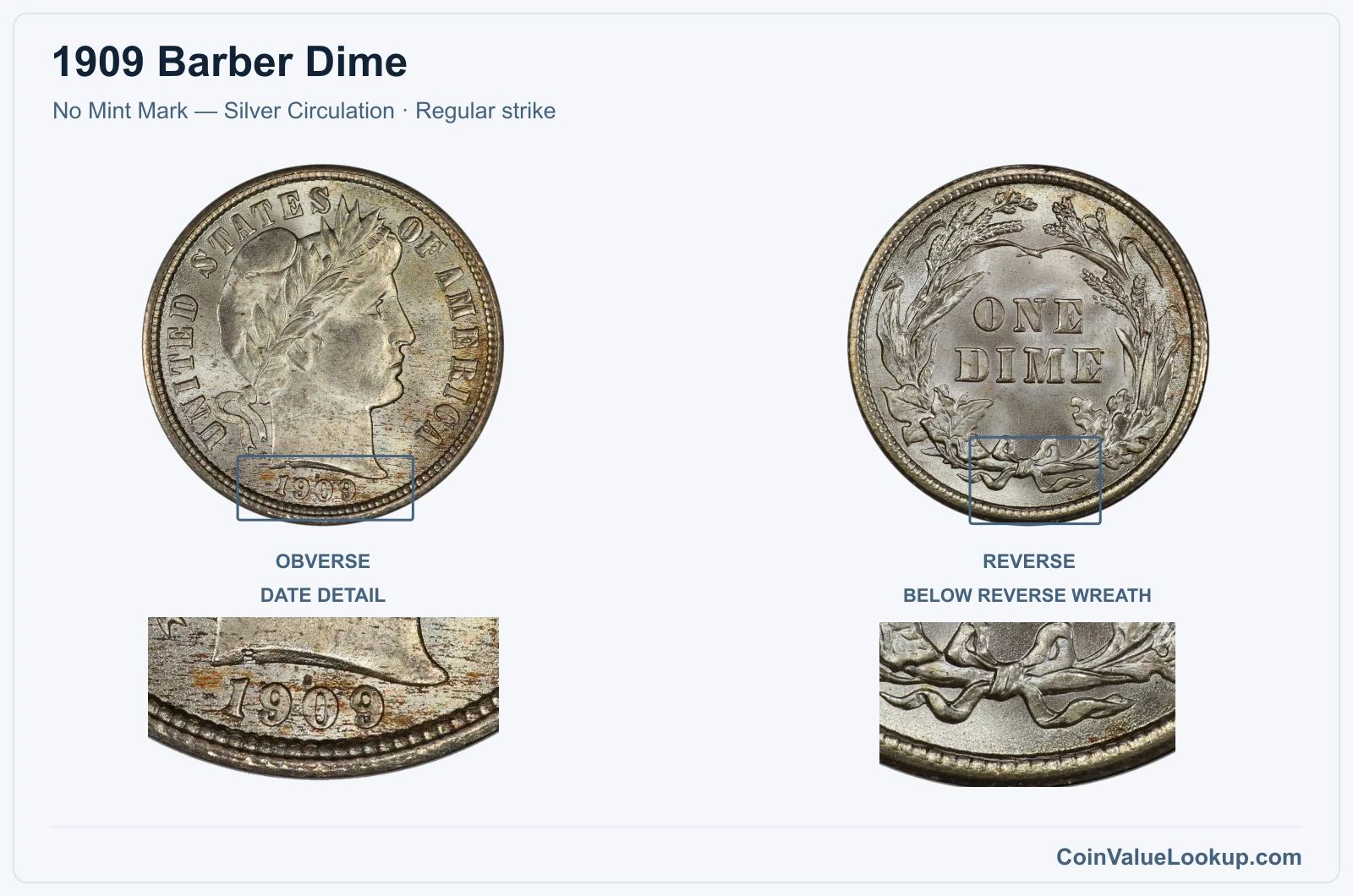
The Philadelphia issue has no mintmark, so check the reverse below the wreath bow — it should be blank. This is typically the most affordable 1909 Barber dime, with guide estimates near $10.91 in G4 and around $253 in MS63.
Philadelphia struck the bulk of Barber dime production most years, so surviving examples are easier to locate in circulated grades.
That said, gem-level survivors with full original luster are a different story entirely. Look for complete hair detail, undisturbed surfaces, and sharp wreath leaves when evaluating a higher-grade piece.
Range Grade
Price Auction Records Appraisal PO PO 1
—
Coin Identifier FR FR 2
—
Coin Identifier AG AG 3
—
Coin Identifier G G 4
—
Coin Identifier
G 6
—
Coin Identifier VG VG 8
—
Coin Identifier
VG 10
—
Coin Identifier F F 12
—
Coin Identifier
F 15
—
Coin Identifier VF VF 20
—
Coin Identifier
VF 25
—
Coin Identifier
VF 30
—
Coin Identifier
VF 35
—
Coin Identifier XF XF 40
Coin Identifier
XF 45
Coin Identifier AU AU 50
Coin Identifier
AU 53
Coin Identifier
AU 55
Coin Identifier
AU 58
Coin Identifier MS MS 60
Coin Identifier
MS 61
Coin Identifier
MS 62
Coin Identifier
MS 63
Coin Identifier
MS 64
Coin Identifier
MS 65
Coin Identifier
MS 66
Coin Identifier
MS 67
Coin Identifier
MS 68
—
—
—
MS 69
—
—
—
MS 70
—
—
—
1909 Barber Dime — D — Silver Circulation
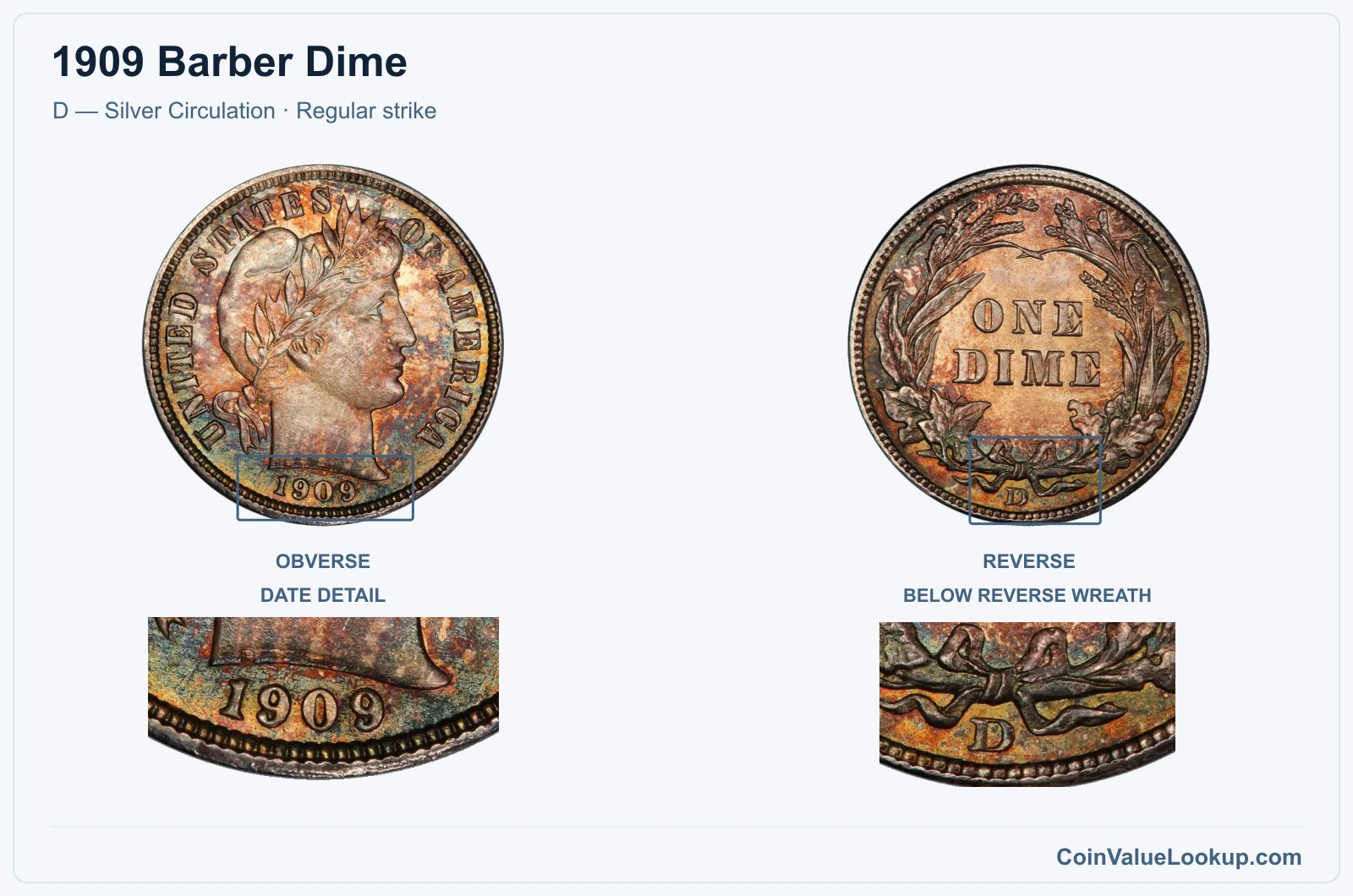
Denver strikes carry a small "D" mintmark below the wreath bow on the reverse. Guide values sit around $19 in G4 and roughly $1,001 in MS63, a noticeable jump above the Philadelphia issue.
Denver had been striking Barber dimes only since 1906, so total output from that mint across the series is limited compared to Philadelphia. In upper grades especially, genuine uncirculated D-mint pieces are scarce.
Confirm the mintmark under magnification — a worn or damaged coin can make the letter hard to read.
Range Grade
Price Auction Records Appraisal PO PO 1
—
Coin Identifier FR FR 2
—
Coin Identifier AG AG 3
—
Coin Identifier G G 4
—
Coin Identifier
G 6
—
Coin Identifier VG VG 8
—
Coin Identifier
VG 10
—
Coin Identifier F F 12
Coin Identifier
F 15
Coin Identifier VF VF 20
Coin Identifier
VF 25
Coin Identifier
VF 30
Coin Identifier
VF 35
Coin Identifier XF XF 40
Coin Identifier
XF 45
Coin Identifier AU AU 50
Coin Identifier
AU 53
Coin Identifier
AU 55
Coin Identifier
AU 58
Coin Identifier MS MS 60
—
Coin Identifier
MS 61
Coin Identifier
MS 62
Coin Identifier
MS 63
Coin Identifier
MS 64
Coin Identifier
MS 65
Coin Identifier
MS 66
Coin Identifier
MS 67
Coin Identifier
MS 68
—
—
—
MS 69
—
—
—
MS 70
—
—
—
1909 Barber Dime — O — Silver Circulation
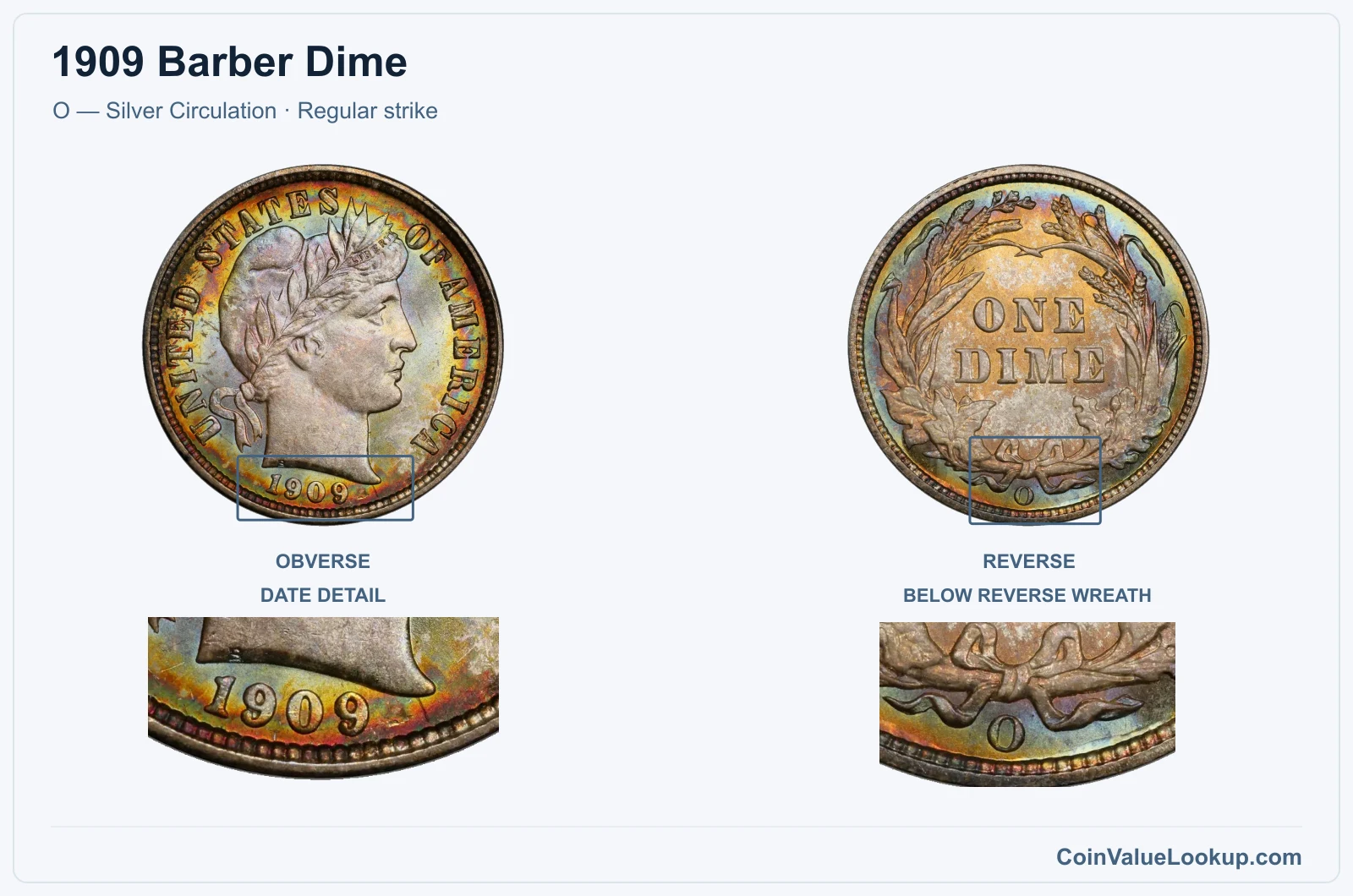
This is the coin that draws the historians. 1909 was the last year the New Orleans Mint produced dimes — period.
The "O" mintmark sits below the wreath bow, same position as other branch mints.
Guide estimates land near $15 in G4 and about $725 in MS63. O-mint Barber dimes are known for sometimes showing softer strikes than their eastern and western counterparts, so evaluate wear carefully against actual strike quality.
A soft headband could be the die, not decades of pocket wear.
Coin Value Lookup is a handy starting point if you want to compare values across other Barber dime dates or different series entirely.
Range Grade
Price Auction Records Appraisal PO PO 1
—
Coin Identifier FR FR 2
—
Coin Identifier AG AG 3
—
Coin Identifier G G 4
—
Coin Identifier
G 6
—
Coin Identifier VG VG 8
—
Coin Identifier
VG 10
—
Coin Identifier F F 12
Coin Identifier
F 15
—
Coin Identifier VF VF 20
—
Coin Identifier
VF 25
Coin Identifier
VF 30
Coin Identifier
VF 35
Coin Identifier XF XF 40
Coin Identifier
XF 45
Coin Identifier AU AU 50
—
Coin Identifier
AU 53
Coin Identifier
AU 55
Coin Identifier
AU 58
Coin Identifier MS MS 60
—
Coin Identifier
MS 61
Coin Identifier
MS 62
Coin Identifier
MS 63
Coin Identifier
MS 64
Coin Identifier
MS 65
Coin Identifier
MS 66
Coin Identifier
MS 67
Coin Identifier
MS 68
—
—
—
MS 69
—
—
—
MS 70
—
—
—
1909 Barber Dime — S — Silver Circulation
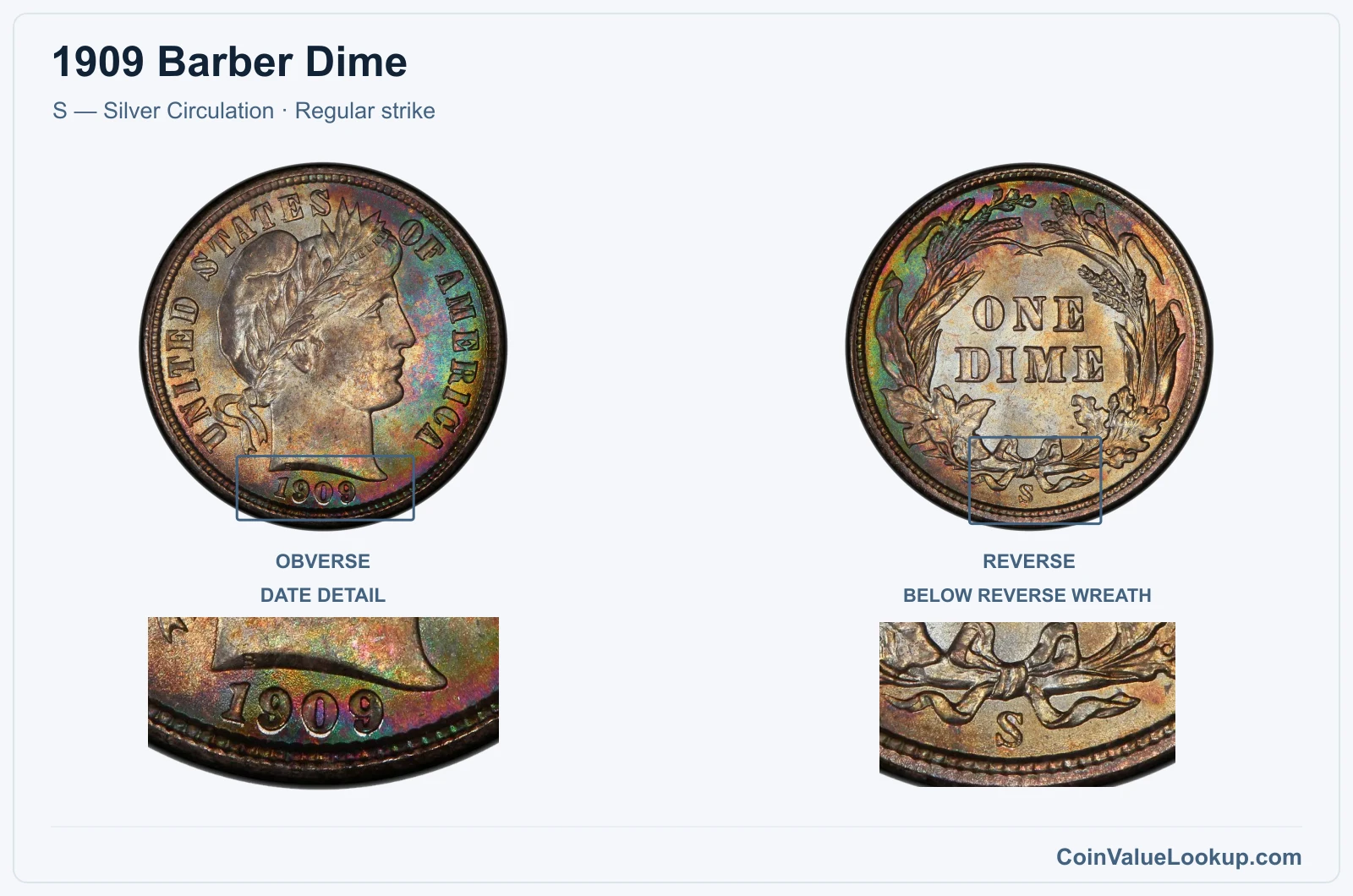
San Francisco pieces carry an "S" below the reverse wreath bow and sit at the top of the business-strike guide range for 1909. Estimates run about $21 in G4 and approximately $1,882 in MS63, making it the priciest regular-issue version in higher grades.
The premium reflects genuine scarcity in uncirculated condition. Most S-mint Barber dimes circulated heavily in Western commerce.
Finding one with full, undisturbed luster is the kind of thing that makes a collector's day. Verify the mintmark carefully, as wear can sometimes blur an "S" into something ambiguous.
Range Grade
Price Auction Records Appraisal PO PO 1
—
Coin Identifier FR FR 2
—
Coin Identifier AG AG 3
—
Coin Identifier G G 4
Coin Identifier
G 6
Coin Identifier VG VG 8
Coin Identifier
VG 10
Coin Identifier F F 12
Coin Identifier
F 15
Coin Identifier VF VF 20
Coin Identifier
VF 25
Coin Identifier
VF 30
Coin Identifier
VF 35
Coin Identifier XF XF 40
Coin Identifier
XF 45
Coin Identifier AU AU 50
Coin Identifier
AU 53
Coin Identifier
AU 55
Coin Identifier
AU 58
Coin Identifier MS MS 60
—
Coin Identifier
MS 61
Coin Identifier
MS 62
Coin Identifier
MS 63
Coin Identifier
MS 64
Coin Identifier
MS 65
Coin Identifier
MS 66
Coin Identifier
MS 67
Coin Identifier
MS 68
—
—
—
MS 69
—
—
—
MS 70
—
—
—
1909 Barber Dime — No Mint Mark — Brilliant Silver Proof
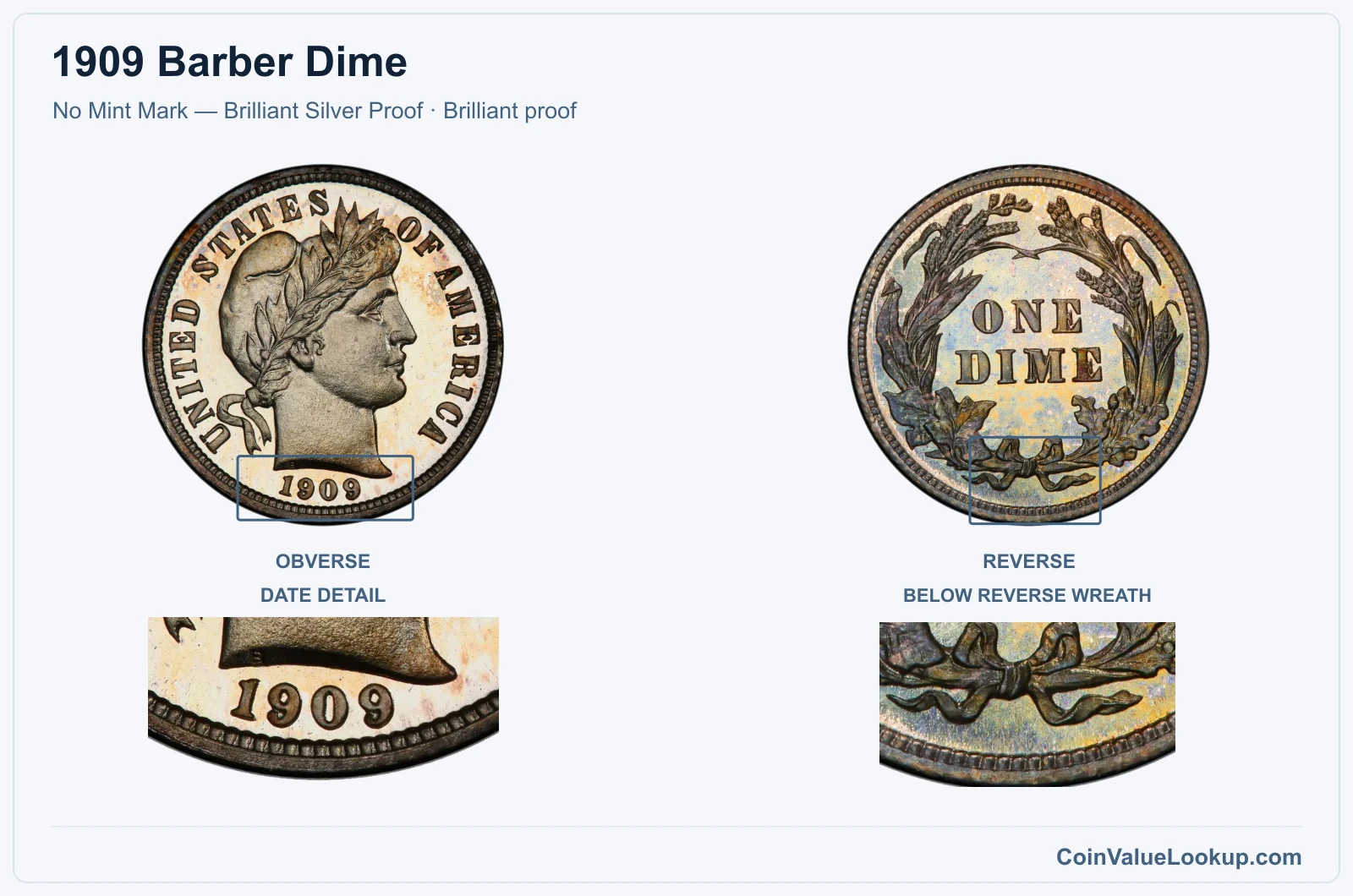
Philadelphia proofs were struck on polished planchets with specially prepared dies, producing mirror-like fields and crisp design details. There is no mintmark.
A PR63 example is listed near $616 in guide estimates.
Do not confuse a well-preserved business strike with a proof — proofs have a distinctly different surface character, with flat, reflective fields that contrast against the devices. Cameo and Deep Cameo designations reflect contrast between frosted devices and mirrored fields; they carry their own market and should not be priced using the standard PR63 figure.
Range Grade
Price Auction Records Appraisal PR PR 1
—
Coin Identifier
PR 2
—
Coin Identifier
PR 3
—
Coin Identifier
PR 4
—
Coin Identifier
PR 6
—
Coin Identifier
PR 8
—
Coin Identifier
PR 10
—
Coin Identifier
PR 12
—
Coin Identifier
PR 15
—
Coin Identifier
PR 20
—
Coin Identifier
PR 25
—
Coin Identifier
PR 30
—
Coin Identifier
PR 35
—
Coin Identifier
PR 40
—
Coin Identifier
PR 45
—
Coin Identifier
PR 50
—
Coin Identifier
PR 53
—
Coin Identifier
PR 55
—
Coin Identifier
PR 58
Coin Identifier
PR 60
Coin Identifier
PR 61
—
Coin Identifier
PR 62
Coin Identifier
PR 63
Coin Identifier
PR 64
Coin Identifier
PR 65
Coin Identifier
PR 66
Coin Identifier
PR 67
Coin Identifier
PR 68
Coin Identifier
PR 69
—
—
—
PR 70
—
—
—
1909 Barber Dime Error List
1. 1909 Barber Dime — Lamination / Split Planchet
A lamination error occurs when layers within the planchet fail to bond properly, creating a visible split, peel, or retained flap of metal on the coin's surface. One seller-reported example involves a 1909-O Barber dime with a reverse lamination.
This has not been independently authenticated, so treat it as a reported candidate rather than a confirmed variety.
If you suspect a lamination on your coin, photograph the affected area and the edge together. You are looking for metal that lifts or separates naturally from within the planchet — not surface scraping, corrosion pitting, or a deliberately cut or tooled area.
Corrosion especially can mimic a lamination at first glance.
Condition, size, and visual impact of the flaw all influence what a lamination error might be worth. No reliable numerical price range is available for this specific date and mint, so individual assessment from a grading service is the prudent path.