1873 Liberty Seated Quarter Coin Value: How Much Is It Worth?
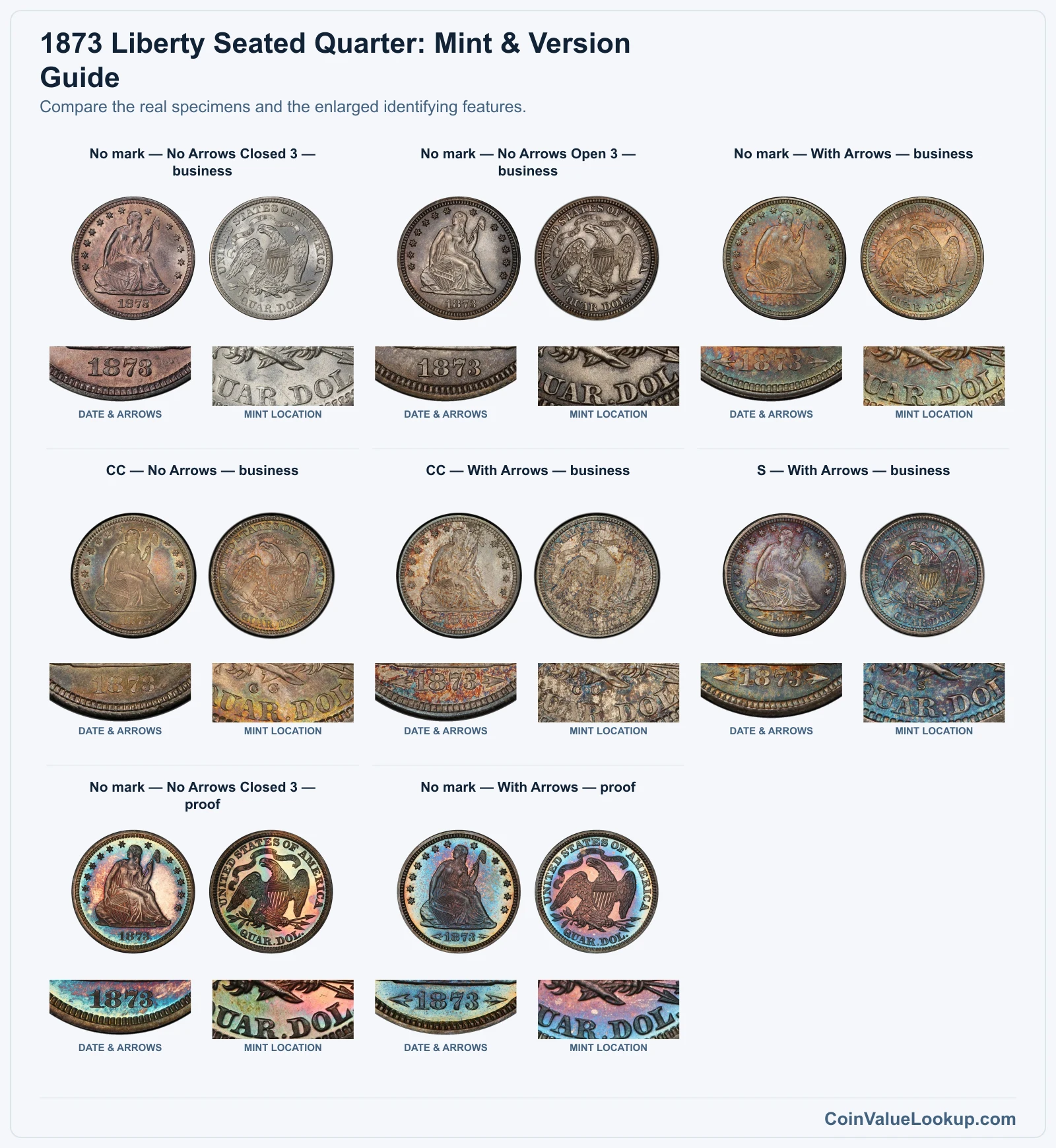
The 1873 Liberty Seated Quarter is one of the more complicated years in the series, and that complexity is exactly what makes it rewarding to study. Depending on mint, reverse design and condition, USA Coin Book guide estimates range from $131.00 to $187,834.00 across the different versions.
Not every 1873 quarter is worth thousands — the specific branch your coin belongs to matters enormously.
Fast Way to Identify Your 1873 Liberty Seated Quarter
The fastest way to start figuring out what you have is to upload clear photos of both sides of your coin. Front and back images let us provide a preliminary identification of your mint, variety and general condition.
That alone narrows the field dramatically for an 1873 quarter, which has eight distinct collectible branches.
1873 Liberty Seated Quarter Value
Upload both sides of your 1873 Liberty Seated Quarter.
Front Obverse
Upload photo
Back Reverse
Upload photo
Which 1873 Liberty Seated Quarter Versions Are Worth Money?
- CC With Arrows business strikes carry the highest guide estimates, reaching $187,834.00 at MS63 per USA Coin Book, due to Carson City's low production and the With Arrows design change.
- No mark With Arrows business strikes are listed up to $42,849.00 at MS63, making high-grade Philadelphia survivors well worth authenticating.
- S With Arrows business strikes start at a more accessible $131.00 in G4 and climb to $5,631.00 at MS63 — the San Francisco mint is the most affordable entry point.
- CC No Arrows business strikes are extremely rare and require specialist authentication; no standard guide estimate was adopted, so each coin is assessed individually.
- No mark No Arrows Closed 3 and Open 3 business strikes also lack adopted guide ranges, making authenticated examples worth professional evaluation.
Step 1: Identify Your 1873 Liberty Seated Quarter Mint Mark and Version
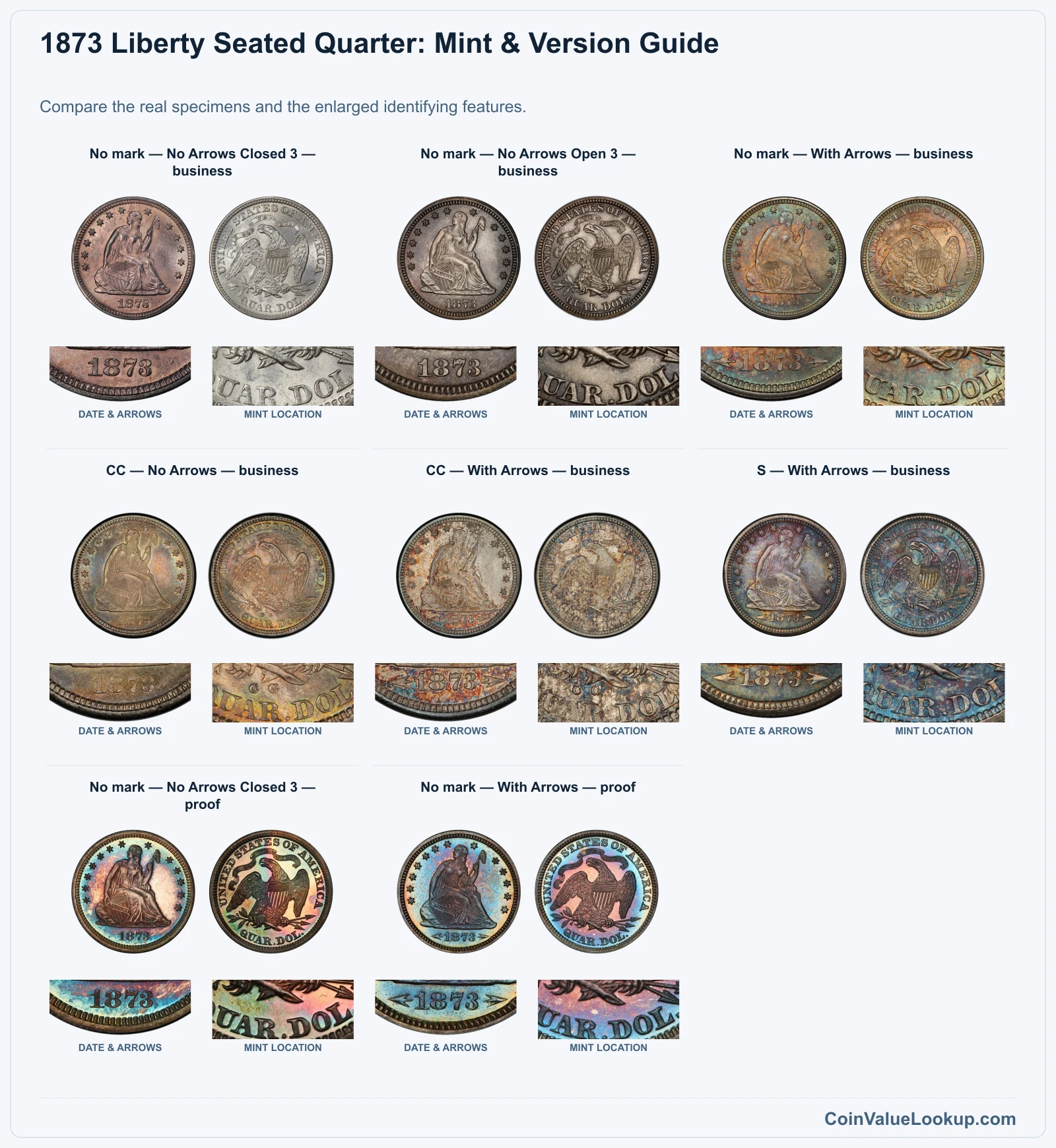
All 1873 Liberty Seated Quarters are struck in 90% silver and 10% copper. The obverse shows Lady Liberty seated, and the reverse displays an eagle with motto.
First, check for a mintmark on the reverse beneath the eagle. Philadelphia coins carry no mintmark.
A "CC" indicates Carson City, and an "S" indicates San Francisco. No other mints produced this denomination in 1873.
Next, look at the date. Some 1873 quarters have small arrowheads flanking the date on either side — these are the "With Arrows" type, struck under the new 6.25-gram weight standard.
Coins without arrows used the earlier 6.22-gram standard.
For Philadelphia No Arrows coins, there is one more split: the shape of the numeral 3. A "Closed 3" has the upper and lower arms nearly touching, leaving only a tiny gap.
An "Open 3" has a clear, wide space between those arms. This distinction matters for both business strikes and proofs.
Proof coins were made only at Philadelphia. They have mirrored fields and sharp details from specially prepared dies.
A proof is a manufacturing method, not a condition grade above mint state.
The eight branches for this year are: No mark No Arrows Closed 3 (business), No mark No Arrows Open 3 (business), No mark With Arrows (business), CC No Arrows (business), CC With Arrows (business), S With Arrows (business), No mark No Arrows Closed 3 (proof), and No mark With Arrows (proof).
Step 2: Check Your 1873 Liberty Seated Quarter Grade
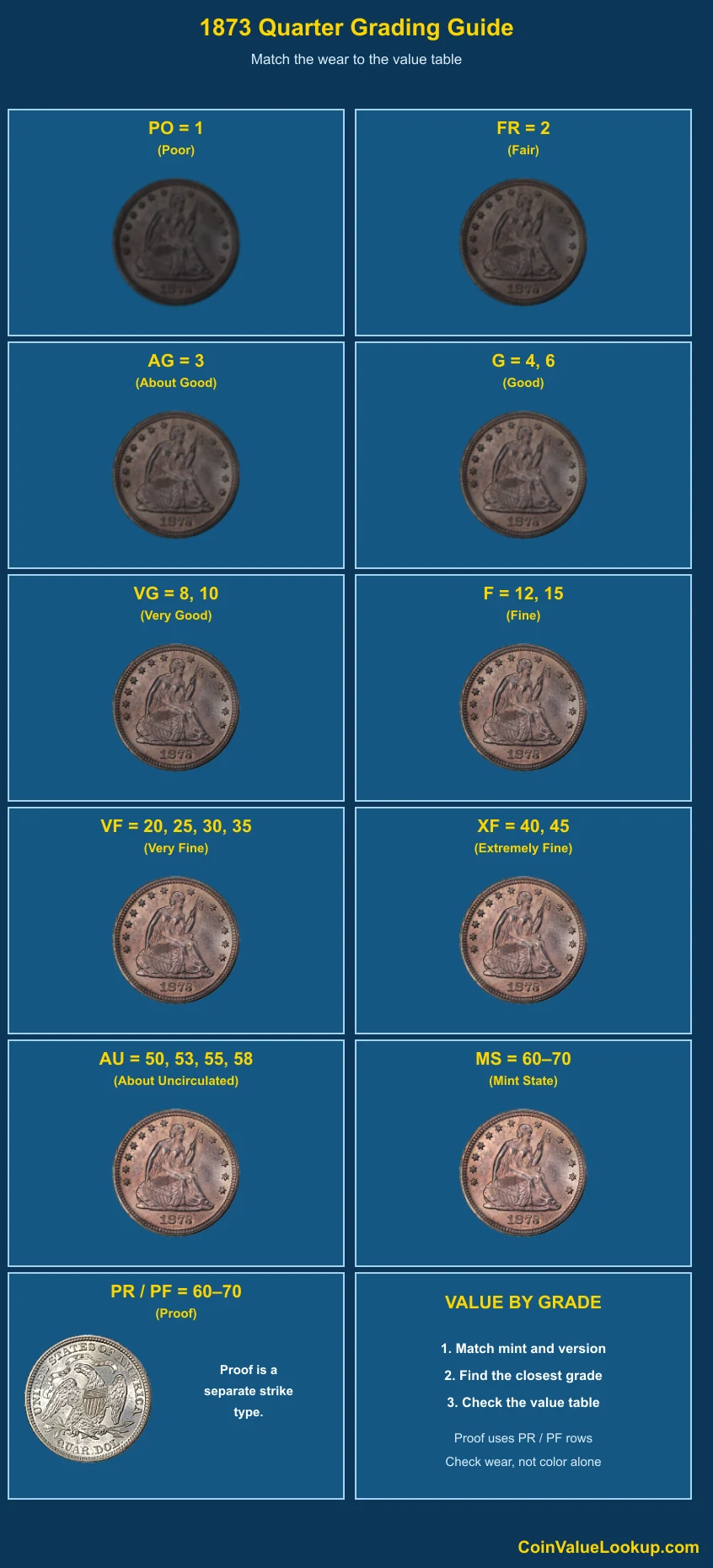
Start by examining Liberty's head, breast, knee and the horizontal lines of her shield on the obverse. On well-worn coins, the head merges into the cap first, then the knee flattens, and finally the shield lines vanish.
Flip the coin over and check the eagle's breast feathers and upper wing tips. These high points wear down in a predictable sequence that helps you estimate grade.
Compare your coin to the reference image, matching both surface wear and remaining luster. A coin with full luster but soft detail on Liberty's head may be weakly struck rather than worn — that is a strike issue, not a wear issue.
Cleaned coins lose their original skin and often show hairline scratches under magnification. A bright, unnaturally shiny surface on a 150-year-old silver coin is a red flag, not a sign of high grade.
Step 3: Check 1873 Liberty Seated Quarter Value by Mint and Version
1873 Liberty Seated Quarter — No mark — No Arrows Closed 3 — business
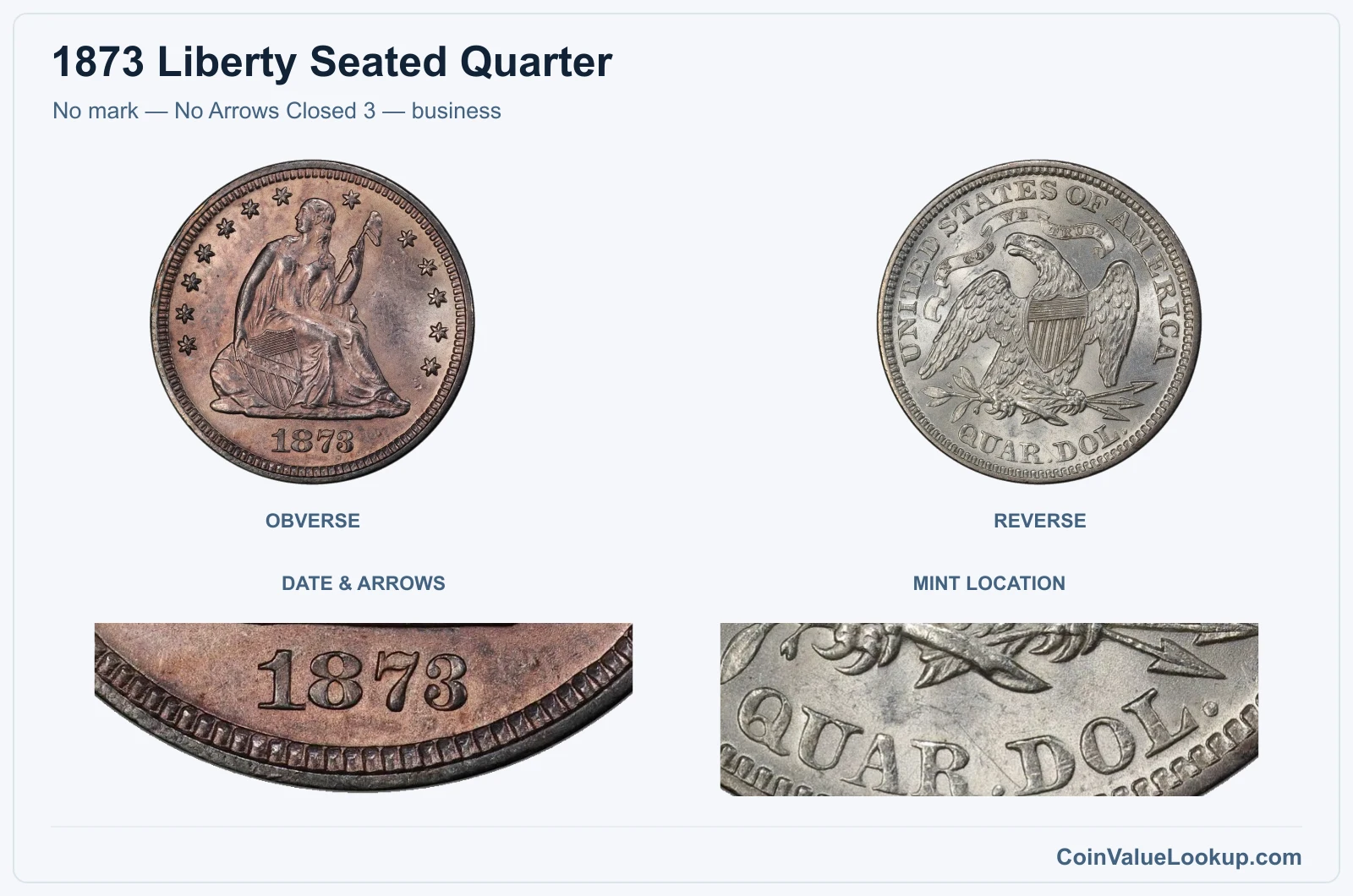
The No Arrows Closed 3 business strike from Philadelphia uses the older 6.22-gram weight standard. Look for a date without flanking arrowheads and a "3" whose upper and lower arms nearly meet, leaving only a narrow gap.
No standard guide price range was adopted for this version. Each coin's value depends on its authenticated identity, condition and whether any errors are present.
Professional grading and authentication are especially useful here, since the Closed 3 and Open 3 distinction can be subtle under wear.
Range Grade
Price Auction Records Appraisal PO PO 1
—
Coin Identifier FR FR 2
Coin Identifier AG AG 3
—
Coin Identifier G G 4
—
Coin Identifier
G 6
—
Coin Identifier VG VG 8
—
Coin Identifier
VG 10
Coin Identifier F F 12
—
Coin Identifier
F 15
Coin Identifier VF VF 20
Coin Identifier
VF 25
Coin Identifier
VF 30
Coin Identifier
VF 35
Coin Identifier XF XF 40
Coin Identifier
XF 45
Coin Identifier AU AU 50
Coin Identifier
AU 53
—
Coin Identifier
AU 55
Coin Identifier
AU 58
Coin Identifier MS MS 60
—
Coin Identifier
MS 61
Coin Identifier
MS 62
Coin Identifier
MS 63
—
—
—
MS 64
—
—
—
MS 65
—
—
—
MS 66
—
—
—
MS 67
—
—
—
MS 68
—
—
—
MS 69
—
—
—
MS 70
—
—
—
1873 Liberty Seated Quarter — No mark — No Arrows Open 3 — business
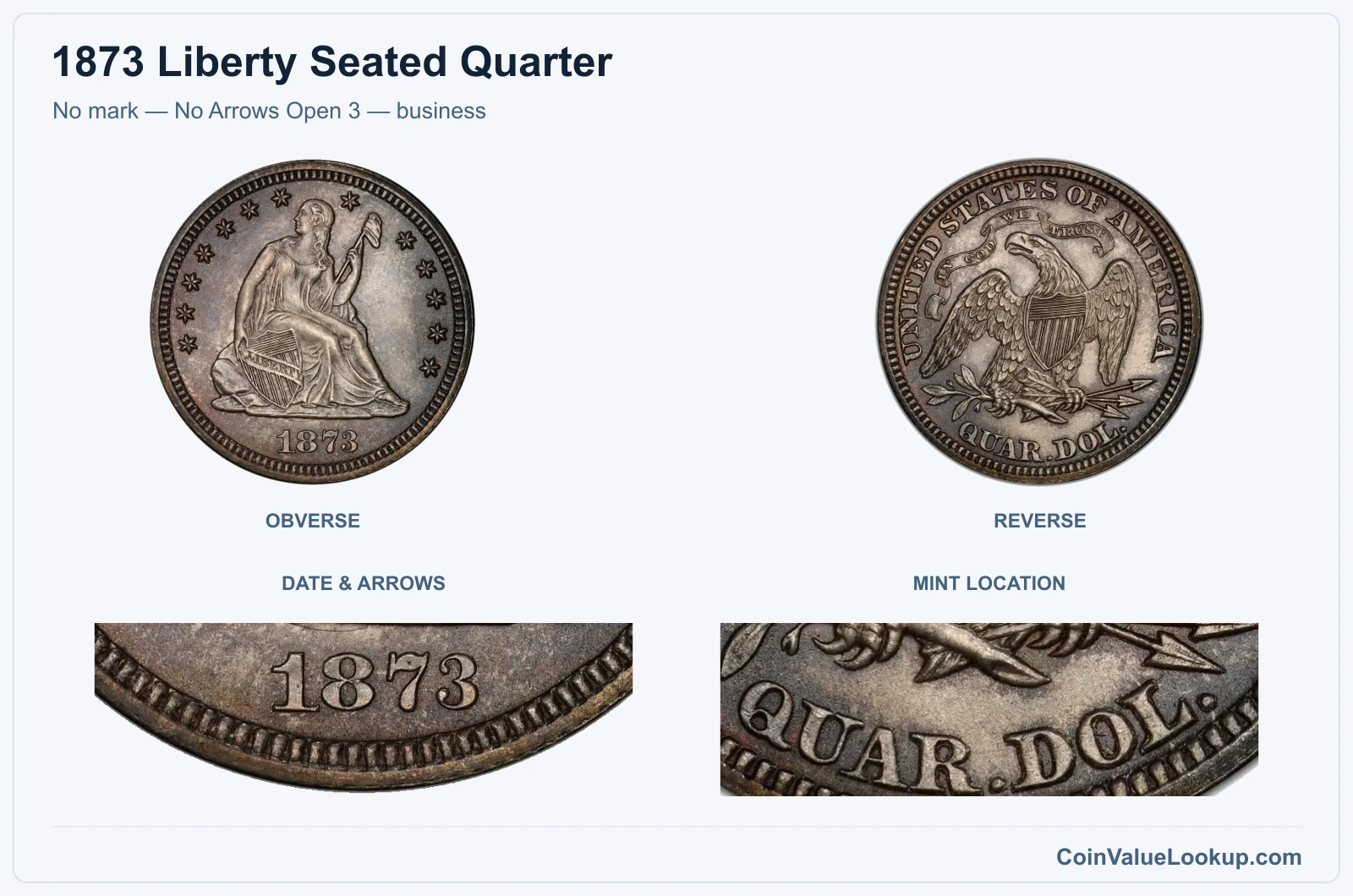
Philadelphia also produced a No Arrows Open 3 business strike. The weight standard is the same 6.22 grams, and there are still no arrowheads beside the date — but the numeral 3 has a clearly visible gap between its upper and lower curves.
No adopted guide range is available for this version either. Value hinges on authenticated identity and preservation.
If you think you have an Open 3, compare your coin's date closely with known examples under magnification before drawing conclusions.
Range Grade
Price Auction Records Appraisal PO PO 1
—
Coin Identifier FR FR 2
—
Coin Identifier AG AG 3
—
Coin Identifier G G 4
—
Coin Identifier
G 6
—
Coin Identifier VG VG 8
Coin Identifier
VG 10
—
Coin Identifier F F 12
—
Coin Identifier
F 15
Coin Identifier VF VF 20
—
Coin Identifier
VF 25
—
Coin Identifier
VF 30
Coin Identifier
VF 35
—
Coin Identifier XF XF 40
Coin Identifier
XF 45
Coin Identifier AU AU 50
—
Coin Identifier
AU 53
—
Coin Identifier
AU 55
Coin Identifier
AU 58
Coin Identifier MS MS 60
—
Coin Identifier
MS 61
—
Coin Identifier
MS 62
Coin Identifier
MS 63
Coin Identifier
MS 64
Coin Identifier
MS 65
Coin Identifier
MS 66
Coin Identifier
MS 67
—
—
—
MS 68
—
—
—
MS 69
—
—
—
MS 70
—
—
—
1873 Liberty Seated Quarter — No mark — With Arrows — business
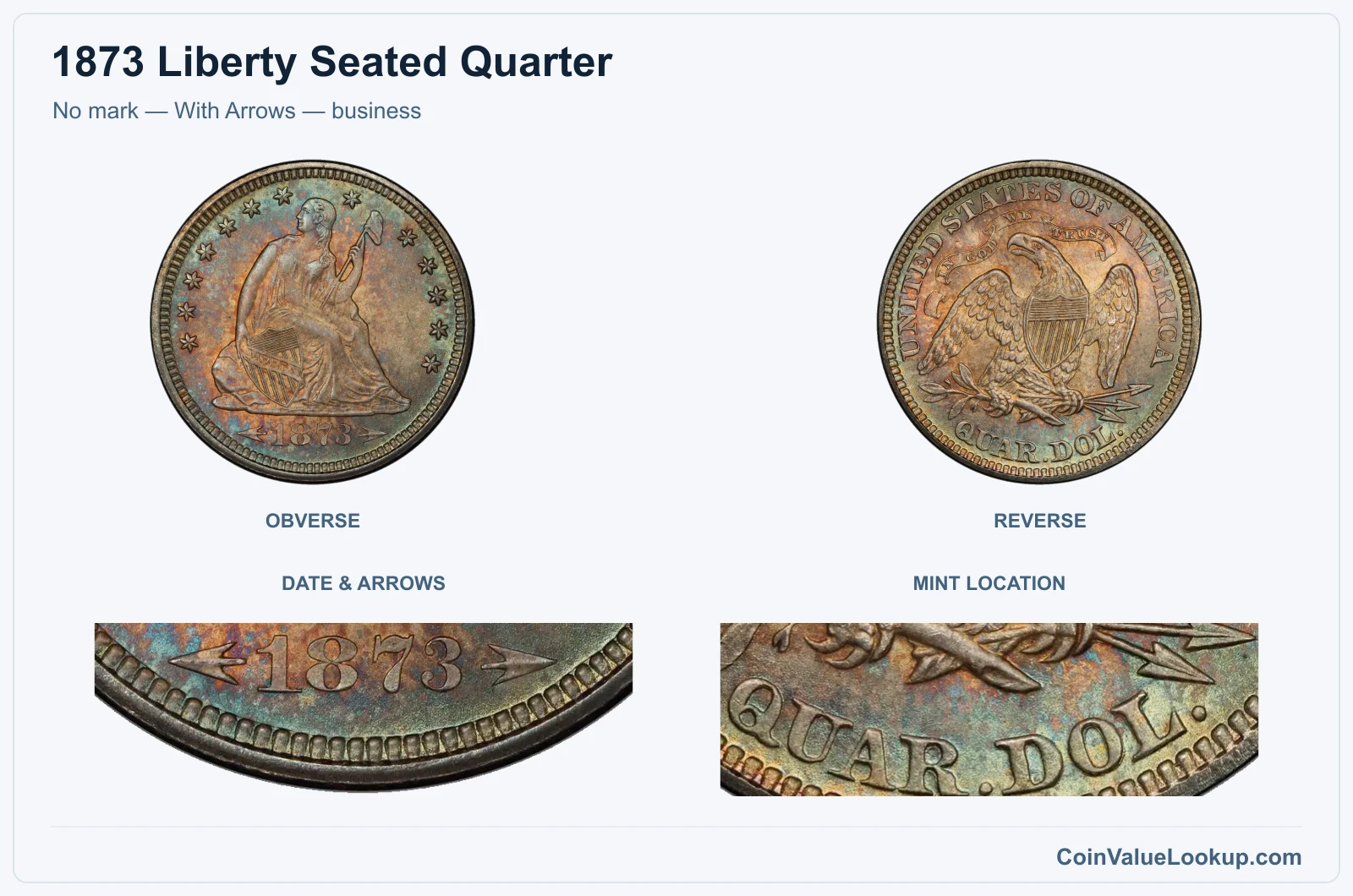
The Philadelphia With Arrows business strike is the most commonly encountered high-value branch. Small arrowheads flank either side of the date, signaling the new 6.25-gram weight standard.
No mintmark appears on the reverse.
USA Coin Book guide estimates place this version at $621.00 in G4, $24,612.00 in MS60, and $42,849.00 in MS63. Even a well-worn example carries real value thanks to the silver content and collector demand for the type.
Mint-state survivors are scarce and command serious premiums.
Coin Value Lookup is a good place to start when you want to look up guide values for other dates and mints in the Liberty Seated Quarter series.
Range Grade
Price Auction Records Appraisal PO PO 1
—
Coin Identifier FR FR 2
—
Coin Identifier AG AG 3
—
Coin Identifier G G 4
—
Coin Identifier
G 6
—
Coin Identifier VG VG 8
—
Coin Identifier
VG 10
—
Coin Identifier F F 12
—
Coin Identifier
F 15
—
Coin Identifier VF VF 20
Coin Identifier
VF 25
—
Coin Identifier
VF 30
Coin Identifier
VF 35
Coin Identifier XF XF 40
Coin Identifier
XF 45
Coin Identifier AU AU 50
Coin Identifier
AU 53
Coin Identifier
AU 55
Coin Identifier
AU 58
Coin Identifier MS MS 60
Coin Identifier
MS 61
Coin Identifier
MS 62
Coin Identifier
MS 63
Coin Identifier
MS 64
Coin Identifier
MS 65
Coin Identifier
MS 66
Coin Identifier
MS 67
Coin Identifier
MS 68
—
—
—
MS 69
—
—
—
MS 70
—
—
—
1873 Liberty Seated Quarter — CC — No Arrows — business
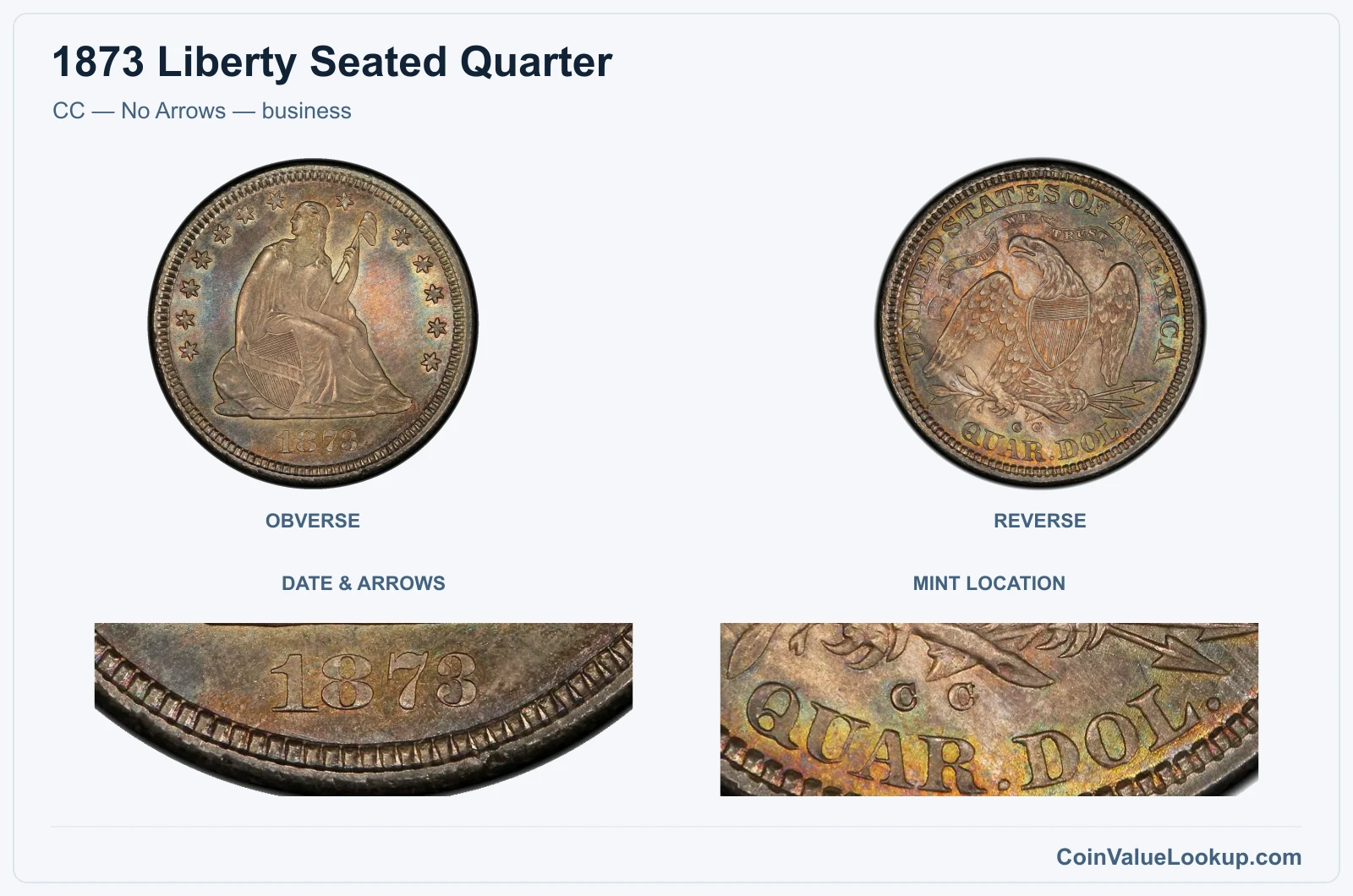
The Carson City No Arrows business strike is extremely rare. It carries no arrowheads beside the date and was struck at the 6.22-gram standard.
The "CC" mintmark sits on the reverse below the eagle.
No standard guide price range was adopted. Any coin claiming to be an 1873-CC No Arrows quarter requires specialist authentication before you accept it as genuine — counterfeits and misattributions exist for this issue.
If you believe you have one, seek a major third-party grading service.
Range Grade
Price Auction Records Appraisal PO PO 1
—
Coin Identifier FR FR 2
—
Coin Identifier AG AG 3
—
Coin Identifier G G 4
—
Coin Identifier
G 6
—
Coin Identifier VG VG 8
—
Coin Identifier
VG 10
—
Coin Identifier F F 12
—
Coin Identifier
F 15
—
Coin Identifier VF VF 20
—
Coin Identifier
VF 25
—
Coin Identifier
VF 30
—
Coin Identifier
VF 35
—
Coin Identifier XF XF 40
Coin Identifier
XF 45
—
—
— AU AU 50
—
—
—
AU 53
—
—
—
AU 55
—
—
—
AU 58
—
—
— MS MS 60
—
—
—
MS 61
—
—
—
MS 62
—
—
—
MS 63
Coin Identifier
MS 64
Coin Identifier
MS 65
—
Coin Identifier
MS 66
—
Coin Identifier
MS 67
—
—
—
MS 68
—
—
—
MS 69
—
—
—
MS 70
—
—
—
1873 Liberty Seated Quarter — CC — With Arrows — business
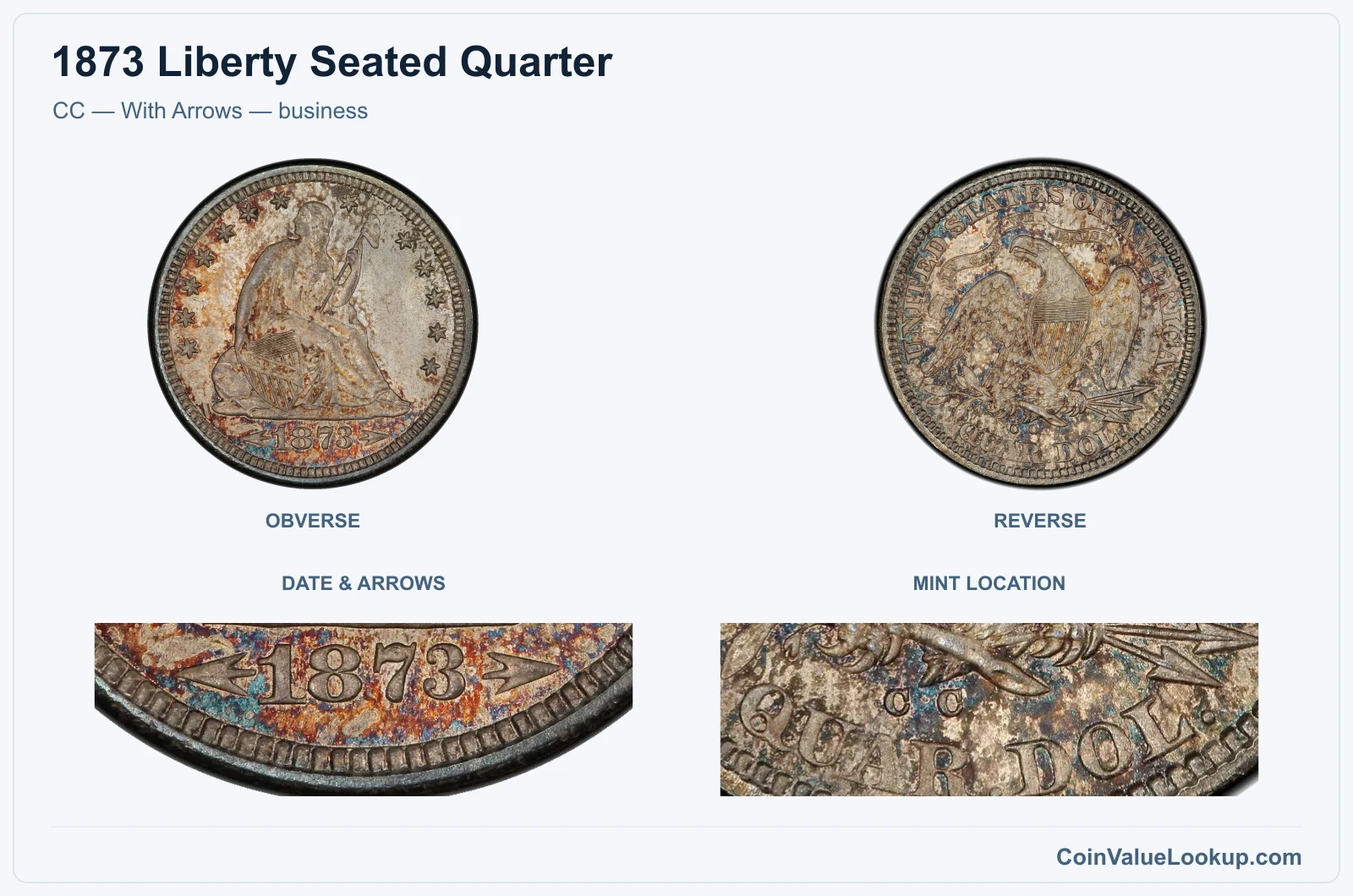
Carson City's With Arrows quarter is the headline coin of 1873. The arrowheads beside the date confirm the 6.25-gram standard, and the "CC" mintmark on the reverse identifies the mint.
Carson City struck comparatively few quarters, and survival rates in any grade are low.
USA Coin Book guide estimates start at $7,341.00 in G4 and reach $120,145.00 in MS60 and $187,834.00 in MS63. Those numbers reflect genuine scarcity, not hype.
Even heavily worn examples are valuable. Authentication is essential — this is exactly the kind of coin that attracts fakes.
Range Grade
Price Auction Records Appraisal PO PO 1
—
Coin Identifier FR FR 2
Coin Identifier AG AG 3
Coin Identifier G G 4
Coin Identifier
G 6
Coin Identifier VG VG 8
Coin Identifier
VG 10
Coin Identifier F F 12
Coin Identifier
F 15
Coin Identifier VF VF 20
Coin Identifier
VF 25
Coin Identifier
VF 30
Coin Identifier
VF 35
Coin Identifier XF XF 40
Coin Identifier
XF 45
Coin Identifier AU AU 50
—
Coin Identifier
AU 53
—
Coin Identifier
AU 55
Coin Identifier
AU 58
—
—
— MS MS 60
—
—
—
MS 61
—
—
—
MS 62
—
—
—
MS 63
—
—
—
MS 64
Coin Identifier
MS 65
—
Coin Identifier
MS 66
—
—
—
MS 67
—
—
—
MS 68
—
—
—
MS 69
—
—
—
MS 70
—
—
—
1873 Liberty Seated Quarter — S — With Arrows — business
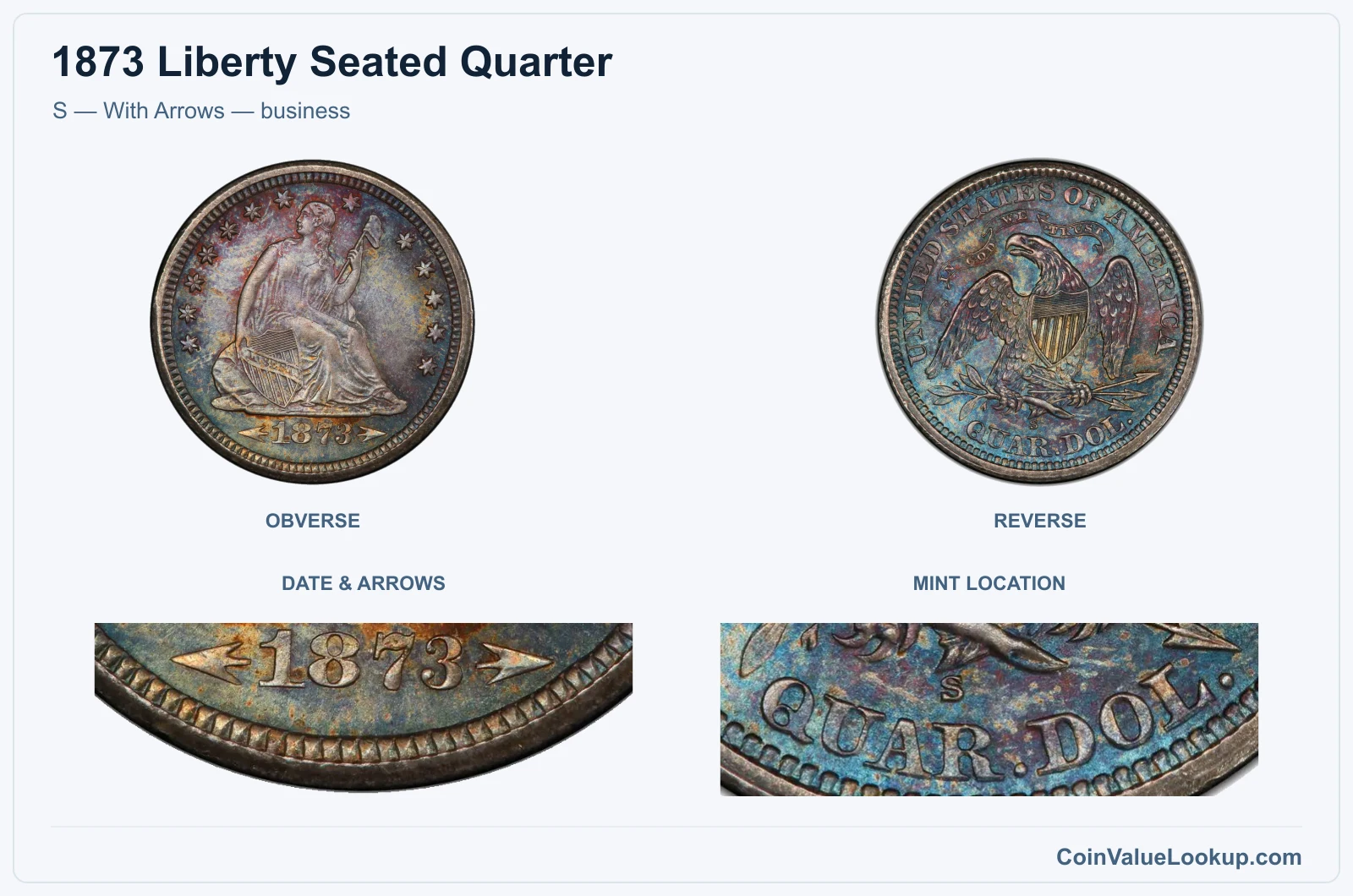
San Francisco produced only the With Arrows variety in 1873. Look for the "S" mintmark on the reverse below the eagle and arrowheads flanking the date.
USA Coin Book estimates this version at $131.00 in G4, $2,120.00 in MS60, and $5,631.00 in MS63. It is the most affordable entry into the 1873 With Arrows quarter market.
Circulated examples turn up more often than the CC or Philadelphia versions, making this a realistic target for collectors building a date set.
Range Grade
Price Auction Records Appraisal PO PO 1
—
Coin Identifier FR FR 2
—
Coin Identifier AG AG 3
—
Coin Identifier G G 4
—
Coin Identifier
G 6
—
Coin Identifier VG VG 8
Coin Identifier
VG 10
Coin Identifier F F 12
Coin Identifier
F 15
Coin Identifier VF VF 20
Coin Identifier
VF 25
Coin Identifier
VF 30
Coin Identifier
VF 35
Coin Identifier XF XF 40
Coin Identifier
XF 45
Coin Identifier AU AU 50
Coin Identifier
AU 53
Coin Identifier
AU 55
Coin Identifier
AU 58
Coin Identifier MS MS 60
—
Coin Identifier
MS 61
Coin Identifier
MS 62
Coin Identifier
MS 63
—
Coin Identifier
MS 64
Coin Identifier
MS 65
Coin Identifier
MS 66
—
—
—
MS 67
—
—
—
MS 68
—
—
—
MS 69
—
—
—
MS 70
—
—
—
1873 Liberty Seated Quarter — No mark — No Arrows Closed 3 — proof
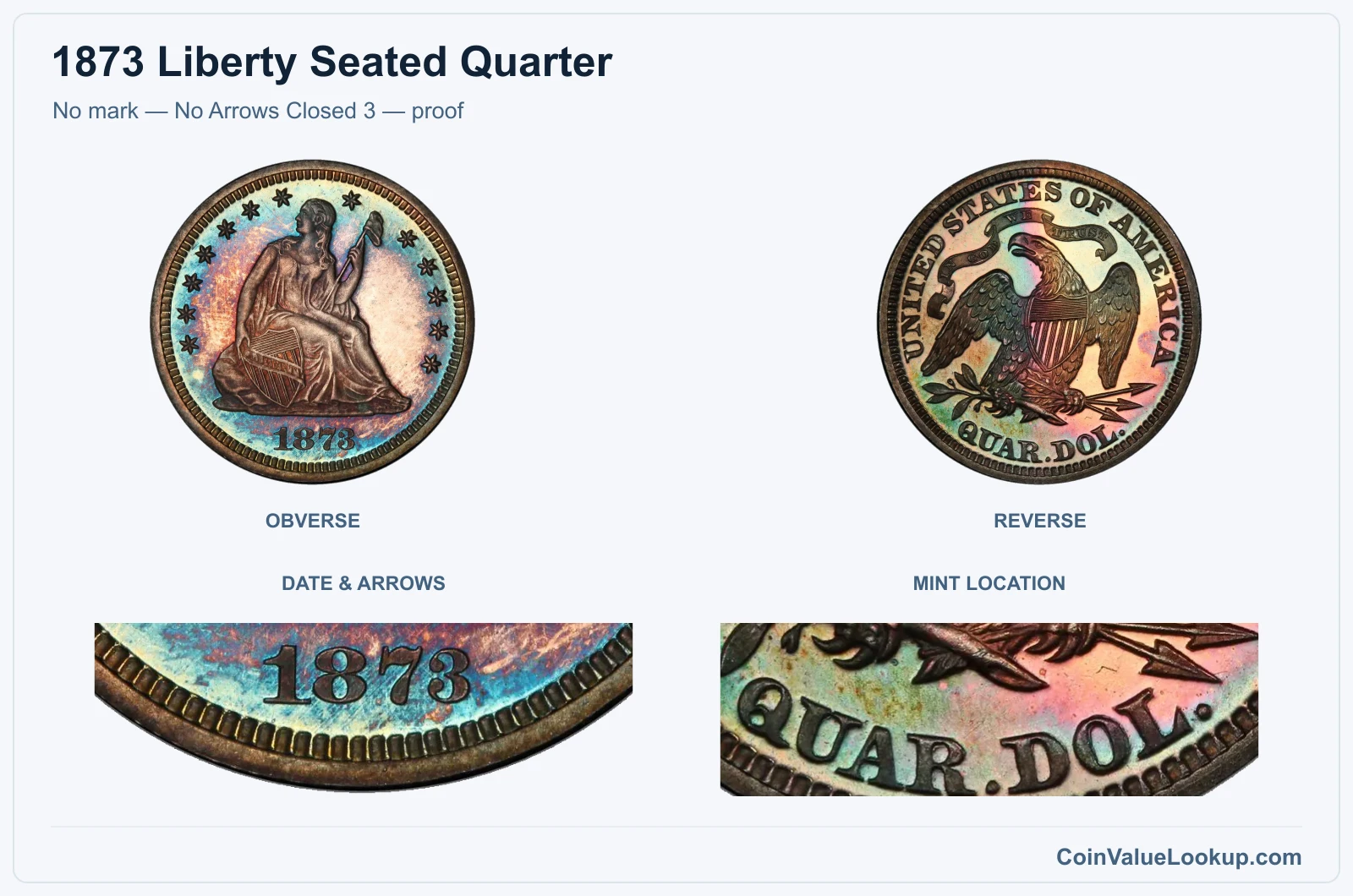
Philadelphia struck proof No Arrows Closed 3 quarters with mirrored fields and precise detail. These are collector-finish coins, not circulation issues.
The date has no flanking arrowheads, and the numeral 3 shows a narrow gap between its curves.
No adopted guide price range is available for this proof version. Value depends on the coin's authenticated identity, surface quality and any impairments.
Proof coins from this era are scarce, and the Closed 3 variety adds another layer of collectibility. Third-party certification is strongly recommended.
Range Grade
Price Auction Records Appraisal PR PR 1
—
Coin Identifier
PR 2
—
Coin Identifier
PR 3
—
Coin Identifier
PR 4
—
Coin Identifier
PR 6
—
Coin Identifier
PR 8
—
Coin Identifier
PR 10
—
Coin Identifier
PR 12
—
Coin Identifier
PR 15
—
Coin Identifier
PR 20
—
Coin Identifier
PR 25
—
Coin Identifier
PR 30
—
Coin Identifier
PR 35
—
Coin Identifier
PR 40
—
Coin Identifier
PR 45
—
Coin Identifier
PR 50
—
Coin Identifier
PR 53
—
Coin Identifier
PR 55
—
Coin Identifier
PR 58
—
Coin Identifier
PR 60
Coin Identifier
PR 61
Coin Identifier
PR 62
Coin Identifier
PR 63
Coin Identifier
PR 64
Coin Identifier
PR 65
Coin Identifier
PR 66
Coin Identifier
PR 67
Coin Identifier
PR 68
Coin Identifier
PR 69
—
—
—
PR 70
—
—
—
1873 Liberty Seated Quarter — No mark — With Arrows — proof
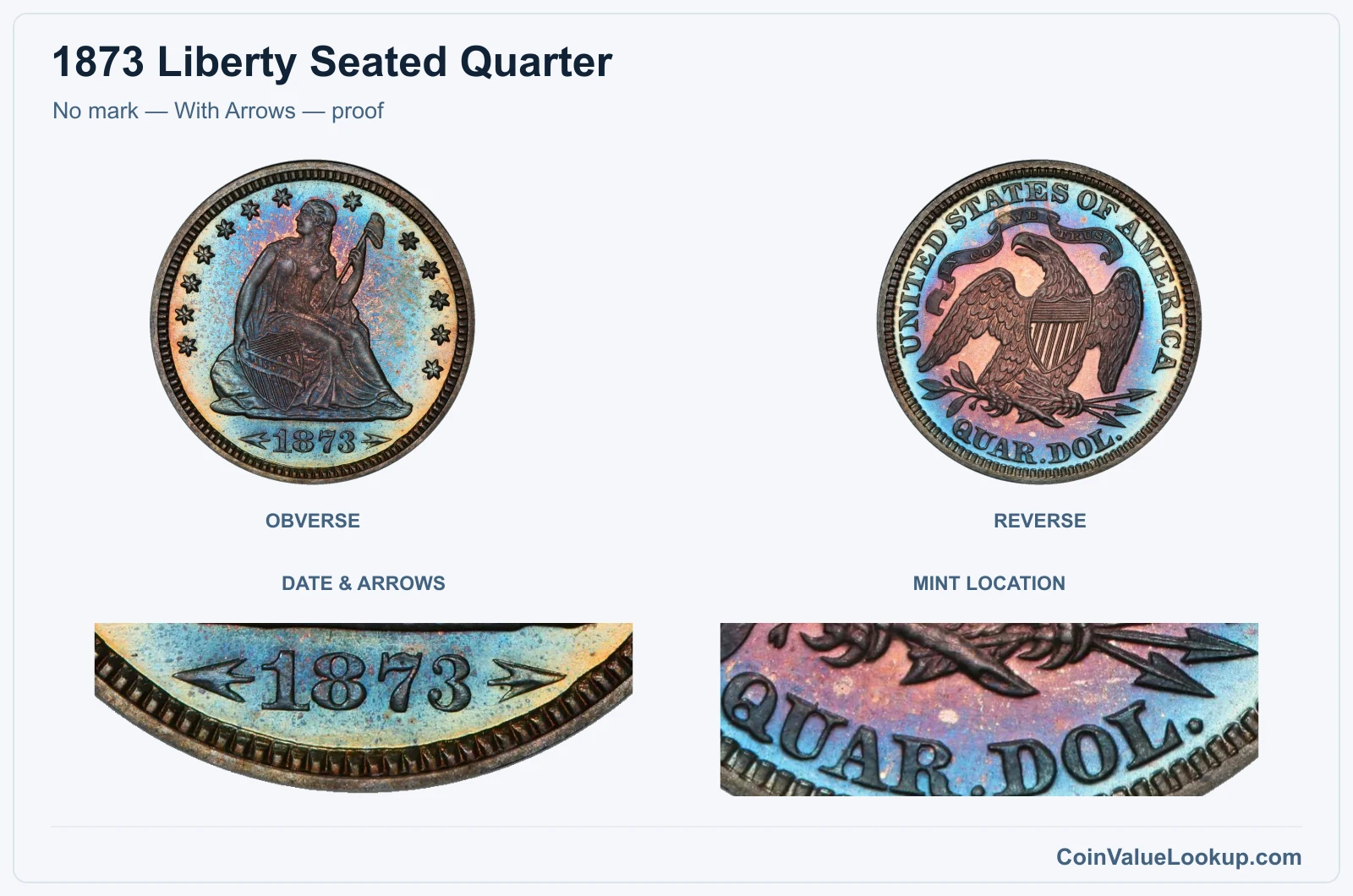
The Philadelphia With Arrows proof is a collector-finish coin struck with the new 6.25-gram standard. Arrowheads appear beside the date, and the fields should show the mirrored surfaces characteristic of proof manufacture.
USA Coin Book lists a guide estimate of $1,072.00 at PR63. Because a proof is a method of manufacture rather than a grade above mint state, even proof coins can show handling marks or haze that affect their grade.
Look for sharp design elements and clean, reflective fields when evaluating quality.
Range Grade
Price Auction Records Appraisal PR PR 1
—
Coin Identifier
PR 2
—
Coin Identifier
PR 3
—
Coin Identifier
PR 4
—
Coin Identifier
PR 6
—
Coin Identifier
PR 8
—
Coin Identifier
PR 10
—
Coin Identifier
PR 12
—
Coin Identifier
PR 15
—
Coin Identifier
PR 20
—
Coin Identifier
PR 25
—
Coin Identifier
PR 30
—
Coin Identifier
PR 35
—
Coin Identifier
PR 40
—
Coin Identifier
PR 45
—
Coin Identifier
PR 50
—
Coin Identifier
PR 53
—
Coin Identifier
PR 55
—
Coin Identifier
PR 58
—
Coin Identifier
PR 60
—
Coin Identifier
PR 61
Coin Identifier
PR 62
Coin Identifier
PR 63
Coin Identifier
PR 64
Coin Identifier
PR 65
Coin Identifier
PR 66
Coin Identifier
PR 67
Coin Identifier
PR 68
Coin Identifier
PR 69
—
—
—
PR 70
—
—
—
1873 Liberty Seated Quarter Error List
1. 1873 Liberty Seated Quarter — Repunched Mintmark
A repunched mintmark occurs when the mintmark punch was applied more than once in slightly different positions, leaving traces of the earlier impression. On an 1873 Liberty Seated Quarter, inspect the "CC" or "S" mintmark on the reverse under magnification for any doubled outline, shadow or secondary letter remnant.
The diagnostic to look for is a ghost of a second letter overlapping or offset from the primary mark. Compare your coin with a normal example at the same magnification — the difference should be consistent and sharp, not fuzzy.
Do not confuse a repunched mintmark with machine doubling, a small die chip sitting near the letter, or surface corrosion that widens the mark's appearance. Value for a confirmed repunched mintmark depends on the specific error's visibility and the coin's overall condition.
2. 1873 Liberty Seated Quarter — Doubled Die
Doubled dies on the 1873 Liberty Seated Quarter result from a misaligned hub impression during die production. The effect shows up as consistent separation or notching in design elements — letters, stars, or parts of Liberty's figure may appear split or thickened.
To check, compare your coin's details against a normal example. Genuine doubling will be uniform across the affected area and present on every coin struck from that die.
Machine doubling is the most common lookalike. It tends to produce flat, shelf-like displacement rather than the rounded, separated profiles of a true doubled die.
Reflections on proof surfaces and post-mint contact marks can also mimic doubling. Value depends on the strength and location of the doubling as well as the coin's grade; no standard guide estimate was adopted for this error.
3. 1873 Liberty Seated Quarter — Off-Center Strike
An off-center strike happens when the coin blank is not properly seated between the dies, producing a design that is shifted to one side with an unstruck crescent of blank metal on the opposite edge. On an 1873 Liberty Seated Quarter, the percentage of displacement and whether the date remains visible are the two biggest factors collectors care about.
Look for a smooth, crescentic area of bare metal along one edge. The design elements on the struck portion should still be sharp and complete for that section.
Do not confuse an off-center strike with a clipped planchet, which shows a curved bite taken from the blank before striking, or with post-mint flattening from damage. A one-sided die misalignment can also shift the design but affects only one face.
No standard guide price was adopted; value depends on the degree of displacement and the coin's condition.